From Zero to Hero: Your Ultimate Guide to Becoming a Ham Radio Operator in Malaysia
Have you ever wanted to talk to astronauts on the ISS, communicate without the internet during a flood, or chat with friends across the globe using nothing but a wire antenna?
Welcome to the world of Amateur Radio (Ham Radio).
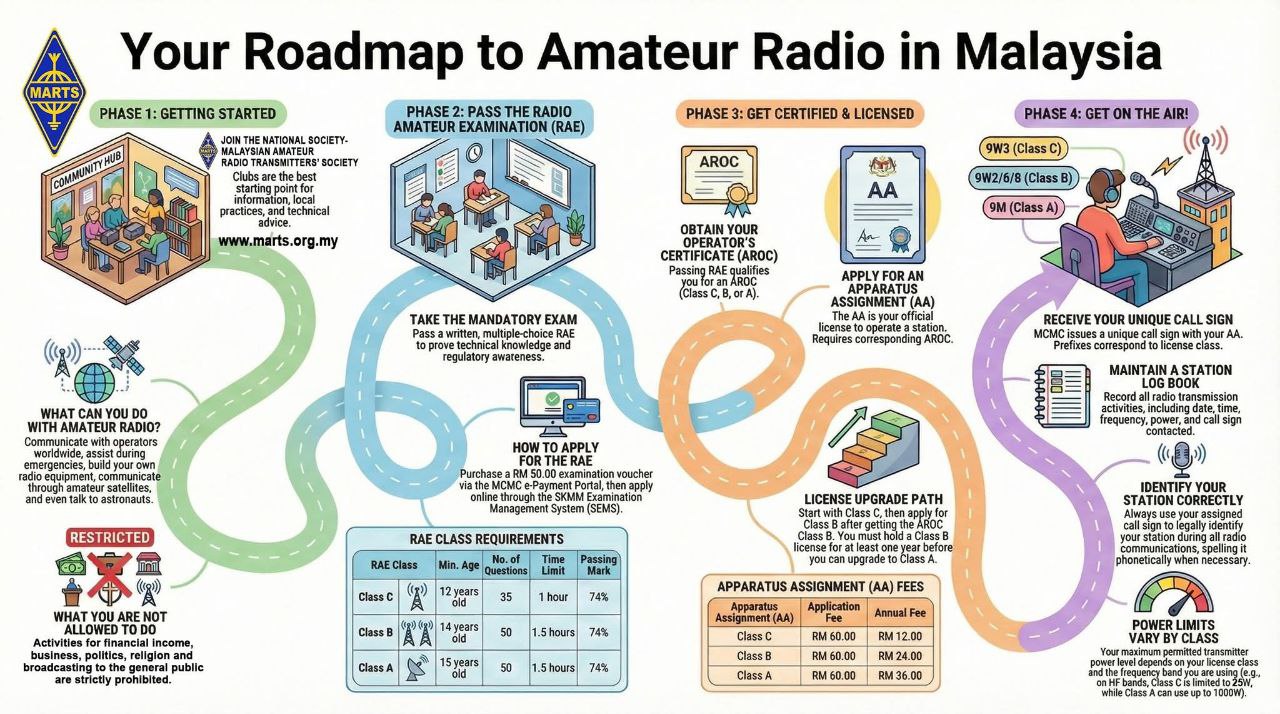
In Malaysia, this is a thriving community of over 14,000 operators who are part hobbyists, part technical wizards, and part emergency responders. If you’ve seen the “Roadmap to Amateur Radio In Malaysia” infographic and felt a spark of curiosity, you are in the right place.
Here is your step-by-step breakdown of how to go from a total beginner to a licensed 9M (or 9W) operator.
Phase 1: Getting Started (The “Listening” Phase)
Before you touch a transmitter, you need to understand the culture. You don’t need a license to listen, only to talk.
- Join the Community: The infographic highlights MARTS (Malaysian Amateur Radio Transmitters’ Society). They are the national body for ham radio. Joining a club is the fastest way to get mentorship (“Elmers” in ham speak) and technical advice.
- Action: Visit marts.org.my to find local chapters.
- What is “SWL”? Short Wave Listening. You can buy a cheap “SDR dongle” online or just use a WebSDR to listen to amateur conversations. This helps you learn the lingo before you ever press the PTT (Push-to-Talk) button.
Phase 2: Passing the RAE (The Exam)
To transmit, you must prove you know what you’re doing. This happens via the Radio Amateur Examination (RAE).
Unlike the old days, you don’t need to learn Morse Code to get started! The Malaysian Communications and Multimedia Commission (MCMC) has streamlined the license into three classes:
The 3 License Classes
| Class | Prefix | Min. Age | The “Need to Know” |
| Class C | 9W3 | 12 | Entry Level. 35 Questions. You get VHF/UHF privileges (local comms) with lower power (25W). Perfect for handheld walkie-talkies. |
| Class B | 9W2 | 14 | Standard. 50 Questions. Unlocks HF bands (long-distance) and higher power (50W). |
| Class A | 9M | 15 | Expert. 50 Questions. Maximum privileges (up to 1000W output). Reserved for experienced operators. |
Pro Tip: Most beginners aim for Class B directly if they are over 14, as it gives you access to HF frequencies where you can talk internationally.
How to Apply
You don’t go to a physical counter anymore.
- Buy an exam voucher (RM 50.00).
- Register online via the MCMC SEMS (SKMM Examination Management System) portal.
Phase 3: Get Certified & Licensed (The Paperwork)
Passing the exam is only half the battle. You need two specific documents to be legal. Think of it like buying a car: you need a driving license (AROC) and road tax (AA).
1. The Operator’s Certificate (AROC)
- What it is: Proof that you passed the exam.
- Validity: It’s yours for life (mostly), but it doesn’t let you build a station yet.
2. The Apparatus Assignment (AA)
- What it is: This is your station license. It permits you to buy and own a radio.
- The Cost:
- Class C: RM 60 (Application) + RM 12 (Annual Fee)
- Class B: RM 60 (Application) + RM 24 (Annual Fee)
- Class A: RM 60 (Application) + RM 36 (Annual Fee)
Important: You must hold a Class B license for at least one year before you are eligible to upgrade to the coveted Class A.
Phase 4: Get On The Air!
Once you have your AA, MCMC will issue your unique Call Sign.
- Example:
9W2ABC(This tells the world you are a Class B operator from Malaysia).
What Can You Do?
- DXing: Hunting for distant stations (e.g., contacting a station in Brazil from your home in KL).
- Satellite Comms: Using a simple handheld radio to bounce signals off passing satellites.
- Emergency Comms: When phone towers go down during floods, hams are often the only line of communication.
The Big “No-Nos”
Amateur radio is strictly non-commercial.
- ❌ No business discussions.
- ❌ No politics or religious broadcasting.
- ❌ No broadcasting music or entertainment.
Ready to Start?
The journey to becoming a “9M” or “9W” starts with a single step.
- Visit the MARTS website to find a study guide.
- Download the “Amateur Radio Handbook” from the MCMC website.
- Find a local club to see a radio in action.
See you on the airwaves!



Post Comment