Linux and FreeBSD Operating Systems: Characteristics and Use Cases
1. Definitions and Project Structure
1.1 What Is Linux
Linux refers to a kernel created by Linus Torvalds and first released in 1991. The kernel manages hardware, memory, and processes. A complete operating system built around the Linux kernel is called a “Linux distribution”. Examples include Ubuntu, Fedora, Debian, and Arch Linux. A distribution combines the Linux kernel with userland tools, libraries, a package manager, and often a desktop environment.
License: The Linux kernel is licensed under GPL version 2. Most GNU utilities are GPL v3.
Development: The kernel has over 20,000 contributors as of 2024. Companies such as Red Hat, Intel, Google, and SUSE contribute code. Linus Torvalds manages releases.
Release cycle: The kernel releases a new version every 8 to 10 weeks. Distributions set their own release schedules. Ubuntu releases every 6 months with LTS versions every 2 years. Debian Stable releases roughly every 2 years. Fedora releases every 6 months.
1.2 What Is FreeBSD
FreeBSD is a complete operating system. It includes the kernel, userland utilities, C library, and documentation developed together in one source repository. The project derives from the Berkeley Software Distribution. Version 1.0 was released in 1993.
License: FreeBSD uses the BSD 2-Clause License. The license permits redistribution and use in source and binary forms, with or without modification, provided the copyright notice is kept.
Development: FreeBSD has a Core Team and around 400 active committers as of 2025.
Release cycle: Major releases occur every 18 to 24 months. Each major release receives support for 5 years. Minor releases occur every 3 to 4 months.
Key structural difference: Linux distributions combine components from multiple projects. FreeBSD ships a base system where all core components are versioned together.
2. Technical Components Compared
| Component | Linux | FreeBSD |
|---|---|---|
| Kernel type | Monolithic with loadable modules | Monolithic with loadable modules |
| Default filesystem | ext4, XFS, Btrfs. ZFS available via OpenZFS module | UFS, ZFS integrated in base |
| Init system | systemd on most major distros. Alternatives: OpenRC, runit | rc system using rc.conf and shell scripts |
| C library | glibc or musl, provided by distro | FreeBSD libc, maintained by FreeBSD project |
| Package management | apt, dnf, pacman, zypper. Formats: deb, rpm, pkg.tar.zst | pkg binary packages. Ports tree for source builds. ~30,000 ports |
| Firewall | nftables, iptables, firewalld | pf from OpenBSD, ipfw, ipfilter |
| Virtualization | KVM, Xen, VirtualBox | bhyve, Xen, VirtualBox |
| Container technology | Docker, Podman, LXC, systemd-nspawn | Jails in base system |
| Display server | Xorg, Wayland | Xorg, Wayland via ports |
| Audio | ALSA, PulseAudio, PipeWire | OSS in base. PulseAudio and PipeWire via ports |
3. Factors That Affect Desktop Use
Desktop use requires hardware compatibility, application availability, and user interface polish. The following factors explain current adoption patterns.
3.1 Hardware Support for Consumer Devices
Linux distributions receive driver support from hardware vendors. Intel, AMD, and Nvidia contribute GPU drivers directly to the kernel or as loadable kernel modules. Kernel 6.10 includes drivers for Intel Arc GPUs, AMD RDNA 3, and Wi-Fi 6E chipsets such as Intel AX210 and MediaTek MT7921. Firmware is distributed in the linux-firmware package.
Vendor certification programs exist. Dell XPS, Lenovo ThinkPad, and Framework Laptop offer models preinstalled with Ubuntu or Fedora. These models are tested for suspend, backlight, and trackpad function.
FreeBSD supports many server NICs and storage controllers. Desktop hardware support is present but follows Linux. The AMDGPU driver was ported to FreeBSD in 2018 and updated periodically. Support for newer Wi-Fi chipsets arrives after Linux. As of FreeBSD 14.1, MediaTek MT7921 is supported. Some Realtek USB Wi-Fi devices require third party modules. Laptop suspend and resume works on some models but is not universal. The FreeBSD wiki maintains a laptop compatibility list.
3.2 Application Ecosystem
Desktop users expect browsers, office suites, media players, and communication tools.
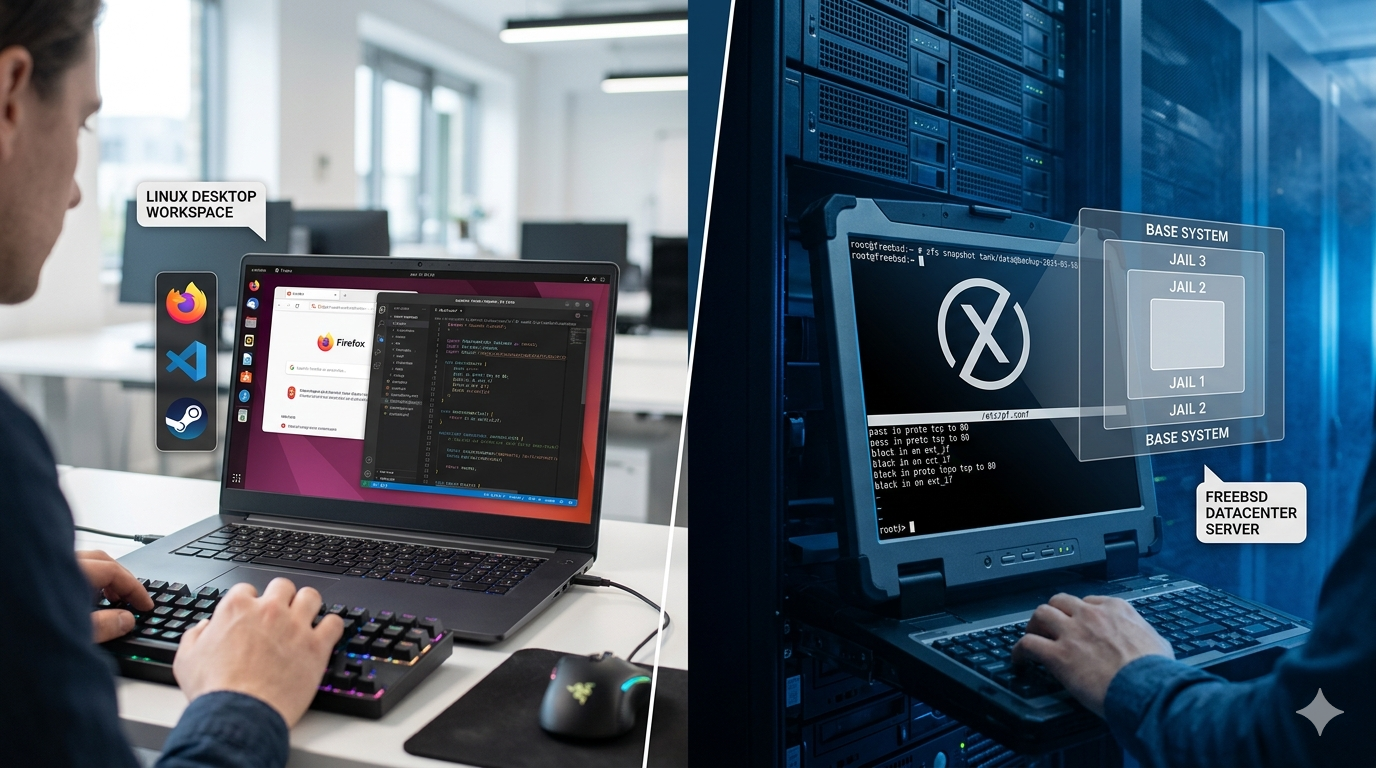
Linux has native builds of Firefox, Chromium, Chrome, LibreOffice, VLC, GIMP, OBS Studio, Steam, VS Code, and JetBrains IDEs. Flatpak and Snap provide sandboxed versions of Spotify, Zoom, Slack, and Discord. Steam uses Proton to run many Windows games. ProtonDB reported in 2025 that 85 percent of the top 1000 Steam games run on Linux.
FreeBSD has Firefox, Chromium, LibreOffice, VLC, and GIMP via ports. There is no official Chrome build. There is no official Slack or Zoom client. Linux binary compatibility, called Linuxulator, can run some Linux applications, but GPU acceleration and audio for conferencing apps are limited. Steam is not supported natively. Wine can run some Windows applications on FreeBSD.
3.3 Desktop Environments
Linux distributions integrate GNOME, KDE Plasma, Xfce, and Cinnamon. GNOME 46 and KDE Plasma 6 support Wayland, fractional scaling, and touchscreens. Development is active. PipeWire provides audio and screen sharing for Wayland.
FreeBSD can install GNOME and KDE from packages. The FreeBSD desktop team ports these environments after Linux releases. Audio uses OSS by default. PipeWire and PulseAudio are available from ports but are not default. Configuration requires more manual steps compared to Ubuntu or Fedora.
3.4 Release and Update Model
Linux distributions vary. Ubuntu LTS provides 5 years of updates. Fedora provides 13 months. Arch Linux uses a rolling model with continuous updates. Kernel updates bring new drivers fast. This benefits new hardware.
FreeBSD releases a base system every 18 to 24 months. freebsd-update upgrades the kernel and userland together. The ABI is stable within a major version. This reduces unexpected changes but delays new hardware support.
4. Factors That Affect Server Use
Server use requires stability, network performance, storage reliability, and maintainability.
4.1 Base System Consistency
FreeBSD distributes the kernel, C library, compiler, and core utilities as one unit. The freebsd-update tool updates all base components. Documentation in the Handbook and man pages corresponds to the installed version. This reduces version mismatch.
Linux distributions combine components from separate projects. glibc, systemd, and the kernel have independent releases. An LTS distribution holds versions stable, but third party repositories can introduce newer libraries. Administrators must consider interaction between components.
4.2 ZFS Integration
ZFS is a filesystem with checksums, snapshots, compression, and send/receive replication. FreeBSD added ZFS in 2007. In FreeBSD 14, OpenZFS 2.2 is in the base system. The installer supports root on ZFS. Boot environments allow booting a previous snapshot if an upgrade fails.
On Linux, OpenZFS is available as a kernel module. Due to CDDL vs GPL licensing, it is not included in the main kernel. Ubuntu includes ZFS, but it is not default. RHEL removed ZFS packages. Administrators who require ZFS must manage the module separately.
Companies that use ZFS at scale include iXsystems for TrueNAS and Netflix for content delivery caches. Netflix published a talk in 2021 describing 200 Gb/s per server using FreeBSD and ZFS.
4.3 Networking Stack and Firewall
FreeBSD includes the pf packet filter from OpenBSD. pf uses a single configuration file and is used in pfSense and OPNsense firewall distributions. The FreeBSD network stack is used in appliances from Juniper and NetApp.
FreeBSD achieved 800 Gb/s of TLS encrypted traffic from a single host in 2023 using kernel TLS and sendfile, as documented by Netflix engineers.
Linux uses nftables and has a high performance network stack. Companies such as Cloudflare and Meta use Linux for edge networks. bpfilter, XDP, and DPDK provide high speed packet processing.
Both stacks are capable. pf is noted for simple syntax and auditability. Linux provides more features for container networking and eBPF.
4.4 Jails
FreeBSD Jails provide operating system level virtualization. A jail has its own filesystem, network address, and processes. Overhead is low because the kernel is shared. Jails have existed since FreeBSD 4.0 in 2000. Tools such as iocage and bastille manage jails. Jails integrate with ZFS for cloning and snapshots.
Linux provides LXC, Docker, and Podman. These tools use namespaces and cgroups. Docker is the industry standard for application containers. For system level containers, LXC is comparable to jails. Jails are part of the base system. Docker requires a daemon.
4.5 Long Term Support
FreeBSD provides 5 years of support for each major release. The ABI is stable within a major release. A binary compiled on FreeBSD 13.0 will run on 13.3 without recompilation.
Ubuntu LTS provides 5 years of standard support. Debian provides 5 years. RHEL provides 10 years. ABI stability is a goal, but glibc symbol versions can change and affect third party binaries.
4.6 License Considerations
The BSD license permits combining FreeBSD code with proprietary code and distributing the result without source. This is used in commercial products such as the Sony PlayStation operating system, which is based on FreeBSD, and Juniper JunOS.
The Linux kernel GPL requires that derivative works distributed in binary form must also provide source code. This requirement is acceptable for many companies but is a consideration for appliance vendors.
5. Deployment Statistics
Public data shows usage patterns.
Desktop: StatCounter reports Linux at 4.1 percent of desktop OS market share in May 2025. FreeBSD is below 0.1 percent. Steam Hardware Survey shows Linux at 2.3 percent in April 2025. FreeBSD is not listed.
Server: W3Techs survey of web servers in 2025 shows Unix at 70 percent. Within Unix, Linux distributions are the majority. FreeBSD is used by specific companies and in the firewall market. The pfSense project reported millions of installations.
Cloud: AWS, Google Cloud, and Azure provide Linux images by default. FreeBSD images are available but less common.
6. Summary of Differences
| Use Case | Linux | FreeBSD |
|---|---|---|
| New laptop hardware | Drivers arrive within months. Vendor support exists. | Drivers may take 1 to 2 years. Community support. |
| Commercial desktop apps | Native builds for Chrome, Zoom, Steam. | Limited. Use web or Linuxulator. |
| Gaming | Proton supports many titles. AMD and Nvidia drivers updated often. | Not a target platform. |
| Root filesystem | ext4, XFS default. ZFS optional. | ZFS in base. UFS available. |
| Firewall | nftables, firewalld. Complex but feature rich. | pf in base. Simple syntax. Powers pfSense. |
| Container model | Docker standard. LXC available. | Jails in base. No daemon. |
| Base OS updates | Kernel and userland separate. Distro dependent. | Kernel and userland updated together. |
| License for products | GPL requires source sharing. | BSD allows closed source derivatives. |
| Documentation | Distro specific. Arch Wiki is extensive. | Handbook is centralized and versioned. |
7. Conclusion
Linux distributions have broad hardware support, commercial application availability, and rapid driver updates. These characteristics align with desktop use where new GPUs, Wi-Fi, and consumer software are required. The large user base provides community help for desktop issues.
FreeBSD provides a single base system, integrated ZFS, the pf firewall, and jails. The release model emphasizes ABI stability for 5 years. The BSD license permits use in closed products. These characteristics align with server, storage, and appliance roles where consistency and long term maintenance are priorities.
Both systems are open source and technically capable. The choice depends on requirements for hardware, software, licensing, and administration model.



Post Comment