computer
dns
domain name server
information technologies
internet
website
a record propagation, advanced dns guide, authoritative dns, cloudflare dns, dns architecture, dns cache, dns caching explained, dns changes not updating, dns explained for beginners, dns history, dns infrastructure, dns lookup, dns management, dns migration, dns performance, dns propagation, dns propagation checker, dns propagation explained, dns propagation time, dns records explained, dns resolution process, DNS Security, DNS server, dns system explained, dns technology, dns troubleshooting, dns ttl, dns tutorial, dns update delay, domain name system, global dns propagation, google public dns, how dns works, how internet dns works, how long dns propagation takes, internet networking, mx record propagation, nameserver propagation, network administration, recursive dns resolver, rfc 1034, rfc 1035, root dns server, time to live dns, tld server, website dns change, website hosting dns, what is dns propagation
9M2PJU
0 Comments
DNS Propagation: How the Internet Learns Where Your Website Lives
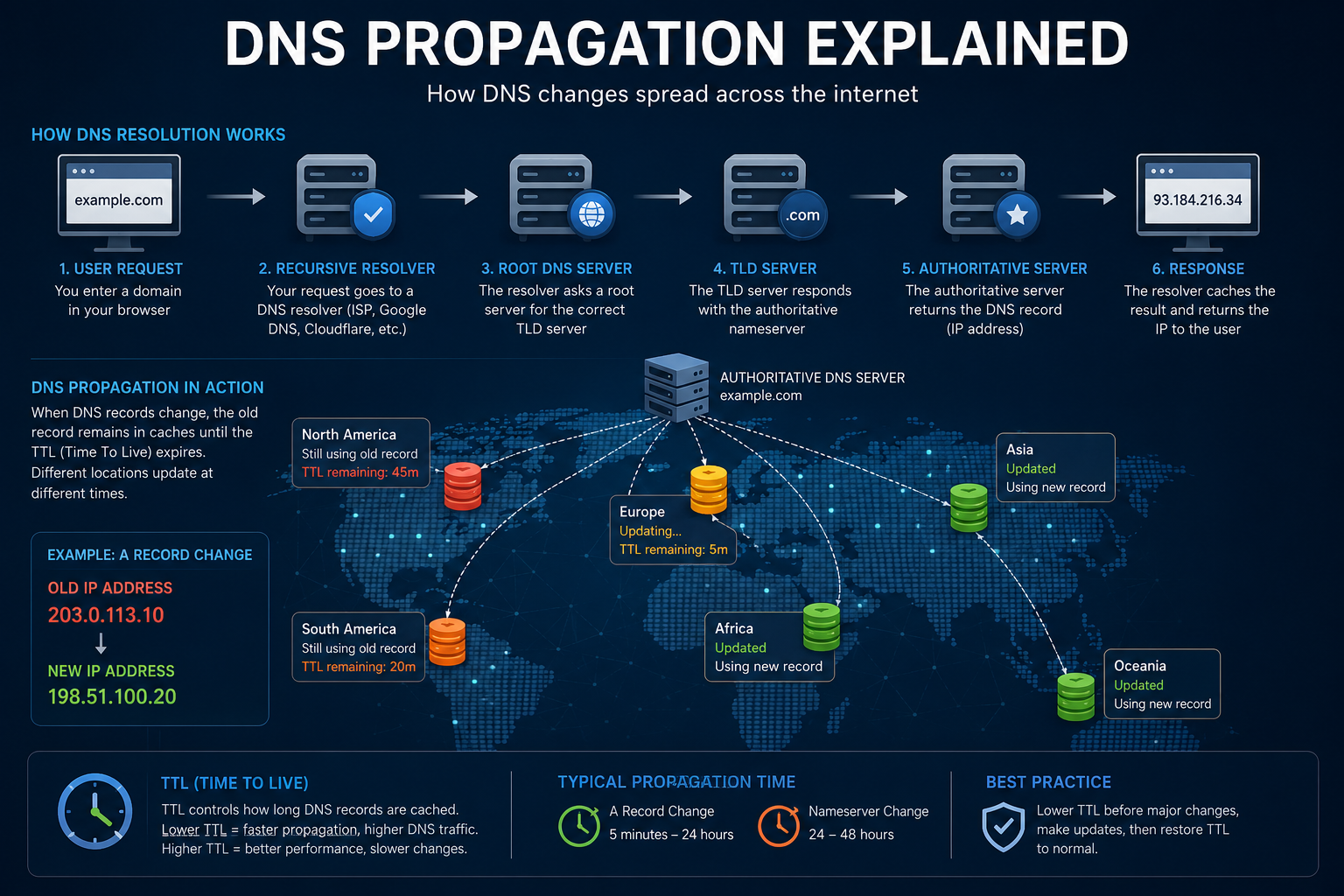
The modern internet depends on the Domain Name System, better known as DNS. Every website visit, email delivery, API request, and cloud service lookup relies on DNS to translate human readable domain names into IP addresses that computers understand.
When administrators change DNS records, those updates do not appear everywhere immediately. This delay is commonly called DNS propagation.
To understand why propagation exists, it helps to understand how DNS was created and how the system actually works.
The History of DNS
In the early days of the ARPANET during the 1970s, computers identified each other using a simple text file called HOSTS.TXT. This file mapped hostnames to IP addresses and was manually distributed to every connected machine.
As the network grew, the system became impossible to maintain efficiently.
Problems included:
- Constant manual updates
- Increasing hostname conflicts
- Large file sizes
- Delayed synchronization across networks
In 1983, computer scientists Paul Mockapetris and Jon Postel introduced the Domain Name System. Their work was formalized in RFC 882 and RFC 883, later replaced by RFC 1034 and RFC 1035.
DNS introduced several critical concepts:
- Distributed architecture
- Hierarchical naming
- Delegated authority
- Caching
- Recursive querying
These features allowed DNS to scale globally and become one of the core technologies of the internet.
What DNS Does
DNS acts like a distributed directory service.
When a user enters a domain such as:
example.com
the system must determine the server IP address associated with that domain.
Instead of memorizing numeric IP addresses, users interact with readable domain names while DNS performs the translation in the background.
For example:
example.com → 93.184.216.34
This process usually completes in milliseconds.
How DNS Resolution Works
DNS resolution involves multiple systems working together.
1. Local Cache Check
The operating system, browser, or router first checks whether the answer already exists in local cache memory.
If the cached result is still valid, the request ends immediately.
2. Recursive Resolver
If the answer is not cached locally, the request goes to a recursive DNS resolver. This is usually operated by:
- Internet service providers
- Cloudflare
- Google Public DNS
- Quad9
- OpenDNS
3. Root DNS Servers
The resolver contacts one of the root DNS servers. These servers do not know the final answer but direct queries to the correct Top Level Domain servers.
For example:
.com.net.org.my
4. TLD Servers
The Top Level Domain server responds with the authoritative nameserver responsible for the domain.
5. Authoritative Nameserver
The authoritative server contains the actual DNS records for the domain and returns the requested information.
Examples include:
- A records
- AAAA records
- MX records
- TXT records
- CNAME records
The resolver then caches the result and sends it back to the user.
What Is DNS Propagation
DNS propagation is the period during which DNS changes become visible across different resolvers and networks worldwide.
For example, a website administrator may change an A record from:
203.0.113.10
to:
198.51.100.20
Some users may immediately reach the new server while others continue reaching the old server temporarily.
This happens because DNS data is cached at many levels across the internet.
Why DNS Propagation Exists
Propagation exists primarily because of caching.
Without caching, every DNS query on the internet would require contacting authoritative servers directly. This would dramatically increase latency and server load.
Caching improves:
- Speed
- Scalability
- Reliability
- Bandwidth efficiency
However, caching also means old information can remain active until the cache expires.
Understanding TTL
Every DNS record includes a value called TTL, or Time To Live.
TTL specifies how long a resolver may cache the record before requesting fresh data.
Example:
TTL = 3600
This means the resolver may keep the cached result for 3600 seconds, or one hour.
If a DNS record changes during that period, users connected to that resolver may still see the old information until the TTL expires.
Common DNS Record Types
A Record
Maps a domain to an IPv4 address.
Example:
example.com → 192.0.2.1
AAAA Record
Maps a domain to an IPv6 address.
CNAME Record
Creates an alias from one domain to another.
Example:
www.example.com → example.com
MX Record
Defines mail servers responsible for receiving email.
TXT Record
Stores text based metadata used for:
- SPF
- DKIM
- Domain verification
- Security policies
NS Record
Specifies the authoritative nameservers for a domain.
How Long DNS Propagation Takes
Propagation time varies depending on:
- TTL settings
- Resolver cache behavior
- ISP infrastructure
- Nameserver changes
- Geographic distribution
Typical timelines:
| Change Type | Common Duration |
|---|---|
| Standard DNS record update | Few minutes to several hours |
| Nameserver change | Up to 24 to 48 hours |
| DNSSEC related changes | Potentially longer |
Many modern resolvers refresh quickly, but complete global consistency can still take time.
Why Some Users See Changes Earlier
Different DNS resolvers refresh records independently.
For example:
- Google Public DNS may refresh quickly
- An ISP resolver may retain older cached records longer
- Local operating system caches may also delay updates
This creates temporary inconsistencies where users in different regions see different results.
DNS Propagation Is Not a Physical Broadcast
The phrase “DNS propagation” can be misleading.
There is no central system pushing updates across the internet.
Instead, propagation happens because:
- Cached records expire
- Resolvers request fresh information
- Updated records gradually replace old ones
The internet slowly converges on the new DNS state over time.
How to Reduce DNS Propagation Delays
Administrators often lower TTL values before major infrastructure changes.
For example:
Current TTL: 86400 seconds
Temporary TTL: 300 seconds
This reduces cache duration and allows changes to spread faster.
After migration is complete, TTL values are usually increased again to improve caching efficiency.
How to Check DNS Propagation
Several tools allow administrators to inspect DNS responses from multiple global locations.
Popular options include:
- DNS Checker
- WhatsMyDNS
- Dig Web Interface
- IntoDNS
Command line tools are also widely used.
Using dig
dig example.com
Using nslookup
nslookup example.com
Using host
host example.com
These tools help verify whether updated DNS records are visible from specific resolvers.
DNS Propagation and Website Downtime
Poor DNS migration planning can cause downtime.
Common mistakes include:
- Changing DNS before new servers are ready
- Forgetting to reduce TTL beforehand
- Misconfigured records
- Incorrect nameserver delegation
Proper staging and verification reduce risk significantly.
DNS in Modern Infrastructure
DNS now supports far more than simple website resolution.
Modern uses include:
- Load balancing
- Failover systems
- CDN routing
- Service discovery
- Email security
- Cloud infrastructure orchestration
- Zero trust networking
Large providers such as Cloudflare, Google, Amazon Route 53, and Akamai operate globally distributed DNS platforms capable of handling massive query volumes with low latency.
Conclusion
DNS propagation is a direct consequence of how the Domain Name System was designed to scale globally.
Caching allows DNS to remain fast and efficient, but it also introduces temporary delays when records change.
Understanding TTL, resolver caching, and authoritative DNS behavior is essential for anyone managing domains, websites, cloud infrastructure, or email systems.
DNS propagation is not a flaw in the internet. It is part of the tradeoff that makes the internet function at global scale.





Post Comment