Why CW Abbreviations Still Live on Voice Modes
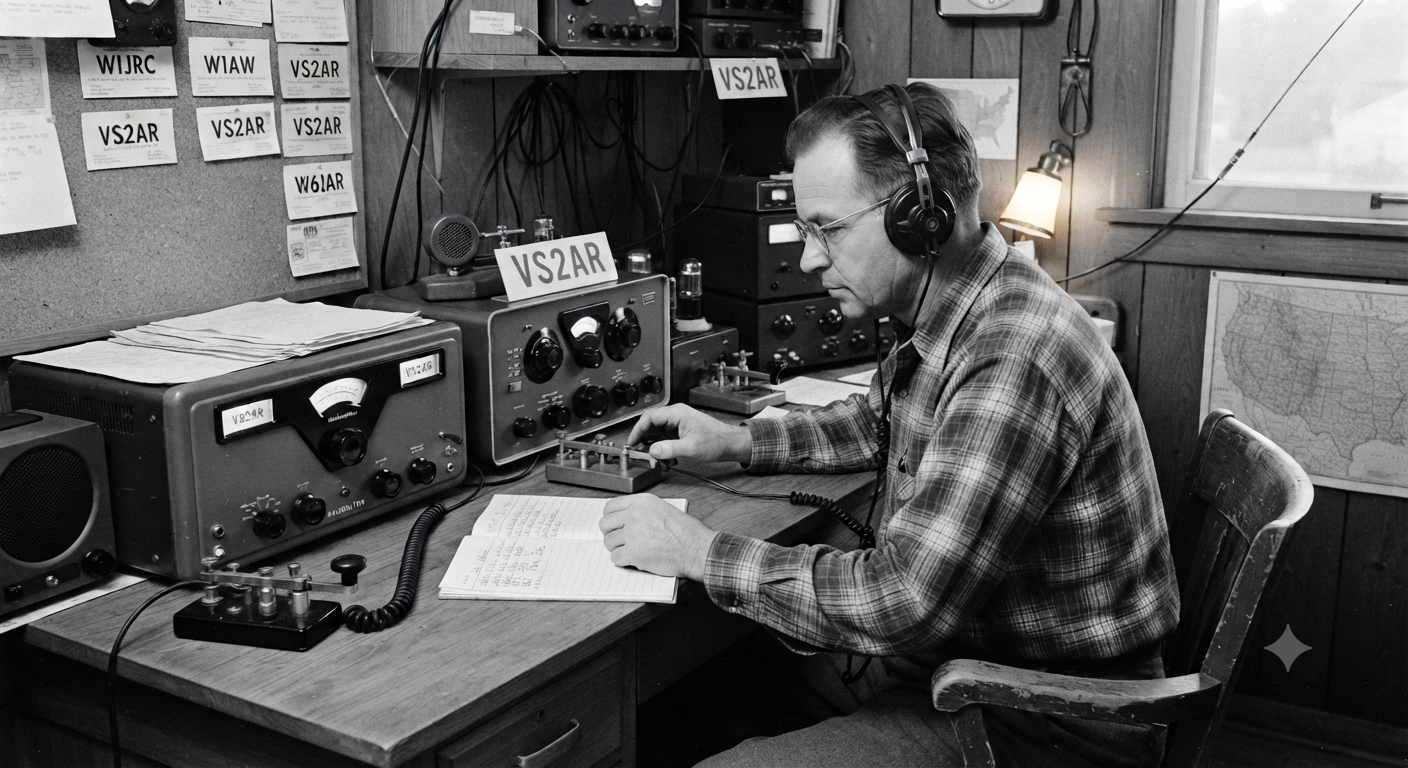
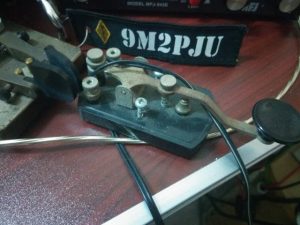
Amateur radio carries more than technology from one generation to the next. It carries a vocabulary. One of the clearest examples is the survival of CW abbreviations, terms built for Morse code, inside SSB, FM, repeater, satellite, and digital voice communication.
Operators who have never touched a Morse key still say “QSL,” “QTH,” “73,” and “OM” on the air without a second thought. This did not happen by accident. It reflects how amateur radio culture carries its own history forward, and how efficient the early shorthand really was.
The Origin of CW Abbreviations
CW stands for Continuous Wave, the term for Morse code transmission. In the early days of radio, bandwidth was limited and signals were often weak. Every character sent cost time and effort, so operators developed abbreviations, procedural signals, and Q-codes to compress common phrases into a few characters.
Examples:
- QTH replaced “What is your location?”
- QRM replaced “I am experiencing interference.”
- 73 replaced “Best regards.”
- OM replaced “Old Man,” meaning a fellow male operator.
These shortcuts sped up communication significantly, especially under poor propagation or during long-distance DX contacts. Many were eventually standardized internationally and adopted by commercial, maritime, and military radio services as well.
The Q-Code System
Q-codes were originally created for CW. The system was developed in the early 1900s specifically for wireless telegraphy, so operators speaking different languages could exchange standard information over Morse code without spelling out full phrases. Voice use came much later, after Q-codes were already standard practice among CW operators. Every Q-code begins with “Q” followed by two letters.
| Q-Code | Meaning |
|---|---|
| QTH | My location is |
| QRM | Interference from other stations |
| QRN | Static or natural noise |
| QSB | Signal fading |
| QSY | Change frequency |
| QSL | I acknowledge receipt |
| QRP | Low power operation |
| QRO | Increase transmitter power |
| QRZ | Who is calling me? |
Although built for Morse code, these expressions became part of everyday amateur radio speech. Hearing “My QTH is Kuala Lumpur” or “You have heavy QSB” on SSB is completely normal.
Why CW Terms Moved Into Voice Operation
1. Efficiency
Many Q-codes are still faster to say than the full sentence they replace.
“Please QSY to 7.155 MHz” is shorter than “Please change your operating frequency to 7.155 MHz.”
“QSL” is quicker than “I confirm receipt of your information.”
This still matters during contests, pileups, emergency traffic, and DX operation, where every second on frequency counts.
2. Shared Operator Culture
Amateur radio has a strong intergenerational learning structure. New operators pick up language directly from experienced operators, often inheriting habits that go back decades. Using terms like 73, OM, YL, XYL, and QSL signals familiarity with amateur radio tradition and etiquette, even among operators who mainly work digital modes.
3. International Understanding
Q-codes cross language barriers by design. An operator in Malaysia, Japan, Germany, or Brazil will recognize QTH, QRM, and QSL regardless of their spoken language. This makes international QSOs smoother, particularly when neither party shares a common language beyond radio shorthand.
Common CW Terms Still Heard on Voice Today
73 is the most widely recognized piece of amateur radio shorthand, meaning “best regards.” It predates radio itself, tracing back to 19th century landline telegraph operating codes. Operators commonly close a voice QSO with “Thanks for the contact, 73.” Note that “73” already carries plural meaning on its own, which is why many operators avoid saying “73s.”
88 means “love and kisses.” It is used far less often than 73, typically between operators who know each other well, and has some association with exchanges involving YL operators.
OM (Old Man) and YL (Young Lady) are traditional terms for male and female operators respectively. Some operators today prefer using first names instead, but the terms remain in common use, especially among longtime operators.
XYL refers to an operator’s wife. The commonly cited explanation is that it derives from “Ex-Young Lady,” a bit of amateur radio humor that has stuck around for decades. The exact origin is not formally documented, but the usage itself is well established: “My XYL also enjoys portable operation.”
QRP originally meant “shall I reduce power?” or, as a statement, “reduce transmitter power.” Today it identifies an entire operating philosophy built around low-power transmission, typically 5 watts or less. “Running QRP at 5 watts” signals both a power level and a mindset.
QRP has gained fresh relevance through Parks on the Air, Summits on the Air, and general field activation activity. A 5-watt station on a mountain summit with a simple wire antenna can outperform a high-power station with weaker operating technique. It is a good demonstration of a principle many experienced operators hold to: operating skill matters more than raw transmitter power.
QRZ, originally “who is calling me?”, is now used almost universally on its own during pileups and contests. A single “QRZ?” efficiently invites the next station to call.
A Note on Voice Procedure Words
It is worth separating CW Q-codes from voice procedure words like “Roger,” “Over,” and “Wilco.” These terms are often grouped together with CW abbreviations, but they come from a different tradition: military and aviation voice radio procedure, not Morse code shorthand. Both traditions shaped modern radio communication, but they developed along separate paths before converging in general radio operating culture.
Digital Modes Still Rely on the Same Shorthand
Modern digital modes such as FT8, PSK31, RTTY, and JS8Call continue to use traditional radio abbreviations inside their exchanges. QTH, QRM, QSB, and 73 all appear regularly in digital contacts, showing how deeply this shorthand is built into radio communication logic itself, independent of the mode carrying it.
Tradition Versus Overuse
There is a difference between using this vocabulary naturally and overusing it. Experienced operators generally value concise, meaningful shorthand, but stacking too many Q-codes into ordinary conversation can sound forced.
Natural: “My QTH is Selangor.”
Overdone: “The QRM at my QTH caused me to QSY because of severe QRN.”
Clarity should come before style. The best operators communicate efficiently without making a simple exchange harder to follow than it needs to be.
Why This Vocabulary Has Lasted
CW abbreviations have carried through spark gap radio, vacuum tubes, SSB, FM repeaters, satellites, internet-linked repeaters, SDR technology, and now digital weak-signal modes. The reason is straightforward: amateur radio is not only about equipment, it is about operating culture and shared identity. Every “73” sent on the air continues a communication tradition that predates radio broadcasting itself.
A modern SDR transceiver running a waterfall display looks nothing like a 1930s Morse station, yet operators on both sides of that gap still exchange the same abbreviations and operating customs. That continuity is part of what makes amateur radio distinct from most other technical hobbies.
Final Thoughts
CW abbreviations were built out of necessity, born from the limits of early Morse transmission, but they survived because they became part of amateur radio identity itself. They carry efficiency, international understanding, and a direct link to the technical heritage of the hobby.
When an operator signs off with “73,” they are not simply ending a conversation. They are taking part in a practice that has connected radio operators across generations and technologies for more than a century.
73,
9M2PJU


Post Comment