Worldwide Amateur Radio Frequency Allocations by IARU Region
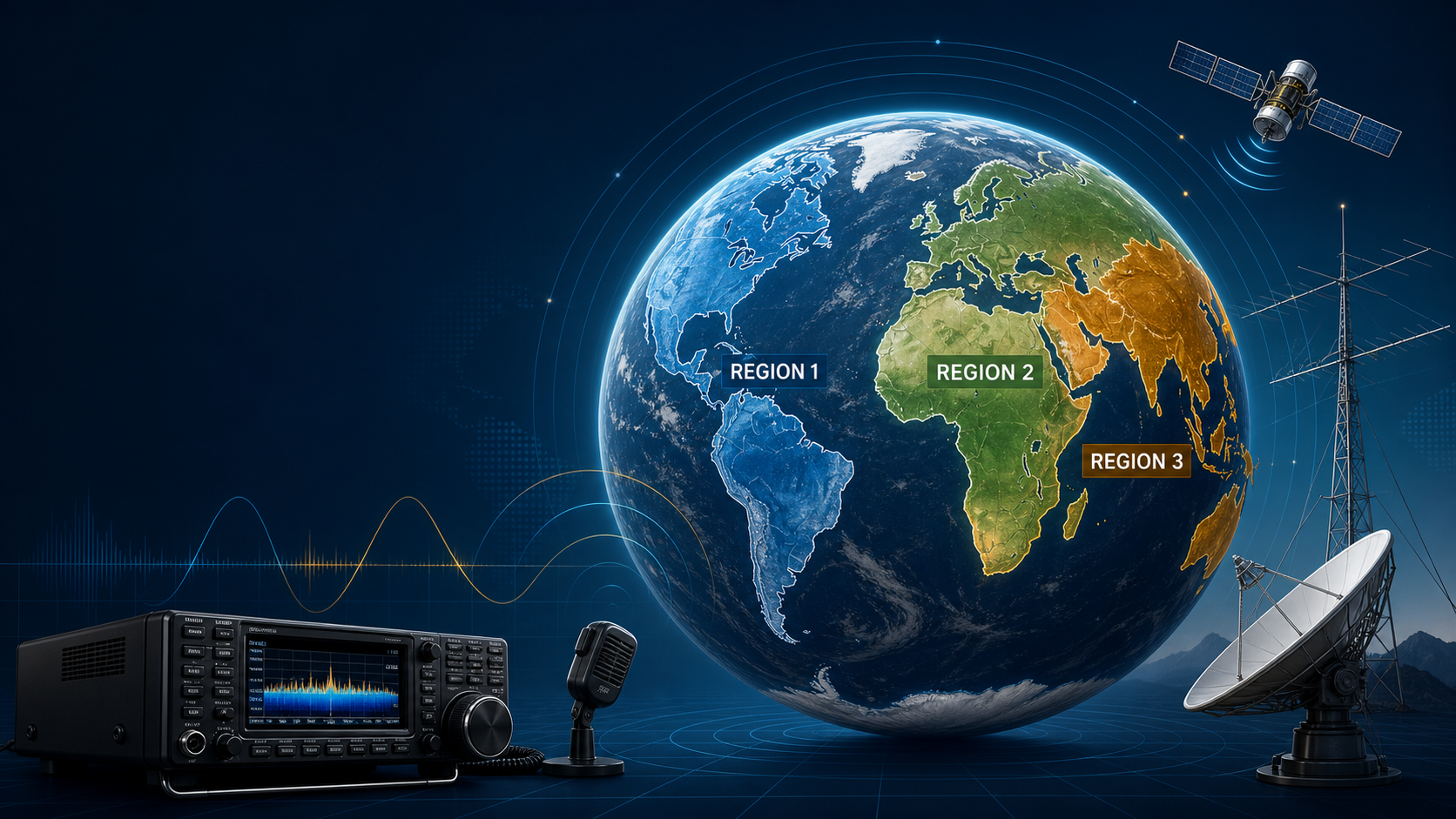
IARU / ITU Regions
| Region | Area Covered |
|---|---|
| Region 1 | Europe, Africa, Middle East, Russia, northern Asia |
| Region 2 | North America, South America, Caribbean, Greenland |
| Region 3 | Asia-Pacific, East Asia, South Asia, Southeast Asia, Australia, New Zealand, Pacific islands |
LF, MF, and HF Amateur Bands
These are the most important worldwide amateur bands below 30 MHz.
| Band | Region 1 | Region 2 | Region 3 | Notes |
|---|---|---|---|---|
| 2200 m | 135.7-137.8 kHz | 135.7-137.8 kHz | 135.7-137.8 kHz | LF, very narrowband, specialist use |
| 630 m | 472-479 kHz | 472-479 kHz | 472-479 kHz | MF, weak-signal and experimental |
| 160 m | 1.810-2.000 MHz | 1.800-2.000 MHz | 1.800-2.000 MHz | “Top Band”; regional/night DX |
| 80 / 75 m | 3.500-3.800 MHz | 3.500-4.000 MHz | 3.500-3.900 MHz | Major regional and night-time HF band |
| 60 m | 5.3515-5.3665 MHz | 5.3515-5.3665 MHz / national channels | 5.3515-5.3665 MHz | Secondary allocation; highly country-dependent |
| 40 m | 7.000-7.200 MHz | 7.000-7.300 MHz | 7.000-7.200 MHz | Only 7.000-7.200 MHz is globally common |
| 30 m | 10.100-10.150 MHz | 10.100-10.150 MHz | 10.100-10.150 MHz | WARC band; normally CW/data, no routine voice |
| 20 m | 14.000-14.350 MHz | 14.000-14.350 MHz | 14.000-14.350 MHz | Primary worldwide DX band |
| 17 m | 18.068-18.168 MHz | 18.068-18.168 MHz | 18.068-18.168 MHz | WARC band; DX, usually contest-free |
| 15 m | 21.000-21.450 MHz | 21.000-21.450 MHz | 21.000-21.450 MHz | Excellent during good solar conditions |
| 12 m | 24.890-24.990 MHz | 24.890-24.990 MHz | 24.890-24.990 MHz | WARC band; solar-cycle dependent |
| 10 m | 28.000-29.700 MHz | 28.000-29.700 MHz | 28.000-29.700 MHz | HF/VHF transition band; DX, FM, repeaters in some countries |
VHF and UHF Amateur Bands
| Band | Region 1 | Region 2 | Region 3 | Notes |
|---|---|---|---|---|
| 6 m | 50-52 MHz common; 50-54 MHz in some countries | 50-54 MHz | 50-54 MHz | “Magic Band”; sporadic-E, TEP, weak signal, FM |
| 4 m | 70-70.5 MHz in some countries only | Not generally allocated | Not generally allocated | Mainly parts of Europe, Africa, and a few others |
| 2 m | 144-146 MHz | 144-148 MHz | 144-148 MHz | Very common local/repeater/satellite band |
| 1.25 m | Not generally allocated | 220-225 MHz, with national variations | Not generally allocated | Mostly Region 2; US/Canada commonly use 222-225 MHz |
| 70 cm | 430-440 MHz | 420-450 MHz | 430-440 MHz common; some countries wider | Repeaters, satellites, digital voice, weak signal |
| 33 cm | Not generally allocated | 902-928 MHz | Not generally allocated | Mostly Region 2, especially North America |
| 23 cm | 1240-1300 MHz | 1240-1300 MHz | 1240-1300 MHz | Satellites, ATV, weak signal, experimentation |
Microwave Amateur Bands
Microwave allocations become more country-specific, but the following are commonly recognized amateur bands internationally.
| Band | Approx. Frequency Range | Regional Notes |
|---|---|---|
| 13 cm | 2300-2450 MHz | Varies significantly by country and region |
| 9 cm | 3300-3500 MHz | Availability varies; affected by commercial/satellite use in many countries |
| 6 cm | 5650-5850 MHz | Common amateur microwave band; shared with other services |
| 3 cm | 10.000-10.500 GHz | Widely used for microwave DX, EME, rain scatter |
| 1.2 cm | 24.000-24.250 GHz | Advanced microwave experimentation |
| 6 mm | 47.000-47.200 GHz | Specialist millimetre-wave operation |
| 4 mm | 75.500-81.000 GHz | Specialist experimental use |
| 2 mm | 134-141 GHz | Very advanced experimental amateur band |
| 1 mm | 241-250 GHz | Experimental, research-level amateur work |
Professional Notes
The most globally consistent amateur HF bands are:
10.100-10.150, 14.000-14.350, 18.068-18.168, 21.000-21.450, 24.890-24.990, and 28.000-29.700 MHz.
The bands with major regional differences are:
80 m, 40 m, 6 m, 2 m, 1.25 m, 70 cm, 33 cm, and the microwave bands.
The 40 m band is especially important:
- Region 1 and Region 3: usually 7.000-7.200 MHz
- Region 2: 7.000-7.300 MHz
- The segment 7.200-7.300 MHz is not globally available to amateurs
The 30 m band is internationally allocated, but it is generally treated as a narrowband CW/data band. Routine SSB voice operation is not normally permitted or accepted there.
The 60 m band is the most country-dependent HF allocation. Although WRC-15 created a narrow worldwide secondary allocation at 5.3515-5.3665 MHz, many countries still use channelized access, special permits, reduced power, or no access.


Post Comment