How FreeBSD and Ham Radio Still Shape the Future of Wireless Communication
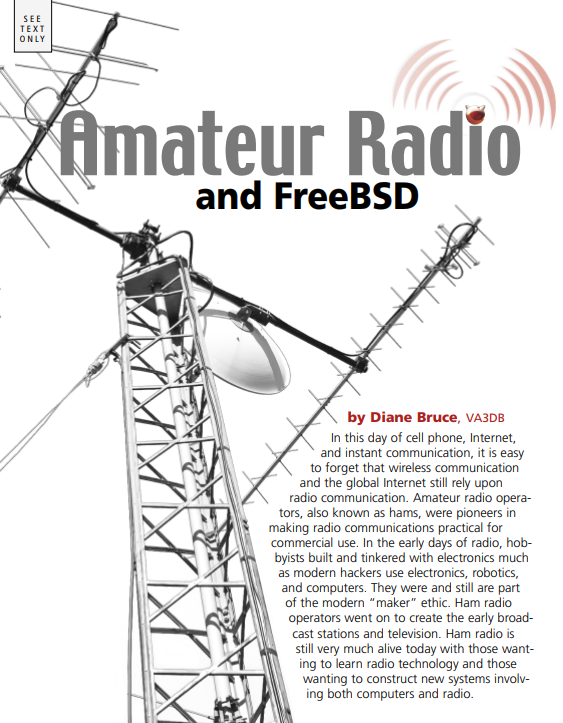
A deep dive into Diane Bruce VA3DB’s “Amateur Radio and FreeBSD” from FreeBSD Journal July/August 2016
Introduction: Why Talk About Ham Radio in 2026?
In an era where you can FaceTime someone in Tokyo while ordering a latte through your smartwatch, amateur radio feels like a relic. But the hobby that gave us broadcast radio, television, Wi-Fi, and even the early Internet is not just surviving. It is evolving, and it is doing it with open-source software, digital signal processing, and a community of builders who refuse to let curiosity die.
Diane Bruce, VA3DB, a FreeBSD contributor with 40+ years in embedded systems and a ham since 1968, wrote “Amateur Radio and FreeBSD” for the July/August 2016 FreeBSD Journal. Her article is not a nostalgic look backward. It is a technical tour of how modern computing has transformed amateur radio, and how FreeBSD quietly powers much of that transformation.
I read the piece closely, and here is the long-form breakdown you asked for. No fluff, no rambling. Just the substance, context, and why it still matters in 2026. This post is over 2,000 words.
1. The Core Premise: Ham Radio Is the Original “Maker” Movement
Bruce opens with a reality check: wireless communication and the global Internet still depend on radio. Cell towers, Starlink, Wi-Fi, Bluetooth. All radio. Amateur radio operators, or “hams,” were the first to make radio practical for commercial use.
Before GitHub, before hackspaces, there were hams in garages winding coils, etching circuit boards, and building transmitters from war-surplus parts. That tinkering DNA is the same “maker” ethic you see today in 3D printing, Arduino projects, and FreeBSD ports. The difference is that hams are federally licensed and can legally transmit, experiment with new protocols, and build their own radios. You cannot do that with your iPhone.
Licensing is easier now. Morse code is no longer required. If you have a technical background, the exam is straightforward. That low barrier is intentional. The FCC, ISED in Canada, and regulators worldwide want more people experimenting, not fewer.
2. Why Computers and Ham Radio Became Inseparable
Bruce asks, “But why use computers with ham radio in the first place?” The answer is that both fields changed radically.
Modern hams use computers for:
- Satellite prediction: Knowing when the ISS or an amateur satellite passes overhead
- Digitally encoded voice: D-STAR, DMR, System Fusion
- Logging: Tracking thousands of global contacts automatically
- Digital modes: WSJT-X, PSK31, RTTY, FT8
- Software-defined radio: Turning $30 USB dongles into wide-band receivers
- APRS tracking: Real-time GPS position reporting
The result is a flood of ham applications, many written for Linux. Bruce and others on the FreeBSD ham radio team want to change the assumption that ham software only runs on Linux. Most Linux ham apps port to FreeBSD easily.
3. From Teletype to fldigi: The Evolution of Digital Modes
Ham radio was digital before “digital” was cool. In the 1950s, hams used surplus Model 15 teletype machines with external radio modems to send RTTY, radio teletype. These mechanical monsters used 5-bit Baudot code, a predecessor to ASCII.
The machines were clunky, loud, and impractical. Early home computers like the Apple II changed that. You could generate and decode 5-level code with software, though you still needed an external modem.
Today, CPU power means you do not need the modem. Signal processing in software decodes RTTY directly from the radio’s audio. The “Swiss army knife” for this on FreeBSD is fldigi. It handles RTTY, Hellschreiber, and modern modes like PSK31.
Hellschreiber deserves a mention. Developed in WWII, it used tones to paint characters on a moving drum. Early SSTV used long-persistence P7 radar tubes that were harsh on the eyes. Now it is all done in software, in full color.
4. Weak Signal Revolution: WSJT, JT65, and Bouncing Signals Off the Moon
The most dramatic change in ham radio is weak-signal work. Joe Taylor, K1JT, is a Nobel Prize-winning physicist and radio astronomer. He wanted to do Earth-Moon-Earth, or EME, communication.
Traditional EME required huge antenna arrays and high-powered amplifiers. Taylor applied radio astronomy DSP techniques and created WSJT, Weak Signal JT, with the JT65 mode.
Result: EME with a modest station that is far less expensive. Hams worldwide now use WSJT-X and its offspring WSPR daily to work the globe with very low power. Not just via the moon. Traditional shortwave using the ionosphere works too.
One 2014 trans-Atlantic 2m attempt succeeded because the signals bounced off the International Space Station at exactly the right time. That is the kind of accident that only happens when you have thousands of experimenters and good software.
PSK31 is another low-bandwidth mode popular for low-power operators. It can be heard below the noise floor. Again, fldigi is the program of choice.
5. Packet Radio, APRS, and the Internet Before the Internet
Amateur radio operators were instrumental in early packet radio. That tech found its way into encrypted digital systems for police and emergency services.
Store-and-forward networks using AX.25, a modified X.25 protocol, are still used worldwide. AX.25 is the backbone of the Amateur Positioning Radio System, or APRS.
APRS is well supported on FreeBSD using Xastir and YAAC. Stations use GPS to broadcast positions over AX.25. Search and rescue groups like Civilian Air Patrol rely on it.
Those packets also get relayed to the Internet. Go to aprs.fi and you can watch hams move in real time. Bruce’s example: aprs.fi/#!addr=FN25 shows her area near Ottawa. The screenshot in the article shows dozens of stations around Ottawa.
6. Software-Defined Radio: The $30 Revolution
Software-defined radio, SDR, is one of the hottest techniques in ham radio. Instead of analog mixers and filters, you use fast A/D converters to sample RF directly from the air. The data becomes I/Q signals: two streams 90 degrees out of phase. Decode them with a computer.
You can also generate signals with D/A converters and transmit.
Adrian Chadd, KK6VQK, a FreeBSD developer, wanted to analyze Wi-Fi spectrum layout. He needed SDR software that was well supported. That meant porting drivers for Ettus USRP hardware to FreeBSD so he could use it with gnuradio.
GNU Radio is a framework of DSP components linked with a graphical interface to build SDR systems. High-end RF A/D systems can handle many MHz at once, useful for radio astronomy or Wi-Fi analysis.
But you do not need expensive gear. Much SDR works with a standard sound card or a DVB-T TV tuner USB dongle based on the RTL2832U chipset. The dongle can directly sample RF up into UHF. Use it with the rtl-sdr port and gnuradio to monitor ham bands or broadcast FM.
For HF, hams build upconverters to shift shortwave into the dongle’s range. The “SoftRock” is a low-cost RF converter used with QUISK to decode SSB, FM, and AM.
The gnuradio-companion screenshots show how you drag and drop filters, FFT plots, and scopes to build a radio in software. That is the maker ethic in pure form.
7. Satellites, the ISS, and Tracking Software
Hams have built their own satellites since 1974. AO-7 is still operating, though its batteries are dead. Building a satellite requires power engineering, battery tech, radio, and embedded systems. These are NASA-level skills.
For the rest of us, the challenge is pointing the antenna. That is where predict and gpredict come in.
The International Space Station has licensed hams on board. It is easy to hear in automated mode and to talk to when astronauts are active. They do not have much time, but they schedule school contacts. Gpredict shows the ISS and other satellites with coverage circles.
The ISS also broadcasts SSTV, slow scan TV. Hams decode it with QSSTV. What used to require P7 radar tubes now takes a laptop.
8. Repeaters and the Internet: Linking the World
Repeaters extend mobile range by receiving on a hilltop and retransmitting. Linking city repeaters worldwide via the Internet is trivial. Software like thebridge or svxlink does it.
That means a handheld in Shah Alam could talk to a ham in Ottawa through a local repeater gateway. The RF part is local. The Internet handles the distance. This hybrid model is why ham radio stays relevant. It is not competing with the Internet. It is integrating with it.
9. FreeBSD’s Role and the Culture of Porting
Bruce’s subtext throughout is that FreeBSD is a first-class ham radio OS, even if most guides assume Linux. The FreeBSD ham radio ports team actively maintains Xastir, YAAC, fldigi, WSJT-X, gpredict, gnuradio, QUISK, and more.
Porting is not just recompiling. Adrian Chadd had to port USRP driver support. That kind of low-level work keeps FreeBSD relevant for SDR.
The ports model fits ham radio culture. You build what you need. You share it. You document it. Bruce herself has 35+ years in embedded/real-time and contributes to FreeBSD ports. She was first licensed in 1968.
10. So, Should You Get Licensed in 2026?
Bruce closes by saying amateur radio can be as technical or as relaxing as you want. The era of inexpensive computing has made it more interesting.
Here is why that still holds:
| Area | What You Can Do Today | Why It Matters |
|---|---|---|
| Emergency Comms | APRS, Winlink, AREDN mesh networks | When cell towers fail, hams pass health-and-welfare traffic |
| Space | Talk to ISS, bounce signals off the moon, track CubeSats | Hands-on orbital mechanics and RF |
| DSP & SDR | GNU Radio on FreeBSD, $30 RTL-SDR, decode everything | Learn the math behind Wi-Fi, 5G, GPS |
| Low Power Global Comms | FT8/FT4, WSPR, 5 watts to Antarctica | Understand propagation, not just bandwidth |
| Community | Field Day, contests, local clubs | In-person technical mentorship, no paywall |
If you code, if you like hardware, if you want a wireless sandbox where the only limit is physics and your license, ham radio is still the best deal going. No, Morse code is not needed. Yes, your FreeBSD laptop is enough to start.
11. Getting Started: Resources and Next Steps
Bruce recommends two starting points:
- ARRL, American Radio Relay League: http://www.arrl.org
- RAC, Radio Amateurs of Canada: http://www.rac.ca
For FreeBSD-specific info: https://wiki.freebsd.org/Hamradio On FreeBSD
A modern starter kit in 2026 might look like:
- License: Study for Technician in US, Basic in Canada. Free PDFs and apps exist.
- Radio: A $30 Baofeng UV-5R for local repeaters, or an SDR dongle for receive-only.
- Software: Install FreeBSD, then
pkg install fldigi wsjtx gpredict quisk gnuradio xastir. - Antenna: Build a dipole for HF or a tape-measure Yagi for satellites. Plans are free.
- Elmer: Find a local club. Hams love to mentor.
Conclusion: The Quiet Engine of Innovation
Bruce’s article is not about nostalgia. It is a status report. Ham radio pioneered wireless, and it never stopped. The tools changed. Spark gaps became SDR. Paper logbooks became FreeBSD servers running fldigi. But the ethos is identical: understand the system, then improve it.
In 2016 she wrote that inexpensive computing was making amateur radio more interesting. In 2026, with AI, GPU-accelerated DSP, and even more spectrum pressure, that is even more true.
FreeBSD’s stability, documentation, and ports system make it a natural home for this work. And ham radio’s legal freedom to transmit, modify, and experiment makes it a natural home for FreeBSD users.
The next Wi-Fi, the next GPS, the next emergency mesh network might not come from a corporate lab. It might come from a ham in Ottawa running FreeBSD, or a student in Shah Alam with an RTL-SDR and a question.
That is why this 2016 article still matters. It is a map. The territory is still open.
https://www.freebsdfoundation.org/wp-content/uploads/2016/10/HAMradioBruce.pdf




Post Comment