Can an Unlicensed Person Transmit on Amateur Radio? A Legal Breakdown (Malaysia & US)
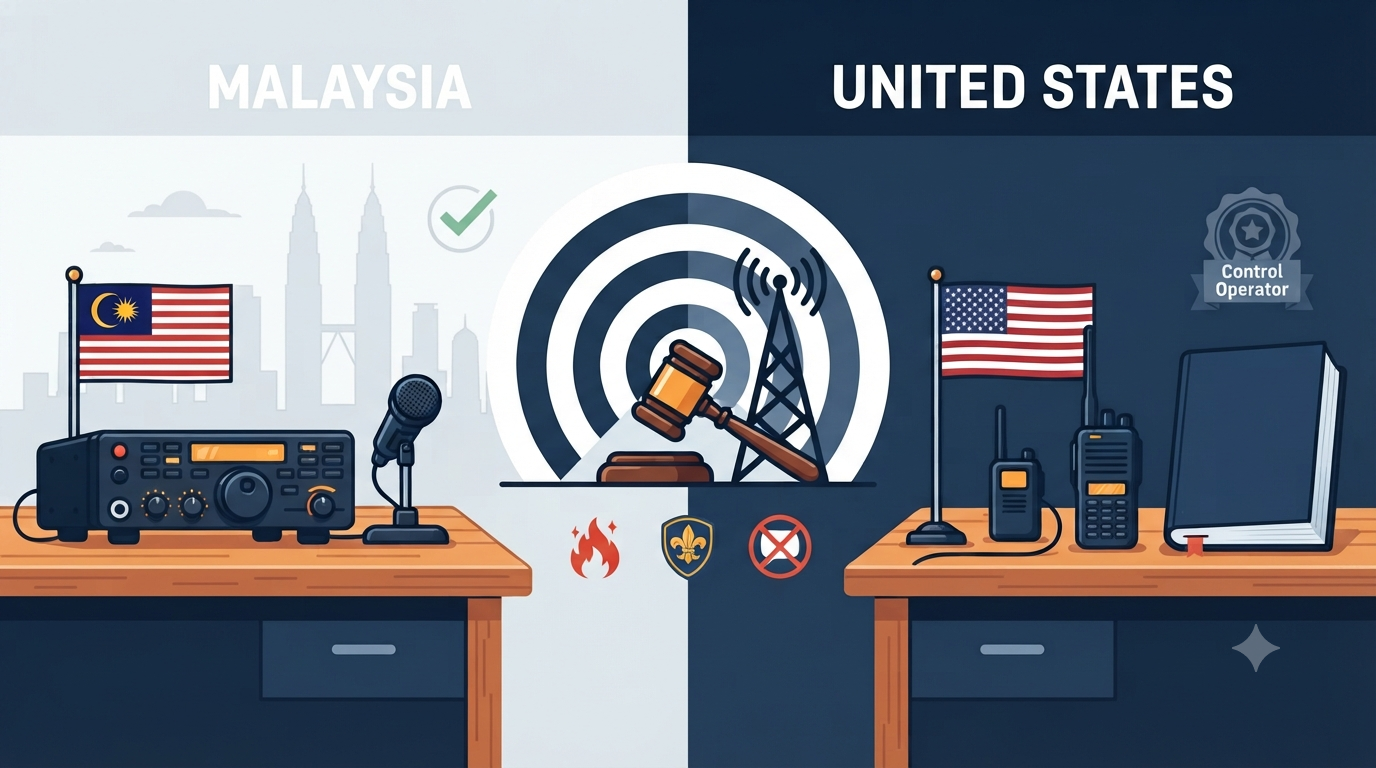
⚠ Disclaimer & Ongoing Updates: This article is intended as an informational summary of amateur radio regulations in Malaysia and the United States as understood at the time of writing. Regulatory frameworks, MCMC Guidelines, and FCC rules may change over time, and interpretations may vary. This post will be updated from time to time as new information becomes available or if there are corrections, clarifications, or changes in the law. If you spot any error, disagree with any point, or have additional insight from your own experience or the official documents, please leave a comment below – constructive corrections are welcome and help make this resource more accurate for everyone.
Amateur Radio Service is a technically oriented activity encompassing education and emergency preparedness, governed by strict domestic and international law. In Malaysia, it is regulated by the Malaysian Communications and Multimedia Commission (MCMC), while in the United States, it falls under the oversight of the Federal Communications Commission (FCC).
A question that frequently causes confusion among radio enthusiasts is: Can an individual who does not hold a licence (no callsign) transmit and communicate over the air using another person’s station and callsign?
This article examines the legal boundaries based on official documents and explores the forms of allowance granted in special situations such as search and rescue (SAR) operations and international youth programmes.
1. The Default Rule: Prohibition on Unsupervised Transmission
The fundamental law of amateur radio establishes that no unlicensed individual is permitted to operate an amateur radio station independently and without supervision without the direct physical presence and control of a licensed operator.
Malaysian Regulatory Perspective (MCMC)
The primary legislation governing amateur radio service in Malaysia is the Communications and Multimedia Act 1998 (Act 588) and the Communications and Multimedia (Spectrum) Regulations 2000. Under this framework, the right to transmit and control station operations is exclusive to holders of a Amateur Radio Operator’s Certificate (AROC) who have passed the Radio Amateur Examination (RAE) and hold a valid Apparatus Assignment (AA).
For day-to-day operational guidance, the Guidelines for Amateur Radio Service in Malaysia, Edition 3.1 (MCMC, 9 August 2024) – which supersedes the Third Edition published on 20 December 2022 – sets out the operating framework for amateur stations. Under this framework, amateur operators are generally not permitted to transmit messages for and on behalf of a third party for ordinary purposes. This means Malaysia adopts a stricter approach than many other countries: all forms of third-party traffic for ordinary, non-emergency purposes are prohibited.
Important note: The Guidelines document is an operational guide, not legally binding regulation. The document itself states that the information is intended as a guide only and should not be relied upon as a legal document. The actual binding regulations are the Communications and Multimedia (Spectrum) Regulations 2000 and Act 588.
MCMC Written Permission Requirement for Third-Party Participation
An important requirement that is often overlooked: under the MCMC framework, the owner of an amateur station may permit an unlicensed person to take part in communications only if prior written permission is received from MCMC. This is confirmed in the official MCMC Radio Amateur Examination (RAE) question bank, and it means that a licensed operator cannot simply invite an unlicensed friend to speak on the radio on an ad-hoc basis – formal written authorisation from MCMC must be obtained beforehand.
From the MCMC RAE Question Bank (Question 58):
“The owner of an amateur station may:”
- A. Permit anyone to take part in communications only if prior written permission is received from MCMC ✓ (correct answer)
- B. Permit anyone to use the station without restrictions
- C. Permit any person to operate the station under the supervision and in the presence of the holder of the amateur operator certificate
- D. Permit anyone to use the station and take part in communications
This question appears in the official examination that every Malaysian amateur radio operator must pass before receiving their Amateur Radio Operator’s Certificate, confirming that prior written permission from MCMC is a binding requirement – not merely a guideline.
From the MCMC RAE Question Bank (Question 76):
“Radio amateurs may use their stations to transmit international communications on behalf of a third party only if:”
- A. The amateur station has received written authorization from MCMC to pass third party traffic ✓ (correct answer)
- B. The communication is transmitted by secret code
- C. Such communications have been authorized by the countries concerned
- D. Prior remuneration has been received
This confirms that even for international third-party traffic, written MCMC authorisation is mandatory – not just for domestic participation.
From the MCMC RAE Question Bank (Questions 77 & 78) – Definitions:
Q77: “Amateur third-party communications is:” – Correct answer: D. The transmission of non-commercial or personal messages to or on behalf of a third party.
Q78: “Third-party traffic is:” – Correct answer: C. A message sent to a non-amateur via an amateur station.
These definitions make clear that “third party” means any non-licensed person whose message is carried by the amateur station – whether they speak on the microphone themselves or simply have a message relayed by the operator.
From the MCMC RAE Question Bank (Question 57):
“Why can’t family members without qualifications transmit using your amateur station if they are alone with your equipment?”
Correct answer: D. They must hold an amateur radio apparatus assignment before they are allowed to be control operators.
This reinforces that being physically present at the station without a licence – even as a family member – does not grant any transmit privilege. The Apparatus Assignment (AA) is the controlling document, not physical access to the equipment.
Exception for educational activities: Organised educational programmes such as the Jamboree on the Air (JOTA) do not require a separate written permission for each session, because the activity is already sanctioned through the issuance of a Special Event Callsign (e.g. the 9M4SJ** series) by MCMC. The Special Event Callsign allocation by MCMC is generally understood to serve as the authorisation for the activity, and the licensed Control Operator supervises the unlicensed participants under the standard Control Operator framework. This is covered in more detail in Section 5 below.
The station owner bears full responsibility for all transmissions sent using their callsign, and may face suspension of their AA for permitting transmissions without proper supervision and control.
United States Regulatory Perspective (FCC Part 97)
Under the Code of Federal Regulations (CFR) Title 47, Part 97, the FCC uses the concept of a Control Operator as specified in §97.105. A Control Operator is a licensed amateur operator designated by the station licensee to ensure the station’s operation complies fully with FCC rules.
A commonly misunderstood point: the FCC does not require the individual speaking on the radio (the third party) to hold an amateur licence, provided a licensed Control Operator is physically present, controls the operation, and is ready to cut the transmission at any moment if a violation occurs. This is governed by §97.115.
Example Script: PROHIBITED SITUATION – Casual Rag-chew in Malaysia
This illustrates a violation of MCMC guidelines if ‘Rahman’ holds no licence.
Rahman (presses PTT): “CQ CQ, this is 9M2PJU operated by Rahman, calling all stations. Anyone monitoring?”
9M2PJU (Licence Holder): Nearby, not monitoring.
9W2XXX: “9M2PJU, this is 9W2XXX returning. Rahman, do you have a licence?”
Rahman: “No, I’m just using my friend’s station.”
Why this is problematic: In Malaysia, this conflicts with MCMC guidelines because third-party traffic is not in an emergency context. 9M2PJU may face disciplinary action for permitting transmission without proper supervision and control.
2. Third-Party Traffic Rules (§97.115): A Frequently Misunderstood Context
§97.115 governs communications involving third parties, including unlicensed individuals using an amateur station to communicate with other stations.
For domestic communications (within the United States), an unlicensed individual may speak on an amateur station under the supervision of a physically present Control Operator.
For international communications involving a third party, an additional condition applies: the foreign station being contacted must be in a country that has a Third-Party Traffic Agreement with the United States. Malaysia is not listed among the countries that have such an agreement with the United States. Because of this, FCC-licensed stations are not permitted to pass third-party traffic to or from Malaysian amateur stations under normal circumstances.
However, §97.115(a)(2) also provides an exception for emergency communications and disaster relief to any foreign station, regardless of whether a Third-Party Traffic Agreement exists. Life-safety communications are not blocked by administrative limitations.
3. Malaysia vs United States: Key Differences at a Glance
Because the Malaysian and US frameworks approach third-party participation very differently, confusion often arises – especially when hams from both countries attempt cross-border contacts involving unlicensed individuals. This section clarifies the practical rules for each side and the combined effect when both are involved.
3.1 Malaysia – Strict Permission-Based Model
Under the MCMC framework, any third-party participation (an unlicensed person speaking on the radio) requires prior written permission from MCMC, regardless of whether the contact is domestic or international. This is confirmed by RAE Questions 58 and 76 above. There is no “Control Operator present” exemption equivalent to the FCC’s rule – the written authorisation is the controlling requirement.
The practical exceptions are:
- Emergency and SAR operations – explicitly allowed under the ITU Radio Regulations and MCMC Guidelines when official communications are disrupted (see Section 4 below).
- MCMC-sanctioned educational events – such as JOTA, where the issuance of a Special Event Callsign (9M4SJ** series) by MCMC itself serves as the authorisation (see Section 5 below).
For ordinary, casual rag-chew involving an unlicensed third party, MCMC does not grant ad-hoc permission. The station owner would need to apply in advance, and approval for non-emergency, non-educational third-party traffic is not generally given.
3.2 United States – Control Operator Model
The US uses a different, more permissive approach under FCC Part 97:
- Domestic (within the US): An unlicensed third party may speak on an amateur station without prior FCC permission, provided a licensed Control Operator is physically present at the control point, continuously monitoring, and ready to cut transmission if a violation occurs (§97.105, §97.115(a)(1)). No written application is needed.
- International: An unlicensed third party may participate in international communications only if:
- The foreign country has a Third-Party Traffic Agreement with the United States, OR
- The communication is emergency or disaster relief traffic (§97.115(a)(2)), which is exempt from the agreement requirement.
3.3 Can an Unlicensed Third Party in Malaysia Talk to an Unlicensed Third Party in the US?
This is one of the most frequently asked questions, and the answer is: No, not for ordinary or casual communications. The contact is blocked on both sides:
| Scenario | Malaysia side | US side | Allowed? |
|---|---|---|---|
| Casual rag-chew (third party to third party) | Blocked – no MCMC permission | Blocked – no US-Malaysia third-party agreement | NO |
| JOTA (scout to scout) | Allowed – Special Event Callsign = MCMC auth | Blocked – no US-Malaysia third-party agreement* | Technically NO on US side |
| Emergency / disaster relief | Allowed – emergency exception | Allowed – §97.115(a)(2) emergency exception | YES |
Why casual third-party QSO is blocked:
- Malaysia side: MCMC requires prior written permission (RAE Q58, Q76), which is not granted for ordinary third-party traffic.
- US side: Malaysia is NOT listed among the countries that have a Third-Party Traffic Agreement with the United States (verified from the FCC International Arrangements page). Because of this, FCC-licensed stations are prohibited from passing third-party traffic to Malaysian stations under §97.115(a)(2).
* The JOTA complication: Even JOTA between Malaysia and the US is technically not permitted on the US side, because the FCC does not have a “JOTA exception” – only an emergency exception. In practice, JOTA happens internationally because many country pairs do have third-party agreements with each other (e.g. US-Australia, US-UK), and not all operators are aware of the international third-party restriction. The JOTA example in this article uses VK2JAM (Australia), which is correct practice because Australia has a third-party agreement with the US. The Malaysia-US JOTA path would still require careful attention to the FCC’s third-party agreement list.
The only scenario where Malaysia-US third-party traffic is clearly permitted: Emergency and disaster relief communications, where both the MCMC emergency exception and the FCC §97.115(a)(2) emergency exception apply, regardless of any third-party agreement.
4. Special Provision I: Emergency Situations and Search and Rescue (SAR) Operations
Although the operational guidelines are ordinarily strict, an absolute exception exists when human life and property are at risk during a disaster or emergency.
Under the International Telecommunication Union (ITU) Radio Regulations and MCMC operational guidance, if the official communications network of a rescue agency is disrupted, amateur radio stations may act as a communication enabler. The MCMC Guidelines themselves list the ability to assist during emergencies and disasters as one of the primary activities amateur operators may carry out.
Standard Operating Procedure
- Control Operator: The licensed operator must be physically present beside the radio equipment at all times to supervise technical functions (power, frequency, and PTT activation).
- Third-Party Traffic: Rescue personnel (such as Fire and Rescue Department officers) are permitted to hold the microphone and relay critical operational information directly under the Control Operator’s supervision and monitoring.
- Correct Identification: Station identification is not changed to the name of the unlicensed individual. Instead, the licence holder opens the frequency, introduces the agency being assisted, and closes each transmission using their official callsign format.
Example Script: PERMITTED SITUATION – SAR Flood Operation
Location: Flood evacuation centre; Fire Department communications disrupted.
9M2SAR acts as Control Operator, holding and controlling the radio at all times.
9M2SAR: “All stations, all stations, this is 9M2SAR, priority traffic. I am at the Kg. Batu Evacuation Centre. With me now is the Fire Department Operations Officer for a situation report. Over.”
Fire Officer (no licence, holding the microphone under 9M2SAR’s control): “9M2SAR, advising that we require 2 additional rescue boats immediately at coordinates 3.05N 101.5E. There are 15 victims trapped including 3 elderly persons. Over.”
9M2SAR (resumes control): “Copy that. 9M2SAR standing by for relay. Out.”
Why this is permissible: The Control Operator is present and in control throughout. The context is a life-threatening emergency. Identification uses only the callsign 9M2SAR. Consistent with MCMC guidelines and FCC §97.115(a)(2).
5. Special Provision II: Youth Education Programme (Jamboree on the Air – JOTA)
Another globally recognised activity is the Jamboree on the Air (JOTA), organised by the World Organization of the Scout Movement (WOSM) in collaboration with the amateur radio community.
In this context, unlicensed scout children are permitted to speak on the radio to exchange greetings internationally. This is not a special exception to the rules, but rather the ordinary application of the existing Control Operator concept: the licence holder is present and in control, while the unlicensed individual participates as a third party who speaks.
Station Control Structure During JOTA
- Licence Holder (e.g. 9M2PJU) – Physical & Technical Control
- Monitors ethics & ready to cut PTT at all times
- Scout Child – Voice Interaction (Microphone only)
Valid JOTA Operating Procedures
- Immediate Control: The Control Operator must be ready at all times to cut transmission if a participant mentions anything that violates broadcast ethics (such as commercial matters, political topics, or inappropriate language).
- Callsign Options: The organiser may use the supervisor’s personal callsign (such as 9M2PJU), or apply to MCMC for a Special Event Callsign. Based on the Guideline on the Allocation of Call Sign to the Amateur Radio Service (MCMC), the general format for special event callsigns is 9M4SLL, where “S” denotes the Special Events category and “LL” represents two letters chosen by the organiser. For JOTA specifically, stations follow the 9M4SJ** pattern – for example, 9M4SJH was used for JOTA in Semenyih, Selangor, 9M4SJC for Kuantan, and 9M4SJA for Taiping.
- International Communications During JOTA: The Control Operator must ensure that all communications are personal and non-commercial in nature, consistent with the third-party traffic regulations applicable in each respective country.
Example Script: PERMITTED SITUATION – International JOTA
Station: 9M4SJH – JOTA Station, Semenyih, Selangor Scout Group
Control Operator: 9M2XYZ
Participant: Aisyah, age 12, no licence
9M2XYZ: “CQ JOTA CQ JOTA, this is 9M4SJH, Special Event Station for the Jamboree On The Air from Semenyih, Selangor, Malaysia. Standing by for any scout stations. 9M4SJH listening.”
VK2JAM: “9M4SJH, this is VK2JAM, Scout Group from Sydney, Australia. Good evening. Over.”
9M2XYZ (hands microphone to Aisyah): “VK2JAM from 9M4SJH, thank you for calling. With me now is Aisyah. Go ahead, Aisyah. Over.”
Aisyah (presses PTT, 9M2XYZ ready beside her): “Hello VK2JAM, my name is Aisyah. I am 12 years old. The weather in Semenyih today is rainy. Have you had your meal? Over.”
VK2JAM: “Hello Aisyah! It’s hot here. We just had a BBQ. 73! Over.”
9M2XYZ (resumes microphone): “VK2JAM, thank you for the QSO. This is 9M4SJH, operator 9M2XYZ. 73, clear.”
Why this is permissible: The Control Operator is in full control throughout. The participant does not control frequency or power. Identification uses the station callsign. The conversation is personal and non-commercial in nature.
Conclusion
Amateur radio regulations are not designed to restrict interest in the hobby, but to safeguard the orderly use of the global radio frequency spectrum from unlawful interference.
The bottom line: unlicensed individuals cannot operate an amateur radio station on their own. They can speak on the radio as a third party, but only when a licensed operator is physically present, controls the operation, and is ready to take immediate action if a violation occurs. In Malaysia, this allowance is limited to emergency contexts and MCMC-sanctioned educational events such as JOTA, based on MCMC operational guidelines. It is not a special privilege, but part of the existing regulatory framework through the Control Operator concept.
The best path for any individual who wishes to operate radio freely and fully is to sit the official examination to obtain a licence and personal callsign.
References
- Communications and Multimedia Act 1998 (Act 588), Malaysia.
- Communications and Multimedia (Spectrum) Regulations 2000, Malaysia.
- Guidelines for Amateur Radio Service in Malaysia, Edition 3.1 (MCMC, 9 August 2024).
- Guideline on the Allocation of Call Sign to the Amateur Radio Service (MCMC).
- CFR Title 47 Part 97.105 – Control operator duties (FCC).
- CFR Title 47 Part 97.115 – Third party communications (FCC).
- FCC International Arrangements – Third Party Communications (FCC).
Beyond the Rules: Self-Regulation and Amateur Radio Ethics
While amateur radio is regulated by governments under an international framework coordinated through the ITU, many operators will tell you that the real backbone of the hobby is something that cannot be legislated: self-regulation and self-discipline.
The rules set by MCMC, FCC, and other regulators define the legal boundaries of what we can and cannot do on the air. But amateur radio ethics go further than the law. They cover how we conduct ourselves on the bands, how we treat fellow operators, how we handle interference, how we mentor newcomers, and how we preserve the spirit of the hobby for the next generation.
Bob Bruninga, WB4APR (SK), the inventor of APRS, once embodied this idea: that amateur radio works best when operators police themselves, help each other, and hold the community to a higher standard than what the regulations alone require. The APRS Foundation’s strategic plan, covered in our previous article, makes this same point: the future of APRS depends on hams themselves, not on any single authority.
In practice, this means:
- Operating cleanly – not just avoiding illegal transmissions, but avoiding inconsiderate ones. Giving space to weak signals, not hogging frequencies, and respecting band plans even when they are not legally binding.
- Helping newcomers – the licence classes and exams exist, but the real learning happens on the air, with patient operators guiding new hams through their first contacts.
- Policing our own – when someone operates poorly, the first response is usually a polite off-air word, not a complaint to the regulator. The community handles its own standards first.
- Being prepared – keeping skills and equipment ready for emergencies, not because the law demands it, but because the community depends on it.
The regulations discussed in this article tell us what is legal. Amateur radio ethics tell us what is right. The best operators hold themselves to both standards, and the hobby is stronger for it.
A good example of this culture is power limits. A Class B licensee in Malaysia is restricted to 50 watts, while a Class A licensee may run up to 1000 watts on certain bands. In practice, no MCMC enforcement officer is sitting next to your rig watching your wattmeter. Yet the vast majority of Class B operators stay within their 50-watt limit anyway, not because they fear getting caught, but because they respect the licence class they earned and the framework that keeps the bands usable for everyone. That kind of self-discipline, doing the right thing when nobody is watching, is one of the highest values in amateur radio. It is what separates a licensed operator from someone who merely holds a piece of paper.
⚠ Disclaimer & Ongoing Updates: This article reflects our understanding of amateur radio regulations at the time of writing and is not legal advice. Rules and guidelines from MCMC and FCC may change, and this post will be updated accordingly as new information or corrections arise. If you have any corrections, additional references, or alternative interpretations, please leave a comment below. Your input helps keep this article accurate and useful for the amateur radio community.



2 comments