amateur radio
battery
electric
electronics
gadget
ham radio
power supply
radio amatur
smartphones
battery charge cycles, battery charging tips, battery cycle life, best battery type for phones, ev battery lifepo4, fast charging battery degradation, heat damages battery, how to maintain battery health, lfp vs li ion, li ion vs lipo, lifepo4 battery, lithium battery comparison, lithium ion battery, lithium iron phosphate, lithium polymer battery, lithium polymer vs lithium ion, optimized charging iphone, phone battery health dropping, phone battery not lasting, phone battery swelling, phone battery wear, protect battery samsung, SEI layer battery, smartphone battery lifespan, why battery health decreases
9M2PJU
0 Comments
Why Your Phone Battery Health Drops And The Real Difference Between Li-ion, Li-Po, and LiFePO4
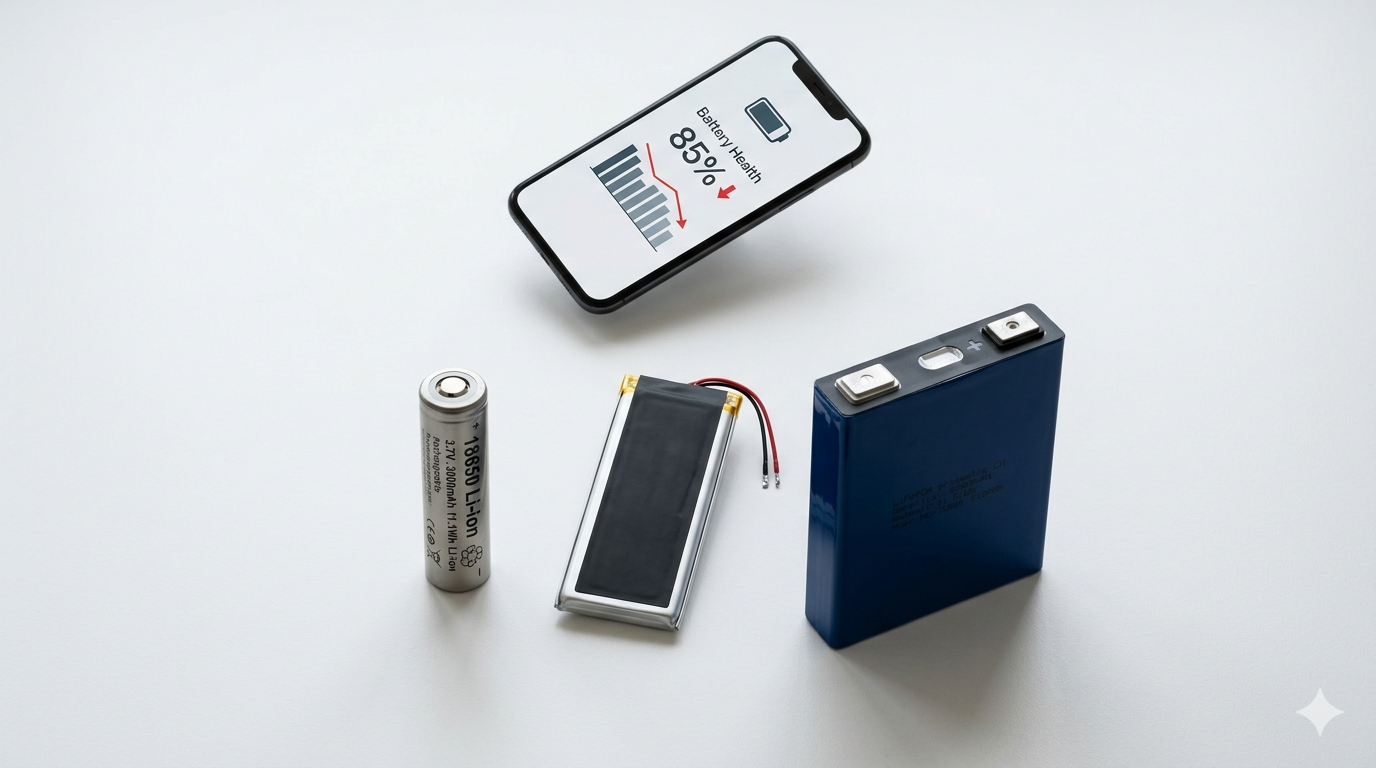
Brand new phone. Battery health: 100%. One year later, it shows 92%. After two years, you are down to 85%. Why can’t it just stay at 100% forever? And why don’t phone makers just use a battery that lasts 10 years?
The answer comes down to chemistry and physics. Let’s break it down.
Why Battery Health Can’t Stay at 100%
A lithium battery is not a water tank. It is more like a sponge. Every time you squeeze and soak it again, the sponge wears out a little. In battery terms, that wear comes from two things: cycle aging and calendar aging.
1. The chemistry inside degrades with every charge
Your phone uses a lithium-ion based battery. When you charge, lithium ions move from the cathode to the anode. When you use the phone, they move back. The problem is that trip is not perfect.
Here is what happens each cycle:
- The SEI layer grows: The anode develops a protective film called the Solid Electrolyte Interphase. Each charge makes it slightly thicker. A thicker SEI makes it harder for lithium to pass through, so capacity drops.
- Lithium gets trapped: Some lithium ions get stuck in the anode and never make it back. Less active lithium means less storage capacity.
- Electrolyte breaks down: The liquid inside slowly decomposes from heat and high voltage. As it dries up, internal resistance goes up and performance drops.
After about 500 full cycles, a typical phone battery is designed to be at 80% health. That is the industry standard, not a defect.
2. Batteries age even if you never use them
This is called calendar aging. Leave a phone in a drawer for a year and the battery will still lose 2 to 3% health. Chemical reactions happen slowly all the time. Storing at 100% or 0% makes it worse.
3. The four things that kill batteries faster:
| Factor | Why it hurts | Common example |
|---|---|---|
| Heat | Above 35°C doubles the rate of chemical breakdown | Gaming while charging, leaving phone in a hot car |
| Staying at 100% | High voltage of 4.35V stresses the cathode | Charging overnight every day |
| Staying at 0% | Voltage below 3.0V damages the anode | Leaving phone dead for days |
| Constant fast charging | High current generates heat and internal stress | Using 65W or 120W chargers daily |
Why do new phones hold 100% for a while?
Manufacturers add a buffer. Example: an iPhone 15 has an actual capacity of 3349 mAh, but Apple rates it at 3279 mAh. That extra 70 mAh covers early wear. While the battery degrades into that buffer, iOS still shows 100%. Once the buffer is gone, you start seeing 99%, 98%, and so on.
You cannot beat physics. But you can pick a battery chemistry that degrades slower. That is where Li-ion, Li-Po, and LiFePO4 come in.
The Three Big Lithium Battery Types Explained
All three are in the lithium family, but they behave very differently. Think of them as siblings with the same parents but different personalities.
1. Lithium-Ion (Li-ion): The classic workhorse
Chemistry: Cathode uses Lithium Cobalt Oxide or NMC. Electrolyte is liquid.
Voltage: 3.6V to 3.7V nominal. Full charge is 4.2V.
Strengths: Highest energy density of the three, 150 to 250 Wh/kg. That means more mAh in a smaller size. This is why laptops and old phones loved it.
Weaknesses: Cycle life is 500 to 1000 cycles to 80% health. Comes in hard metal cans, so you cannot make it super thin. Biggest issue is safety. If punctured, overheated, or overcharged, cobalt-based Li-ion can go into thermal runaway and catch fire.
Cost: Moderate.
Used in: Laptops, budget power banks, vapes, older Teslas, power tools.
2. Lithium Polymer (Li-Po): The slim and flexible one
Chemistry: Basically Li-ion with a gel or polymer electrolyte instead of liquid. The name polymer refers to the electrolyte.
Voltage: 3.7V nominal, 4.2V full. Same as Li-ion.
Strengths: Comes in a soft pouch. Can be made thin, curved, or shaped to fit a phone body. That is why every modern flagship uses it.
Weaknesses: Shortest lifespan, 300 to 500 cycles. Very sensitive to heat. Puffs up easily if mistreated. Energy density is slightly lower than classic Li-ion.
Cost: More expensive due to manufacturing complexity.
Used in: iPhone, Samsung Galaxy, Xiaomi, drones, RC cars, earbuds, smartwatches. Anything that needs to be thin.
Important note: If your phone specs say Li-ion Polymer, that means Li-Po. It is just marketing.
3. LiFePO4 or LFP: The tank
Chemistry: Cathode uses Lithium Iron Phosphate. Completely different chemistry.
Voltage: 3.2V to 3.3V nominal. Full charge is only 3.65V. Lower than the other two.
Strengths: The durability king. Cycle life is 2000 to 6000 cycles. Charge it daily and it still lasts over 10 years. Safest lithium battery on the market. Puncture it, overcharge it, short it, and it will not explode or catch fire. Iron-phosphate is chemically stable and does not release oxygen when hot. It is also cheaper now because it does not use cobalt or nickel.
Weaknesses: Lowest energy density, 90 to 160 Wh/kg. It is about 30% heavier and bulkier for the same capacity. Low voltage means you need more cells in series for devices that expect 3.7V. Hard to make thin.
Cost: Cheapest of the three today.
Used in: Home solar storage, power stations, budget EVs like BYD and Tesla Model 3 RWD, electric buses, UPS systems.
Direct Comparison Table
| Feature | Li-ion | Li-Po | LiFePO4 |
|---|---|---|---|
| Nominal voltage | 3.7V | 3.7V | 3.2V |
| Energy density | Highest | High | Lowest, heavier |
| Cycle life | 500 to 1000 | 300 to 500 | 2000 to 6000 |
| Safety | Can catch fire | Prone to swelling | Extremely safe |
| Form factor | Cylindrical or hard case | Thin, flexible pouch | Thick, hard case |
| Cost | Moderate | Expensive | Cheapest |
| Best for | Laptops, tools | Phones, drones | EVs, solar, power stations |
Why Phones Don’t Use LiFePO4
Simple answer: size and voltage.
LiFePO4 is 3.2V. Phones are designed around 3.7V systems. You would need extra circuitry and more cells. Add the low energy density, and a 5000 mAh LFP phone battery would be 30% thicker than a Li-Po 5000 mAh.
Would you buy an iPhone that is as thick as a power bank just to get 95% health after 5 years? Manufacturers bet that you would not. So every phone uses Li-Po. Thin, light, fast charging. The trade off is battery health drops faster. Phone makers expect you to upgrade every 2 to 3 years.
EVs are different. Cars do not care about a few extra kilograms. They want low cost, safety, and 1 million km durability. That is why BYD Blade Battery and Tesla’s LFP models are taking over the EV market.
How to Slow Down Battery Degradation
You cannot stop physics, but you can slow it down.
- Control heat: Do not game while charging. Do not leave your phone on the dashboard. Heat is the number one killer.
- Stay in the 20 to 80% range: This is the lowest stress zone for voltage. Use iPhone Optimized Charging or Samsung Protect Battery at 85%.
- Avoid 0%: Charge before you hit 20%. Deep discharge damages the anode.
- Use slow charging when possible: A 5W or 10W charger overnight is gentler than 65W all the time. Save fast charging for emergencies.
- Do a full cycle once a month: Drain below 10% then charge to 100% to calibrate the battery meter. Do not do this daily.
Realistic expectation: Battery health at 80% after 2 to 3 years is normal for Li-Po. Below 80%, both iOS and Android will recommend a replacement because the risk of sudden shutdowns increases.
The Bottom Line
Battery health drops because the chemical reactions inside are not 100% reversible. Every charge causes microscopic damage. That is the nature of lithium-ion and lithium-polymer batteries.
You do have a tougher option in LiFePO4, but you trade size and weight for lifespan. Until solid-state batteries arrive, Li-Po remains the king for phones because thin and light still wins.
So next time you see 87% battery health, do not panic. It is not broken. It is just chemistry. Treat it well, keep it cool, avoid extremes, and it will serve you fine. If you want zero worry, upgrade every two years. Or wait for the next battery revolution.
For now, Li-Po runs the mobile world. Light, slim, powerful. Just a little fragile, like most good things.




Post Comment