amateur radio
ham radio
9m2pju, amateur radio club culture, amateur radio elmer, amateur radio newcomers, antenna theory beginners, dunning kruger effect amateur radio, EMCOMM competency, false information ham radio, ham radio learning curve, ham radio misinformation, ham radio propagation, hamradio.my, overconfident ham radio operators, toxic amateur radio culture
9M2PJU
0 Comments
The Dunning-Kruger Curve: What Amateur Radio Reveals About Overconfidence, Toxic Authority, and the Cost of Never Learning
There is a peculiar moment that most licensed amateur radio operators can recall with either amusement or embarrassment. It happens shortly after passing the exam. The ink on the license is barely dry, the callsign is freshly minted, and suddenly the new operator has opinions. Strong ones. About antenna gain, about propagation, about why the old-timers are doing it all wrong.
This is not a character flaw. It is neuroscience.
In 1999, psychologists David Dunning and Justin Kruger published a paper in the Journal of General Psychology that documented something most experienced people had already suspected: incompetent individuals consistently overestimate their own competence. More precisely, the cognitive tools required to recognize a skill gap are largely the same tools required to possess the skill itself. If you lack the skill, you also lack the apparatus to perceive that you lack it. The result is a well-documented cognitive bias now universally known as the Dunning-Kruger effect.
Amateur radio, with its steep and multi-disciplinary learning curve, is one of the most vivid natural laboratories for observing this phenomenon in real time. But there is a dimension to this story that goes beyond the ordinary growing pains of a new hobbyist. The most serious problem is not the newcomer who does not yet know what he does not know. It is the senior operator who stopped learning decades ago, built an identity around being the authority, and now actively resists correction while confidently teaching the next-generation everything he got wrong.
The Curve, Mapped Onto the Shack
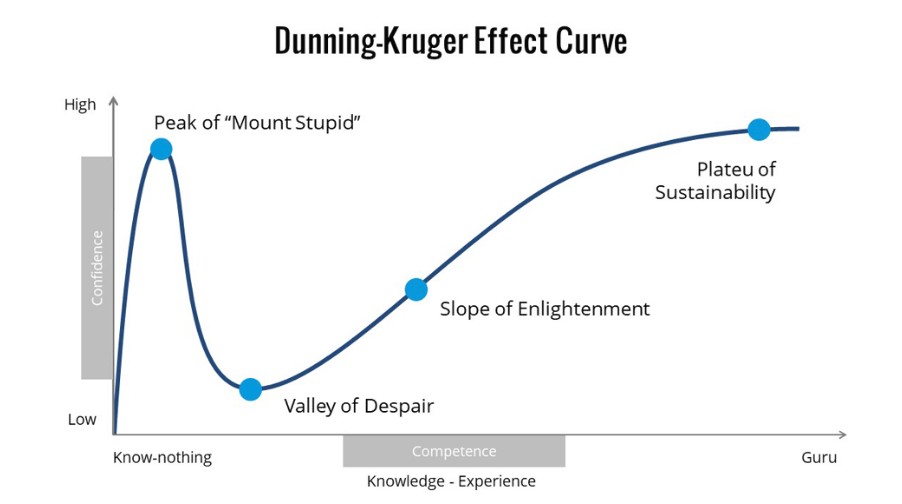
The Dunning-Kruger effect is often illustrated as a curve. Confidence rises sharply as knowledge begins, peaks dramatically at a point of minimal actual competence, then collapses as real learning begins to reveal the true depth of ignorance. Confidence eventually recovers, climbing steadily as genuine mastery develops, but it never again reaches the unchecked heights of early enthusiasm.
In amateur radio, this curve maps almost perfectly onto the journey from newly licensed operator to seasoned practitioner.
Peak of Mount Stupid. This is the operator who passed the exam and immediately began correcting others on the repeater. He has memorized band plans and can recite the ITU phonetic alphabet. He has purchased an antenna analyzer he does not fully understand and has strong opinions about which HF radio is best, despite having used precisely one of them. He is confident because the exam covered everything, and he passed the exam.
The Valley of Despair. Something happens. Perhaps it is the first failed attempt at a CW contact, or the realization that his signal reports are consistently poor despite the “perfect” antenna he built from a YouTube video. He joins a DX cluster and discovers that operators making contact with rare entities seem to be doing something he cannot yet articulate. The confidence drains. There is more here than he understood. A great deal more.
The Slope of Enlightenment. This is where serious operators live for years. They are learning antenna theory properly now, not just formulas but physics. They understand that an SWR of 1.5:1 at the radio means almost nothing without knowing the feedline loss. They have worked through the ARRL Antenna Book and are beginning to understand why some sections exist. Their confidence is real but calibrated. They know what they do not know.
The Plateau of Sustainability. The elmer. The club technical officer. The operator who has held a license for years and still reads journals and attends conventions because the field keeps moving. When asked a question, he answers, “That depends on several factors.” He is right. It always does.
Most operators, if they stay engaged and keep learning, travel this curve in roughly that order. The trouble begins when someone gets stuck.
When the Curve Becomes a Trap
There is a particular species of amateur radio operator that every club has encountered. He has been licensed for decades. His shack is full of equipment. He speaks with authority on every topic, from antenna theory to band conditions to regulatory matters. He is wrong, frequently, and he does not know it.
Worse: he teaches.
This operator is not merely overconfident in the way all beginners are. He has calcified. He passed through the peak of Mount Stupid years ago and, instead of descending into productive doubt, he built a house there. He found a community that reinforced his certainty. He became the one who answers questions. And somewhere in that process, learning stopped entirely.
This is not the Dunning-Kruger effect in its temporary, correctable form. This is what happens when the effect is never corrected, when social dynamics in a club or online group reward confident assertion over accurate knowledge, and when the mechanism of feedback that should produce humility is systematically removed.
To understand why this happens in amateur radio specifically, it helps to understand what the hobby’s social structure looks like to a newcomer. A new licensee arrives with no operational experience. The exam has given him a framework, but frameworks without practice are fragile things. He does not know what he does not know. He needs guidance, and the path of least resistance is to seek it from whoever speaks most confidently in the club meeting, the repeater net, or the Facebook group.
The person who speaks most confidently is not always the person who knows most accurately.
In amateur radio communities, seniority is treated as a proxy for knowledge. The operator who has held a callsign for thirty years is deferred to, even if those thirty years involved no serious technical study, no experimentation, and no engagement with how the field has evolved. He was there before the newcomer. He has contacts. He has equipment. He has stories. These things are mistaken for expertise.
The newcomer asks a question about antenna impedance matching. The senior operator gives an answer. The answer is wrong, but it is delivered with the calm authority of a man who has never been seriously questioned. The newcomer writes it down.
The Tells
This type of operator has recognisable patterns that, once identified, are impossible to unsee.
He appeals to duration rather than evidence. “I have been doing this for forty years” is his most common argument. It is not an argument. It is a claim about time. Forty years of practice built on a misunderstanding produces forty years of compounded error. Duration is evidence of persistence, not correctness.
He dismisses sources he has not read. The ARRL Handbook, peer-reviewed papers on propagation, antenna modelling output: waved away. “That is theory. In practice, it is different.” This construction, theory versus practice, is the refuge of someone who cannot engage with the theory and will not admit it. In electromagnetic physics, theory and practice are not in opposition. When they appear to diverge, it usually means the practice was not measured carefully.
He is irritated by questions. A genuine expert welcomes precise questions because precise questions are interesting. The calcified operator finds them threatening, because they expose the limits of imprecise knowledge. He responds with impatience, condescension, or deflection. He changes the subject. He questions the newcomer’s motive for asking.
He corrects correct information. This is the most damaging behavior. A newcomer arrives having read something accurate from a reputable source. The senior operator contradicts it, not because he has better information, but because it conflicts with his existing belief. The newcomer defers. A correct understanding is replaced with a wrong one, and the newcomer goes on to propagate the error.
He mistakes confidence for correctness in others. His social epistemology is built on assertiveness rather than evidence. He tends to agree with whoever argues most forcefully, regardless of technical merit. He is easily captured by whoever in his circle is most dominant.
Where Overconfidence Appears Most Frequently
HF Propagation
Nothing humbles an operator faster than HF propagation, and nothing emboldens a new one faster than a lucky opening. A newly licensed operator catches a 10-meter opening, works a dozen stations in Europe in one afternoon, and concludes that 10 meters is easy. He does not yet know that this was a sporadic-E event, that 10 meters has been largely dead for years, and that experienced operators treat such an afternoon as a small miracle worth logging carefully.
He will find out when the band closes and does not open again for months.
Digital Modes
Digital modes have significantly lowered the technical barrier to HF contacts. This is largely beneficial. It has also created operators who believe they understand weak-signal propagation because the software decoded a signal they could not hear. The software did the work. The operator clicked the button. These are not the same skill.
This is not an argument against digital modes, which are genuinely impressive technology. It is an observation that ease of use can create an illusion of mastery that obscures the underlying physics, and that illusion can harden into the kind of false authority described above.
Antenna Theory
Amateur radio operators argue about antennas with the intensity of a theological dispute. Much of this argument is conducted by people who have never used antenna modelling software, never measured a radiation pattern, and never read a textbook on electromagnetic theory. They are arguing from experience, which has value, and from intuition, which is error-prone, and from forum posts, which are a mixture of both.
The operator who has spent time in EZNEC or 4NEC2, who has worked through the derivation of antenna gain from first principles, who understands why a quarter-wave vertical over poor ground is genuinely disadvantaged, that operator tends to argue much less loudly. Not because he is less confident, but because his confidence is proportional to his actual understanding.
Emergency Communications
Perhaps the highest-stakes manifestation in amateur radio is EMCOMM. Exercises and actual activations have repeatedly surfaced operators who arrive with expensive equipment and a deep sense of purpose but without the procedural discipline, net etiquette, or message-handling proficiency that effective emergency communication requires.
The ability to key a radio and transmit is not EMCOMM competence. Traffic handling, net control, coordination with served agencies, and operating under stress with degraded equipment are skills that take years of regular practice. The operator who shows up confident after one or two training sessions is a liability, not a resource. Similar organizations internationally have had to develop structured credentialing and activation protocols specifically because well-meaning but undertrained operators created problems during actual events.
The Ecosystem That Sustains the Problem
No individual pathology persists without an ecosystem that sustains it. The toxic confident operator thrives in specific conditions.
Closed groups with no external validation. A repeater net or club where membership is stable and newcomers rarely bring outside knowledge is a perfect incubator. There is no mechanism for correction. The same people talk to the same people, reinforcing the same beliefs, year after year.
Social punishment for disagreement. In some amateur radio communities, correcting a senior member is socially costly. The newcomer who politely cites a contradicting source is labelled argumentative or disrespectful. Most newcomers choose social acceptance over technical accuracy, which is a rational short-term decision with poor long-term consequences.
Platform dynamics that reward confidence over accuracy. Facebook groups and forum threads do not distinguish between a correct answer posted confidently and an incorrect one posted confidently. The confident wrong answer from a senior member with many connections often gets more endorsement than a correct answer from an unknown newcomer. The group converges on the wrong answer through social momentum, not reasoning.
The absence of testing. Much of amateur radio is not empirically self-correcting in the short term. A new operator builds an antenna based on bad advice. The antenna works, after a fashion, because almost any vaguely resonant antenna will make contacts. He has no baseline against which to measure how much worse it performs than a correctly designed version. The bad advice is never falsified. The operator who gave it receives no signal that he was wrong.
Why He Will Not Open His Mind
The question most people ask is: why does this not self-correct? Are the operators who provide wrong information eventually confronted with evidence?
Not necessarily.
Confirmation bias ensures he notices instances where his advice appeared to work and forgets or dismisses instances where it did not. The antenna built on his wrong advice made contacts; he counts this as validation. The fact that a correctly designed antenna would have made three times as many contacts is a counterfactual he never encounters.
His identity is bound to his expertise. For a person who has been the community authority on a subject for more than twenty years, discovering that a foundational belief is wrong is not merely an intellectual event. It is an identity threat. The psychological cost of updating the belief is not just the discomfort of being wrong, it is the dismantling of a social role. Many people will sustain decades of error to avoid that experience.
His social group reinforces rather than corrects. The people around him have built their own understanding on his foundation. If he is wrong, they are wrong, and they have told others, who are also wrong. Correction would require a cascade of uncomfortable admissions that the social group is not structured to produce.
He conflates challenge with disrespect. A question that presupposes he might be incorrect feels, to him, like an attack. He does not experience it as a learning opportunity but as an affront to his status. His response is defensive rather than curious. Curiosity would require a willingness to be wrong, which his position does not permit.
The Specific Damage Done
The consequences are not abstract. They are specific and traceable.
Newcomers are turned away from the technical depth of the hobby. If every serious question is met with a confident wrong answer delivered by someone who finds the question slightly irritating, most people will stop asking serious questions. They operate at the surface they were given, which was already wrong, and never discover what the hobby actually contains.
Emergency communications capability is degraded. An operator trained on bad information is not just personally disadvantaged, he is a liability. He transmits on occupied frequencies because he was taught that you just wait a moment and key up. He mangles message formats because he was told formal procedures are not relevant in practice. He gives other operators wrong advice.
Regulatory misunderstanding spreads. Confident wrong information about what is and is not permitted gets repeated until it becomes received wisdom. Operators work outside permitted parameters not out of deliberate non-compliance but because someone they trusted told them what they were doing was legal.
The hobby’s reputation for technical excellence erodes. Amateur radio has historically commanded respect because it demanded genuine technical competence. That reputation is maintained or lost at the club and community level, one operator at a time.
The Elmer as Antidote
The traditional institution of the elmer, the experienced operator who mentors a newcomer, exists in part as a structural correction to Dunning-Kruger. A good elmer does not simply transfer information. He creates calibrated doubt. He asks the new operator to explain why something works, not just whether it works. He assigns exercises that will produce failure, because failure is the most efficient calibration tool available.
The best Elmers are distinguished by a particular quality, they remember being wrong. They can tell you exactly the moment their understanding of a concept was revealed to be incomplete, and they can describe what correct understanding felt like when it arrived. This memory makes them patient with confident ignorance in others, because they have been there themselves.
A good elmer also says three words that the toxic authority operator has apparently forgotten: “I do not know.” Said in front of a newcomer, those three words are not weakness. They are the most important model of scientific honesty the newcomer will ever receive in the hobby.
What Can Actually Be Done
The uncomfortable truth is that the calcified Dunning-Kruger operator is largely unreachable through direct challenge. Telling a person that they are confidently wrong and have been for decades does not produce reflection. It produces entrenchment.
What can be done is structural.
Clubs and groups can establish cultures where sources are cited, where “I am not sure, let me check” is modeled by respected members as normal behavior, and where the standard for a good answer is accuracy rather than confidence. This culture has to be established by the most socially powerful members of the group because culture is downstream of social power.
Online groups can establish moderation norms that distinguish between confident assertion and evidenced claim. Groups that require people to cite sources when making technical claims produce noticeably better information environments than groups that do not.
Newcomers can be pointed toward primary sources before they are pointed toward people. The local guidelines, the ARRL publications, the ITU Radio Regulations, the relevant MCMC circulars, manufacturer application notes, etc. should be the first references, and the senior operator’s opinion should be a secondary input cross-checked against them, not the other way around. “What does the handbook say?” is a more reliable starting point than “What does the most confident person in the universe say?”
The newcomer who receives an answer that does not quite make sense should be encouraged, not socially punished, for saying so. The question “Can you show me where I can read more about this?” is not disrespectful. It is precisely the right response to an unsourced claim from any source, regardless of how long that source has held a callsign.
A Calibration
Amateur radio is self-governed in a meaningful sense. The community trains its own operators, and largely determines its own technical culture. Regulatory agencies license individuals, but they do not control how a club treats a newcomer’s question or what a Facebook group decides is accepted wisdom.
This means the standard of technical honesty in the amateur radio community is entirely the community’s responsibility. Nobody else is coming to enforce it.
The hobby deserves operators who are precise, who update their beliefs when evidence demands it, who say “I do not know” when they do not know.
The newcomer who is given correct information, pointed toward good sources, and told that the field is deep and that learning never really ends, that newcomer stays in the hobby. He becomes technically competent. He eventually becomes someone else’s elmer, and he passes on something worth passing on.
The newcomer who is given confident nonsense from someone who will not be questioned, that newcomer either leaves, or worse, stays and becomes the next generation of the same problem.


Post Comment