Top 5 Biggest Amateur Radio Clubs in the World: A Global Tour of Ham Radio’s Heavyweights
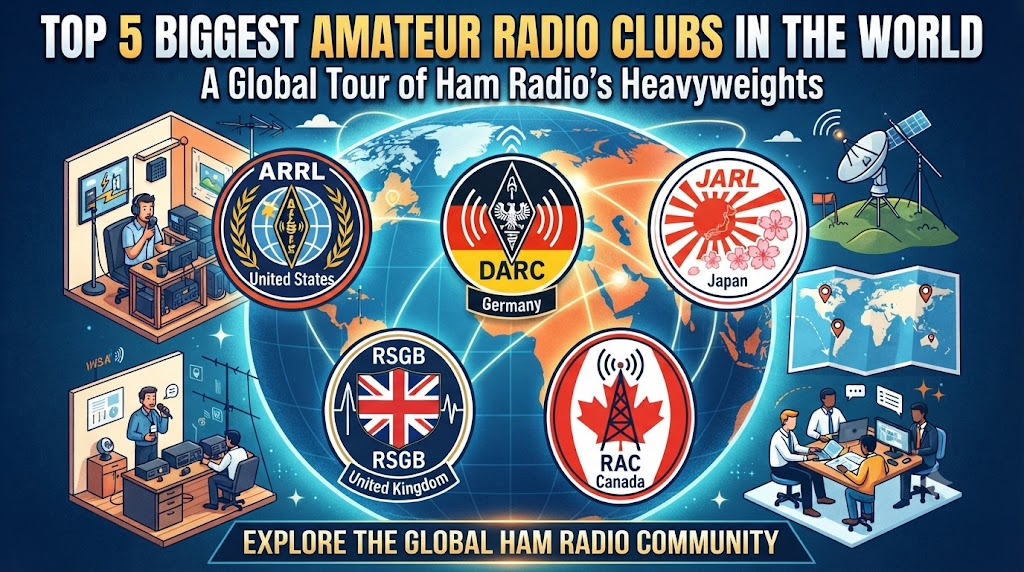
Top 5 Biggest Amateur Radio Clubs in the World: A Global Tour of Ham Radio’s Heavyweights
There is a quiet pride in being an Amateur radio operator. Whether you are building a new antenna, chasing DX on a Sunday morning, or simply listening to the bands with a cup of coffee, you are part of something much larger than your shack. Across every continent, national amateur radio clubs and associations keep the hobby alive, defend our spectrum, and connect operators from one generation to the next.
But which of these organisations are truly the biggest? When we talk about the largest amateur radio clubs in the world, we usually mean national societies with the highest paid membership rolls. These are the associations that publish the magazines, run the QSL bureaus, represent us at the International Amateur Radio Union, and speak to regulators on our behalf.
This article takes a relaxed look at the top five biggest amateur radio clubs in the world by membership. We will explore their history, mission, vision, members, and the activities that keep them on the air.
Last updated: July 2026.
The Big Five at a Glance
| Rank | Club | Country | Founded | Members (latest reported) | Headquarters |
|---|---|---|---|---|---|
| 1 | ARRL | United States | 1914 | 137,114 (end of 2024) | Newington, Connecticut |
| 2 | JARL | Japan | 1926 | 61,372 (March 2026) | Tokyo |
| 3 | DARC | Germany | 1950 | ~31,600 (2026 estimate) | Baunatal, Hesse |
| 4 | RSGB | United Kingdom | 1913 | 19,700 (end of 2025) | Bedford, England |
| 5 | ARI | Italy | 1927 | 11,100+ (2023) | Milan |
These numbers are taken from the latest published annual reports, press releases, and official estimates available in 2026. Membership totals move up and down each year, but the ranking has been stable for a long time.
1. ARRL, American Radio Relay League
History
The American Radio Relay League is the undisputed giant of amateur radio. It was founded in May 1914 by Hiram Percy Maxim, 1AW, and Clarence Tuska in Hartford, Connecticut, and formally incorporated on January 29, 1915. Maxim wanted a network of relay stations that could pass messages across the United States, and from that practical idea grew the national association for amateur radio in the United States.
The ARRL survived two world wars, the Great Depression, the rise of television, the internet age, and the digital revolution. Today it is headquartered in Newington, Connecticut, alongside the famous W1AW station.
Mission and Vision
The ARRL’s mission is to promote and protect the art, science, and enjoyment of amateur radio, and to develop the next generation of radio amateurs. Its vision is to be globally recognised for promoting amateur radio through superior content, training, and licensing; protecting amateur radio through work with regulators and industry; and investing in the future of the hobby by inspiring young people in radio communications and technology.
Members
The ARRL 2024 Annual Report puts year-end membership at 137,114, with a retention rate of 79.9 percent. The League’s public-facing pages often round this to about 145,000 members. Either way, it remains by far the largest amateur radio organisation in the world, made up of full members, associate members, international members, and affiliated clubs.
Activities
The ARRL keeps busy. It publishes QST and several other magazines, operates the historic W1AW station, administers the DXCC, WAS, and VUCC awards, and runs the popular ARRL Field Day. It also coordinates the Amateur Radio Emergency Service, serves as one of the largest Volunteer Examiner Coordinators for the FCC, and maintains an active lobbying presence in Washington.
If you have ever taken a US amateur radio exam, worked a DX station chasing ARRL awards, or read a product review from the ARRL Lab, you have already felt the League’s influence.
2. JARL, Japan Amateur Radio League
History
The Japan Amateur Radio League, or JARL, was founded on June 12, 1926, in Tokyo. It is the national society representing amateur radio operators in Japan, a country with one of the oldest and most technically sophisticated amateur radio cultures in the world.
JARL became a member of the International Amateur Radio Union and has represented Japanese amateurs at global forums for nearly a century. The organisation weathered wartime restrictions, post-war rebuilding, and the rapid technological changes that swept Japan in the late twentieth century.
Mission and Vision
JARL’s purpose is to encourage the sound development of amateur radio in Japan and to contribute to the advancement of radio science and culture both at home and abroad. The League works closely with Japan’s telecommunications regulators, promotes technical standards, and helps newcomers enter the hobby.
Members
JARL membership has trended gently downward in recent years, reflecting the ageing of the hobby in Japan, but it remains enormous by global standards. According to JARL’s 2025/2026 annual report, total membership stood at 61,372 as of 7 March 2026, including regular, corporate, family, and associate members. At its peak in the mid-1990s, JARL reported well over 100,000 members, a reminder of how large the Japanese amateur community once was.
Activities
JARL publishes a regular members’ magazine, operates a QSL bureau, and organises contests and on-air events. It also plays a central role in licence examination support, spectrum advocacy, and international coordination for Japanese amateurs. For anyone working Japan on HF or VHF, JARL is the organisation behind the stations you hear.
3. DARC, Deutscher Amateur-Radio-Club
History
The Deutscher Amateur-Radio-Club e.V., usually called DARC, was founded in 1950 at the Kurzwellentagung in Bad Homburg. It is the national amateur radio association for Germany and the largest IARU member society in Europe.
Germany’s amateur radio history is complicated by the Second World War, during which amateur radio was largely suppressed. The DARC was formed in the post-war years to rebuild the hobby, represent German amateurs, and reconnect with the international amateur community.
Mission and Vision
DARC exists to promote amateur radio, represent the interests of German radio amateurs before national and international regulators, and create the best possible conditions for the amateur radio service. It is organised into 24 districts and roughly 960 local associations, making it one of the most decentralised national societies in the world.
Members
DARC publishes exact membership totals sparingly, but the latest available estimates place it at roughly 31,600 members in 2026. That represents more than half of all licensed amateur radio operators in Germany, a high penetration rate that speaks to the strong tradition of club membership in German amateur radio.
Activities
DARC publishes CQ DL, Germany’s leading amateur radio magazine, and sponsors a wide range of contests, awards, and technical projects. It runs a QSL bureau, offers licence courses, provides technical advice, and maintains a strong presence at the annual HAM RADIO trade show in Friedrichshafen. For German hams, DARC is the central hub of the hobby.
4. RSGB, Radio Society of Great Britain
History
The Radio Society of Great Britain began life as the London Wireless Club in 1913, making it one of the oldest amateur radio organisations in the world. It was granted the title of “Radio Society of Great Britain” in 1925 and has represented UK amateurs ever since.
The RSGB has been present for every major chapter of British amateur radio history, from the pioneering days of spark transmitters to the modern era of digital modes and software-defined radio.
Mission and Vision
The RSGB exists to protect, promote, and enhance the use, understanding, and enjoyment of wireless communication. In practice, that means defending spectrum access, supporting the UK amateur radio examination framework, publishing technical material, and representing UK amateurs nationally and internationally.
Members
The RSGB’s 2025 Annual Report (covering the year ended 31 December 2025) puts membership at 19,700 and affiliated clubs at 465. The report notes that membership fell by 3.3 percent during the year, reflecting the same pressures facing many national societies. The work is delivered by eight full-time and ten part-time staff, supported by more than 450 volunteers.
Activities
The RSGB publishes RadCom, one of the most respected Amateur radio magazines in the world, and produces the weekly GB2RS news broadcast. It manages the amateur radio examination process in the UK, supports club development, defends spectrum at international conferences, and runs operating awards and contests. For British amateurs, the RSGB is the practical and political backbone of the hobby.
5. ARI, Associazione Radioamatori Italiani
History
The Associazione Radioamatori Italiani, or ARI, was founded in 1927 in Milan as the Associazione Radiotecnica Italiana. It took its current name in 1977. The association was founded by Ernesto Montù, one of Italy’s pioneering amateurs, and Guglielmo Marconi himself served as honorary president until his death in 1937.
That connection to Marconi gives ARI a special place in the hearts of many hams. The organisation has represented Italian amateurs through fascism, war, reconstruction, and the modern digital age.
Mission and Vision
ARI’s mission is to promote and protect amateur radio in Italy, preserve the country’s rich radio heritage, and support technical education among members. It is a non-profit organisation that represents Italian amateurs before the Ministry of Economic Development and the International Amateur Radio Union.
Members
The most recent public membership figure, from ARI’s May 2024 editorial covering 2023, puts membership at more than 11,100 authorised radio amateurs and 600 radio clubs, spread across over 290 local sections throughout Italy. The society has reported modest growth, bucking the decline seen in many other national associations.
Activities
ARI publishes the monthly RadioRivista, operates a QSL bureau, organises contests and awards, and supports youth initiatives such as ARI YOTA Italia. Its local sections are active in training, technical demonstrations, and public events. Italian hams are often among the most enthusiastic DX operators on the bands, and ARI is the organisation that supports them at home and abroad.
What These Giants Have in Common
Looking at the five largest amateur radio clubs in the world, a few patterns stand out.
First, they are all national societies, not local clubs. They represent their countries at the International Amateur Radio Union and speak to national regulators. Second, they all publish a flagship magazine. Third, they all operate some form of QSL bureau and awards programme. Fourth, they all depend heavily on volunteers, even when they have professional staff.
Most importantly, they all share the same fundamental purpose: to keep amateur radio alive and thriving for the next generation of operators.
Why It Matters to You
You do not need to belong to the largest club on the planet to enjoy amateur radio. But knowing that these organisations exist matters. They are the ones defending the bands we use, training the examiners who license new hams, and publishing the magazines that help us become better operators.
If you are a new ham, joining your national society is one of the best ways to support the hobby. If you are an experienced operator, your membership helps fund spectrum advocacy and public service programmes that benefit every amateur, whether they join or not.
So the next time you work a station across the border or read a DX report, remember that behind the call sign stands a long tradition of clubs, volunteers, and members who made the contact possible.
Sources and Further Reading
- ARRL 2024 Annual Report (PDF): http://www3.arrl.org/files/file/About%20ARRL/Annual%20Reports/2024%20ARRL%20Annual%20Report.pdf
- ARRL Official Website: https://www.arrl.org
- ARRL About the League (mission and vision): https://www.arrl.org/about-arrl
- JARL Official Website: https://www.jarl.org
- JARL 2025/2026 membership report via hamlife.jp: https://www.hamlife.jp/2026/06/19/jarl-kaiin-nenrei-202603/
- DARC Official Website: https://www.darc.de
- DARC 2026 membership estimate (amateurfunkpraxis.de): https://amateurfunkpraxis.de/mitgliederstatistik.html
- RSGB Annual Report 2025: https://rsgb.services/public/publications/accounts/2026/rsgb_report_and_financial_statement_2025.pdf
- RSGB Official Website: https://rsgb.org
- ARI Official Website: https://www.ari.it
- ARI editorial on membership growth, May 2024: https://www.ari.it/en/editoriali/8073-leditoriale-di-maggio-2024.html
- International Amateur Radio Union Member Societies: https://www.iaru.org/reference/member-societies/
- Amateur Radio by the Numbers, OERadio: https://oeradio.at/en/amateur-radio-by-the-numbers/






Post Comment