FT8 and CW Duty Cycle: What It Does To Your Transceiver
FT8 and CW Duty Cycle: What It Does To Your Transceiver
If you have been around FT8 for any length of time, you have probably heard someone say “be careful, FT8 is hard on your radio.” It is one of those things people repeat without always explaining, and it leaves new operators wondering whether they are about to cook their transceiver.
This article is a relaxed, plain language look at what duty cycle actually means, how FT8 and CW compare, and what is really happening inside your radio when you press that transmit button. No scary warnings, just the facts so you can operate with confidence.
What Duty Cycle Actually Means
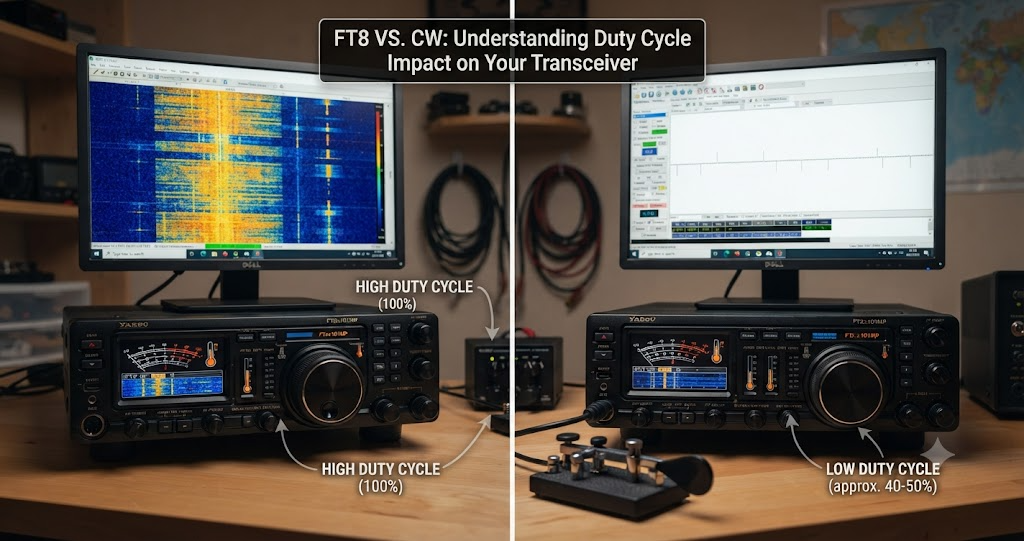
Duty cycle is the percentage of time your transmitter is producing full RF power, averaged over a transmission. It is the single biggest factor in how much heat your radio’s final amplifier (the PA) has to deal with.
- 100% duty cycle means the PA is putting out full power continuously, with no breaks. The heat builds up steadily.
- 50% duty cycle means the PA is at full power half the time and off or idle the other half. The heat has time to dissipate.
- 20% duty cycle means the PA is at full power only one fifth of the time. Very little heat buildup.
Here are the commonly accepted duty cycle figures for amateur modes.
| Mode | Duty Cycle (within a single transmission) |
|---|---|
| FM / AM | 100% |
| RTTY | 100% |
| FT8 and most digital modes | 100% |
| CW | about 50% |
| SSB (unprocessed voice) | about 20% |
| SSB (with compression) | about 50% |
The key takeaway is this. FT8 is a 100% duty cycle mode, even though it rides on a USB signal. The fact that FT8 uses SSB modulation tricks a lot of people into thinking it has SSB’s gentle 20% duty cycle. It does not. During the 12.6 seconds FT8 is transmitting, the PA is producing continuous full power with no pauses.
The Numbers For FT8 Specifically
A full FT8 cycle is 30 seconds.
- 15 seconds receive (PA off, radio cooling)
- 15 seconds transmit slot, of which:
- about 12.64 seconds is actual RF modulation (key down, full power)
- about 2.36 seconds is ramp up, ramp down, and gaps
So within a single FT8 transmission, the instantaneous duty cycle is 100%. The PA sees continuous full power for almost 13 seconds straight.
Averaged over the full 30 second TX/RX cycle, the duty cycle is about 42% (12.64 divided by 30). That is still much higher than CW or SSB averaged the same way.
The Numbers For CW Specifically
CW is roughly 50% duty cycle during key down. Here is why.
- A dot is on for one unit, off for one unit. That is 50% on its own.
- A dash is on for three units, off for one unit. That is 75% on.
- Inter-character spacing adds more off time.
- Inter-word spacing (7 units off) adds even more.
When you average dots, dashes, inter-character gaps, and inter-word gaps across a typical CW transmission, you land at about 50% key down time. And during the off periods, the PA cools.
Averaged over a full QSO where you transmit roughly half the time and receive the other half, CW’s effective duty cycle drops to about 25%. FT8 over the same QSO is about 42%. That is nearly double the heat load.
What This Means For Your Transceiver
This is where it gets practical. The PA in your radio (the final transistors that produce RF power) turns DC power into RF signal, and the rest into heat. The efficiency of a typical HF PA is around 50 to 70 percent. That means if you are outputting 100 watts, the PA is dissipating another 50 to 100 watts as heat inside your radio.
With CW, that heat comes in short bursts with cooling gaps between them. The heatsink and fan can keep up easily.
With FT8, that heat comes in a continuous 12.6 second slab, every 15 seconds, for as long as you are on the air. The heatsink has no chance to cool during the transmission, and only 15 seconds between transmissions to recover. Over a long FT8 session (an hour of CQing on a busy evening), the heat just keeps building.
What Can Go Wrong
- PA overheating. The output transistors can hit their thermal limit and either throttle back (some modern radios do this automatically) or, in worst cases, fail. Older radios without good thermal protection are most at risk.
- Final amplifier drift or damage. Sustained heat can stress solder joints, change bias points, and over time degrade the PA transistors. This is cumulative damage, not a single event.
- Power supply stress. A 100% duty cycle mode pulls full current continuously. A power supply that handles 100W CW fine may sag or overheat on FT8 if it is marginally sized.
- Balun and antenna tuner damage. This is a big one that people overlook. Baluns and tuners are often rated in PEP watts for SSB. A balun rated for 1000W PEP SSB may only handle 200W on FT8, because the continuous power heats the ferrite core. There are many documented cases of balun cores cracking, melting, or catching fire from FT8 at high power. The rule of thumb from balun manufacturers is to derate to about 20% of the SSB PEP rating for digital modes.
- Coaxial switches, relays, and connectors. Same story. Components rated for PEP SSB can fail at FT8 power levels because the continuous RF current heats contacts and dielectrics.
- Amplifier stress. External amplifiers, especially solid state ones, are particularly sensitive. Some LDMOS amplifiers actually dissipate more heat at lower power outputs than at full power, due to how the matching network works. This is counterintuitive but well documented. The main enemy is always heat, so airflow and fan management matter more than raw power level.
The Practical Rules
Here is what experienced FT8 operators do.
- Run 20 to 50 watts, not 100. For most HF FT8 work, 20 to 50 watts into a decent antenna is plenty for worldwide contacts. You do not need full power. FT8’s weak signal performance means you can be heard at low power.
- Never run an amplifier on FT8 unless you know its duty cycle rating. Many amps are rated for full power SSB and CW but need to be backed off significantly for digital modes. Check the manual. If it says “1500W PEP,” that does not mean 1500W FT8. A common guideline is 500W or less for FT8 on a 1500W rated amp, with careful attention to temperature.
- Watch the temperature. If your radio or amp has a temperature readout, keep an eye on it. If it is climbing past 60 to 70 degrees C, back off the power or take a break.
- Make sure airflow is unrestricted. Do not block vents, do not stack equipment, and if your radio has a fan, let it run. Some operators program higher fan speeds for digital modes.
- Derate baluns and tuners to 20% of SSB rating. If your balun is rated for 1000W PEP SSB, treat it as a 200W balun for FT8. This is the single most common cause of balun failure on FT8.
- Let the radio cool between long sessions. If you have been CQing for an hour, give the radio a few minutes with the fan running before you pack up.
A Quick Comparison Table
| Aspect | CW | FT8 |
|---|---|---|
| Instantaneous duty cycle | about 50% | 100% |
| Average duty cycle over a QSO | about 25% | about 42% |
| Heat per transmission | Bursts with cooling gaps | Continuous slab, no cooling |
| Typical power needed | 100W for normal work | 20 to 50W for worldwide DX |
| Amplifier friendliness | Very friendly | Needs care and derating |
| Balun stress | Low | High, derate to 20% of SSB rating |
| Risk to older radios | Low | Moderate to high at full power |
The Short Version
CW is forgiving because it is 50% duty cycle with natural cooling breaks. FT8 is demanding because it is 100% duty cycle during transmit, with only 15 seconds of cooling between transmissions. Your radio, amplifier, balun, and power supply all feel the difference.
The good news is that FT8 does not need much power to work the world. Run 20 to 50 watts, watch the temperature, keep your airflow clear, and your equipment will last a long time. The mode was designed for weak signal work, so let it do its job at low power. Your transceiver will thank you, and so will your electricity bill.
Sources and Further Reading
- Understanding PEP power and duty cycle in amateur radio (PA9X): https://www.pa9x.com/pep-power-and-duty-cycle-in-amateur-radio/
- Duty Cycle of FT8 (Elecraft mailing list, K3WYC): https://www.mail-archive.com/elecraft%40mailman.qth.net/msg257577.html
- Pattern and Match: Duty Cycle (VE3VN): https://ve3vn.blogspot.com/2026/05/duty-cycle.html
- FT8 What Why and How (K5PA, CTDXCC presentation): https://k5pa.com/CTDXCC-FT8-Oct-2018_small.pdf
- FT8 Presentation (VE2YNI, WIAARC): https://wiarc.ca/media/2020/02/FT8-Presentation-VE2YNI.pdf
- The FT8 Digi Mode (MBARS): https://mbars.uk/wp-content/uploads/2018/05/The-FT-8-DigiMode-Talk.pdf
- The FT4 and FT8 Communication Protocols (QEX paper, Taylor / Franke / Somerville): https://wsjt.sourceforge.io/FT4_FT8_QEX.pdf
- WSJT-X User Manual: https://wsjt-x-doc.readthedocs.io/
- FT8 on Wikipedia: https://en.wikipedia.org/wiki/FT8




Post Comment