amateur radio
emergency communication
ham radio
hobby
homebrew
malaysia
radio amatur
9m2, 9w2, amateur radio awards, amateur radio emergency communications, amateur radio handbook, amateur radio malaysia, amateur radio satellites, apparatus assignment Malaysia, aprs malaysia, AROC Malaysia, DXing Malaysia, EmComm Malaysia, fldigi, ham radio contesting, ham radio digital modes, ham radio malaysia, HF radio Malaysia, Malaysia ham radio license, MCMC amateur radio, NVIS communication, OSCAR satellites, packet radio, psk31, public service communications, QSL cards, radio communication skills, radio operating etiquette, radio repeaters Malaysia, RTTY, VHF UHF radio
9M2PJU
0 Comments
Amateur Radio in Malaysia: A Practical Hobby, A Technical Skill, And A Public Service
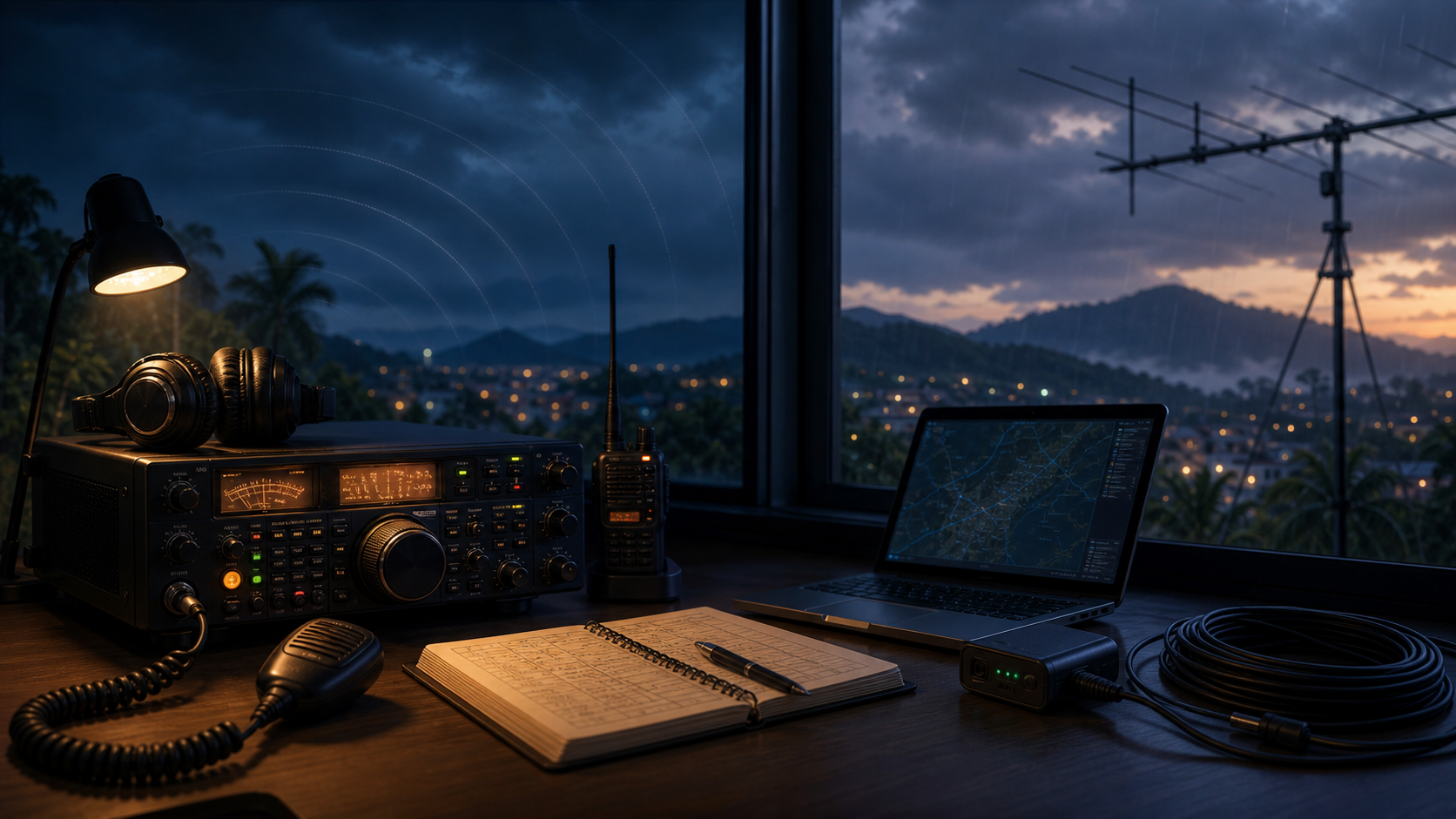
Amateur radio is often misunderstood from the outside. To some people, it looks like an old hobby built around antennas, knobs, strange voices in static, and callsigns that sound like secret codes. To those who actually practise it, amateur radio is something much wider. It is a technical workshop, a communication discipline, a public service network, a global friendship channel, and a lifelong learning path.
The Malaysian Communications and Multimedia Commission’s Amateur Radio Handbook, First Edition, published on 20 December 2022, captures that wider meaning very clearly. It explains not only how amateur radio works, but why it still matters in a world filled with smartphones, fibre broadband, satellite Internet, and social media.
The answer is simple: amateur radio is independent communication. It teaches people how to communicate when normal systems are busy, damaged, unavailable, or unsuitable. It also teaches responsibility, safety, discipline, technical awareness, and respect for shared spectrum.
For Malaysia, where geography includes dense cities, rural villages, islands, coastal communities, mountains, forest areas, and flood-prone regions, amateur radio is not just a weekend pastime. It is a skill that can become valuable when the situation becomes difficult.
This article is based on the MCMC Amateur Radio Handbook, but it is written as a practical introduction for readers who want to understand the real value of amateur radio, especially in the Malaysian context.
Amateur Radio Is More Than Talking On Air
At its simplest, amateur radio allows licensed operators to communicate by radio for non-commercial purposes. A radio amateur can talk locally through VHF or UHF, communicate across Malaysia, reach other countries on HF, exchange digital messages, track stations using APRS, operate through satellites, join contests, collect awards, and support communications during public service events or emergencies.
But the real heart of amateur radio is not the equipment. It is the operator.
A good amateur radio operator learns how to listen before transmitting, how to choose the correct band and mode, how to identify properly, how to avoid interference, how to handle messages accurately, and how to stay calm under pressure. These habits matter because radio spectrum is shared. No single operator owns a frequency simply because they use it often. Every station has to cooperate.
This is one of the first lessons amateur radio teaches: technical freedom must come with operating discipline.
In Malaysia, amateur radio operation requires proper authorization. A person must obtain the Amateur Radio Operator’s Certificate and then apply for an Apparatus Assignment before transmitting. The handbook explains three operator classes: Class C, Class B, and Class A. Operators start at Class C, progress to Class B, and later may qualify for Class A. Class A gives wider privileges, including access to more bands and higher power, so experience and responsibility are important.
This licensing structure is not just bureaucracy. It protects the radio spectrum, encourages learning, and helps ensure that operators understand what they are doing before they transmit.
The Culture Of Good Operating
One of the most important themes in the handbook is good amateur practice. Radio may be technical, but operating is also social. Every transmission happens in a shared space, and bad habits can quickly disturb others.
Good operating begins with listening. Before calling CQ or joining a conversation, an operator should listen carefully and ask whether the frequency is in use. This matters because propagation is not always equal in both directions. You may not hear one side of an existing contact, but your transmission can still interfere with it.
Operators should also leave short pauses between transmissions. On repeaters, linked systems, and emergency nets, this pause allows another station to break in with urgent traffic. It also gives the repeater or linked network time to reset properly. A clean radio conversation is not a race.
The handbook also reminds operators to avoid sensitive or inappropriate topics on air. Politics, religion, race, sex, personal attacks, harassment, and offensive discussion have no place in amateur radio operation. The amateur bands are not anonymous chat rooms. They are regulated public spectrum, and every operator is identified by callsign.
Good practice also includes using the minimum necessary power. More power is not always better. Excessive power can create interference and does not replace proper antennas, good station setup, and good operating technique. A skilled operator with modest equipment can often communicate more effectively than a careless operator using high power.
This is where amateur radio becomes a craft. The best operators are not always the loudest. They are usually the ones who understand propagation, timing, antennas, audio quality, and procedure.
Safety Is Part Of The Hobby
Amateur radio involves electricity, radio frequency energy, towers, masts, batteries, cables, and antennas. That means safety cannot be treated as an afterthought.
The handbook gives special attention to antenna safety. Antennas and support structures must be kept away from power lines. A failed antenna, wire, or mast should never be able to fall onto electrical wiring. People should also be protected from touching active antennas or being exposed unnecessarily to radio frequency energy.
Portable operation has its own safety concerns. Operators may work from fields, campsites, hills, disaster areas, or temporary public service stations. In those situations, batteries must be handled properly, cables should not create trip hazards, antennas should be marked or isolated, and equipment must be protected from rain, heat, and accidental damage.
Emergency communications adds another layer. In a disaster area, an operator must not become part of the problem. A volunteer communicator should not block rescue work, enter unsafe zones without authorization, or try to perform tasks outside their assigned role. The radio operator’s job is communication.
That may sound simple, but in emergencies simple jobs done correctly can be extremely valuable.
Understanding The Bands
One reason amateur radio remains fascinating is that different frequency bands behave differently.
VHF and UHF bands, such as 2 metres and 70 centimetres, are commonly used for local communication, repeaters, mobile operation, handheld radios, APRS, and satellites. These bands are often described as line-of-sight, meaning height and terrain matter. A handheld radio in a valley may have limited range, while a repeater on a hilltop can cover a much larger area.
HF bands behave differently. Signals on HF can travel long distances by reflecting or refracting through the ionosphere. This makes international communication possible with surprisingly modest equipment when conditions are right. Bands such as 40 metres, 20 metres, 15 metres, 10 metres, and others all have different strengths depending on time of day, season, solar activity, and propagation conditions.
The handbook also discusses 60 metres, 80 metres, and 160 metres, which can be valuable for regional coverage, especially when Near Vertical Incidence Skywave operation is used. NVIS is especially relevant for emergency communications because it can support reliable medium-distance coverage without relying on repeaters, towers, Internet, or cellular networks.
In practical Malaysian terms, this matters a lot. VHF and UHF may work well in urban areas or where repeaters are available, but terrain, forests, mountains, and distance can limit them. HF, especially NVIS on suitable bands, can fill the gap between local handheld communication and long-distance international communication.
This is why a serious amateur radio operator should not think only in terms of one radio or one band. Each band is a tool. The skill is knowing which tool fits the situation.
Repeaters: The Gateway For Many New Operators
Many new operators begin with a VHF or UHF handheld radio. It is affordable, portable, and easy to use. With a nearby repeater, a small handheld can communicate over a much wider area than simplex operation would normally allow.
A repeater receives on one frequency and retransmits on another. The operator listens to the repeater output and transmits on the repeater input. The repeater may require an offset and a CTCSS tone. In Malaysia, common offsets include minus 600 kHz on 2 metres and minus 5 MHz on 70 centimetres, although operators must always follow the specific repeater configuration.
A repeater is not just a radio on a hill. It usually includes a receiver, transmitter, controller, duplexer, antenna system, power supply, and sometimes linking equipment. The controller handles keying, identification, time-out behaviour, courtesy tones, and other functions. A duplexer allows the repeater to transmit and receive at the same time while protecting the receiver from its own transmitter.
Because repeaters serve many users, repeater etiquette is important. Keep transmissions clear and not too long. Leave pauses. Identify correctly. Do not monopolize the channel. During emergencies or public service operations, routine chatter should give way to priority traffic.
Repeaters are convenient, but operators should also practise simplex. If a repeater fails, simplex may be the only local option available.
APRS And Packet Radio: Tactical Information On The Air
The handbook explains packet radio and APRS as important digital parts of VHF and UHF operation.
Packet radio sends information in digital packets. It can be used for text data, bulletin systems, station-to-station communication, and digipeating. A digipeater receives a packet and retransmits it, extending coverage.
APRS, the Automatic Packet Reporting System, is often misunderstood as only a vehicle tracking system. In reality, APRS is a tactical information system. It can show station positions, objects, weather data, messages, bulletins, and real-time situational information. During public service or emergency work, that can be very useful.
For example, a net control station can see the locations of mobile stations, shelters, checkpoints, hazards, or supply points. Operators can exchange short messages and update objects on a map. APRS supports one-to-many visibility, which is exactly what field coordination often needs.
In Southeast Asia, 144.390 MHz is commonly associated with APRS operation, while other regions use different frequencies. Operators must follow the correct local band plan and operating practice.
APRS is a good example of amateur radio becoming a practical information network, not only a voice communication tool.
Beyond Repeaters: VHF And UHF Can Do More
Some operators think VHF and UHF are only for local repeaters. The handbook shows that this is too narrow.
Under the right conditions, VHF and UHF can support long-distance communication. Tropospheric ducting, Sporadic E, transequatorial propagation, meteor scatter, auroral propagation, and moonbounce can extend signals far beyond normal line-of-sight expectations.
Weak-signal work on VHF and UHF often uses CW, SSB, and narrowband digital modes instead of FM. Horizontal polarization is common for long-distance terrestrial work because it can reduce ground losses compared with vertical polarization. Beacons, WSPR, propagation reports, and careful listening help operators recognize openings.
This side of amateur radio rewards patience and technical understanding. It also reminds us that radio propagation is not fixed. The atmosphere, ionosphere, terrain, frequency, antenna height, polarization, and time all affect what is possible.
For many operators, the first long-distance VHF contact is unforgettable because it feels impossible until it happens.
Emergency Communications: Where Skill Becomes Service
One of the strongest parts of the handbook is its treatment of disaster, public service, and emergency communications.
Modern society depends heavily on communication infrastructure. Cellular towers, fibre routes, microwave links, power systems, and Internet networks work well on normal days. During floods, landslides, earthquakes, storms, major accidents, or power failures, these systems may become overloaded or damaged.
Amateur radio cannot replace the national telecommunications industry, and it should not pretend to. Its strength is different. Amateur radio is flexible, decentralized, portable, and operated by trained volunteers who can adapt quickly.
The handbook mentions Malaysian emergency examples such as the Highland Towers collapse in 1993, the East Coast floods in December 2014, and the Sabah or Mount Kinabalu earthquake in 2015. These events show why independent communication remains important.
In emergency work, amateur radio operators can provide communication between locations, shelters, relief centres, local authorities, field teams, and support organizations. VHF and UHF can serve local operations. Repeaters can extend coverage if they remain functional. HF can link wider areas. Digital modes can carry written messages accurately. NVIS can support regional communication over difficult terrain.
The most important emergency communication principle is not equipment. It is discipline.
Operators must pass messages accurately, keep logs, follow net control instructions, and avoid becoming involved in decisions outside their communication role. If an operator is also medically trained, a rescue volunteer, or a technical specialist, those are separate roles. When assigned as a communicator, the duty is to communicate.
This distinction matters because emergency operations need clear responsibilities. A radio operator who abandons the radio to do something else may break the communication chain at the worst possible time.
Tactical Callsigns And Accountability
The handbook discusses tactical callsigns, such as names or numbers assigned to locations or functions. In an emergency net, a station may be called “Shelter One”, “Command Post”, “Logistics”, or another tactical identifier.
This is useful because people rotate. If one operator finishes a shift and another takes over, the function remains the same. Net control does not need to remember which personal callsign is currently operating from each location.
However, tactical callsigns do not replace legal identification. Operators must still identify with their own callsigns according to the rules. Logs should record who operated, when they operated, what messages were handled, and what actions were taken.
This balance between tactical clarity and regulatory identification is essential for professional emergency communication.
Traffic Handling: Accuracy Before Speed
Message handling is one of the oldest and most valuable amateur radio skills. It is also one of the easiest to underestimate.
In casual conversation, a missing word may not matter. In emergency traffic, a missing word can change meaning. A wrong place name, wrong number, wrong medicine, wrong road, or wrong time can create confusion. That is why the handbook emphasizes accuracy before speed.
A receiving station should not acknowledge a message as complete until it has been copied correctly. If something is unclear, ask for a repeat. Use standard procedure. Speak slowly enough to be copied. Spell when needed. Use phonetics when needed. Do not add unnecessary words that are not part of the message.
For voice traffic, operators should avoid turning formal messages into conversation. For CW and digital traffic, proper formatting and standard abbreviations can help efficiency, but clarity remains the goal.
Net Control Station plays a central role in organized traffic handling. The handbook describes the NCS as the “boss but not bossy”, meaning net control must be firm, organized, punctual, and calm without being arrogant. A good NCS knows the area, manages the frequency, keeps logs, moves traffic when necessary, and maintains order.
This is a professional skill. It can be practised in ordinary nets long before an emergency happens.
Digital Modes On HF: Low Power, High Capability
HF digital communication is one of the most exciting areas of modern amateur radio. The handbook explains that digital modes are not new. Morse code itself is a digital mode in the broad sense. RTTY became popular after surplus teletype equipment became available. Later, personal computers and sound cards made many new modes accessible to ordinary operators.
Today, a basic digital HF station may need only an HF transceiver, a computer, suitable software, and an interface. Many modern transceivers include USB sound card capability, making setup easier than before.
Digital modes are valuable because they can communicate effectively using low power and narrow bandwidth. PSK31, RTTY, MFSK, Olivia, JT65, FT-style weak-signal modes, and other modes each serve different purposes. Some are conversational. Some are better for contesting. Some are designed for weak-signal exchange. Some are useful when propagation is poor.
The handbook highlights good digital operating practice:
- Keep power modest. Digital modes often work well at low power.
- Avoid overdriving audio.
- Disable speech processing.
- Keep ALC low or near zero.
- Prevent RF feedback into audio equipment.
- Use clean signals and respect bandwidth.
This matters because a poorly adjusted digital station can create splatter and interfere with many other users. Digital operation may look simple on screen, but responsible setup still requires technical care.
For emergency communication, digital modes can provide written records and reduce ambiguity. Software such as FLDigi and related tools can support structured message forms. This is especially useful when messages must be logged, forwarded, printed, or reviewed later.
Voice is fast and natural, but written digital traffic is often better when accuracy and accountability matter.
Contesting: Sport That Builds Real Skills
Contesting is sometimes seen as the sporting side of amateur radio. Operators try to make as many valid contacts as possible within a defined time, following contest rules that specify bands, modes, categories, exchanges, scoring, and log submission.
The handbook explains that contesting began partly as a way to sharpen the ability to pass information quickly. Today it is also a competitive sport, but its practical value remains. A good contester learns to listen carefully, identify callsigns quickly, manage pileups, use propagation intelligently, log accurately, operate efficiently, and keep a station running under pressure.
These skills are directly useful in emergency communications. A contest station with good antennas, power systems, logging discipline, and trained operators can also become a strong emergency communication station when needed.
Contesting also teaches humility. Big stations have advantages, but propagation can level the field. A small station with good timing, patience, and smart operating can still make impressive contacts. QRP contesting, where operators use low power, proves that skill and persistence matter.
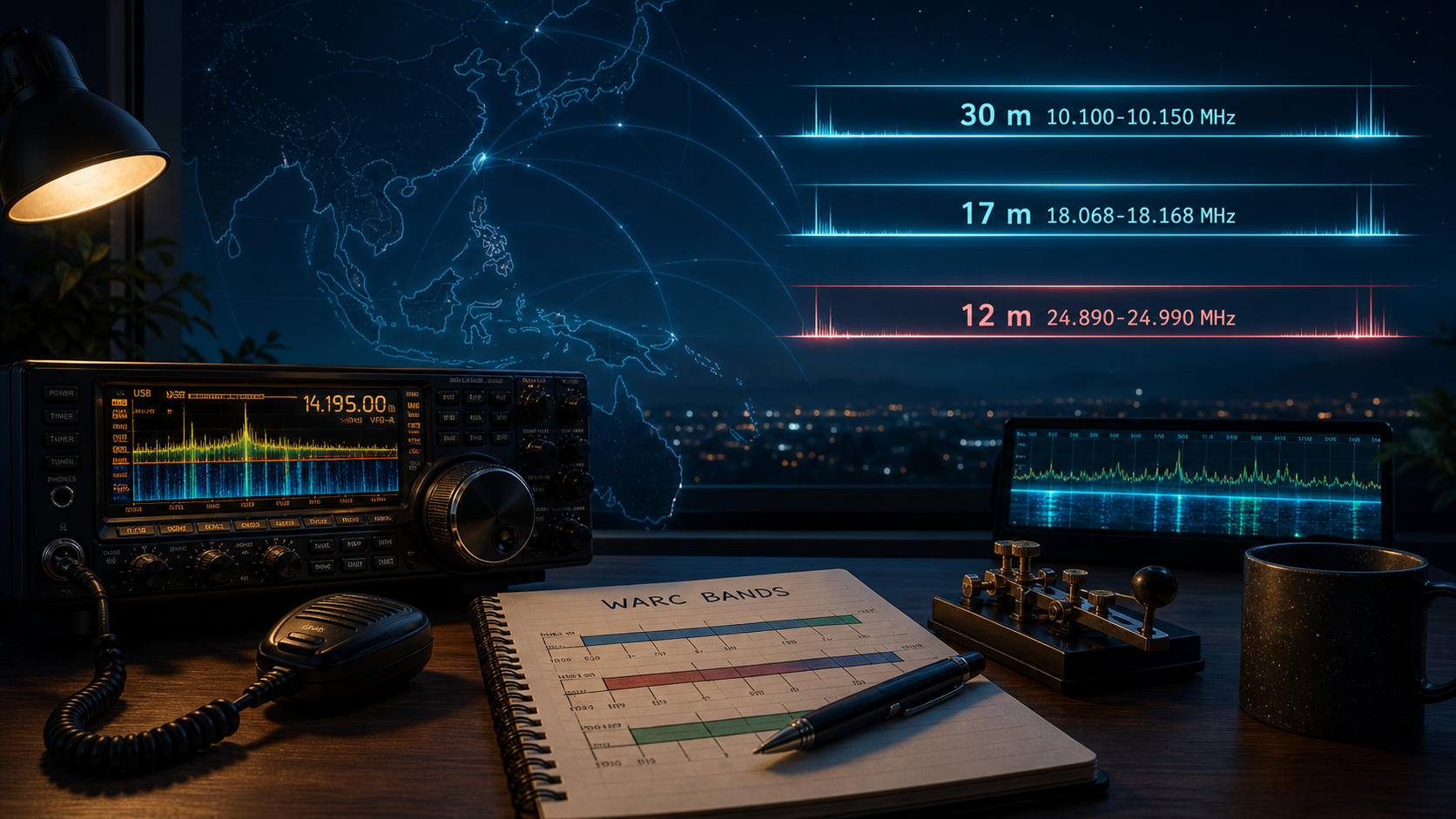
The handbook also notes an important operating tradition: contests generally avoid the WARC bands by gentleman’s agreement. This is not only about rules. It reflects amateur radio culture, where voluntary cooperation and unwritten law help keep the bands usable for different kinds of operators.
That idea deserves respect. Not every good operating habit needs to begin as enforcement. Some standards survive because experienced operators teach them, practise them, and pass them on.
DXing: The Joy Of Reaching Beyond The Horizon
DXing is the pursuit of distant, rare, or difficult stations. For a new operator, a first contact outside Malaysia can feel like magic. For an experienced DXer, the challenge may be a rare island, a remote territory, a difficult propagation path, or a limited-time DXpedition.
DXing rewards knowledge. Operators learn which bands open at which times, how the solar cycle affects propagation, how antenna angle matters, how low-band noise affects reception, and how to listen for weak signals inside interference.
The handbook makes an encouraging point: expensive equipment helps, but it is not the whole story. Many operators have worked impressive DX with modest radios and wire antennas. Patience, listening, timing, and understanding propagation can go a long way.
DXing also builds international friendship. A short contact may last only seconds, but behind it is a shared global culture of callsigns, QSL cards, logs, awards, and mutual respect.
There is also an emotional side. DXing gives the feeling of travelling by radio. A station in Malaysia can reach another operator across oceans, mountains, and continents using equipment built, installed, and understood by the operator. That feeling is difficult to replace with an Internet message.
Amateur Satellites: Space Is Within Reach
The handbook includes a full chapter on amateur satellites, and this is one of the best reminders that amateur radio is not stuck in the past.
Amateur satellites may carry voice repeaters, linear transponders, packet systems, telemetry, and experimental payloads. Some are dedicated amateur spacecraft. Others ride as secondary payloads with educational, research, or technical missions. Many are known by OSCAR designations, issued through the amateur satellite community.
Most beginners start with Low Earth Orbit satellites. These move quickly across the sky and may be available for only a few minutes during each pass. Operators need to know Acquisition of Signal, Loss of Signal, azimuth, elevation, satellite footprint, and Doppler shift.
Doppler shift is especially important on UHF and higher frequencies. As the satellite approaches, passes, and moves away, the apparent frequency changes. Operators must adjust for this manually or with software control.
Some FM satellites can be worked with surprisingly simple equipment: a handheld transceiver, a directional antenna, and tracking information. More advanced satellite stations may use full-duplex radios, circularly polarized antennas, azimuth and elevation rotators, mast-mounted preamplifiers, computer control, and Doppler correction.
Satellite operation teaches planning, timing, directional antenna handling, frequency discipline, and respect for limited shared access. On an FM satellite, only one QSO can usually happen at a time, so short and efficient operating is essential.
For a modern amateur operator, satellites offer something powerful: the chance to communicate through space using personal skill and amateur equipment.
Awards And QSL Cards: Proof, Memory, And Motivation
QSL cards remain one of amateur radio’s classic traditions. A QSL card confirms that a two-way contact took place. It usually includes callsigns, date and time in UTC, band or frequency, mode, signal report, location, and sometimes grid square or other details.
The handbook treats QSL cards not merely as souvenirs, but as records. They support awards, confirm achievements, and preserve memories. A well-kept log and accurate QSL practice show that an operator takes the hobby seriously.
Awards give operators goals. In Malaysia, MARTS offers awards such as Worked All Malaysia, Malaysia Century Club, and Malaysia Worked All States. Internationally, organizations such as ARRL, RSGB, and CQ Magazine offer well-known awards including Worked All States, Worked All Continents, DXCC, IOTA, and Worked All Zones.
Awards encourage operators to improve antennas, learn propagation, keep better logs, explore bands, and contact different regions. They also teach geography and international awareness.
Malaysia has a special place in DXing because it spans two DXCC entities: West Malaysia in Asia and East Malaysia in Oceania. That makes Malaysian stations especially interesting to many international operators.
Legal, Safe, And Appropriate
The handbook’s legal chapter uses three words that every operator should remember: legally, safely, and appropriately.
Legally means operating within the rules, license privileges, frequency allocations, power limits, identification requirements, and MCMC regulations.
Safely means ensuring that radio activity does not harm the operator, other people, property, or public infrastructure. This includes electrical safety, antenna safety, RF exposure awareness, and responsible field operation.
Appropriately means following good amateur practice, respecting other users, using the minimum necessary power, avoiding malicious interference, identifying properly, and behaving with courtesy.
This final word, appropriately, is where the spirit of amateur radio lives. Some things are written into law. Others are built through community standards, band plans, operating customs, gentleman’s agreements, and unwritten law. A good operator respects both.
For example, voluntary band plans help different modes and activities share spectrum efficiently. They may not always carry the same force as regulation, but they are still important. Without cooperation, the bands become disorderly. With cooperation, many different users can enjoy the same limited spectrum.
This is why amateur radio is not just about passing an exam. The exam opens the door. The real education happens on air, in clubs, in nets, in field exercises, at the workbench, during failed experiments, and through mentoring from experienced operators.
What New Operators Should Learn First
A new amateur radio operator does not need to learn everything at once. The handbook covers a wide field, but the journey can be approached step by step.
Start with legal operation. Understand your license class, callsign, frequency privileges, station identification rules, and current MCMC guidelines.
Then learn good voice procedure. Practise listening before transmitting, calling clearly, using phonetics correctly, giving signal reports, and ending contacts politely.
Next, understand your equipment. Know how to set frequency, offset, tone, power level, squelch, memory channels, microphone gain, and antenna connection. Learn the difference between simplex and repeater operation.
After that, build practical habits. Keep a log. Use UTC for radio records. Learn how to make a QSL card. Join nets. Visit clubs. Participate in field days or public service events.
Then explore. Try HF, digital modes, APRS, satellites, contesting, DXing, or emergency communication training. Each area will teach something different.
Most importantly, stay humble. Amateur radio is a large field. Even experienced operators continue learning.
Why Amateur Radio Still Matters
It is fair to ask why amateur radio still matters when the world already has smartphones and the Internet.
The answer is that amateur radio is not competing with those systems. It is different from them.
A smartphone depends on towers, backhaul, power, network operators, subscriptions, software platforms, and commercial infrastructure. Amateur radio can be as simple as two stations, two antennas, power, and operators who know what they are doing.
That independence is valuable. It is valuable during emergencies, but also valuable for education. Amateur radio teaches physics, electronics, geography, weather, antennas, digital communication, discipline, and public service in a hands-on way.
It also builds community. Clubs, nets, contests, DX contacts, emergency exercises, satellite passes, and QSL exchanges all connect people who share curiosity and responsibility.
The MCMC handbook shows amateur radio as a broad and serious activity. It is technical, but not only technical. It is fun, but not only entertainment. It is regulated, but not lifeless. It is traditional, but still modern. It can be local through a handheld radio, regional through NVIS, global through HF, digital through computers, and orbital through satellites.
That combination is rare.
Conclusion
Amateur radio in Malaysia deserves to be seen as a living skill. It is a hobby, yes, but a hobby with public value. It invites people to build, listen, experiment, serve, compete, explore, and communicate across distance without depending entirely on commercial networks.
The MCMC Amateur Radio Handbook gives a strong foundation for that journey. It reminds operators to be legal, safe, and appropriate. It introduces the bands, repeaters, APRS, VHF and UHF weak-signal work, emergency communications, traffic handling, DXing, contesting, HF digital modes, satellites, awards, and the operating culture that holds everything together.
For newcomers, amateur radio may begin with a handheld radio and a local repeater. For those who continue, it can become a lifetime of learning. One day it may be a casual evening net. Another day it may be a contact across the world. Another day it may be a digital message from a temporary field station. And during a real emergency, it may become the communication link someone is waiting for.
That is why amateur radio still matters.
It gives ordinary citizens the knowledge and discipline to communicate when communication matters most.
Source note: This article is based on the Malaysian Communications and Multimedia Commission, Amateur Radio Handbook, First Edition, 20 December 2022. Readers should refer to the latest MCMC guidelines, spectrum plan, and official regulations for current legal requirements.


Post Comment