amateur radio
gentlemen agreement
ham radio
high frequency
operating tips
tips and tricks
unwritten law
warc band
10 MHz, 12 meters, 17 meters, 18 MHz, 24 MHz, 30 meters, amateur radio, DX operating, ham radio operating ethics, HF bands, IARU band plan, IARU Region 3 band plan, ITU frequency allocation, Malaysia amateur radio, no contest bands, WARC 1979, warc bands
9M2PJU
0 Comments
WARC Bands: Origin, History and the Gentlemen’s Code
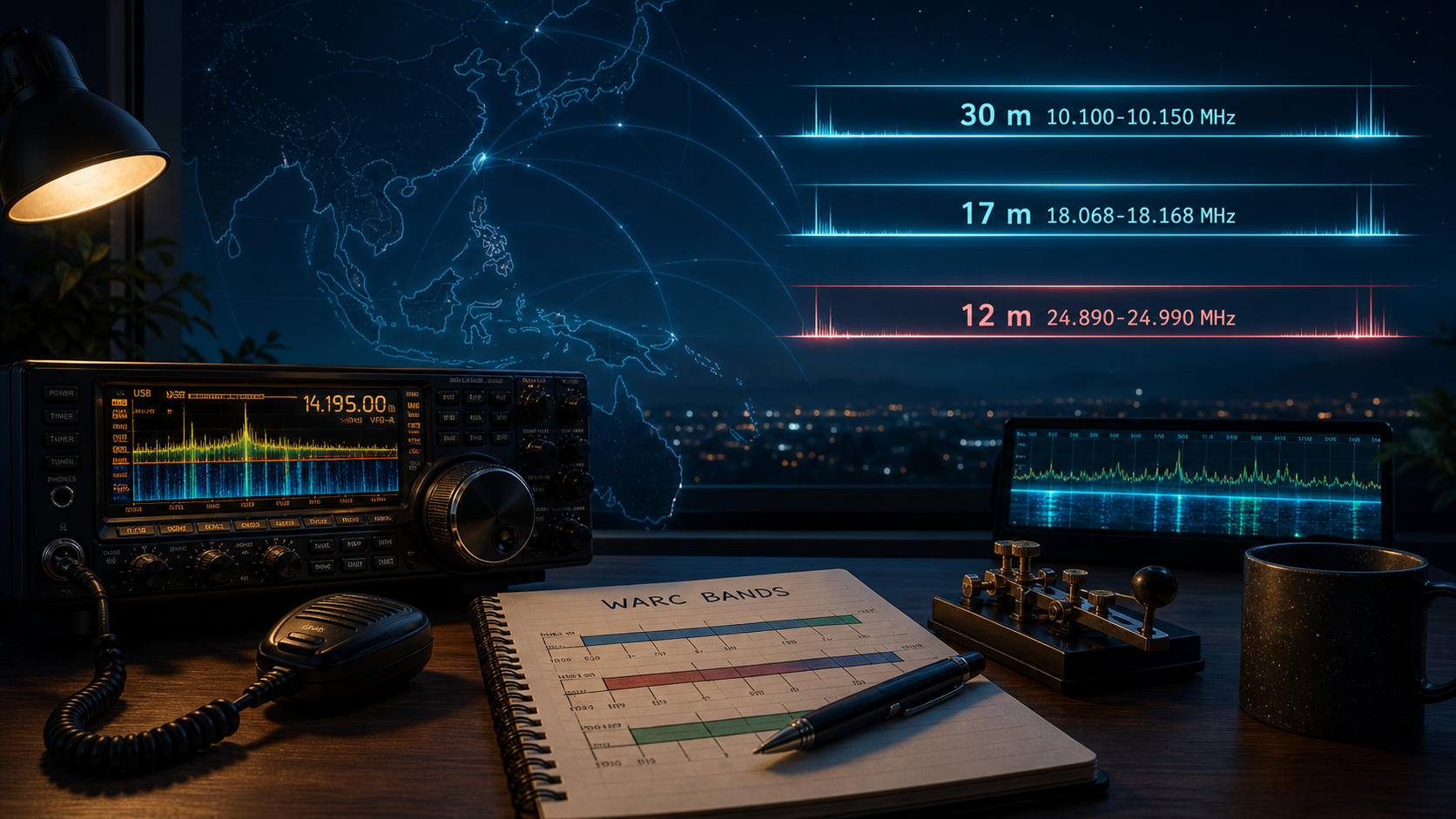
In amateur radio, not all HF bands are equal. Some are wide, crowded, and heavily used during contests. Others are narrow, quieter, and operate under a different culture of restraint. The WARC bands belong to the second category.
The WARC bands are three HF amateur allocations created after the 1979 World Administrative Radio Conference:
- 30 metres – 10.100 to 10.150 MHz
- 17 metres – 18.068 to 18.168 MHz
- 12 metres – 24.890 to 24.990 MHz
They are narrow bands: 30 metres is only 50 kHz wide, while 17 metres and 12 metres are each 100 kHz wide. Because of that narrowness, and because 30 metres is a secondary amateur allocation, these bands have developed a strong operating culture based on careful use, low interference, and no contest activity.
Allocation Status
The three WARC bands do not all have the same regulatory status.
30 metres, 10.100 to 10.150 MHz, is allocated to the amateur service on a secondary basis. Amateur stations must not cause harmful interference to primary users and must accept interference from them.
17 metres, 18.068 to 18.168 MHz, is a primary amateur allocation.
12 metres, 24.890 to 24.990 MHz, is a primary amateur allocation in ITU Region 3.
Malaysia is in ITU Region 3, so Malaysian amateurs should read these bands together with national licensing conditions and the IARU Region 3 band plan. Where national regulations and the regional band plan differ, national regulations prevail.
IARU Region 3 Band Plan Source
This article is corrected against IARU Region 3 Document R3-004, revised 3 September 2019, titled IARU Region 3 Interim Band Plan. The document states that this version was adopted at the IARU Region 3 Directors’ meeting held in Tokyo on 3 September 2019.
The 2019 document uses a newer format with columns for:
- Frequency segment
- Maximum bandwidth
- Preferred mode and generic usage
- ITU Region 3 status
Important definitions in the document include:
- Narrowband modes: CW, RTTY, PSK, JT65, WSPR, FT8, SIM31, or similar modes not exceeding 500 Hz.
- Digimodes: digital data modes restricted to the bandwidth of the frequency segment.
- Phone: SSB, DSB AM, FM, and digital voice modes with similar bandwidth not exceeding 6 kHz below 50 MHz.
- CoA: Centre of Activity frequency recommended by IARU.
30 Metres: 10.100 to 10.150 MHz
The amateur allocation is 10.100 to 10.150 MHz, but the 2019 IARU Region 3 band plan table gives preferred usage from 10.110 to 10.150 MHz:
| Segment | Maximum bandwidth | Preferred usage | Status |
|---|---|---|---|
| 10.110-10.130 MHz | 200 Hz | CW, including 10.116 MHz QRP CoA | Secondary amateur |
| 10.130-10.150 MHz | 500 Hz | CW and narrowband digimodes | Secondary amateur |
The footnotes identify common digital frequencies:
- WSPR: 10.1386 MHz
- JT65: 10.1380 MHz
- FT8: 10.1360 MHz
The 2019 Region 3 band plan also notes that some administrations allow phone in 10.115-10.140 MHz. This is not a general permission for all Region 3 amateurs. For Malaysian operators, do not treat 30 metres as a normal voice band unless Malaysian regulations specifically permit it.
The practical rule remains simple: 30 metres is a narrow, secondary band best used for CW and narrowband digital modes.
17 Metres: 18.068 to 18.168 MHz
The 2019 IARU Region 3 band plan divides 17 metres as follows:
| Segment | Maximum bandwidth | Preferred usage | Status |
|---|---|---|---|
| 18.068-18.095 MHz | 200 Hz | CW, including 18.086 MHz QRP CoA | Primary amateur and amateur-satellite |
| 18.095-18.110 MHz | 2700 Hz | CW and narrowband digimodes | Primary amateur and amateur-satellite |
| 18.110-18.120 MHz | 2700 Hz | CW, narrowband, phone, and 18.110 MHz international beacon with 500 Hz guard band | Primary amateur and amateur-satellite |
| 18.120-18.168 MHz | 2700 Hz | CW and phone | Primary amateur and amateur-satellite |
The footnotes identify common digital frequencies:
- WSPR: 18.1046 MHz
- JT65: 18.1020 MHz
- FT8: 18.1000 MHz
The band plan also identifies:
- 18.130 MHz – SSB QRP Centre of Activity
- 18.160 MHz – Digital Voice Centre of Activity
- 18.160 MHz – Emergency Centre of Activity, all modes within +/- 5 kHz
This means 17 metres is not simply “CW, digital, then phone.” The 18.110-18.120 MHz segment is shared in the plan for CW, narrowband, and phone, while the main CW/phone segment continues from 18.120 to 18.168 MHz.
12 Metres: 24.890 to 24.990 MHz
The 2019 IARU Region 3 band plan divides 12 metres as follows:
| Segment | Maximum bandwidth | Preferred usage | Status |
|---|---|---|---|
| 24.890-24.915 MHz | 200 Hz | CW, including 24.906 MHz QRP CoA | Primary amateur and amateur-satellite |
| 24.915-24.930 MHz | 500 Hz | CW and narrowband modes | Primary amateur and amateur-satellite |
| 24.930-24.940 MHz | 2700 Hz | CW, narrowband modes, DX, phone, and 24.930 MHz international beacon with 500 Hz guard band | Primary amateur and amateur-satellite |
| 24.940-24.990 MHz | 2700 Hz | CW and phone | Primary amateur and amateur-satellite |
The footnotes identify common digital frequencies:
- WSPR: 24.9246 MHz
- JT65: 24.9170 MHz
- FT8: 24.9150 MHz
The plan also identifies:
- 24.950 MHz – SSB QRP Centre of Activity
- 24.960 MHz – Digital Centre of Activity
So for Region 3, the main phone portion of 12 metres begins at 24.940 MHz, while 24.930-24.940 MHz is a mixed-use segment that includes the international beacon and guard band.
Summary of the Region 3 WARC Band Plan
| Band | Allocation | Region 3 preferred segments | Key notes |
|---|---|---|---|
| 30m | 10.100-10.150 MHz | 10.110-10.130 CW; 10.130-10.150 CW/narrowband digimodes | Secondary amateur; FT8 10.136 MHz; some administrations allow phone in 10.115-10.140 MHz |
| 17m | 18.068-18.168 MHz | 18.068-18.095 CW; 18.095-18.110 CW/digimodes; 18.110-18.120 mixed including beacon; 18.120-18.168 CW/phone | Emergency CoA 18.160 MHz +/- 5 kHz |
| 12m | 24.890-24.990 MHz | 24.890-24.915 CW; 24.915-24.930 CW/narrowband; 24.930-24.940 mixed including beacon; 24.940-24.990 CW/phone | SSB QRP CoA 24.950 MHz; Digital CoA 24.960 MHz |
Contest Activity
The 2019 IARU Region 3 band plan does not describe WARC bands using the old informal phrase “gentlemen’s agreement.” Instead, it states the operating expectation directly:
Contest activity below 30 MHz should be restricted to the 160 m, 80 m, 40 m, 20 m, 15 m, and 10 m bands.
By omission, this keeps contest activity away from 30 m, 17 m, and 12 m. The same section encourages non-contesting amateurs to use contest-free bands during large international contests.
This is why the WARC bands remain valuable: during major contests, they provide space for ordinary QSOs, DX contacts, propagation checks, emergency readiness, and quieter operating.
Emergency Communications
The 2019 Region 3 document says amateur radio emergency communications should have priority over all other usage, especially on specified Emergency Centre of Activity frequencies during emergency communications.
For the WARC bands, the key emergency frequency in the uploaded Region 3 plan is:
- 18.160 MHz – 17 metre Emergency Centre of Activity, all modes within +/- 5 kHz
This frequency is not a private or permanently reserved channel. It is a centre of activity: a recommended gathering point during emergency operations or emergency communications training.
Good Operating Practice on the WARC Bands
Because these bands are narrow, operators should use them with more discipline than wider HF bands.
On 30 metres, use CW and narrowband digital modes unless your national administration specifically permits another mode. Keep in mind that 30 metres is secondary and narrow.
On 17 metres, protect the international beacon area around 18.110 MHz and be aware of the 18.160 MHz emergency and digital voice centre of activity.
On 12 metres, protect the international beacon area around 24.930 MHz and note that the main phone segment begins at 24.940 MHz in the Region 3 plan.
On all three WARC bands:
- Avoid contest-style operation.
- Keep transmissions narrow and clean.
- Listen before calling.
- Respect beacons and centres of activity.
- Move away from ongoing QSOs.
- Give priority to emergency communications.
Final Note for Malaysian Operators
The IARU Region 3 band plan is a regional operating guide, not a replacement for Malaysian law or licence conditions. Malaysian operators should always follow MCMC requirements first. The Region 3 band plan is best used as a practical operating reference where national rules do not give more specific instructions.
Source: IARU Region 3 Document R3-004, IARU Region 3 Interim Band Plan, revised 3 September 2019.


Post Comment