amateur radio
club
CW
cw operator
ham radio
morse code
morse key
amateur radio, BrassPounder, cw, FEA, FEA Crossing, FEA CW Net, FEA-100, FISTS, FISTS Americas, FISTS CW Club, FISTS Down Under, FISTS East Asia, FISTS Europe, G3ZQS, Geo Longden, JL3YMV, Key Note, morse code, morsEAsia
9M2PJU
0 Comments
FISTS CW Club: Keeping Morse Code Alive on the Air
FISTS CW Club and FISTS East Asia: Keeping Morse Code Alive on the Air
“When you’ve worked a FISTS, you’ve worked a friend.”
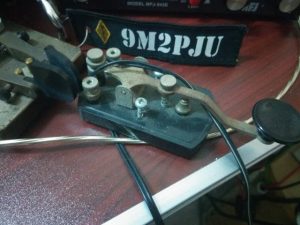
If you have ever turned the VFO down to the bottom of any HF band and heard the steady rhythm of CW — fists pounding brass, sending names, RST and member numbers — you have almost certainly crossed paths with FISTS, the International Morse Preservation Society. With chapters on four continents and a worldwide membership measured in the thousands, FISTS is one of amateur radio’s most enduring and fastest-growing organisations, devoted exclusively to Morse code operating.
This article traces the origin, mission, history, vision, membership and activities of the FISTS CW Club, with a special focus on its East Asia chapter — FISTS East Asia (FEA) — and the chapter’s long-running quarterly newsletter, morsEAsia.
Origin: A Club Born in Lancashire, 1987
The FISTS CW Club was founded in 1987 by the late George “Geo” Longden, G3ZQS, of Darwen, Lancashire, England. Geo recognised a gap that had been widening for years: as the number of ex-professional Morse operators declined, newcomers drawn to CW were increasingly left without mentors. The HF bands appeared crowded with high-speed signals “well beyond their limited skills”, and many beginners were tempted to swap the key for a microphone rather than persevere.
In his own introduction to the club, Geo wrote:
“A love of MORSE and a concern for its perpetuation are the only requisites for membership. There is no specific speed requirement and neither is membership of the RSGB or other National body demanded.”
The name FISTS itself comes from old CW slang — a “fist” being an operator’s individual keying characteristic. Geo borrowed the term from the banner of the earlier TOPS club (“Where FISTS Make Friends”), whose founder Phil was, in Geo’s words, “delighted when I told him of the connection.”
In its first year, FISTS reached 300 members, mostly in Great Britain and Europe. From that modest beginning grew a worldwide institution.
Mission: Three Straightforward Goals
FISTS is unusual among amateur radio clubs in that it is devoted exclusively to CW. Its mission is captured in three plain statements that have remained unchanged since the club’s founding:
- Further the use of Morse code.
- Engender friendships among members.
- Encourage newcomers to use Morse code.
There is no minimum speed requirement, no obligation to belong to any national society, and no commercial interest. The club has no paid employees. As FISTS East Asia puts it: “Accuracy Transcends Speed & Courtesy at All Times.”
History: From a Lancashire Kitchen Table to Four Chapters
The growth of FISTS is the story of four chapters, each formed to serve members in a particular region with local banking, language and newsletter distribution:
| Chapter | Founded | Website | Notes |
|---|---|---|---|
| FISTS Europe (HQ) | 1987 | https://www.fists.co.uk/ | The founding chapter, based in the UK. Publishes Key Note. |
| FISTS Americas | 1990 | https://www.fistsna.org/ | Started to help 11 US members receive the newsletter; Nancy Kott, WZ8C, of Hadley, Michigan served as US representative until her Silent Key in 2014. Now serves over 2,000 members across North, Central and South America and the islands. |
| FISTS Down Under | 1998 | http://www.fdu.org.au/ | Formed to serve VK/ZL members; Ralph Sutton, ZL2AOH, was the inaugural representative. New Zealand membership is the largest of any country outside England, Wales and North America. |
| FISTS East Asia | 2004 | https://www.fists-ea.org/ | Formed by a few BV (Taiwan) and JA (Japan) members to provide services in members’ native languages. |
By March 2023, worldwide membership had passed 15,000. Geo Longden, G3ZQS, is remembered each year through the club’s continuing activities; his founding vision — that veteran operators should help newcomers — still defines FISTS today.
The Four Chapters and Their Websites
The umbrella organisation, The International Morse Preservation Society, is represented online at https://www.fists.org/ — a simple portal page that links to each of the four regional chapters. Founded in 1987 by G3ZQS, the society lets each chapter run its own membership, newsletter, activities and QSL bureau while sharing the FISTS name, member-number space and awards programme.
FISTS Europe (HQ) — https://www.fists.co.uk/
The founding chapter and administrative headquarters of the society, serving members in Europe and the UK. The site is the most activity-dense of the four, hosting:
– The full calendar of on-air activities: FISTS Ladder (monthly Sunday sessions), Straight Key 24-Hour Sprint, Bug Key 24-Hour Sprint, Straight Eight, Bug Key Week, Mechanical Key Week, Mechanical Medley, Top Gun, and the month-long European Tour.
– BrassPounder — the monthly activities newsletter written by Activities Manager David G4YVM, with results and logs.
– Key Note — the quarterly A5 news booklet, available to members in PDF and audio (.mp3) formats. Recent issues have included articles such as a 1kW CW dummy load (DL2AAA), CW Hotline (G5VZ), US Navy straight key restoration (M8WRW), and “Stand up for Morse Code!” (G3ZOD).
– The FISTS Log Converter tool (currently v4.9.4) for submitting logs.
– News feeds via RSS, Bluesky and Facebook.
FISTS Americas — https://www.fistsna.org/
The Americas Chapter serves North, Central, South America and the associated islands. Highlights:
– Lifetime dues-free membership for new members joining from March 2019 onward (downloaded newsletters only).
– A free FISTS CW Club cloth patch for new Americas members who complete one 10-minute CW QSO with a FISTS member during their first full year.
– Activities unique to the chapter: Code Buddies (mentoring programme), FISTS Friday, the G3ZQS Memorial Event, and the Nancy Kott Memorial Event (honouring the late WZ8C, the chapter’s longtime US representative).
– The full Awards programme: Century Series, Platinum Series, 1- and 2-Way QRP, Millionaire, Perpetual Prefix, and Spectrum awards.
– Operator aids including the Log Converter Program, Logbook Page, Century/Platinum/NANFA/WAS logs, Dupe Check Sheet, FISTS Calling Frequencies, and a Basic CW Operating Manual.
– Calculators for grid square, dipole/inverted-V, and open-line impedance.
– The Americas Keynote newsletter, with the current issue members-only and the previous issue public.
– Sprint results and cumulative reports in the Archives section.
FISTS Down Under — http://www.fdu.org.au/
The VK/ZL chapter, covering Australia and New Zealand. The site features:
– FISTS Down Under Awards & Certificates — including the new FISTS QRP Award (based on the NAQRP Award).
– A Leagues Table for ongoing operating competition.
– Learning the Code resources and a Q-Codes reference.
– Reverse Beacon Network integration for spotting CW activity.
– The Wednesday Wrap 2026 events calendar.
– Special events such as the QRS International Flight Contest (a lightweight QRS CW contest) and ANZAC Day Straight Key Day (April 25th, an initiative of Graeme VK5GG).
– A members’ Sked & messaging App for arranging QSOs.
– The FDU Newsletter (quarterly, members-only).
FISTS East Asia — https://www.fists-ea.org/
The East Asia Chapter, the subject of the next section, serves members across Asia and is detailed separately below.
Vision: Perpetuating Morse as a Living Art
FISTS is not a museum for Morse code. Its vision is to keep CW a living, breathing on-air activity — a mode used daily for real QSOs, not merely preserved as a curiosity. The club’s philosophy is that Morse proficiency grows through practice and friendship, not through tests and speed limits. Every activity, award and publication is designed to:
- give beginners a pressure-free place to operate,
- give veterans a way to “put something back into the hobby”,
- and to build the lasting on-air friendships that are the true reward of CW.
The motto of the East Asia chapter captures this neatly: “Accuracy Transcends Speed & Courtesy at All Times.”
Members: Who Belongs to FISTS?
FISTS members are, in the club’s own words, “young, old, both OMs and YLs” — they live in every US state and across dozens of countries, hold every licence class, and operate at widely varying proficiency levels. Some are prospective licensees and SWLs. The only requirement for membership is, simply, that you like Morse code.
Membership is free for FISTS East Asia (annual fees were abolished in April 2006); the chapter is funded entirely by optional donations and modest certification fees. Worldwide, members receive a unique FISTS member number that is exchanged during QSOs and counts toward the club’s awards programme.
Activities: Contests, Nets, Sprints and Awards
FISTS is famously active on the air. The calendar is packed year-round with events designed to suit every key and every skill level.
FISTS CW Club (Europe / HQ) activities
- FISTS Ladder — monthly Sunday sessions (14:00–15:59 & 18:00–19:59 UTC) collecting points for CW QSOs with members and non-members.
- Straight Key 24-Hour Sprint and Bug Key 24-Hour Sprint — single-day events dedicated to specific key types.
- Straight Eight, Bug Key Week, Mechanical Key Week — week-long operating events.
- Top Gun, Mechanical Medley, European Tour — seasonal special events.
- BrassPounder — the monthly activities newsletter written by Activities Manager David G4YVM, with results and logs.
- Key Note — the quarterly A5 news booklet, available to members in PDF and audio (.mp3) formats.
FISTS East Asia activities
- FEA CW Net — informal CW sessions for anyone who wants to practice English-language QSO:
- Part I: 7.026 MHz (± QRM), from 2300 UTC Saturdays (0700 Taiwan/Singapore, 0800 JST Sundays).
- Part II: 14.054 MHz (± QRM), from 0800 UTC Sundays (1600 Taiwan/Singapore, 1700 JST Sundays).
- Typical speed: 12–15 WPM. Controllers include JE1RZR, JL1GEL, JS1QIZ, JO3HPM, JK7UST/JE7YTQ and JL3YMV (the JA national club station, currently JR0ZIW).
- FEA Crossing — every Friday 23:30 to Saturday 00:30 UTC on 7.025–7.030 MHz. A relaxed one-on-one QSO event, designed to make it easier to find members on the bands.
- FEA-100 Award — for working 100 FISTS members.
- FISTS Center of Activity Frequencies (East Asia): 7.028, 10.118/10.128/10.133, 14.058, 18.085, 21.058/21.138, 24.908 and 28.058 MHz.
- BBS in English, Japanese and Chinese.
- QSL Bureau for quick exchange of members’ cards.
The FISTS Awards programme
A popular point-based scheme that rewards working FISTS members:
– Century (100 points), Silver (250), Gold (500), Diamond (1000)
– Platinum (100 Century Award holders worked), 250 Century, 500 Century
– Worked FISTS All US States (QRP and QRO categories)
Points: 1 for own country, 2 for DXCC-different country, 3 for any FISTS club station, and 5 for the national club stations GX0IPX, ZL6FF, KN0WCW, VK2FDU and JL3YMV.
FISTS East Asia: A Closer Look
FISTS East Asia (FEA) was established on 28 March 2004 by a small group of Taiwanese (BV) and Japanese (JA) members — about 20 founding members in total. The chapter’s purpose was to give East Asian members services in their native languages, a local QSL bureau, and a regional supplement to the UK-produced Key Note.
FEA operates two websites:
– Primary: https://www.feacw.net/
– Secondary: https://www.fists-ea.org/
The chapter is multilingual by design: its BBS runs in English, Japanese and Chinese, and its newsletter publishes Japanese-language appendices alongside the main English edition. Membership is genuinely international — recent additions include operators from India (VU2AQJ, VU22FX), the Philippines (4I1HFE/AI5PJ), Thailand (HS0ZRM), China (BA4RKS/KS3E) and Japan (JA5KJD), reflecting the chapter’s reach across East and South Asia.
A small but important administrative note from the chapter: membership “annual confirmation” has been replaced with confirmation every four years, easing the burden on overseas members.
morsEAsia: The Voice of FISTS East Asia
The flagship publication of FISTS East Asia is the quarterly newsletter morsEAsia — a name that elegantly fuses “Morse” and “East Asia” while preserving the capitalisation that spells out the chapter’s identity.
Publication schedule
morsEAsia is published four times a year, in:
– January
– April
– July
– October
The current edition at the time of writing is the July 2026 issue, with the next issue due in October 2026.
Format and access
- Distributed as PDF (Adobe Reader required), with selected issues also available as MP3 audio for visually impaired members — a tradition inherited from the founding FISTS club.
- A Japanese-language appendix is published alongside many issues (notably April, July and October in recent years).
- A full Table of Contents and a searchable archive are maintained on the FEA website.
- All back issues from July–August 2004 to the present are freely downloadable — an unbroken 22-year record of the chapter’s life.
What’s inside
morsEAsia serves as both the chapter’s record and its meeting place. Typical content includes:
– Chapter news and new-member announcements (with FISTS member numbers).
– Reports from the FEA CW Net and FEA Crossing, including controller logs and participant lists.
– Results of club contests and sprints.
– Technical articles on keys, antennas and CW operating practice.
– Member profiles and Silent Key memorials.
– News from the wider FISTS family — Key Note (Europe), Key Note (Americas) and the FDU Newsletter (Down Under) — for which FEA members have access through the members-only page.
The newsletter is the chapter’s principal means of binding together a membership spread across multiple time zones and languages, and its free, open archive makes it a valuable resource for any CW operator interested in the history of Morse in Asia.
Why FISTS Still Matters
In an era of digital modes and POTA pile-ups, FISTS is a quiet reminder that Morse code is not a relic but a craft — one that rewards patience, courtesy and a willingness to slow down for the newcomer. Geo Longden’s founding insight, that beginners need a place where “the satisfactions and pleasure of Morse” are not “denied them by a lack of opportunity”, is as true in 2026 as it was in 1987.
FISTS East Asia, with its multilingual welcome, its weekly nets and its 22-year run of morsEAsia, extends that welcome across half the globe. Whether you are a JA operator working the Sunday net on 14.054 MHz, a BV station calling CQ FISTS on 7.028, or a newcomer anywhere in the world sending your first hesitant dots and dashes — FISTS is there, and a friend is on the other end of the key.
When you’ve worked a FISTS, you’ve worked a friend.
Sources
- FISTS (International Morse Preservation Society) portal: https://www.fists.org/
- FISTS CW Club (Europe HQ): https://www.fists.co.uk/
- FISTS Americas: https://www.fistsna.org/
- FISTS Down Under: http://www.fdu.org.au/
- FISTS East Asia: https://www.fists-ea.org/ and https://www.feacw.net/
- morsEAsia archive: https://www.fists-ea.org/nl/index.htm
- Geo Longden G3ZQS introduction: https://fists.co.uk/g3zqsintroduction.html


Post Comment