QRP Amateur Radio: The Art of Operating with 5 Watts or Less
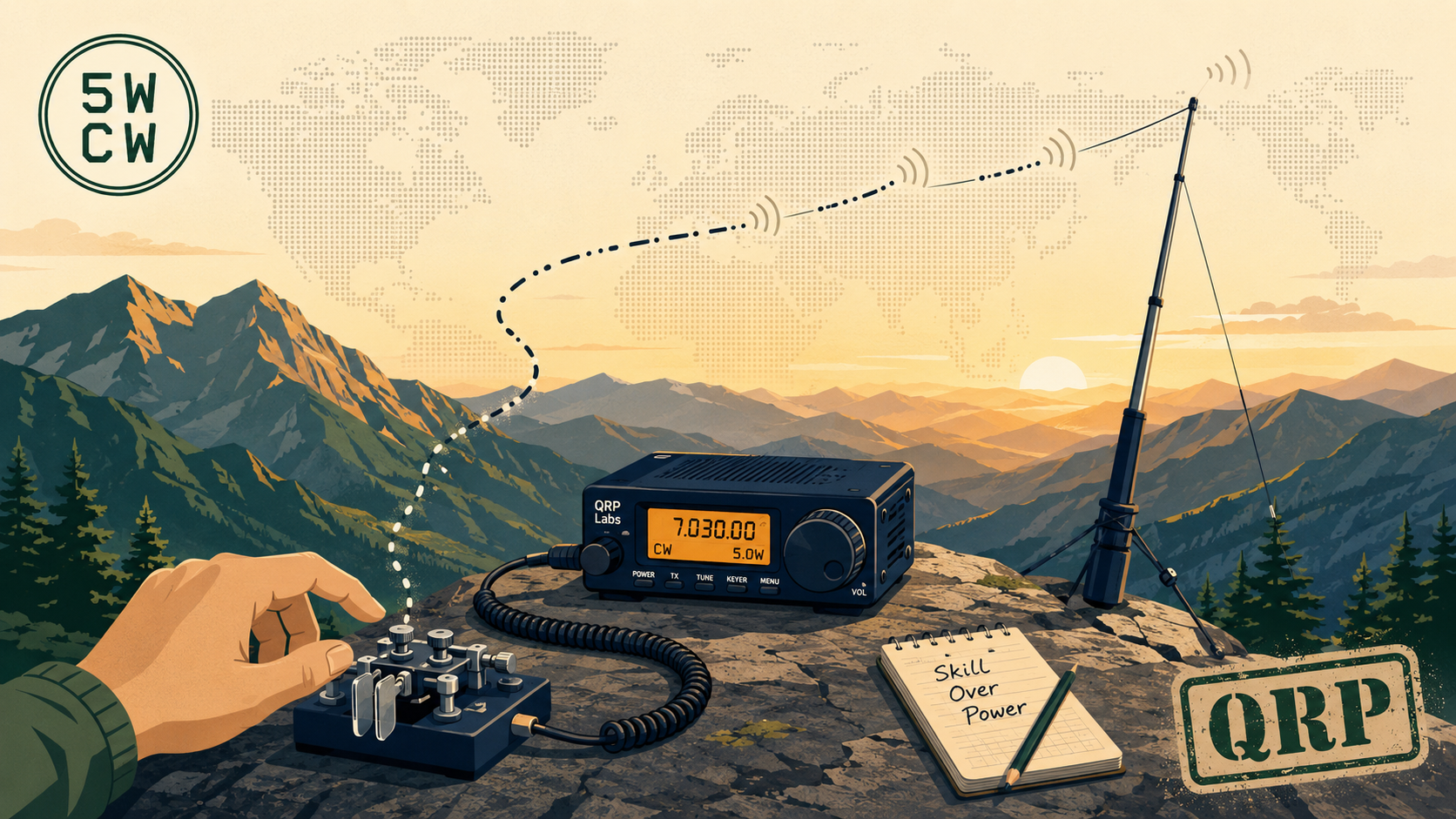
QRP is the art of doing more with less. In a world where amateur radio operators can legally transmit up to 1,500 watts in some countries, a dedicated community chooses to operate at 5 watts or less, chasing the same DX, entering the same contests, and making contacts around the world with less power than a household light bulb.
QRP operation is one of the oldest and most enduring traditions in amateur radio. It is a philosophy, a technical challenge, a culture, and for many operators, a way of life. This article explores the origins, principles, equipment, operating practices, and culture of QRP amateur radio.
1. What Is QRP?
The term QRP comes from the standard Q code used in radio communication. In Q code, “QRP” means “Reduce power” and “QRP?” asks “Should I reduce power?” In amateur radio practice, QRP has come to mean deliberate low-power operation, where the operator chooses to transmit at reduced power rather than being forced to by technical or regulatory limitations.
The generally accepted power limits for QRP, recognised by the ARRL and most amateur organisations worldwide, are:
- CW, AM, FM, and digital modes: 5 watts output or less
- SSB (single sideband): 10 watts PEP (peak envelope power) or less
Operators who push the limits even further, using less than 1 watt, practice what is known as QRPp (QRP petite). Transatlantic and even transpacific contacts have been made with milliwatt-level transmitters, proving that with the right conditions, antennas, and operating skill, extraordinary distances are possible with almost no power.
2. Origins and History
QRP is not a modern invention. In fact, every early amateur transmission was QRP by necessity. When Guglielmo Marconi made his first transmissions in 1895, his spark-gap transmitter operated from batteries at under 10 watts. Early amateurs in the 1900s and 1910s built spark-gap transmitters from Ford Model T ignition coils, producing a few watts of wide-band RF energy. There was no alternative. Low power was simply the reality of the technology.
The practice of deliberate low-power operation as a conscious choice began to appear in the early 1920s. In 1924, U.S. amateur radio magazines began publishing editorials and articles encouraging operators to reduce power output, both for experimentation and to reduce interference on the bands. The argument was simple: if you can work the same stations with 5 watts as with 100 watts, why use 100?
Between 1920 and 1940, most amateur transmitters were low-power by economic necessity. Transmitting tubes were expensive, and cheap audio output tubes producing 10 to 15 watts were all many amateurs could afford. QRP was not yet a movement. It was simply how most people operated.
After World War II, the landscape changed. War-surplus equipment flooded the market, transmitting tube prices dropped, and 100-watt transmitters became the norm. QRP became a choice rather than a necessity. In the 1960s, manufacturers like Heathkit began producing affordable QRP kits with advanced features (VFO, multiband capability, CW filters), and QRP started to develop its own identity as a distinct pursuit within amateur radio.
The modern QRP movement crystallised between 1968 and 1981 in the United States. Key figures included Doug DeMaw (W1FB), who wrote seminal articles on solid-state QRP design in QST and co-authored “Solid-State Design for the Radio Amateur” (1977); Adrian Weiss (W0RSP), author of “Joy of QRP”; and Albert Kahn and Jack Burchfield, co-founders of Ten-Tec, whose Argonaut 505 QRP transceiver (reviewed in QST in December 1970) became a landmark product, with over 10,000 units produced.
In 1961, the QRP Amateur Radio Club International (QRP ARCI) was founded in the United States. It remains the world’s largest QRP organisation, publishing QRP Quarterly magazine and hosting the annual “Four Days In May” (FDIM) gathering at the Dayton Hamvention. In 1974, the G-QRP Club was founded in the United Kingdom by Reverend George Dobbs (G3RJV). With approximately 4,000 members and its magazine SPRAT, it remains a cornerstone of the British QRP community. German-speaking operators have the DL-QRP-AG, and there are active QRP groups in Japan, Australia, and many other countries.
3. The Philosophy of QRP
QRP is driven by several interconnected philosophies that go beyond simply turning down the power knob:
“Brain over brawn.” This is perhaps the most common QRP motto. With only a few watts of signal, you cannot brute-force your way through a pileup or overpower QRM and QRN. You must rely on operating skill, timing, antenna efficiency, propagation knowledge, and patience. QRP operators learn to listen carefully, choose the right moment to call, and exploit propagation openings that higher-power stations might not even notice.
“Minimum power necessary.” In the United States, FCC Part 97.313(a) states that amateur stations “shall use the minimum amount of transmitter power necessary to carry out the desired communications.” QRP enthusiasts take this rule seriously and argue that most contacts do not require 100 watts, let alone 1,500. If 5 watts will do the job, 5 watts is the correct amount of power.
Simplicity and elegance. There is an aesthetic dimension to QRP. A well-designed QRP transceiver is a compact, efficient, elegant piece of engineering that does exactly what it needs to do and nothing more. Many QRP operators build their own equipment from kits or from scratch, valuing the understanding that comes from constructing your own station. The QRP ARCI’s design challenges explicitly reward minimalism, economy of components, and operating efficiency.
Portability and freedom. QRP equipment is small, light, and battery-friendly. A complete QRP station, including radio, battery, antenna, and accessories, can weigh under 3 kg and fit in a backpack. This opens up operating locations that are simply inaccessible to larger stations: mountain summits, national parks, remote islands, hotel balconies, and campsites. QRP and outdoor operating are natural partners.
Environmental responsibility. QRP consumes less power, which means smaller batteries, less charging, and a smaller carbon footprint. In emergency communications, where battery power and generator fuel are precious resources, QRP is not just a philosophy but a practical necessity.
4. QRP Calling Frequencies
QRP operators have established designated calling frequencies on each amateur band. These are gathering points where QRP operators listen for and call CQ. The standard QRP CW calling frequencies are:
| Band | CW (MHz) | SSB (MHz) |
|---|---|---|
| 160m | 1.810 | 1.910 |
| 80m | 3.560 | 3.985 |
| 40m | 7.040 (7.030 in Europe) | 7.285 |
| 30m | 10.106 (10.116 on QRP-L) | N/A (CW/digital only) |
| 20m | 14.060 | 14.285 |
| 17m | 18.096 | 18.130 |
| 15m | 21.060 | 21.385 |
| 12m | 24.906 | 24.950 |
| 10m | 28.060 | 28.385 |
| 6m | 50.060 | 50.1625 |
| 2m | 144.060 | 144.285 |
Note that 7.040 MHz is also designated as an RTTY/DX frequency in the ARRL band plan, which has caused some friction over the years. In Europe, 7.030 MHz is more commonly used as the QRP CW frequency. Operators should always listen before transmitting and be prepared to move slightly off the calling frequency to avoid interfering with other activity.
5. Modes of Operation
QRP operators use a variety of modes, each with different strengths for low-power work:
CW (Morse code): The traditional QRP mode. CW is approximately 10 to 15 dB more efficient than SSB voice, meaning a 5-watt CW signal is roughly equivalent to a 50 to 150-watt SSB signal in terms of readability. CW also occupies very little bandwidth (approximately 100 Hz), which reduces QRM. For decades, CW was the only realistic option for QRP DX work, and it remains the mode of choice for many QRP purists.
SSB (voice): More challenging with QRP due to the higher power requirement and wider bandwidth. A 10-watt SSB signal can work DX under good conditions, but the operator must be more strategic about when and where to call. SSB QRP is popular for Field Day, POTA activations, and local/regional nets.
FT8: The digital mode that revolutionised QRP. FT8 can decode signals down to approximately -24 dB below the noise floor. With 5 watts and a modest antenna, worldwide FT8 contacts are routine, not exceptional. During the current Solar Cycle 25, intercontinental FT8 QSOs with QRP power levels are commonplace. FT8 has made QRP DX accessible to operators who might struggle with CW, though some argue it has reduced the incentive to develop operating skill.
WSPR (Weak Signal Propagation Reporter): Developed in 2008 by Joe Taylor (K1JT), a Nobel Prize winner in physics, WSPR is designed specifically for propagation research. It can detect signals down to approximately -32 dB S/N. Typical WSPR operation uses 200 mW to 1 watt, making it the ultimate QRPp tool. WSPR does not support two-way QSOs; instead, it maps propagation conditions worldwide by having stations transmit brief beacons that are decoded and logged by receiving stations. The WSPRnet database records millions of spots and is a valuable resource for propagation research.
JS8Call: An extension of the FT8 concept that supports keyboard-to-keyboard messaging, making it usable for actual conversations rather than just signal reports. JS8Call can work across thousands of kilometres with QRP power levels.
PSK31 and RTTY: Older digital modes that work reasonably well with QRP, though they are less sensitive than FT8 and WSPR. PSK31 is popular for ragchewing with low power.
6. Equipment
The QRP equipment market has never been healthier. From ultra-premium transceivers to budget kit projects, there is something for every operator and every budget. A 2023 survey by QRPer.com ranked the most popular QRP transceivers for field operation:
6.1 Premium QRP Transceivers
Elecraft KX2: The most popular QRP transceiver for field operation. At just 13 ounces (370 grams) and 5.8 x 2.8 x 1.5 inches, it is the smallest full-featured HF radio on the market. It covers 80-10 metres, outputs up to 10 watts, and includes a 32-bit DSP with dual watch, stereo audio, programmable filters, noise blanking, and auto-notch. Options include an internal 2.6 Ah Li-ion battery (up to 8 hours of operation), an internal automatic antenna tuner, and a built-in microphone for hand-held operation. The KX2 is a true software-defined radio (SDR) in a pocket-sized package.
Elecraft KX3: The larger sibling of the KX2, covering 160-6 metres with all modes. The KX3 offers more features, including a panadapter option (PX3), 100-watt amplifier option (KXPA100), internal ATU, and optional 2-metre or 4-metre transverter. It is a favourite for SOTA activations, Field Day, and DXpeditions where compact size matters but full-band coverage is needed.
Icom IC-705: A portable, battery-powered SDR transceiver covering HF, 6m, 2m, and 70cm. Features include a large touchscreen display, built-in GPS, Wi-Fi for remote control, and D-STAR digital voice. Maximum power is 10 watts on HF and 5 watts on VHF/UHF. The IC-705 is popular for POTA, SOTA, and portable digital operation.
6.2 Mid-Range QRP Transceivers
Yaesu FT-817 / FT-818: The FT-817 (introduced in 2000) and its updated version, the FT-818, are legendary QRP radios. They cover HF, 6m, 2m, and 70cm with 5 watts output. The internal battery pack makes them truly portable, and they have been the entry point into QRP for thousands of operators worldwide. Though no longer in production, they remain the second most popular QRP radio for field operation.
lab599 Discovery TX-500: A rugged, waterproof QRP transceiver designed for outdoor adventure. Covers 80-10 metres with 10 watts output. Compact, lightweight, and built to withstand harsh conditions. Popular with SOTA and POTA activators who need durability.
Xiegu X6100: A compact, portable SDR transceiver with built-in battery, touchscreen, and internal ATU. Covers 80-10 metres with 10 watts output. Popular for air travel due to its small size and all-in-one design.
6.3 Budget and Kit QRP Radios
QRP Labs QCX+ / QMX: Single-band (QCX+) or multiband (QMX) CW-only transceiver kits from QRP Labs. The QCX+ costs approximately $50-70 as a kit and outputs 3-5 watts on a single band. It includes built-in test equipment (voltmeter, RF power meter, frequency counter, signal generator), WSPR beacon mode, and GPS interface for frequency calibration. The QMX is the multiband successor with 5 watts on 80-10 metres. These kits are the gold standard for affordable, high-performance QRP CW operation.
QRP Labs QDX: A 5-watt digital-only transceiver kit for FT8, FT4, JS8Call, and WSPR. At approximately $69, it is excellent value for digital QRP operation. Requires a PC running WSJT-X but offers full transceiver functionality for digital modes.
Mountain Topper (MTR-3B / MTR-4B): Ultra-compact, three or four-band CW-only transceivers designed specifically for SOTA activations. Weighing just a few ounces, they are the ultimate “summit radio” for operators who count every gram.
uBITX: An open-source, multi-band SSB/CW transceiver kit from Ashhar Farhan (VU2ESE). Covers 80-10 metres with approximately 5 watts output. Available as a bare board or fully assembled. The uBITX has a large and active community of builders who modify and improve the design, making it one of the most popular homebrew QRP platforms in the world.
6.4 Antennas for QRP
At QRP power levels, the antenna matters more than at higher powers. Every decibel lost in the antenna system is a significant fraction of your total output. A 50% efficient antenna at 100 watts gives you 50 watts ERP, which is still respectable. The same 50% efficiency at 5 watts gives you only 2.5 watts ERP. Add a few more decibels of feedline loss and mismatch, and you could be radiating less than 1 watt.
The most popular QRP antennas are:
- End-Fed Half-Wave (EFHW): Resonant, efficient, and needs only one support point. The most popular QRP portable antenna. Can be deployed as a sloper, inverted-V, or horizontal depending on available supports.
- Linked Dipole: A tuned half-wave dipole with crocodile clips or connectors for band switching. Lightweight, inexpensive, and very efficient. Popular for SOTA and POTA.
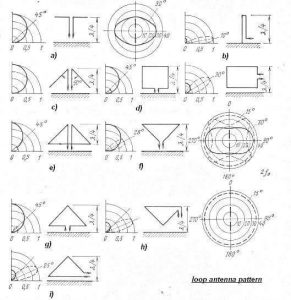
- Magnetic Loop: Ideal for balconies, restricted spaces, and indoor operation. Low near-field losses but typically single-band without retuning. Can be surprisingly effective despite small size.
- Vertical with counterpoise: Good for low-angle radiation and DX work, but requires an efficient ground system or counterpoise to avoid ground losses that are especially punishing at QRP power levels.
- Random wire with tuner: The most flexible option. A random-length wire (typically 29-41 feet) fed through an antenna tuner. Not the most efficient, but the most versatile for multi-band portable operation.
The golden rule of QRP antennas: an Elecraft KX2 with a good wire antenna at 15 metres height will outperform a 100-watt radio with a compromise antenna. Investment in antenna quality pays off more than investment in transmitter power.
7. Example Operations
7.1 SOTA (Summits On The Air)
SOTA is tailor-made for QRP. Activators carry lightweight equipment to mountain summits and make contacts from the top. A typical SOTA activation involves a QRP transceiver, a lightweight wire antenna (often an EFHW or linked dipole deployed on a telescopic fishing pole), and a small Li-ion battery. The entire station weighs under 3 kg. A successful SOTA activation requires just four QSOs, which is achievable in minutes with CW or FT8. Many of the world’s most active SOTA operators work exclusively QRP. The combination of a high-altitude location (excellent take-off angle), quiet RF environment (no urban noise), and an efficient antenna means QRP signals from summits can be remarkably strong.
7.2 POTA (Parks On The Air)
POTA applies the SOTA concept to national and state parks. It is more accessible than SOTA (no mountain climbing required) and has grown enormously in popularity. QRP is the natural choice for POTA activations, where the goal is to set up a temporary station in a park, make contacts, and pack up. POTA activators often use FT8 with QRP power, making contacts across continents from a picnic table with 5 watts and a wire antenna thrown into a tree.
7.3 QRP Contesting
Most major contests now have dedicated QRP categories, including CQWW DX, ARRL International DX, CQ WPX, and many others. Power is limited to 5 watts, and results are scored separately from higher-power categories. The appeal is clear: you compete against equally powered stations, and every QSO feels like an achievement. QRP ARCI also organises twelve dedicated QRP contests per year, ranging from sprint-style events to multi-hour operating sessions.
7.4 Field Day
The ARRL Field Day, held annually in June, is the largest amateur radio event in North America. QRP stations compete in their own category, often operating from tents, vehicles, or portable shelters with battery or solar power. A QRP Field Day station can be set up in minutes and operated for the full 24-hour period from a single battery, demonstrating the practical value of low-power operation in emergency conditions.
7.5 QRPp and Milliwatt Operation
For the truly dedicated, QRPp means operating below 1 watt. Operators have achieved DXCC (working 100 countries) with less than 1 watt of output power. The record for the lowest-power transatlantic contact is measured in milliwatts. QRPp operators rely on exceptional antennas, excellent propagation conditions, and the most efficient modes (CW and WSPR). The Milliwatt, a journal dedicated to QRPp operation, documented many of these achievements during the height of the QRP movement.
8. QRP Culture and Community
QRP has a distinct culture within amateur radio. QRP operators tend to be:
- Builders and experimenters: Many QRP operators build their own equipment from kits or from scratch. The satisfaction of making a transatlantic contact with a radio you soldered together yourself is unmatched in the hobby.
- Outdoor-oriented: QRP and portable operation go hand in hand. SOTA, POTA, IOTA (Islands On The Air), and WWFF (World Wide Flora and Fauna) are dominated by QRP operators.
- Skilled operators: Because QRP signals are weak, operators must develop excellent listening skills, timing, and propagation awareness. QRP operators are often among the most skilled CW operators in the hobby.
- Community-minded: QRP clubs (QRP ARCI, G-QRP Club, DL-QRP-AG, NorCal QRP Club, Colorado QRP Club) are active and welcoming. QRP gatherings at hamfests like Dayton Hamvention, Friedrichshafen, and Pacificon are social highlights of the year.
- Minimalists: There is a QRP aesthetic that values simplicity, elegance, and doing more with less. A QRP station on a summit with a wire antenna and a battery is the distilled essence of amateur radio: a person, a radio, and the ionosphere.
9. Pros and Cons of QRP
| Pros | Cons |
|---|---|
| Equipment is small, light, and portable | Weaker signal makes it harder to be heard in pileups |
| Lower power consumption, longer battery life | More sensitive to antenna inefficiency and feedline loss |
| Lower cost (radios, batteries, solar panels) | Fewer QSOs per hour, especially in contests |
| Less interference to other stations and electronics | Requires more operating skill and patience |
| Build-it-yourself culture and kit availability | Not suitable for rapid emergency net control |
| Encourages antenna experimentation and optimisation | Some modes (SSB voice) are significantly harder with QRP |
| Compatible with outdoor activities (SOTA, POTA, hiking) | Can be frustrating in poor propagation conditions |
| Dedicated QRP contests and awards | QRP categories in contests can have low participation in some regions |
| FT8 and WSPR make QRP DX routine | Some argue digital modes reduce the skill aspect of QRP |
| Aligns with regulatory principle of minimum power | Not all countries have QRP-friendly power limits or categories |
10. Current Trends
QRP is experiencing a renaissance driven by several converging trends:
Solar Cycle 25: The current solar cycle has brought excellent HF propagation conditions, making QRP DX contacts easier than they have been for over a decade. Even 5-watt SSB contacts across the Pacific are possible during good openings.
Digital modes: FT8, WSPR, and JS8Call have made QRP DX accessible to operators who lack CW skills. The barrier to entry for successful QRP operation has never been lower.
SOTA and POTA growth: The explosive growth of SOTA and POTA has created a large community of outdoor QRP operators. These programmes provide purpose and structure for portable QRP operation, with awards, leaderboards, and online spotting.
SDR technology: Modern QRP radios like the Elecraft KX2/KX3, Icom IC-705, and Xiegu X6100 are full software-defined radios with DSP features that rival or exceed desktop rigs. The gap between QRP and QRO equipment capability has narrowed dramatically.
USB-C power delivery: Modern QRP transceivers can run directly from USB-C power banks, the same ones used to charge phones. A 20,000 mAh power bank can power a QRP radio for an entire day of operating. This has eliminated the need for heavy lead-acid batteries in portable operation.
Kit and homebrew revival: Companies like QRP Labs have made high-performance QRP kits available at prices that make experimentation affordable. The uBITX and its derivatives have created a vibrant open-source hardware community. QRP building is no longer limited to those with extensive electronics knowledge; detailed instructions and online support make it accessible to anyone willing to learn.
11. Summary
QRP is not about deprivation. It is about efficiency, skill, and the satisfaction of making contacts with minimal power. The difference between 100 watts and 5 watts is only 13 dB, roughly 2 S-units on a receiver. In practice, a good antenna, good propagation, and good operating technique can close that gap entirely. QRP operators prove every day that you do not need a kilowatt to work the world. You need a few watts, a good antenna, and the patience to listen.
Whether you are a seasoned operator looking for a new challenge, a new amateur who wants to start portable, or someone who simply believes that less is more, QRP offers a path into the deepest and most rewarding parts of amateur radio. The equipment has never been better, the propagation has not been this good in over a decade, and the community is welcoming and active worldwide.
As the old QRP saying goes: “If you can hear them, they can hear you.” All you need is 5 watts and the will to try.
73, and good DX.
9M2PJU
References
- Wikipedia – QRP Operation – General overview of QRP history, definitions, and practices.
- QRP Amateur Radio Club International (QRP ARCI) – World’s largest QRP organisation, founded 1961. Publisher of QRP Quarterly.
- ARRL – Why QRP? – ARRL article by Kenny Chaffin (WB0E) from February 1990 QST.
- ARRL – QRP: More Than a State of Mind – ARRL overview of QRP equipment and operating practices.
- Adrian Weiss (W0RSP) – The Five-Watt QRP Movement in the US, 1968-1981 – Detailed history of the modern QRP movement.
- QRPer.com – QRP Transceiver Survey Results 2023 – Community survey of most popular QRP field radios.
- Elecraft KX2 Product Page – Specifications and features of the KX2 transceiver.
- Elecraft KX3 Product Page – Specifications and features of the KX3 transceiver.
- QRP Labs QCX+ Product Page – Single-band 5W CW transceiver kit.
- OERadio – QRP Operation: Around the World with 5 Watts – Comprehensive guide to modern QRP operating.
- Broken Signal – Why Your Antenna Matters More at 5 Watts Than 100 Watts – Analysis of antenna efficiency at QRP power levels.
- ARRL – The Considerate Operator’s Frequency Guide – Official ARRL band plan including QRP calling frequencies.
- Roger Wendell (WB0JNR) – QRP Frequencies – Comprehensive list of QRP calling frequencies worldwide.
- WSPRnet – Weak Signal Propagation Reporter network and database.
- WiMo – The Allure of QRP – Overview of QRP philosophy and equipment.



Post Comment