PMR446 in Malaysia: The Complete Guide to License-Free 446 MHz Walkie Talkies
⚠ Disclaimer & Ongoing Updates: This article is intended as an informational summary of PMR446 regulations in Malaysia as understood at the time of writing. Regulatory frameworks and MCMC Class Assignments may change over time. This post will be updated from time to time as new information becomes available. If you spot any error or have additional insight, please leave a comment below.
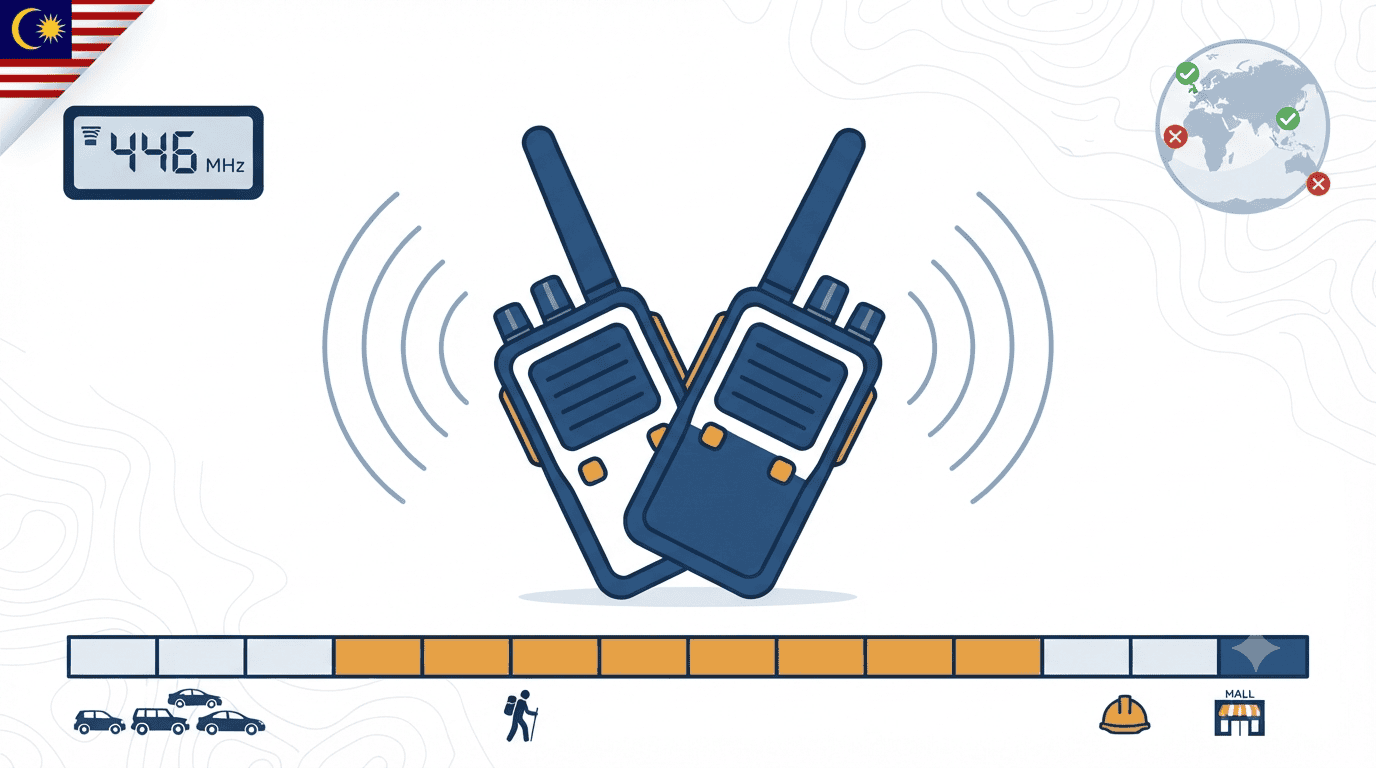
PMR446 (Private Mobile Radio 446 MHz) is the international standard for license-free, short-range voice communication using handheld walkie talkies. Since 24 June 2025, Malaysia has fully adopted PMR446 as the sole license-free personal radio service under MCMC Class Assignment No. 2 of 2025, replacing the old 477 MHz PRS band that many Malaysians had been using for years.
This guide covers everything you need to know about PMR446 in Malaysia: frequencies, channels, power limits, equipment, antenna rules, legal restrictions, recommended radios, and what happens when you take your walkie talkie overseas.
1. What Is PMR446?
PMR446 is a license-free radio service originally established in Europe under CEPT/ECC Decision (15)05. It allows anyone to operate a low-power handheld radio on the 446 MHz band without needing an individual license, provided the equipment meets specific technical standards.
The key characteristics of PMR446 are:
- License-free: No application, no fee, no callsign required
- Handheld only: No base stations, no repeaters, no vehicle-mounted units with external power
- Short-range: Typically 500 metres to 3 km in urban areas, up to 5 km or more in open terrain
- Simplex: One frequency, push-to-talk, no duplex operation
- Peer-to-peer: Radios talk directly to each other, no infrastructure needed
In Malaysia, PMR446 is governed by the Communications and Multimedia Act 1998 (Act 588) and the Communications and Multimedia (Spectrum) Regulations 2000. MCMC issues a Class Assignment that permits anyone to use PMR446 equipment, provided the device is type-approved and carries a SIRIM/MCMC label.
2. Frequencies and Channels
The PMR446 band spans 446.0 MHz to 446.2 MHz and is divided into two segments: analogue and digital.
2.1 Analogue PMR446 (FM Voice)
The analogue segment uses 12.5 kHz channel spacing with narrowband FM (NFM) modulation. There are 16 channels:
| Channel | Frequency (MHz) | Channel Spacing | Notes |
|---|---|---|---|
| 1 | 446.00625 | 12.5 kHz | NFM |
| 2 | 446.01875 | 12.5 kHz | NFM |
| 3 | 446.03125 | 12.5 kHz | NFM |
| 4 | 446.04375 | 12.5 kHz | NFM |
| 5 | 446.05625 | 12.5 kHz | NFM – Scouts (5/5) |
| 6 | 446.06875 | 12.5 kHz | NFM |
| 7 | 446.08125 | 12.5 kHz | NFM – Mountain safety (7/7) |
| 8 | 446.09375 | 12.5 kHz | NFM |
| 9 | 446.10625 | 12.5 kHz | NFM |
| 10 | 446.11875 | 12.5 kHz | NFM |
| 11 | 446.13125 | 12.5 kHz | NFM |
| 12 | 446.14375 | 12.5 kHz | NFM |
| 13 | 446.15625 | 12.5 kHz | NFM |
| 14 | 446.16875 | 12.5 kHz | NFM |
| 15 | 446.18125 | 12.5 kHz | NFM |
| 16 | 446.19375 | 12.5 kHz | NFM |
Before January 2018, only channels 1-8 were available for analogue use. The expansion to 16 channels followed ECC Decision (15)05, which Malaysia has now adopted.
2.2 Digital PMR446
The digital segment uses the upper half of the band (446.1 MHz to 446.2 MHz) and supports two digital standards:
dPMR446 (FDMA): Uses 6.25 kHz channel spacing with 4FSK modulation, defined by ETSI TS 102 490. This gives 32 digital channels.
DMR Tier 1 (TDMA): Uses 12.5 kHz channel spacing with two-slot TDMA, defined by ETSI EN 300 113-2. This gives 16 digital channels.
Digital PMR446 offers several advantages over analogue:
- Clearer audio, especially at the edge of range
- Better noise rejection
- Support for short data messages and GPS location
- More efficient use of spectrum
- Battery life improvements due to lower duty cycle
However, analogue and digital radios on the same channel are not directly compatible. A dPMR radio cannot decode a DMR signal, and vice versa. Most modern digital PMR446 radios support both analogue and digital modes, switching automatically or manually.
3. Power Limits
The maximum power output for PMR446 in Malaysia is 0.5 watts ERP (500 mW). This applies to both analogue and digital modes. This is the same limit used across Europe and most PMR446-adopting countries.
This power limit is intentionally low. PMR446 is designed for short-range personal and business communication, not long-distance DXing. The low power also means the band can be shared by many users in the same area without excessive interference.
Important: Many cheap programmable radios sold in Malaysia (such as the Baofeng UV-5R) can output 5 watts or more. These are not PMR446 radios. They are amateur radio transceivers that require an Amateur Radio Operator’s Certificate (AROC) and Apparatus Assignment (AA) from MCMC. Using a 5W radio on PMR446 frequencies without a licence is illegal and can result in fines under Act 588.
4. Antenna Rules
One of the strictest rules in PMR446 is the antenna requirement. Under the ETSI standard (EN 303 405) and MCMC Class Assignment:
- The antenna must be integral (built-in and fixed)
- The antenna must not be removable by the user
- You cannot swap to a higher-gain external antenna to boost range
- No external antenna connectors are permitted on PMR446 equipment
This rule exists to prevent users from increasing their effective radiated power beyond the 0.5W ERP limit by using high-gain antennas. A removable antenna would also allow connection to amplifiers or external antennas mounted on buildings, which would violate the handheld-only, short-range intent of the service.
Permitted accessories include external microphones (including VOX types), earphones, headphones, external speakers, and battery packs. These do not affect the RF characteristics of the radio.
5. CTCSS and DCS Privacy Codes
PMR446 channels are shared. If two groups are on the same channel in the same area, they will hear each other. To reduce unwanted interference, PMR446 radios support two signalling systems:
CTCSS (Continuous Tone-Coded Squelch System): A sub-audible tone (between 67 Hz and 254.1 Hz) is transmitted continuously. The receiving radio only opens its squelch if it detects the correct tone. There are 50 standard CTCSS tones.
DCS (Digital-Coded Squelch): A continuous digital code is transmitted at low level. The receiver only opens if the correct code is detected. There are 105 standard DCS codes plus their inverted variants.
Important: CTCSS and DCS do not make your conversation private. They only prevent you from hearing other users who are using a different tone or code. Anyone on the same channel with no tone (or the correct tone) can still hear you. Think of it as a doorbell, not a lock.
6. Legal Restrictions in Malaysia
Under MCMC Class Assignment No. 2 of 2025, the following rules apply to PMR446 operation in Malaysia:
- SIRIM/MCMC certification is mandatory. Every PMR446 radio sold in Malaysia must be type-approved by SIRIM and carry the MCMC label. No label means illegal radio.
- 0.5W maximum power. Any radio capable of transmitting above 0.5W on the 446 MHz band is not a PMR446 device and requires a licence.
- Fixed antenna only. The antenna must be integral and non-removable.
- No encryption. PMR446 channels must remain open. Speech inversion (analogue scrambling) is permitted in some jurisdictions, but full digital encryption is not.
- No phone patch. You cannot connect a PMR446 radio to a telephone line or network.
- No repeaters. PMR446 is simplex, peer-to-peer only. No repeater operation, no duplex, no store-and-forward.
- 180-second transmission limit. The maximum continuous transmission time is 180 seconds (3 minutes). The radio must automatically cut transmission after this period.
- No harassment, hoax calls, or jamming. Channel commandeering is only permitted for genuine emergency communications.
- Handheld only. No base stations, no vehicle-mounted units with external power, no fixed installations.
Violations can result in fines under Act 588, confiscation of equipment, and prosecution.
7. What Happened to 477 MHz?
Before PMR446, Malaysia used a license-free PRS service on the 477 MHz band. Many Malaysians still have old 477 MHz walkie talkies (such as the popular Baofeng BF-888S programmed for 477 MHz frequencies) sitting in drawers or being sold second-hand.
Under Class Assignment No. 2 of 2025, the 477 MHz band is no longer listed for personal radio service. This means:
- 477 MHz walkie talkies are now illegal to operate in Malaysia
- You cannot legally transmit on 477 MHz PRS frequencies anymore
- If you still have a 477 MHz radio, it should be retired or reprogrammed (if it supports 446 MHz, which many do not)
The transition from 477 MHz to PMR446 aligns Malaysia with the international standard used by Europe, Singapore, Thailand, and many other countries. This means a PMR446 radio bought in Malaysia can be used in any PMR446-adopting country (subject to local rules, see Section 9 below).
8. Recommended PMR446 Radios
When buying a PMR446 radio in Malaysia, look for two things: the PMR446 label and the SIRIM Approved sticker. Here are some popular and reliable options:
8.1 Analogue PMR446 Radios
Baofeng BF-88ST Pro: An affordable entry-level PMR446 radio with 16 channels, 0.5W output, non-removable antenna, 1200 mAh battery, and CTCSS/DCS support. Available in both FRS (US) and PMR446 (Europe/Malaysia) versions. Make sure you buy the PMR446 version.
Retevis RT24: A business-grade PMR446 radio with rugged design, long battery life, and good audio quality. Popular for restaurants, warehouses, and event management. 16 channels, 0.5W, IP-rated construction.
Retevis RT648: An IP67 waterproof PMR446 radio designed for outdoor and industrial use. Can withstand submersion in 1 metre of water for 30 minutes. Good for hiking, construction sites, and marine environments.
Motorola TLKR T8: A premium consumer PMR446 radio with LCD display, vibration alert, and good build quality. 8 analogue channels, 0.5W, rechargeable battery. More expensive but reliable.
8.2 Digital PMR446 Radios
Retevis RT40: A dual-mode PMR446 radio supporting both analogue and DMR digital modes. 48 channels (32 digital + 16 analogue), 0.5W, 2000 mAh battery, Type-C charging. Good value for a digital radio.
Icom IC-F29DR3: A professional-grade dPMR446 radio with excellent audio quality, rugged construction, and long battery life. More expensive but built to last. Supports both analogue and digital modes.
Kenwood ProTalk TK-3401D: A dPMR446 radio that can switch between 6.25 kHz digital and 12.5 kHz analogue at the press of a button. Compact, lightweight, and well-built.
8.3 What to Avoid
Avoid any radio advertised as “UHF 400-470 MHz programmable” or “136-174/400-470 MHz”. Sellers may claim these are “license-free if you set to PMR446”, but if the radio can transmit outside 446 MHz at more than 0.5W, MCMC considers it a controlled item. You need an Amateur Radio licence for those.
Specifically, the following popular radios are not PMR446 and require an amateur radio licence:
- Baofeng UV-5R (5W, programmable, removable antenna)
- Baofeng BF-F8HP (8W, programmable, removable antenna)
- Quansheng UV-K5 (5W, programmable, removable antenna)
- Any radio with a removable antenna and power above 0.5W
9. Taking PMR446 Overseas
Your PMR446 walkie talkie is 100% legal in Malaysia. Once you leave the country, you are subject to the local spectrum regulations of whatever country you are in. “License-free in Malaysia” does not mean “license-free worldwide”.
9.1 Where PMR446 Is Legal
PMR446 is legal in most of Europe and many Asian countries:
| Country/Region | PMR446 Legal? | Notes |
|---|---|---|
| European Union, UK | Yes | Original PMR446 standard. Specs match Malaysia exactly. |
| Singapore | Yes | IMDA allows 446 MHz, 0.5W ERP |
| Thailand | Yes | NBTC allows 446 MHz PMR446 |
| Indonesia, Vietnam | Likely yes | Many follow 446 MHz, but check current regulations |
| Malaysia | Yes | Under MCMC Class Assignment No. 2 of 2025 |
9.2 Where PMR446 Is NOT Legal
| Country/Region | PMR446 Legal? | Alternative Service |
|---|---|---|
| USA, Canada | No | FRS (462/467 MHz, 2W max, 22 channels). 446 MHz is allocated to licensed amateur radio. |
| Australia, New Zealand | No | UHF CB (476-477 MHz, 5W max, 80 channels) |
| Japan | No | Specific 422 MHz band, 10 mW only. 446 MHz not permitted. |
| China, UAE, Qatar, India | Strictly no | 446 MHz reserved for government/military. Import without permit = confiscation. |
9.3 Practical Advice for Travel
- Check before you travel: Search for “PMR446 legal in [country name]” or check the local regulator’s website (FCC for USA, ACMA for Australia, IMDA for Singapore, etc.)
- Match the specs: Even if a country allows 446 MHz, the power limit may be lower than 0.5W. A 500 mW Malaysian set would be illegal in a 10 mW country.
- Antenna must be fixed: This is a universal PMR446 requirement. If your radio has a removable antenna, it may not be legal even in PMR446 countries.
- Customs declarations: In countries where 446 MHz is restricted (China, UAE, India), you must declare the radio at customs. No permit = confiscation on arrival.
- Europe is generally safe: If your radio is genuine PMR446 with CE marking, it should be legal throughout the EU and UK.
- USA is a common trap: Many Malaysians travelling to the US assume their PMR446 radio is fine. It is not. 446 MHz in the US is part of the amateur radio 70 cm band. You need an FCC amateur licence to transmit there.
9.4 PMR446 vs FRS vs GMRS vs UHF CB Comparison
| Feature | PMR446 | FRS (US) | GMRS (US) | UHF CB (AU) |
|---|---|---|---|---|
| Frequency | 446 MHz | 462/467 MHz | 462/467 MHz | 476/477 MHz |
| Channels | 16 analogue + 32 digital | 22 | 30 | 80 |
| Max Power | 0.5W ERP | 2W | 50W | 5W |
| License Required | No | No | Yes ($35 FCC, 10 years) | No |
| Antenna | Fixed/integral only | Fixed (FRS-only units) | Removable allowed | Removable allowed |
| Repeaters | No | No | Yes | Yes |
| Legal In | EU, UK, MY, SG, TH | USA, Canada | USA only | Australia, NZ |
As you can see, a PMR446 radio and an FRS radio operate on completely different frequencies. They cannot communicate with each other. If you are travelling to the US and need license-free radio, buy an FRS radio locally.
10. Common Use Cases for PMR446 in Malaysia
PMR446 is ideal for short-range communication where mobile phones are impractical or where you want instant, no-cost, push-to-talk communication within a group:
- Convoy coordination: Family road trips, group motorcycle rides, cycling events
- Outdoor activities: Hiking, camping, fishing, bird watching, geocaching
- Events: Wedding coordination, sports events, fun runs, community gatherings
- Business: Restaurants, retail shops, warehouses, construction sites, security teams
- Marine and water activities: Boat-to-boat communication, jet ski groups, kayaking (use waterproof models like the Retevis RT648)
- Shopping malls and large buildings: Security staff, maintenance teams, parking coordination
- Emergency preparedness: Keeping a pair of PMR446 radios in your emergency kit for when mobile networks go down
Limitations to keep in mind: PMR446 is not suitable for safety-of-life communications. The service is unprotected, meaning MCMC will not investigate interference complaints between PMR446 users. If you need guaranteed communication for critical operations, you need a licensed radio service.
11. Range Expectations
The actual range of a PMR446 radio depends heavily on terrain, obstacles, and environmental conditions. With 0.5W and a fixed antenna, here are realistic expectations:
| Environment | Expected Range |
|---|---|
| Dense urban (city centre, tall buildings) | 300-500 metres |
| Suburban (houses, low buildings) | 500 metres – 1 km |
| Open flat terrain (fields, parks) | 1-3 km |
| Open water (sea, lake) | 2-5 km |
| Hilltop to hilltop (line of sight) | 5-10 km |
| Forest/jungle (dense vegetation) | 200-500 metres |
UHF frequencies like 446 MHz penetrate buildings better than VHF, which is why PMR446 works reasonably well inside shopping malls and warehouses. However, concrete walls, metal structures, and underground areas will significantly reduce range.
12. PMR446 vs Amateur Radio: Which Is Right for You?
Many people ask whether they should get a PMR446 radio or an amateur radio licence. The answer depends on your needs:
| Feature | PMR446 | Amateur Radio (9M/9W) |
|---|---|---|
| License required | No | Yes (RAE exam + AA) |
| Cost | RM 50-300 per radio | RM 100+ exam fee + RM 50-1000+ radio |
| Max power | 0.5W | 50W (Class B) or 1000W (Class A) |
| Range | Up to 5 km | City-wide to worldwide (HF) |
| Frequencies | 446 MHz only | HF, VHF, UHF bands |
| Antenna | Fixed only | Any antenna, any height |
| Repeaters | No | Yes |
| Satellite/ISS | No | Yes |
| Digital modes | Limited (dPMR/DMR) | Extensive (APRS, FT8, DSTAR, etc.) |
| Use case | Family, events, business | Hobby, emergency comms, experimentation |
If you just need to talk to your family at the shopping mall or coordinate a convoy, PMR446 is the right choice. If you want to talk to people in other states or countries, experiment with digital modes, or participate in emergency communications, get an amateur radio licence.
13. PMR446 vs GMRS: A Detailed Comparison
GMRS (General Mobile Radio Service) is the United States’ answer to the need for more powerful personal radio communication. While PMR446 is the standard in Malaysia, Europe, and much of Asia, GMRS is the go-to service for families and groups in the US who need more range than FRS offers but do not want to sit an amateur radio exam. Understanding the differences between PMR446 and GMRS is important, especially for Malaysians who travel to the US or read about American radio culture online.
13.1 Regulatory Framework
PMR446 in Malaysia is governed by MCMC under a Class Assignment, which means no individual licence is needed. Anyone can buy a SIRIM-approved radio and start using it immediately.
GMRS in the United States is governed by the FCC under Part 95, Subpart E of the FCC Rules. Unlike PMR446, GMRS requires an FCC licence. The licence costs USD 35, is valid for 10 years, and covers the licensee and their immediate family members. No exam is required, but you must apply through the FCC Universal Licensing System (ULS).
13.2 Frequencies and Channels
PMR446 operates on 446.0 to 446.2 MHz with 16 analogue channels (12.5 kHz spacing) and up to 32 digital channels. All channels are simplex.
GMRS operates on 462 MHz and 467 MHz with 30 channels. The channel structure is more complex:
- Channels 1-7: Shared with FRS. Simplex, 5W max for GMRS.
- Channels 8-14: Shared with FRS. Simplex, 0.5W max (same as PMR446 power).
- Channels 15-22: GMRS-only simplex channels, 50W max.
- Channels 15-22 repeater inputs: 467 MHz, used to access GMRS repeaters.
- 8 repeater pairs: GMRS allows repeater operation, which PMR446 does not.
The ability to use repeaters is one of the biggest advantages of GMRS over PMR446. A GMRS repeater on a hilltop can extend communication range to 20 miles (32 km) or more, while PMR446 is limited to direct radio-to-radio communication with no repeater support.
13.3 Power Output
This is where the two services differ dramatically:
| Specification | PMR446 (Malaysia) | GMRS (USA) |
|---|---|---|
| Maximum power | 0.5W ERP | 50W ERP (on channels 15-22) |
| Low-power channels | All channels 0.5W | Channels 8-14: 0.5W only |
| Shared channels | N/A | Channels 1-7: 5W max for GMRS |
| Effective range (urban) | 300-500 metres | 1-3 km (handheld), 8-16 km (mobile) |
| Effective range (open) | 1-5 km | 5-10 km (handheld), 20+ km (repeater) |
GMRS radios can be 100 times more powerful than PMR446 radios on the high-power channels. This is why GMRS is popular with off-road groups, overlanding communities, and rural families in the US who need reliable communication over large distances.
13.4 Equipment Restrictions
| Feature | PMR446 | GMRS |
|---|---|---|
| Antenna | Fixed/integral only, non-removable | Removable antenna allowed on GMRS-only channels |
| Radio type | Handheld only | Handheld, mobile, and base station allowed |
| External power | Not permitted | Allowed (mobile and base stations) |
| Repeaters | Not allowed | Allowed (8 repeater pairs) |
| Phone patch | Not allowed | Allowed (with restrictions) |
| Encryption | Not allowed | Not allowed (voice only, no encryption) |
| Text messaging | Limited (digital PMR446 only) | Allowed (short data messages since 2017 FCC update) |
| GPS location | Limited (digital PMR446 only) | Allowed (since 2017 FCC update) |
The removable antenna rule is a major difference. PMR446 radios must have a fixed antenna, which limits range optimisation. GMRS radios (on GMRS-only channels) can use external antennas mounted on vehicles or buildings, dramatically improving range.
13.5 Licensing Comparison
| Requirement | PMR446 (Malaysia) | GMRS (USA) |
|---|---|---|
| Licence required | No | Yes (FCC GMRS licence) |
| Cost | Free | USD 35 (RM ~150) |
| Validity | No expiry (Class Assignment) | 10 years, renewable |
| Exam required | No | No |
| Covers family | Yes (anyone can use) | Yes (immediate family members) |
| Callsign assigned | No | Yes (FCC callsign, e.g. WRXYZ) |
| Identification | Not required | Required (callsign at end of transmission and every 15 minutes) |
One advantage of PMR446 is simplicity. No licence, no callsign, no identification, no paperwork. You buy the radio and use it. GMRS requires an FCC licence and callsign identification, but the process is straightforward since no exam is needed.
13.6 Use Case Comparison
Choose PMR446 if you:
- Live in Malaysia, Singapore, Europe, or any PMR446-adopting country
- Need short-range communication (under 5 km)
- Want zero paperwork and zero cost beyond the radio itself
- Are using it for family outings, events, or small business coordination
- Want a radio you can carry in your pocket
Choose GMRS if you:
- Live in the United States
- Need longer range (5-20+ km)
- Want to use repeaters for extended coverage
- Are part of an off-road, overlanding, or rural community
- Want mobile or base station capability
- Are willing to pay USD 35 for a 10-year licence
13.7 Can You Use GMRS in Malaysia?
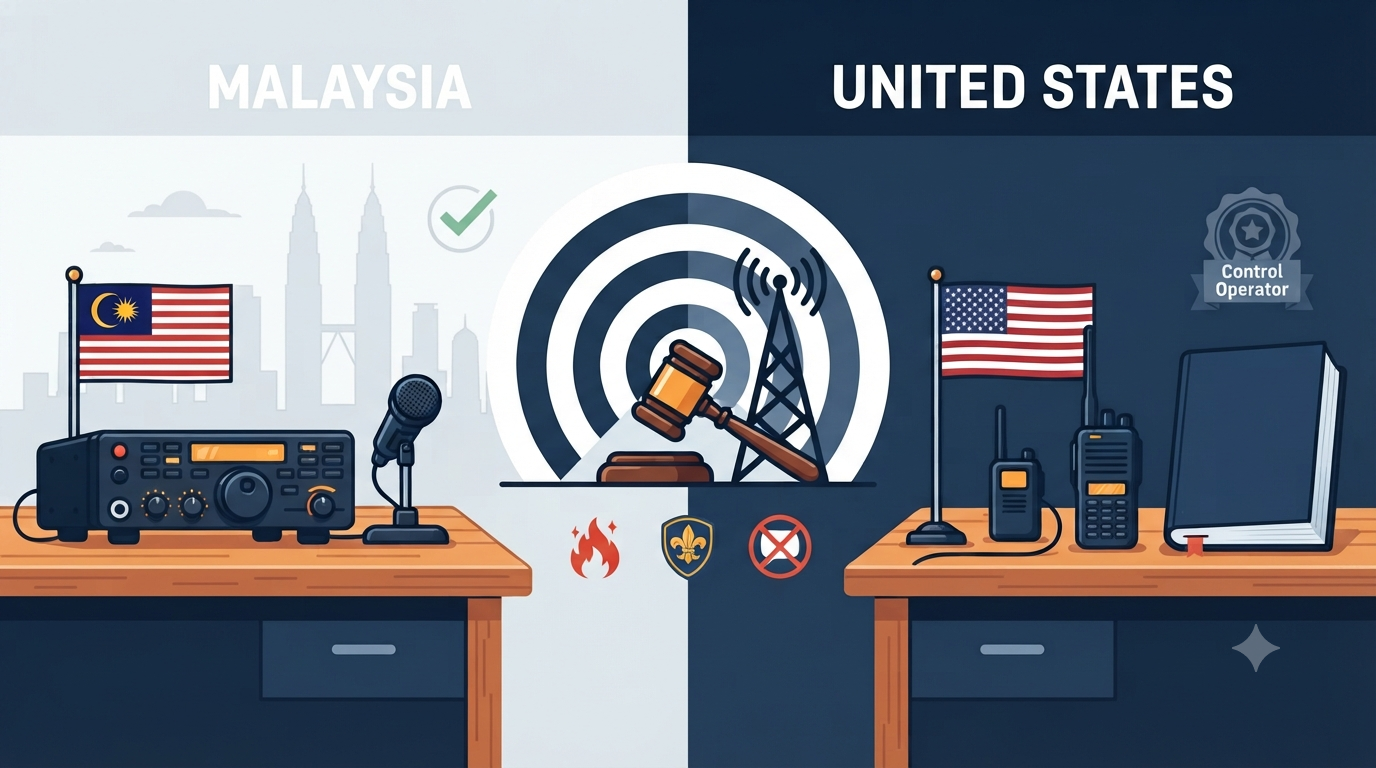
No. GMRS frequencies (462 MHz and 467 MHz) are not allocated for personal radio service in Malaysia. Transmitting on GMRS frequencies in Malaysia without an appropriate licence is illegal under Act 588. If you import a GMRS radio from the US, you cannot legally use it in Malaysia.
Conversely, you cannot use a PMR446 radio in the US either. The 446 MHz band in the US is part of the amateur radio 70 cm allocation, and transmitting there requires an FCC amateur radio licence. This is a common mistake made by travellers who assume their PMR446 radio is universally legal.
13.8 Summary Table
| Feature | PMR446 (Malaysia) | GMRS (USA) |
|---|---|---|
| Frequency band | 446.0 to 446.2 MHz | 462 MHz and 467 MHz |
| Channels | 16 analogue + 32 digital | 30 (22 shared with FRS + 8 GMRS-only) |
| Max power | 0.5W ERP | 50W ERP |
| Licence | None (Class Assignment) | FCC licence (USD 35, 10 years) |
| Exam | None | None |
| Antenna | Fixed, non-removable | Removable (GMRS channels) |
| Repeaters | No | Yes (8 repeater pairs) |
| Radio type | Handheld only | Handheld, mobile, base station |
| Range (typical) | 0.5 to 5 km | 1 to 20+ km (repeater) |
| Callsign ID | Not required | Required |
| Encryption | No | No |
| Legal in Malaysia | Yes | No |
| Legal in USA | No (requires amateur licence) | Yes (with licence) |
| International compatibility | EU, UK, SG, TH, and others | USA only |
The bottom line is that PMR446 and GMRS serve similar purposes but are designed for different regulatory environments. PMR446 prioritises simplicity and international compatibility. GMRS prioritises range and flexibility within the US. Neither is better in absolute terms, they are just optimised for different markets and use cases.
Conclusion
PMR446 is now the standard for license-free walkie talkie communication in Malaysia. It is simple, affordable, and internationally compatible with most of Europe and many Asian countries. The rules are straightforward: 0.5W, fixed antenna, 446 MHz, no repeaters, no encryption, handheld only.
If you are still using an old 477 MHz radio, it is time to upgrade. If you are tempted by a cheap 5W Baofeng UV-5R, remember that it is not a PMR446 radio and requires a licence. Buy a proper SIRIM-approved PMR446 radio, keep it within the rules, and enjoy reliable, license-free communication for your everyday needs.
And if you find that PMR446 range is not enough for your needs, consider sitting the MCMC Radio Amateur Examination (RAE) to get your amateur radio licence. With a Class B AROC, you can transmit up to 50W on VHF and UHF, use repeaters, and access a whole world of radio communication that PMR446 cannot offer.
References
- MCMC Class Assignment No. 2 of 2025 (MCMC, 24 June 2025).
- CEPT/ECC Decision (15)05 – Harmonised frequency range 446.0-446.2 MHz for analogue and digital PMR446.
- ETSI EN 303 405 – Harmonised Standard for Analogue and Digital PMR446 Equipment.
- ETSI TS 102 490 – Peer-to-Peer Digital PMR using FDMA, 6.25 kHz channel spacing.
- Wikipedia – PMR446 – General reference and channel tables.
- Ofcom IR2009 – Analogue and Digital PMR446 Information Sheet (UK).
- FCC – General Mobile Radio Service (GMRS) (USA).
- Malaysia’s License-Free Walkie Talkie Frequencies: The 2025 MCMC Update (Hamradio.my).
- Can You Use a Malaysian PMR Walkie Talkie Overseas? (Hamradio.my).
- MCMC Amateur Radio Operator Certification – RAE exam information.
⚠ Disclaimer & Ongoing Updates: This article reflects our understanding of PMR446 regulations in Malaysia at the time of writing and is not legal advice. MCMC Class Assignments may change. If you have any corrections, additional references, or alternative interpretations, please leave a comment below. Your input helps keep this article accurate and useful for everyone.



Post Comment