DXRank.net: Live Performance-Based Ranking Dashboard for Ham Radio Operators
TL;DR: Quick Summary
DXRank.net is a free live ranking dashboard for amateur radio operators that scores real completed contacts by how hard they were, not by how many you logged. Built by Marco Tomassini, it fetches fresh QSOs every 5 seconds, refreshes rankings every 15 seconds, and weighs distance, mode, bandwidth, manual versus automated operation, logged station power, band and propagation conditions, and timing into a single all-time DXRank Score. Gold, Silver, Bronze and Oak medals mark your lifetime standing, letter-and-number tiers track daily, weekly and monthly form, and a free banner puts your rank, score and QSO map on your QRZ biography page. Registration is open, ADIF log import works now, and Pro analysis tools are on the way.
What Is DXRank?
DXRank is a live performance-based ranking platform for radio amateurs that turns completed on-air contacts into a transparent skill score, a worldwide leaderboard, and a lasting record of operating achievement.
That sentence matters because almost every ranking hams know counts volume. DXCC counts entities confirmed. Contest results count points piled up in 48 hours. Club Log charts count band slots filled. DXRank asks a different question: how demanding was each contact, and what does it say about the operator who made it? A patient 5-watt SSB contact across 12,000 km of marginal propagation can outscore several automated digital contacts to nearby stations, because the system explicitly rewards distance reached, skill used, and challenge overcome.
Why Performance Ranking Fills a Real Gap
A short history of ham rankings
Amateur radio has ranked operators for nearly a century, and each system reflects the values of its era:
- 1937: DXCC. The ARRL DX Century Club set the classic target: confirm 100 DX entities. Pure achievement counting, verified by cards and later by Logbook of the World. Still the gold standard of DXing.
- 1990s to 2000s: Online logs. eQSL, QRZ Logbook, and HRDLOG moved confirmations online and added their own award ladders.
- 2008: Club Log. Michael G7VJR built log analysis forDXers: DXCC tracking, band-slot tables, most-wanted lists, and expedition leaderboards. Analytical, but still volume and entity driven.
- 2010s: Contest scoreboards. Live scoreboards during CQ WW and CQ WPX showed rates and multipliers in real time, but only inside contest weekends.
- 2020s: FT8 and the volume flood. Automated and semi-automated digital modes made huge contact totals cheap. A station running unattended FT8 can log more in a weekend than a CW operator logs in a year, and traditional totals can’t tell the two apart.
DXRank is a product of that last development. When contact counts stopped distinguishing effort from automation, somebody had to score the effort itself. DXRank scores every eligible QSO with a versioned proprietary algorithm that weighs how the contact was made, then publishes the result live.
The core idea in one paragraph
Every contact earns points from a simple spine: distance divided by kilometres per base point, multiplied by a power factor and a mode factor, with bonuses descending in tier order, plus extras such as a regional band bonus of 1.30x when you succeed on a quiet band. Manual operating beats automation. Low power beats high power for the same path. A contact on a dead band beats the same contact on the wide-open band. Your all-time DXRank Score is the sum of everything, and it never resets.
Inside the Live Dashboard
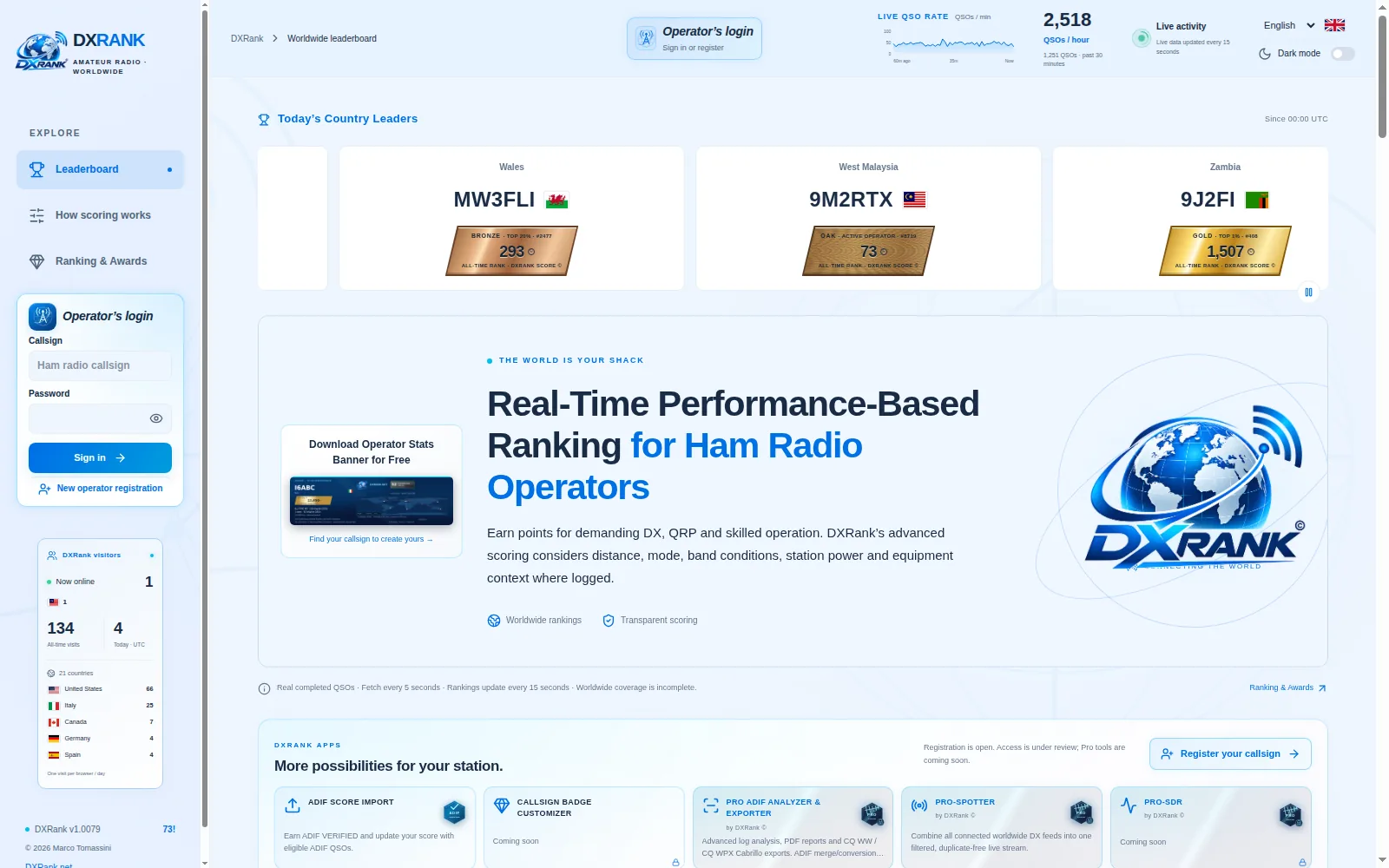
The homepage at DXRank.net opens on the worldwide leaderboard, and it feels alive in a way static award pages never do. At the time of writing, the header showed a live QSO rate graph, 2,509 QSOs per hour, and 1,247 QSOs in the past 30 minutes, with a note that live data updates every 15 seconds. A demo network banner appears when you browse without data, so first-time visitors always see the layout working.
Today’s Country Leaders
Below the hero sits the most addictive panel on the site: Today’s Country Leaders, reset at 00:00 UTC. Each card names one leading operator per DXCC country, with their medal, percentile, competition rank, and all-time score. During research for this article the cards included MW3FLI of Wales on Bronze with 293 points, 9M2RTX of West Malaysia as an active Oak operator with 73 points, and 9J2FI of Zambia on Gold with 1,507 points. Seeing a 9M callsign on the board on an ordinary day shows the system tracks Malaysian stations in real time, and it gives local operators a daily reason to check in.
Live activity and transparency notes
The site is unusually honest about its pipeline. It states plainly: real completed QSOs, fetch every 5 seconds, rankings processed every 15 seconds, QSO history shown with a 10-minute delay covering 60 to 10 minutes ago, contacts expiring 30 minutes after their logged QSO time, and worldwide coverage incomplete. That last line is important. DXRank doesn’t claim to see every QSO on earth. It ranks what it can verify, and says so.
Five languages and dark mode
The interface ships in English, Italian, German, Spanish and French, with a dark mode toggle and an installable layout that can be added to a phone home screen. The whole project carries a 2026 copyright to Marco Tomassini with a version stamp (v1.0079 at the time of writing), and the footer signs off with 73, as it should.
How Scoring Works
The “How scoring works” section is the heart of the project, and it reads like a manifesto for skilled operating.
Every contact, and the skill it takes
The DXRank Scoring System combines an advanced proprietary algorithm with operating context: distance, mode, bandwidth, manual versus automated operation, logged station power, band and propagation conditions, timing, and more advanced parameters calculated in real time. The goal is to recognize the skill behind each radio contact and give operating achievements a place beyond the contact count.
The principles, stated plainly
- Distance earns recognition. A distant station fading into noise, shifting propagation, and changing band conditions make long-haul contacts harder, and the score reflects that.
- How beats how many. A demanding long-distance SSB QSO can outweigh several automated digital contacts. Achievement is more than volume. A very distant automated digital QSO doesn’t necessarily outweigh a shorter SSB contact.
- QRP gets its due. An otherwise comparable contact made with lower station power receives greater recognition for the additional challenge. With QRP, every watt matters.
- Dead bands pay. A QSO on a less favorable band can earn more than a comparable contact on the most active open band for that time and region. Overcoming difficult conditions deserves recognition, and a regional band bonus of 1.30x applies when either station triggers it on a qualifying quiet band.
- Every mode belongs. The system celebrates different kinds of challenge instead of declaring one true mode, and it is designed to evolve as new metrics and insights become available.
- Equipment context counts. Logged station details feed future refinements, so the equipment behind achievements will matter more over time.
Versioned and diagnostic
Scoring is versioned, with collection diagnostics and a preview tool that shows weekly ranking impact before a new version ships. That means rule changes are traceable instead of silent, which is exactly what a ranking with ambition needs.
Two Ways to Wear Your Rank
DXRank splits recognition into a permanent record and a current-form snapshot, and understanding the split is the key to the whole site.
All-time medals: the lasting record
The premium badge beside your callsign totals the score from every eligible QSO stored on the platform and compares you against the full all-time operator population. Points and tier stay consistent across period and equipment filters:
| Medal | Meaning |
|---|---|
| Diamond (aqua-blue) | Ranked number 1 overall |
| Gold | Top 1 percent of all-time operators |
| Silver | Top 5 percent |
| Bronze | Top 20 percent |
| Oak (wood-grain) | Active operator below Bronze cut |
Equal scores share competition rank, and in a small population there may be no Gold qualifiers behind the first-place operator. Your score accumulates permanently, and changing the selected display period never resets progress.
Temporary tiers: current form
The compact glossy badge shows a letter-and-number tier for performance across all eligible QSOs in the selected GMT period, independent of other filters. It awards no separate points. Points accumulate only in the all-time score, while the tier tells the story of your day, week, or month:
| Tier | Meaning |
|---|---|
| S1, S2, S3 | Top 1, 3, and 6 percent (elite short-period form) |
| A | Top 10, 15, or 20 percent |
| B | Top 30, 40, or 50 percent |
| C | Top 60, 70, or 80 percent |
| D | Top 90, 95, or 100 percent |
Callsign sheets and banners show the period dates, so a shared badge is always readable in context. The design message is clear: the medal says who you are, the tier says how hot you’re right now.
Coming soon: physical awards
The ranking section teases awards, prizes, and gadgets, including a concept premium glass desk stand with a bolted CNC-milled metal badge engraved with the example Gold Tier for I6ABC. Availability and requirements will be announced on the site.
Operator Tools: From ADIF Import to QRZ Banner
Registration is open. You sign up with your callsign, set a password (securely hashed, never viewable), and access is granted under review. Once inside, the DXRank Apps panel offers a practical toolchain.
ADIF score import (working now)
No API subscription is needed. Export ADIF from your logging program (up to 1 MB or 1,000 records per file), drop it into the import preview, and the tool selects only eligible contacts: completed contacts involving your callsign, with valid UTC date and time from launch onward, matching your signed-in station callsign. Historical, incomplete, and mismatched contacts are excluded, existing QSOs are never counted twice, and nothing is added until you confirm. Imported logs are labeled as user-provided, only scoring fields are retained, and the live map shows newly accepted eligible contacts. An ADIF verification medal marks operators who complete the process.
Pro ADIF analyzer and exporter (coming soon)
The Pro tier promises full historical log analysis with detailed band, mode, and activity charts, PDF statistics reports, and Cabrillo 3.0 exports for CQ WW and CQ WPX in CW or SSB, plus POTA submissions through ADIF. Contest exchanges must be recorded or corrected, and the tool refuses to guess missing data. This is the correct philosophy for contest paperwork, and it will make DXRank a pre-contest analysis stop if delivered.
QRZ biography banner (free)
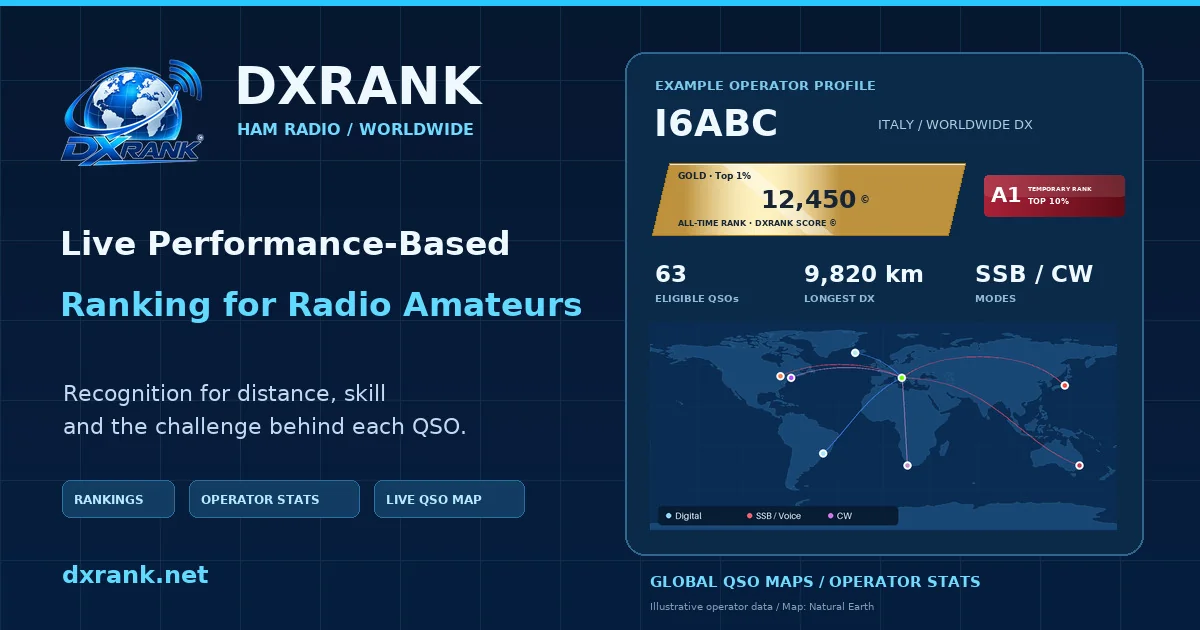
The friendliest feature on the site is free today: search your callsign, generate a personal operator stats banner with your rank, score, QSO map, and statistics, then add it to your QRZ biography with the image tool or pasted HTML. The image follows the selected period and refreshes every few minutes. The example I6ABC banner with Gold rank and A1 tier shows exactly how it looks, and it’s the fastest way to carry your DXRank identity across the web.
Callsign badge customizer, Pro Spotter, Pro SDR
Three more tiles round out the roadmap. The callsign badge customizer will personalize the rank badge itself. Pro Spotter will merge connected worldwide DX feeds into one filtered duplicate-free live stream (with the honest caveat that spots are reception reports, not confirmed QSOs). Pro SDR is listed as coming soon. Registration for Pro access is open, with tools remaining locked until granted.
Data Honesty: What DXRank Will Not Do
Trustworthy rankings need visible boundaries, and DXRank states several:
- Spots aren’t QSOs. Reception reports and DX cluster spots never enter the feed, map, or rankings as contacts.
- Evaluated sources stay isolated. Trial scans of reviewed public providers and their documented access never leak evaluated data into the main rankings. Evaluation stops on refresh, navigation away, or an expired heartbeat.
- Duplicates collapse. Confirmed processed QSOs count once per contact, not once per reporting station.
- Coverage is incomplete. The site says worldwide coverage is incomplete, right on the front page. Rankings compare the verified visible population fairly, with percentile logic and shared ranks for ties, instead of pretending to omniscience.
In a hobby full of black-box leaderboards, that candor is a feature.
Comparison: DXRank Against Classic Rankings
| Attribute | DXRank | DXCC (ARRL) | Club Log | QRZ Awards | Contest Scoreboards |
|---|---|---|---|---|---|
| What it measures | Skill-weighted contact performance | Entities confirmed | Log analysis, slots, most-wanted | Confirmations and operating awards | Points within one event |
| Update speed | Live, rankings every 15 seconds | Batch, on log submission | On log upload | On logbook sync | Live during contests only |
| Automation penalty | Yes, manual beats automated | None | None | None | None (assisted classes separate) |
| QRP recognition | Explicit power factor | None | None | None | None (categories only) |
| Band difficulty bonus | Yes, regional 1.30x quiet-band bonus | None | None | None | None |
| Cost to participate | Free registration, ADIF import | Award fees apply | Free | Free with account | Entry free, results delayed |
| Physical awards | Planned desk stand and gadgets | Certificates, plaques, medallions | None (charts and tables) | Certificates | Trophies and plaques |
| Best for | Daily motivation and skill proof | Lifetime DX achievement | DX planning and tracking | Casual award chasing | Weekend competition |
The honest takeaway: DXRank doesn’t replace DXCC, Club Log, or contesting. It sits beside them as the daily game, the reason to switch on the rig on a Tuesday, chase a quiet band, run low power, and watch the tier badge move by tomorrow.
Practical Workflows for New Operators
1. Register and claim your callsign
Open DXRank.net, choose new operator registration, and sign up with your callsign. Access is under review, so approval may take time. Once inside, your station page becomes your lasting record.
2. Import your recent log
Export ADIF from your logger (WSJT-X, N1MM, Log4OM, Cloudlog, or anything that writes ADIF), keep the file under the size limits, and run the score import preview. Confirm only when the eligible list looks right. Check back after the next ranking cycle to see your medal move.
3. Put the banner on QRZ
Generate the free operator stats banner and add it to your QRZ biography. It refreshes automatically, so your page always shows current form without maintenance.
4. Hunt a Country Leader card
Check Today’s Country Leaders after 00:00 UTC, find your country’s current leader, and work the bands that leader is scoring on. For Malaysian operators, the West Malaysia card is the daily target to beat.
5. Play the QRP and quiet-band game
The scoring rewards you most where effort is highest. Try a low-power session on a thin band during an unfashionable hour, log accurately with power recorded, and compare the points per QSO against a routine high-power session on the open band. Most operators will find the quiet session wins, and that discovery is the entire point of DXRank.
Honest Limitations
- Coverage is incomplete. Rankings reflect verified visible contacts, not every QSO on earth. Treat percentiles as relative to the active population.
- The algorithm is proprietary. The scoring spine is public but the full weights aren’t, so independent replication is impossible. Versioning and impact previews partly answer this.
- Registration needs approval. Open registration with access under review means you may wait before tools unlock.
- Pro tools are pending. The analyzer, Cabrillo exporter, Spotter, SDR, and badge customizer are announced but not yet delivered.
- Young population effects. With a growing operator base, top-percentile cutoffs can behave oddly, including missing Gold qualifiers behind number one.
- Reddit origins are unverified from here. The announcement thread on r/HamRadio was unreachable during research, so this article is built from the live site itself. If the author posts scoring details in the thread comments, they are worth reading alongside this guide.
Why It Matters
Amateur radio runs on motivation. DXCC gives us the mountain, contests give us the weekends, and clubs give us the community, but none of them answers the small daily question: was tonight’s session any good? DXRank answers it with a number that respects how you operate. It tells the QRP portable station on a hilltop that their evening meant more than a kilowatt of automation, and it tells the newcomer with a wire antenna that a single hard-won contact counts. Systems shape behavior, and a system that pays for distance, skill, and difficult conditions will produce more distance, more skill, and more operators willing to try difficult conditions. That is good for the hobby, good for the bands, and good for every logbook, including yours.
Frequently Asked Questions (FAQ)
What is DXRank.net?
DXRank.net is a free live ranking dashboard for ham radio operators. It scores verified completed QSOs by distance, mode, power, and band difficulty into an all-time DXRank Score with medals and short-period performance tiers.
How is DXRank different from DXCC or Club Log?
DXCC and Club Log count entities, slots, and confirmations. DXRank scores how demanding each contact was, rewarding long paths, manual modes, low power, and quiet bands, with live updates every 15 seconds.
Is DXRank free to join?
Yes. Registration with your callsign is open, ADIF score import and the QRZ biography banner are free, while Pro analysis tools require granted Pro access and remain in development.
How do medals and tiers work?
All-time medals (Diamond, Gold, Silver, Bronze, Oak) rank your lifetime score against every operator. Temporary tiers (S, A, B, C, D with numbers) show form over a selected day, week, or month without separate points.
Can I show my DXRank on QRZ?
Yes. Generate the free operator stats banner for your callsign and embed it in your QRZ biography. The image carries your rank, score, and QSO map and refreshes automatically every few minutes.
Sources and Further Reading
- DXRank.net – Live Performance-Based Ranking for Radio Amateurs – Official homepage, live leaderboard, country leaders, scoring explanation, ranking and awards, and operator apps.
- DXRank Legal and Privacy – Official legal and privacy page covering data handling, cookies, and terms of use.
- r/HamRadio announcement thread for DXRank.net – Community announcement and discussion of the live performance-based ranking dashboard.
- QRZ.com – Callsign database and logbook where DXRank operator banners can be displayed on biography pages.
73 de 9M2PJU



Post Comment