Amateur Radio and the Spirit Behind It
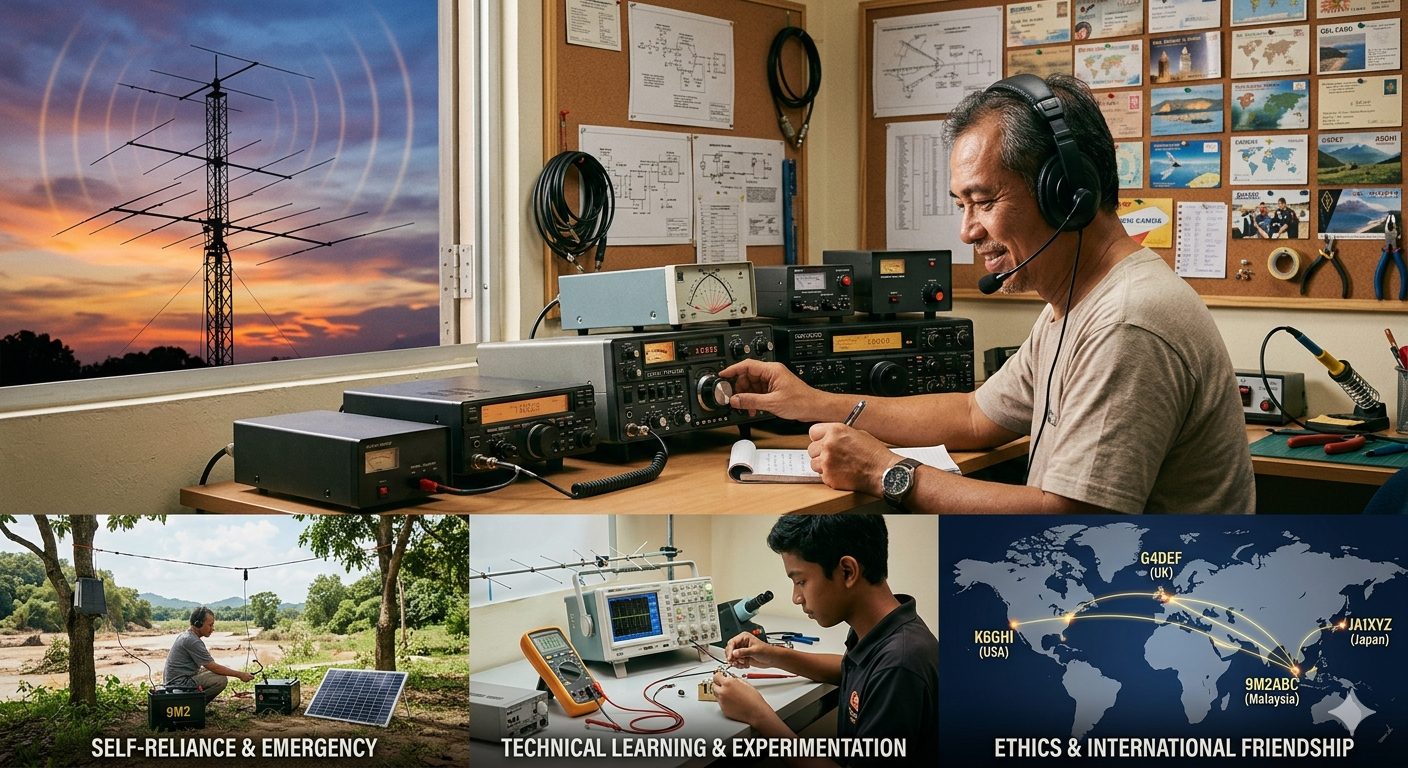
Amateur radio is often misunderstood by modern society, especially in countries where technology is seen only as entertainment, social media, or commercial business. To many people, radio communication looks outdated. Some think it is merely “talking on walkie-talkies.” Others assume it has no purpose in the age of smartphones and the internet.
But those who truly understand amateur radio know that it is far more than equipment, antennas, frequencies, or licenses.
Amateur radio is a culture of discipline, logic, ethics, experimentation, self-reliance, and service to humanity.
It is one of the few hobbies in the modern world where a person’s character matters more than appearance, wealth, or social status.
The Spirit of Amateur Radio
The original spirit of amateur radio was never about popularity or showing off equipment.
It was built upon several core principles:
- Technical learning
- Self-training
- International friendship
- Emergency communication
- Respect for regulations
- Ethical operation
- Contribution to society
A licensed Amateur radio operator learns that communication is not merely speaking. Communication is responsibility.
Every transmission represents the operator’s discipline, technical knowledge, and integrity.
Unlike social media, amateur radio cannot hide a person’s true behavior for very long. Operators quickly become known for either professionalism or poor conduct.
That is why experienced operators respect skill, patience, honesty, and operating ethics more than expensive radios.
Logic and Rational Thinking
Amateur radio naturally attracts people who value logic and critical thinking.
Radio Propagation does not care about emotions, ego, race, politics, or social popularity.
Physics remains physics.
An antenna either works efficiently or it does not.
A feedline either has loss or it does not.
A signal either propagates or it does not.
This environment teaches operators to think rationally instead of emotionally.
Many operators become deeply interested in:
- Electronics
- RF engineering
- Propagation science
- Emergency systems
- Meteorology
- Satellite communication
- Digital modes
- Networking
- Power systems
- Antenna design
The hobby rewards experimentation and evidence-based understanding.
When a station fails, operators troubleshoot logically.
When interference occurs, operators investigate methodically.
When communication breaks down during disasters, operators adapt and improvise.
This mindset builds maturity and problem-solving ability.
The Ethical Foundation
One of the strongest values in amateur radio is ethics.
Ethical operators understand:
- Frequencies are shared resources
- Power should be used responsibly
- Communication should remain respectful
- Emergency traffic has priority
- False information is dangerous
- Interference is unacceptable
- Knowledge should be shared honestly
A good operator does not intentionally jam others.
A good operator does not spread panic and false information.
A good operator does not abuse frequencies for ego or attention.
The best operators are usually calm, disciplined, and technically competent.
In many ways, amateur radio preserves values that modern online culture is slowly losing.
The Difference Between Amateur Radio Culture and Typical Social Thinking
In many societies, including among parts of the Malay community, public thinking is often heavily influenced by emotions, trends, social pressure, and appearances.
People may value:
- Status symbols
- Group approval
- Viral popularity
- Blind loyalty
- Empty arguments
- Emotional reactions over facts
Unfortunately, this mindset sometimes discourages independent thinking.
A person who studies deeply, questions assumptions, or focuses heavily on technical knowledge may even be viewed as strange or overly serious.
Amateur radio culture is different.
In amateur radio:
- Evidence matters
- Skill matters
- Operating discipline matters
- Technical accuracy matters
- Calm behavior matters
- Respect is earned through competence
Nobody cares whether an operator is rich, famous, politically connected, or socially influential if they cannot operate properly.
A simple homemade station operated by a skilled and ethical operator often earns more respect than expensive equipment used irresponsibly.
This is one reason many technically minded individuals feel more comfortable within the amateur radio community than in ordinary social environments.
Self-Reliance and Preparedness
Amateur radio also teaches independence.
When modern systems fail during floods, blackouts, storms, or disasters, amateur radio operators often continue communicating using:
- Batteries
- Solar power
- Portable antennas
- Improvised stations
- Off-grid systems
This spirit of preparedness creates resilient individuals.
Operators learn:
- Power management
- Emergency planning
- Communication discipline
- Field deployment
- Technical improvisation
These are real-world skills that remain valuable even when advanced infrastructure collapses.
Global Brotherhood Beyond Politics
One remarkable aspect of amateur radio is that signals cross borders naturally.
Operators speak with people from different:
- Countries
- Religions
- Cultures
- Languages
- Political systems
Yet the communication remains focused on mutual respect and technical exchange.
A radio signal does not ask about race before propagating.
This creates a unique form of international friendship rarely found elsewhere.
Many operators discover that ordinary people around the world are often more reasonable and respectful than political narratives suggest.
Why Amateur Radio Still Matters
Modern communication systems are centralized and commercially controlled.
Smartphones depend on:
- Cellular towers
- Internet infrastructure
- Corporate networks
- Electrical grids
- Government regulation
Amateur radio remains decentralized.
An operator with a radio, antenna, and power source can still communicate independently.
That independence is extremely valuable.
Amateur radio also preserves technical curiosity in an age where many people use technology without understanding how it works.
It encourages people to become creators and experimenters instead of passive consumers.
Conclusion
Amateur radio is not merely a hobby.
It is a discipline that develops:
- Technical intelligence
- Ethical behavior
- Rational thinking
- Self-reliance
- Patience
- Responsibility
It teaches people to respect truth over emotions, evidence over assumptions, and competence over appearances.
In a world increasingly dominated by noise, superficial attention, and emotional reactions, amateur radio continues to represent something rare:
A community built upon knowledge, discipline, experimentation, and genuine human communication.
That spirit is why amateur radio still survives today, and why it will continue to matter in the future.
73,
9M2PJU




Post Comment