amateur radio
linux
open source
Technology
9M2PJU, Clear Sky Institute, Docker, Elwood Downey, geomagnetic K-index, Ham Radio Shack, HamClock, Inovato Quadra, OHB, ohb.works, Open Hamclock Backend, open source hardware, raspberry pi, SFI, solar weather, space weather, VOACAP, WB0OEW
9M2PJU
1 Comments
Open Hamclock Backend (OHB): Keeping Thousands of HamClocks Alive with Open Source Infrastructure
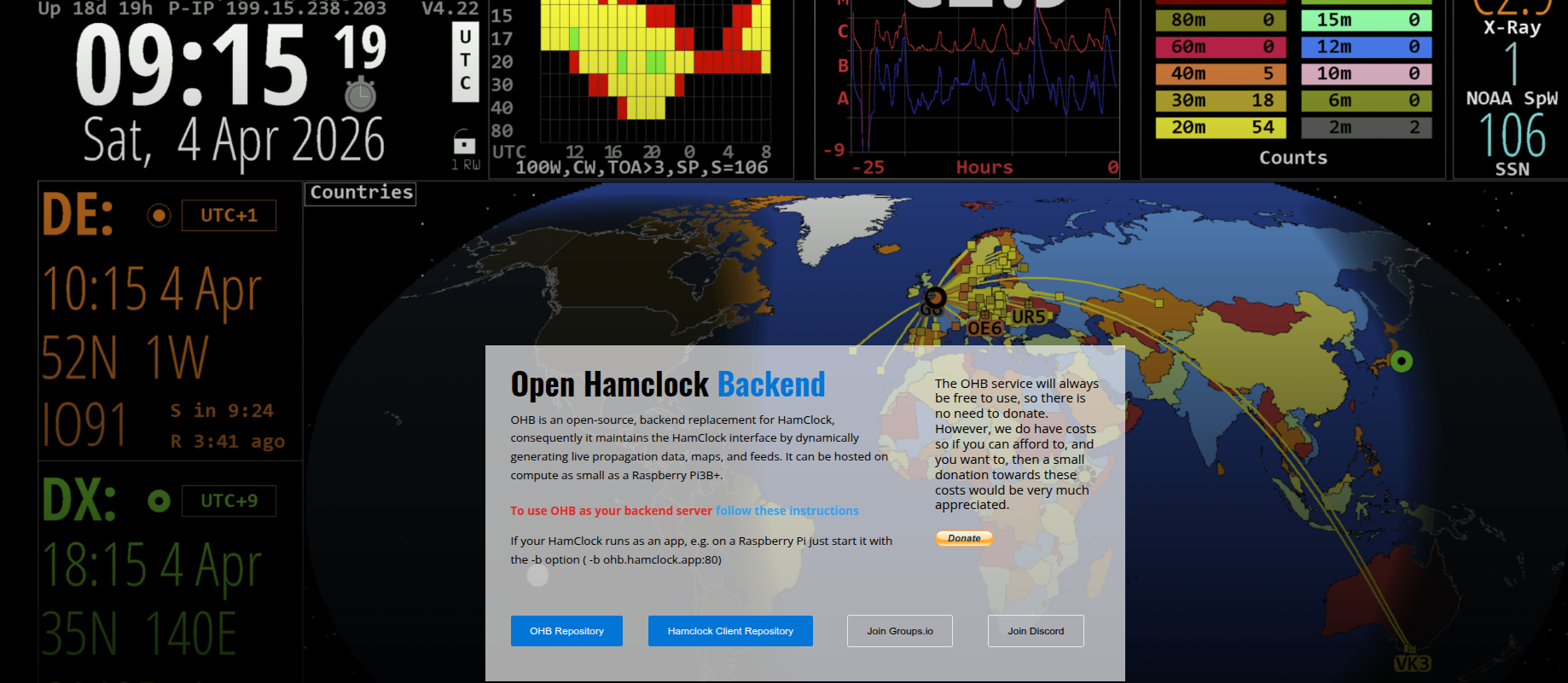
TL;DR: Open Hamclock Backend (OHB) is a community-driven, open-source server platform that replaces the sunsetting Clear Sky Institute centralized backend for HamClock devices. By dynamically replicating space weather feeds, VOACAP HF propagation maps, solar telemetry, satellite tracking, and DX cluster data, OHB ensures that tens of thousands of Raspberry Pi, Inovato Quadra, and desktop HamClocks continue functioning indefinitely through public community endpoints at ohb.works or private self-hosted Docker instances.
For nearly a decade, Elwood Downey WB0OEW’s iconic HamClock has served as the visual centerpiece of modern amateur radio shacks worldwide. Running on dedicated Raspberry Pis, Inovato Quadra mini PCs, and desktop monitors, HamClock presents a real-time command center: greyline terminator maps, NOAA space weather telemetry, VOACAP propagation predictions, satellite passes, DX spots, and contest calendars.
However, HamClock was built on an architectural vulnerability: a centralized, proprietary backend server. Every client worldwide relied on Clear Sky Institute’s servers to fetch, process, and render backend imagery and telemetry. Following the sad passing of WB0OEW and the subsequent announcement that the original Clear Sky Institute backend servers would reach end-of-life (EOL) in mid-2026, the amateur radio community faced a crisis: without a functioning backend, tens of thousands of shack monitors would permanently display connection errors.
To solve this challenge, the amateur radio developer community mobilized to create the Open Hamclock Backend (OHB) project (hosted at ohb.works with open-source development at github.com/openhamclock).
OHB reverse-engineered, modernized, and open-sourced the entire backend infrastructure, ensuring that amateur radio operators can switch to resilient community servers or self-host their own private backend with zero client-side recompilation.
Last updated: August 2026.
What is the Open Hamclock Backend (OHB)?
Open Hamclock Backend (OHB) is an open-source server-side software suite and community infrastructure network that dynamically generates and serves propagation maps, solar indices, weather telemetry, and astronomical data to legacy and modern HamClock clients.
+-------------------------------------------------------------------------+
|                  External Live Data Feeds & Agencies                    |
|  [NOAA / SWPC Solar]  [VOACAP Propagation]  [NASA/CelesTrak TLE]  [WMM] |
+------------------------------------+------------------------------------+
                                     | (Automated Ingest & Synthesis)
+------------------------------------v------------------------------------+
|               Open Hamclock Backend (OHB) Service Engine                |
|  - Ingest Pipeline: Space Weather, Solar Indices (SFI, K, A, SSN)      |
|  - Rendering Core: Dynamic VOACAP Map Generator & Greyline Terminator   |
|  - Cache & CDN: Redis Edge In-Memory Caching & REST Endpoint Router    |
|  - Open Standards: Fully compliant with official HamClock Standards    |
+------------------------------------+------------------------------------+
                                     |
           +-------------------------+-------------------------+
           | (Public Community CDN)                            | (Local LAN API)
+----------v-------------------------+       +-----------------v----------+
|  Public Cloud: https://ohb.works   |       |  Self-Hosted Docker Node   |
|  - Global High-Availability API    |       |  - Raspberry Pi / NAS / VM |
|  - Free for all amateur operators  |       |  - 100% Offline / Resilient|
+------------------+-----------------+       +-----------------+----------+
                   |                                           |
                   +-------------------+-----------------------+
                                       | (HTTP / JSON / Binary Maps)
+--------------------------------------v----------------------------------+
|                    HamClock Client Hardware in Shacks                   |
|  [Inovato Quadra]  [Raspberry Pi 3/4/5]  [Linux / Mac PC]  [CYD/ESP32]  |
+-------------------------------------------------------------------------+
Rather than requiring operators to modify their hardware or flash unverified custom firmware, OHB operates as a transparent drop-in replacement. It strictly implements the data formats, HTTP endpoints, binary image structures, and space weather payload specifications expected by existing HamClock software.
Architectural Deep Dive: Legacy Dependency vs Modern OHB
To understand the magnitude of the OHB project, one must examine how the original HamClock client was designed to function:
+-------------------------------------------------------------------------+
|               HamClock Architecture: Legacy vs Open OHB                 |
+------------------------------------+------------------------------------+
| Legacy Clear Sky Institute Setup   | Modern Open Hamclock Backend (OHB) |
+------------------------------------+------------------------------------+
| - Single centralized server        | - Globally distributed CDN cluster |
| - Closed-source backend logic      | - 100% Open Source (Python/Docker) |
| - Hardcoded single point of failure| - Configurable endpoint / Self-host|
| - Shutting down mid-2026           | - Community maintained indefinitely|
| - Proprietary image rendering      | - Open VOACAP / NOAA pipeline      |
+------------------------------------+------------------------------------+
1. The Legacy Server Model
In the original architecture, the client (running on an Inovato Quadra or Raspberry Pi) was a relatively lightweight rendering frontend. Complex mathematical tasks, such as generating ray-traced VOACAP high-frequency propagation coverage maps, calculating solar flux index (SFI) curves, compiling planetary K-index geomagnetic history, and formatting satellite two-line element (TLE) orbital vectors, were performed remotely on the Clear Sky Institute server.
When that single server infrastructure went into scheduled retirement, the client software had no native fallback.
2. The OHB Solution: Open, Modular, and Decentralized
The OHB development team analyzed every HTTP request, binary map payload, and API exchange made by HamClock clients to build a modular replacement:
- Real-Time Data Ingest: Pulls directly from primary authoritative scientific sources, including the NOAA Space Weather Prediction Center (SWPC), the British Geological Survey, CelesTrak, and the US Naval Observatory.
- Dynamic Image Synthesis: Re-implements the custom map projection and color-coding algorithms to generate exact pixel-compatible GIF and PNG map overlays on the fly.
- Caching & High Performance: Built on modern asynchronous Python frameworks (FastAPI) paired with Redis caching and CDN frontends, ensuring sub-second response times even under heavy global load.
Key Data Services Delivered by OHB
OHB powers all core panels and panes across the HamClock interface:
+-------------------------------------------------------------------------+
|                        OHB Core Services Matrix                         |
+-------------------+--------------------+-------------------+------------+
| Solar & Geospace  | HF Propagation     | Space & Orbital   | Operations |
| - SFI (10.7cm)    | - VOACAP De-DX Maps| - Satellite TLEs  | - DX Cluster|
| - Sunspot Number  | - Aurora Activity  | - ISS Ground Track| - Contest Cal|
| - Planetary Kp / A| - MUF Curves       | - Moon Phase & Sun| - ADIF Stats |
| - X-Ray Flux Flare| - Band Openings    | - Ephemeris Engine| - NTP UTC  |
+-------------------+--------------------+-------------------+------------+
1. Space Weather & Solar Metrics
OHB ingests real-time solar data from NOAA satellites and space observatories:
- Solar Flux Index (SFI): Measured at the 10.7 cm (2800 MHz) radio band by the Dominion Radio Astrophysical Observatory in Penticton, Canada.
- Geomagnetic Disturbance Indices: Planetary Kp-index (3-hour geomagnetic activity) and daily planetary A-index to monitor geomagnetic storms.
- Solar Flare Activity: Real-time GOES satellite X-ray flux readings (A, B, C, M, and X-class flares) with radio blackout warnings.
- Sunspot Progression: Daily Sunspot Numbers (SSN) and solar cycle 25 trending graphs.
2. VOACAP Propagation Engine
The most visually striking feature of HamClock is its live point-to-point and area HF propagation maps. OHB runs an automated backend VOACAP (Voice of America Coverage Analysis Program) calculation pipeline. Given the station’s Maidenhead grid locator, transmit power, and antenna type, OHB renders full-color world maps depicting the Maximum Usable Frequency (MUF) and Signal-to-Noise Ratio (SNR) across the 80m through 10m amateur bands.
3. Satellite Tracking & Orbital Mechanics
OHB updates orbital two-line element (TLE) sets every few hours from CelesTrak. It provides real-time orbital calculation data for the International Space Station (ISS), amateur radio satellites (AO-91, SO-50, RS-44, IO-117), and weather satellites (NOAA/Meteor), allowing the clock to show live ground tracks, footprints, and pass countdowns.
4. DX Cluster & Contest Schedules
OHB connects to global DX cluster networks (such as DXSpider and CC Cluster) and contest aggregators, compiling active DX spots, spotted frequencies, DXCC entities, and upcoming weekend contest calendars.
Comparison: Clear Sky Legacy vs OHB vs Alternatives
| Feature | Clear Sky Legacy | Open Hamclock Backend (OHB) | Self-Hosted OHB (Docker) | Alternative Shack Clocks |
|---|---|---|---|---|
| Operational Status | Sunsetting / EOL | Active & Maintained | Active & Maintained | Varies by Project |
| Backend Cost | Free (Closed) | Free (Community Supported) | Free (Self-Hosted) | Free / Paid Hardware |
| Source Code | Closed Source | 100% Open Source (GPL) | 100% Open Source (GPL) | Varies |
| Server Infrastructure | Single Server | Distributed CDN Cluster | Local Network / Private | Local / Cloud |
| VOACAP Map Generation | Yes | Yes (Full Parity) | Yes (Local Compute) | Often Simplified |
| Client Recompilation | N/A | None Required | None Required | Full Flash Required |
| Hardware Compatibility | Pi / Inovato / PC | All Existing HamClocks | All Existing HamClocks | Dedicated MCU / Screens |
| Offline Resilience | None | High (Cloud Redundancy) | Total (Runs on Local LAN) | High (On-device) |
How to Switch Your HamClock to the Open Backend
Switching an existing HamClock installation to the Open Hamclock Backend is straightforward and does not require reflashing your operating system or reinstalling client packages.
+-------------------------------------------------------------------------+
|                  Two Ways to Connect to Open Backend                    |
+------------------------------------+------------------------------------+
| Method 1: HamClock Setup Screen    | Method 2: Local DNS Override       |
| (Simplest for Inovato & Pi)        | (Network-Wide for Multiple Clocks) |
+------------------------------------+------------------------------------+
| 1. Click screen setup or restart   | 1. Open Pi-hole / router DNS       |
| 2. Navigate to Page 3 / Backend    | 2. Add local DNS rewrite:          |
| 3. Set custom server: ohb.works    |    clearskyinstitute.com ->        |
| 4. Save and reboot client          |    IP address of ohb.works         |
+------------------------------------+------------------------------------+
Method 1: Configuring Custom Backend in HamClock Settings
- On your HamClock display, tap anywhere in the Setup area or restart the client with the
-sflag to enter the configuration wizard. - Advance through the configuration pages to the Backend / Server settings.
- Replace the default Clear Sky Institute URL with the public OHB endpoint:
ohb.works - Save the configuration and click Done.
- HamClock will restart, verify the connection to
ohb.works, and immediately resume pulling live propagation maps and solar indices.
Method 2: Self-Hosting OHB with Docker
For clubs, emergency operations centers (EOC), and operators who demand complete offline resilience, OHB can be run locally on a Raspberry Pi 3B+, home server, or Network Attached Storage (NAS) via Docker Compose:
- Clone the official repository:
git clone https://github.com/openhamclock/open-hamclock-backend.git cd open-hamclock-backend - Launch the stack using Docker Compose:
docker compose up -d - Point your HamClock setup screen to your local server’s IP address (e.g.,
http://192.168.1.50:8000).
Frequently Asked Questions (FAQ)
What is Open Hamclock Backend (OHB)?
Open Hamclock Backend (OHB) is an open-source community replacement for the sunsetting Clear Sky Institute server that powers HamClock devices with live solar weather, VOACAP propagation maps, and satellite tracking.
Why is the original HamClock server shutting down?
Following the passing of HamClock creator Elwood Downey WB0OEW, the original Clear Sky Institute backend servers were scheduled for retirement in mid-2026, necessitating a community-run alternative.
Do I need to buy new hardware or reinstall HamClock?
No. Existing HamClock setups on Raspberry Pi, Inovato Quadra, or desktop PCs remain fully compatible. Operators only need to update the backend server address in HamClock settings to ohb.works.
Is the public OHB service free to use?
Yes. The public infrastructure at ohb.works is completely free and supported by community contributions from amateur radio operators worldwide.
Can I self-host my own HamClock backend?
Yes. The entire OHB codebase is open-source and provides pre-built Docker containers that can run locally on a Raspberry Pi, NAS, or home lab server for total offline independence.
Summary: Preserving Open Amateur Radio Infrastructure
The Open Hamclock Backend project is a prime example of the amateur radio community’s dedication to open-source sustainability and self-reliance. By transforming a centralized proprietary service into a transparent, distributed, and self-hostable standard, the developers behind OHB have safeguarded tens of thousands of shack monitors for years to come. Whether you connect via the public ohb.works cloud or spin up a local Docker container, HamClock remains the undisputed visual heart of the modern ham shack.
73 from 9M2PJU.
Sources and Further Reading
- Open Hamclock Backend (OHB) Official Portal – Documentation, server status, and setup instructions.
- Open HamClock Backend GitHub Repository – Source code, Docker Compose files, and issue tracker.
- HamClock Standards Organization – Technical specifications for HamClock API parity.
- Inovato Quadra HamClock Community – Inovato Quadra mini PC HamClock hardware guides.
- CYD Ham Dashboard Guide – 9M2PJU technical guide to low-power ESP32 shack dashboards.
- 9M2PJU HF Propagation Prediction Tool – Free online HF propagation modeling platform.



1 comment