Finding North with an Analog Watch: The Sun Clock Trick
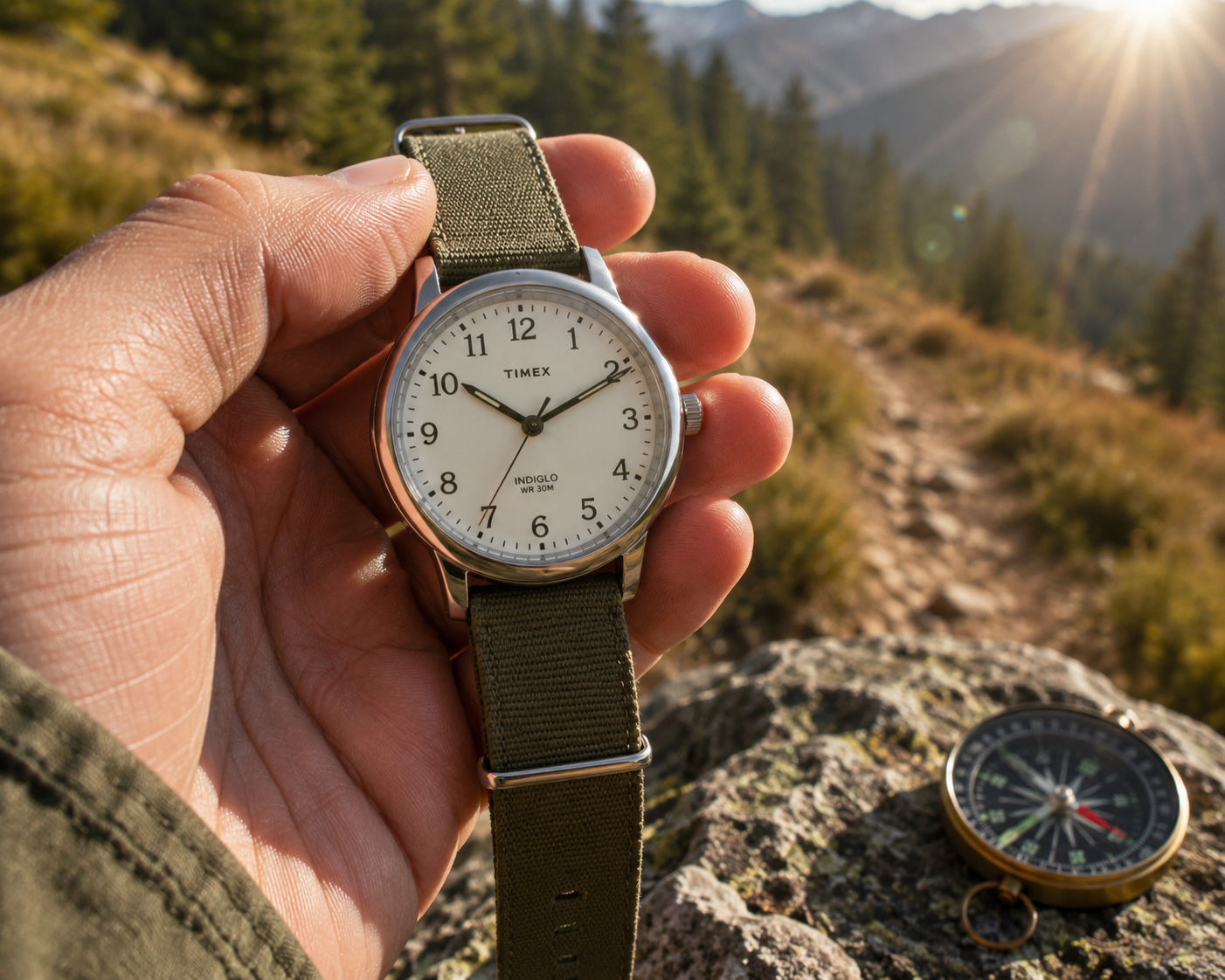
Every so often a survival tip circulates online that sounds too clever to be true: you can find north using nothing but an analog watch and the sun. It is not a myth, but it is also not a precision instrument. With the right technique and a few corrections, an analog watch can give you a rough sense of direction when you have no compass, no GPS, and no phone signal.
The Basic Method
The trick works because the sun moves across the sky at a predictable rate. Over a full day, the sun completes roughly 360 degrees, which means it appears to move about 15 degrees per hour. An analog watch face is also divided into 12 hours, so the hour hand tracks the sun’s position in a useful way.
In the Northern Hemisphere
- Remove the watch and hold it flat in your palm.
- Point the hour hand directly at the sun.
- Find the point on the watch face that is halfway between the hour hand and 12 o’clock.
- That halfway point points roughly south. North is directly opposite.
If the time is 4:00 p.m., point the hour hand at the sun. The halfway mark between 4 and 12 is 2, which points south. So north is at the 8 o’clock position.
In the Southern Hemisphere
The sun arcs across the northern part of the sky, so the logic flips:
- Hold the watch flat and point 12 o’clock at the sun.
- Find the point halfway between 12 and the current hour hand.
- That halfway point points roughly north.
Why the Math Works
The earth rotates once every 24 hours, so the sun shifts 15 degrees of azimuth per hour. In the Northern Hemisphere, the sun rises in the east and sets in the west, passing through the south at solar noon. If you treat the hour hand as the sun’s position and 12 o’clock as solar noon, the bisector points south.
At solar noon, the hour hand is already at 12, so the bisector is exactly south. At 6:00 a.m., the sun is roughly in the east, so the bisector between 6 and 12 points south. The geometry holds as long as you use the correct solar time.
The Fine Print: Time Zones and Daylight Saving
This is where the trick gets approximate.
• Clock time is not solar time. Your watch shows time-zone time, which can be off by a full hour or more from the actual local solar time. If your location is near the eastern edge of a time zone, the sun is “behind” your watch by up to 30 minutes. Near the western edge, it is “ahead.”
• Daylight saving time shifts everything by 15 degrees. During DST, the hour hand is one hour ahead of the sun’s real position. If you are on DST, you can
compensate by using the halfway point between the hour hand and 1 o’clock instead of 12 o’clock.
• The equation of time. The earth’s orbit is slightly elliptical, so solar noon can drift by about ±15 minutes over the year. That adds another error of up to 7 or 8 degrees.
How Accurate Is It?
In ideal conditions, the watch method can get you within about 20 to 30 degrees of true north. That is enough to pick a general direction for a short hike, but it isnot enough for precise land navigation or for plotting a bearing across long distances.
The method also fails when:
• The sun is directly overhead, such as near the equator at noon.
• The sky is overcast or the sun is hidden by terrain.
• You are near the poles in summer or winter, where the sun behaves very differently.
• The watch is digital, unless you mentally draw the hour hand on an analog face.
A Practical Alternative: The Shadow Stick Method
If you have a stick and a few minutes of sun, the shadow method is often more reliable:
- Push a straight stick into flat ground.
- Mark the tip of its shadow.
- Wait 15 to 30 minutes.
- Mark the new tip of the shadow.
- Draw a line between the two marks. The first mark points roughly west, the second mark points roughly east, and north is perpendicular to that line.
This works at any time of day and does not depend on what your watch says.
Final Verdict
Using an analog watch to find north is a real, clever trick, but it belongs in the “good enough in an emergency” category. It is not magic, and it is not a replacement for a compass. It works best on a clear morning or afternoon, when you are away from your time-zone edge, and when you can mentally adjust for daylight saving time.
Keep a real compass in your pack, and consider the watch method a fun backup rather than your main navigation tool.






Post Comment