MCMC Appendix C: The Statutory Declaration of Wireless Secrecy Explained
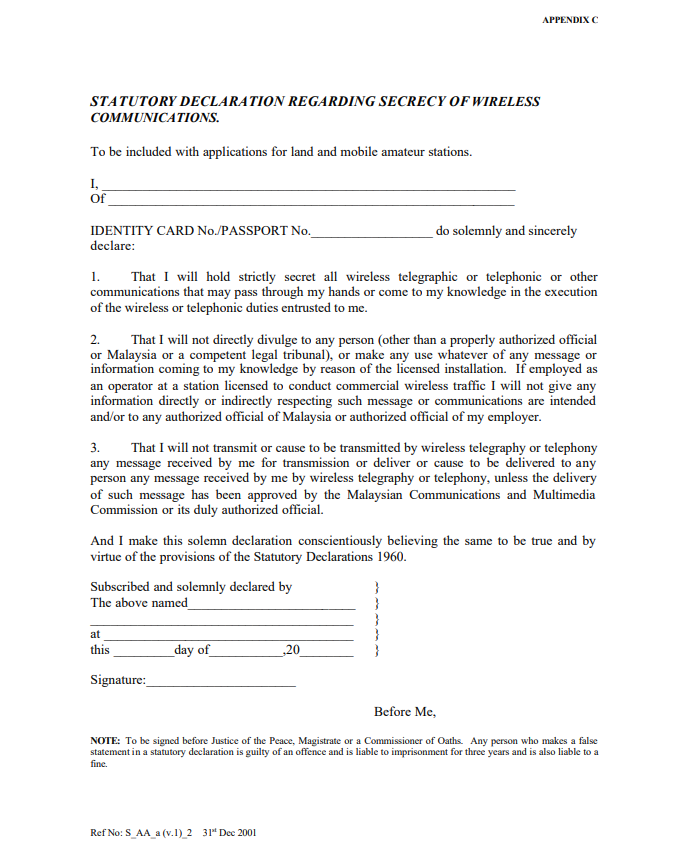
When you apply for your amateur radio licence (ASAA) in Malaysia, there is a lot of paperwork. But one form is very important. You have to sign it in front of a Commissioner of Oaths (Pesuruhjaya Sumpah). This form is called the Statutory Declaration Regarding Secrecy of Wireless Communications, or simply, Appendix C.
Many new ham radio operators sign this form quickly without reading it. But this single page is a serious legal promise under the Statutory Declarations Act 1960. It tells you exactly what you can and can’t do on the radio.
If you want to keep your radio licence safe and stay out of trouble with the MCMC, you need to understand what you’re promising.
Last updated: August 2026.
The Three Big Promises
When you sign Appendix C, you’re making three strict promises to the government about radio signals.
1. You Must Keep Secrets
The first rule says you must keep all radio messages secret if they pass through your radio.
As a ham operator, your antenna will pick up signals that aren’t for you. You might hear commercial ships, businesses, or other local services. The rule is simple: if the message isn’t meant for you or the public, it’s a secret. You can’t record it, you can’t post it on Facebook, and you can’t talk about it with your friends.
2. You Cannot Share Information
The second rule is even stricter. It says you can’t share any secret message you hear with anyone else. You also can’t use the information for yourself.
The only time you can share a secret message is if you are reporting it to a government official (like the MCMC or the police) or if a judge in court forces you to. In amateur radio, what you hear on the air, stays on the air.
3. You Cannot Send Messages for Other People
The last rule is very important for everyday radio use. You promise that you won’t use your radio to send messages for other people, unless the MCMC gives you special permission.
Amateur radio frequencies are strictly for learning, testing equipment, and talking with other licensed hams. If hams were allowed to send messages for normal people or businesses, the radio bands would be full of commercial chat. This would ruin the hobby for everyone.
What Happens If You Break the Promise?
What happens if a ham operator ignores Appendix C and sends a message for a business, or leaks a secret radio message?
Because you signed a legal oath, the punishment is very heavy. The MCMC uses the Communications and Multimedia Act (CMA) 1998 to punish you:
- You Lose Your Licence: The MCMC can cancel your ASAA licence. You’ll lose your callsign and you can no longer use a radio.
- They Take Your Radio: MCMC officers and the police (PDRM) can raid your house and take all your radio equipment.
- Heavy Fines and Jail: Breaking the CMA 1998 is a crime. You can be fined hundreds of thousands of Ringgit and even go to jail.
Also, the form itself has a clear warning at the bottom. It says that if you lie when signing the form, you can be sent to prison for up to three years and pay a fine.
Summary for Malaysian Hams
Appendix C isn’t just a piece of paper. It’s a serious law that protects amateur radio in Malaysia. By forcing hams to keep secrets and banning messages for third parties, the MCMC stops businesses from stealing our frequencies.
Use your radio responsibly. Only talk to other licensed operators, respect the privacy of the airwaves, and enjoy the hobby safely.
Sources and Further Reading
- Malaysian Communications and Multimedia Commission (MCMC) Official Portal
- Communications and Multimedia Act 1998 (PDF)
73 from 9M2PJU