HamFire 2026: Work the N0F-N9F Fire Prevention Week Special Event Stations
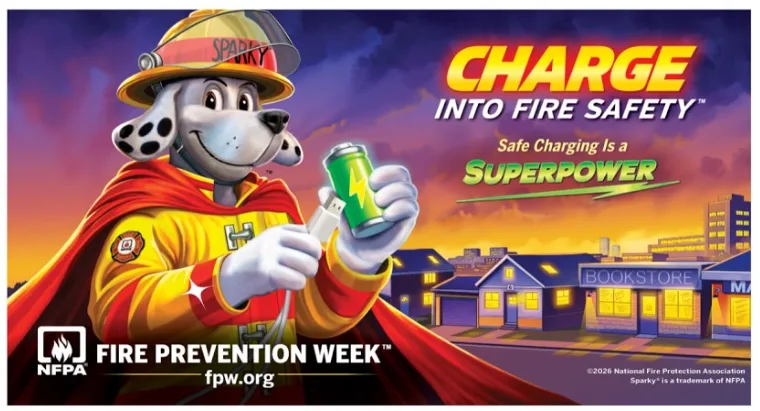
TL;DR: HamFire is the annual amateur radio special event for US National Fire Prevention Week. In 2026, ten regional stations N0F through N9F plus wildcard stations KF2IRE and VE3FIRE will be QRV October 4-10, midnight to midnight UTC. Work any 10 of the 12 stations to earn the Clean Sweep certificate, request QSL cards via manager W4GJ with a SASE, and pick up real fire safety on every phone contact, because operators close each QSO by reading a safety tip. The 2026 theme matches the NFPA campaign Charge into Fire Safety: safe lithium-ion battery charging.
What Is HamFire?
HamFire is a US amateur radio special event in which volunteer stations N0F through N9F plus KF2IRE and VE3FIRE go on the air during National Fire Prevention Week to promote fire safety and hand out contacts, QSL cards, and a Clean Sweep certificate.
There is no contest scoring and no leaderboard. Operators run phone and digital contacts all week, and on voice modes each QSO ends with a short fire prevention tip read over the air. Hunters chase the stations across bands, educators use the event in schools, and everyone walks away knowing a little more about not burning the house down.
HamFire 2026 at a Glance
| Item | Detail |
|---|---|
| Event | HamFire Fire Prevention Week Special Event 2026 |
| Dates | October 4-10, midnight to midnight UTC |
| Regional stations | N0F, N1F, N2F, N3F, N4F, N5F, N6F, N7F, N8F, N9F (one per US call area) |
| Wildcard stations | KF2IRE (Siemens Fire Safety USA ARC), VE3FIRE (Canada) |
| Modes | Phone, digital (CW practice varies by operator team) |
| On-air habit | Fire safety tip read at the close of each phone QSO |
| Award | Clean Sweep certificate for working any 10 of the 12 stations |
| Certificate window | Applications open at event start through December 31, 2026 |
| QSL route | SASE (USA) or SAE plus 2 green stamps (DX) to W4GJ, allow 6-8 weeks |
| Cost | On-air participation is free; QSL postage and optional certificate printing covered by volunteers and donors |
| Official site | hamfire.com |
The 12 Stations and Who Runs Them
Each of the ten US call areas fields one N*F station, and two wildcards round out the dozen. Every station in the 2026 roster below is volunteer staffed, and several teams include emergency responders who may go quiet mid week when real calls come in.
| Callsign | Station owner | 2026 operator team notes |
|---|---|---|
| N0F | Matt Genelin, N0YNT | Region 0 crew (CO, IA, KS, MO, MN, ND, SD) |
| N1F | Mike Fandell, N5QYQ | Operated by Steve McGrath, AA1HF |
| N2F | Steve Masticola, WX2S | Lou Asbaty K2AN, Bob Jonas WX2I; the original 2013 station |
| N3F | Judy Smith, KC3JAS | Large mid Atlantic team including WA3LWR, KA3E, K3XMB, K3DBG, KB3CWG, K2LNS, WA3LLF, K3ZK, KE3LB, N3URF |
| N4F | Scott Parker, K7LU | Students of W. T. Loften High School (K4WTL) plus W4GJ, KR4ABM, K3LB and others |
| N5F | Clay Mayrose, WA6LBU | W5KZJ, W5BJ, K9JN on the roster |
| N6F | Jeffrey B Widen, K6QCB | Big California crew: NC6R, KM6YMC, WA6LIE, WB6HYH, KM6UWI, KF6PUZ, W6JH, N6ACL, NZ6Q, N6DPL, KK6WKI, K6DGQ, K6CPR |
| N7F | Stacy Webb, KK7CJV | Mountain west team: KF7PXT, N7BCM, WA6LIE, KE7NLU, KM7FZY, W4IDX, N7NHS, K7ZZQ, AA7VG, KJ7WFN, N3ZB, N1NYT, AI7DK |
| N8F | Roman Brandau, WU8R | N8JEN, N8MRB, K8GIB, KB8UEY |
| N9F | Jerry Hankins III, N9WQP | AD0TY, WA9THI, W9AWX |
| KF2IRE | Siemens Fire Safety USA ARC presidents | K2AN, N2OCS, WX2I, WX2S, KC2EKX; the club that started it all |
| VE3FIRE | David Lambert, VE3KGK | Ontario crew: VA3ATB, VE3IMG, VE3EI, VA3CBN, VE3YOB, VE3NRJ, VE3IDT, VE3ACW, VE3XN |
Two details are worth noting. First, the Canadian station has carried both VE3FIRE and VA3FIRE calls over the years because of quirks in Canadian special event licensing, so check the current year roster before logging. Second, N4F doubles as a school club activity: Fire and EMS Academy students at Loften High School in Gainesville, Florida run contacts as licensed operators, which makes HamFire one of the few US special events with a classroom at the key.
How to Work HamFire: Certificate, QSL, and Skeds
The Clean Sweep certificate
Work any 10 of the 12 stations during the event week and the Certificate of Achievement is yours. The bar is deliberately set as a challenge rather than a participation prize: with twelve stations spread across ten call areas plus two wildcards, propagation will hide at least one or two from any single location on any single day. Dozens of hunters earn it every year by skill and diligence, in the organizers own words.
Certificate applications for 2026 open when the event starts and stay open through December 31, 2026. Contact the certificate manager through the address on the certificate page when your log shows ten. Keep your own log evidence, because with volunteer operators and merged ADIF files, the organizers reconcile claims after the week ends.
QSL cards
Paper QSL cards are available for every station through one manager, which keeps the paperwork simple:
- USA hunters: mail your card plus a self addressed stamped envelope (SASE) to Dr. Bob Lightner, W.T. Loften High School ARC, 3000 East University Avenue, Gainesville, FL 32641, USA.
- DX hunters: mail your card plus a self addressed envelope and 2 green stamps to the same address.
- Allow 6-8 weeks for a reply. No electronic QSLs and no bureau cards.
- Follow the instructions exactly. The QSL page warns that requests which ignore the instructions get no response.
Printing is underwritten in part by Lee Barrett, K7NM (photoqsls.com), with donations covering the rest, so a small extra contribution with your request is appreciated but not required.
Hearing a missing station
All operators are volunteers squeezing chair time around jobs and, for the emergency responders among them, real incidents. If a station is thin on your bands, keep checking the spots, try the other end of the day, and consider 40 and 20 meters first for daytime regional coverage plus 80 and 40 after dark. Skeds are at each station owner discretion; use the stations page to reach the right owner. And if your region station is quiet and you have a strong nationwide signal, the organizers openly recruit: volunteering next year beats complaining this year.
The 2026 Safety Tips: Charge Into Fire Safety
Every phone QSO in HamFire ends with an operator reading one fire safety tip. The 2026 list has 17 tips, and every one of them is about lithium-ion batteries: how to charge them, where to charge them, and when to stop using them. That is no accident. It mirrors the official NFPA Fire Prevention Week 2026 theme word for word: Charge into Fire Safety: Safe Charging Is a Superpower, with key messages the NFPA published in June and September 2026.
The HamFire 2026 tips, condensed:
- Use the manufacturer cord and charger or an approved equivalent.
- Charge on a hard flat surface such as a table or desk.
- Never charge on beds, couches, or under pillows where heat gets trapped.
- Stop using a device that runs very hot, swells, smokes, or smells strange.
- Unplug at full charge instead of leaving devices plugged in.
- Charge big batteries (e-bikes, scooters, power tools) outside and away from exits.
- On aircraft, keep charging devices where you can see them, never in overhead bins.
- Never charge e-cigarettes or vapes on a plane.
- Store batteries at room temperature, dry and out of direct sun.
- Never expose batteries to freezing below 32 F (0 C) or heat above 105 F (40 C), such as a hot car.
- Keep loose cells in protective non metal cases against short circuits.
- Retire any battery with odor, swelling, leaking, heat, or odd noises at once.
- Never bin old or damaged lithium-ion batteries in household trash.
- Drop spent or damaged batteries at a hazardous waste facility or a retail recycling point.
- Ask the manufacturer about device specific or damaged battery handling.
- Most phone makers recommend stopping at 80 percent unless a long trip needs 100 percent.
- Lithium Iron Phosphate (LFP) cells are the exception and can take 100 percent routinely.
For radio amateurs the list lands close to home. Our shacks are full of lithium packs: HT batteries, portable power stations, 18650 cells, e-bike packs in the garage, and cordless tool batteries on the bench. Tips 6, 10, 11, and 13 read like they were written after a walk through a typical ham garage.
Why Fire Safety Is Such a Big Thing in the US
Visitors sometimes wonder why fire prevention gets a whole presidentially proclaimed week, a cartoon dalmatian, and a ham radio event with twelve special callsigns. The answer stacks up in four layers: a founding disaster, a stubborn death toll, the way Americans live and heat and cook, and a new battery fire wave arriving on top.
It started with the Great Chicago Fire
On October 8-10, 1871, a fire leveled much of Chicago, killing about 300 people and leaving roughly 100,000 homeless. Legend blames Mrs. Catherine O’Leary cow kicking over a kerosene lantern, a story the HamFire history page retells, though the true spark was never proven and suspicion shadowed O’Leary for life. The same dry windy night also saw the Peshtigo Fire tear through Wisconsin, killing an estimated 1,500 to 2,500 people and still the deadliest wildfire in US history, though Chicago stole the headlines.
The anniversary stuck. The NFPA has sponsored Fire Prevention Week around October 9 since 1922, making it the oldest US public health observance on record, and US presidents have formally proclaimed it every year since Calvin Coolidge in 1925. Sparky the Fire Dog joined as mascot in 1951. When HamFire runs October 4-10, it rides a commemoration more than a century deep.
The toll is still thousands of lives a year
Modern building codes, smoke alarms, and sprinklers cut US fire deaths enormously from 1970s levels, yet the numbers remain grim. NFPA research put the 2019-2023 average at about 2,600 civilian deaths and 10,770 injuries per year in reported US home fires alone, with home fires causing roughly 70 percent of all US civilian fire deaths. Total direct property damage across all US fires runs into the tens of billions of dollars annually.
The cause ranking barely moves year to year, and it explains why prevention messaging never stops:
- Cooking is the leading cause of reported home fires and home fire injuries, averaging about 159,400 home fires, 430 deaths, 3,850 injuries, and over 1.1 billion dollars in damage per year from 2019 to 2023. Unattended cooking is the top factor, ranges and cooktops dominate the deaths, and Thanksgiving is the peak day of the year.
- Smoking materials remain the leading cause of home fire deaths overall, especially among adults aged 45 to 84, with many victims asleep or unable to act.
- Heating equipment runs second for home fires, injuries, and deaths at roughly 65,000 fires and 430 deaths per year, a seasonal killer each winter.
- Electrical distribution and lighting causes fewer fires (about 31,650 per year) but the highest property damage per fire category at around 1.6 billion dollars annually.
Put simply, the fires that kill Americans start in kitchens, ashtrays, furnaces, and breaker panels. All four are preventable with habits and hardware, which is exactly what a prevention week exists to teach.
American housing and habits raise the stakes
Several structural facts keep the US toll high compared with peer nations. Much of the housing stock is wood frame construction, which burns fast once a room flashes over. Central heating runs hard through long northern winters. Cooking culture centers on high heat frying with oil and grease, the exact ignition profile behind the worst kitchen fires. An aging population means more victims with limited mobility, and NFPA data show the oldest Americans face the highest per capita death rates. Add attached garages full of fuel, paint, and now lithium packs, plus e-bikes charging in apartment hallways, and the fuel load inside an ordinary home keeps growing while escape times shrink to two minutes or less in a modern furnished room.
The lithium-ion wave is the new front
The NFPA chose a battery theme for Fire Prevention Week two years running because the failure mode is new, unfamiliar, and violent. Lithium-ion cells pack huge energy into a small space, and a damaged or badly charged cell can enter thermal runaway: heat feeds chemical breakdown which feeds more heat, ending in jets of flame, toxic gas, and sometimes explosion. E-bike and scooter fires made national headlines with hundreds of incidents and multiple fatalities in cities, and phones, laptops, power tools, toys, and vapes all carry the same chemistry at smaller scale. Because the technology is young, most people never learned charging discipline the way their grandparents learned chimney discipline. Tips like charge on hard surfaces, unplug at full, and never bin damaged cells are the smoke alarm lecture of this decade.
Wildfire and the volunteer backbone
Beyond the home, the wildland urban interface keeps fire on national news every summer, with whole towns threatened when wind driven fires meet dry suburbs. And the response system itself is a civic institution: the majority of US firefighters are volunteers, and Fire Prevention Week is the one week each year when departments, schools, and community groups all push the same messages together. A ham event that puts fire safety tips on the air coast to coast fits naturally into that week.
The Story of HamFire: From One Station to Twelve
HamFire began in 2013 with a single station, N2F, dreamed up by the Siemens Fire Safety USA amateur radio club KF2IRE, a club whose charter makes every member a president. The model was the 13 Colonies special event, and organizer Ken Villano KU2US personally showed the team how a multi station event works.
Growth came fast. N3F and N4F joined in 2014, the first certificate appeared in 2015 alongside N1F and N8F, and the response boosted participation by an order of magnitude. In 2016 the event added N0F, N5F, N6F, and N7F, launched hamfire.com, and set up printed QSL cards with manager Larry Skilton K1IED. N9F completed all ten call areas in 2017. The Canadian wildcard has alternated between VE3FIRE and VA3FIRE with licensing quirks. QSL management later passed to Bob Lightner W4GJ, who also runs the school club station, and certificate debates in the blog show organizers tuning the award to stay a real challenge: ten of twelve, no participation prize version, with adjustments when a region can’t activate.
HamFire Compared With Other US Special Events
| Feature | HamFire (N*F + wildcards) | 13 Colonies (K2A-K2M etc.) | Route 66 On the Air | Typical Single Club Special Event |
|---|---|---|---|---|
| Theme | Fire safety education | US independence history | Mother Road nostalgia | Club anniversary or town event |
| Stations | 12 across 10 call areas + Canada | 13+ across original colonies + bonuses | 20+ along Route 66 | Usually 1, sometimes 2 |
| Duration | 7 days (Oct 4-10) | About 7 days around July 4 | About 9 days in September | 1-2 days |
| Award bar | Work 10 of 12 (Clean Sweep) | Clean sweep of all + bonuses | Full sweep optional | QSL or certificate for 1 contact |
| On-air education | Safety tip closes each phone QSO | Historical facts exchanged | Town info exchanged | Rarely structured |
| QSL | Central manager (W4GJ), SASE | Per station managers | Per station | Per station or eQSL |
| School involvement | Yes, N4F high school team | Sometimes | Rarely | Rarely |
| Contest pressure | None, explicitly not a contest | None, but sweep chasing is intense | None | None |
HamFire closest cousin is clearly 13 Colonies, and the organizers say so themselves. The differences are the school station, the per QSO safety tip ritual, and a single QSL manager for all twelve calls.
Practical Tips for Hunting HamFire Week
- Start early in the week. Propagation and volunteer schedules shift daily. Banking N0F or a quiet wildcard on day one beats hoping for them on day seven.
- Cover the bands. Regional daytime contacts favor 40 and 20 meters, with 80 and 40 after dark and 15 and 10 when the sun cooperates. Digital modes run when phone piles thin out.
- Log carefully. Twelve similar calls (N0F through N9F) invite busted Cors: double check the digit before moving on, since the certificate needs ten distinct stations.
- Listen for the tip. Stay through the safety tip at each QSO close. Apart from respect for the theme, tips confirm you worked a genuine HamFire operator.
- Mind the wildcards. KF2IRE and VE3FIRE count the same as any N*F toward the ten, and they often run bigger teams with more airtime.
- QSL promptly. Send the SASE or SAE plus green stamps right after the event while the manager team is active, and keep a copy of what you sent.
Frequently Asked Questions
When is HamFire 2026 and who is on the air?
October 4-10, midnight to midnight UTC. Ten regional stations N0F through N9F plus wildcards KF2IRE and VE3FIRE, all run by volunteers. Check hamfire.com for the current roster.
How do I earn the Clean Sweep certificate?
Work any 10 of the 12 stations during event week, then apply through the certificate page before December 31, 2026. Ten distinct stations is a firm requirement, not a participation prize.
How do I get HamFire QSL cards?
Mail your card with a SASE (USA) or SAE plus 2 green stamps (DX) to Dr. Bob Lightner, W.T. Loften High School ARC, 3000 East University Avenue, Gainesville, FL 32641, USA. Allow 6-8 weeks.
Why does every phone QSO end with a safety tip?
That is the point of the event. Operators read one fire prevention tip per contact to spread the NFPA message. The 2026 tips cover lithium-ion battery charging under the Charge into Fire Safety theme.
Why does the US make such a big deal of fire prevention?
A long history starting with the 1871 Great Chicago Fire, about 2,600 home fire deaths yearly, cooking as the top ignition source, and a new wave of lithium-ion battery fires keep prevention a national priority every October.
Sources and Further Reading
- HamFire official site: hamfire.com
- 2026 stations roster: hamfire.com/stations.html
- National Fire Prevention Week history (Great Chicago Fire): hamfire.com/fpw.html
- 2026 fire safety tips (battery charging): hamfire.com/tips.html
- Clean Sweep certificate rules: hamfire.com/certificate.html
- QSL information: hamfire.com/QSL.html
- Event history and FAQ: hamfire.com/faq.html
- How to volunteer and station requirements: hamfire.com/helping.html
- NFPA Fire Prevention Week 2026 theme announcement: nfpa.org
- NFPA Fire Prevention Week 2026 campaign page: nfpa.org
- NFPA home cooking fires report: nfpa.org
- NFPA home fire victims by age and gender: nfpa.org
73 de 9M2PJU


Post Comment