QSO Transcriber: On-Device iPhone Transcription, Callsign Suggestions, and Logbook for Ham Radio
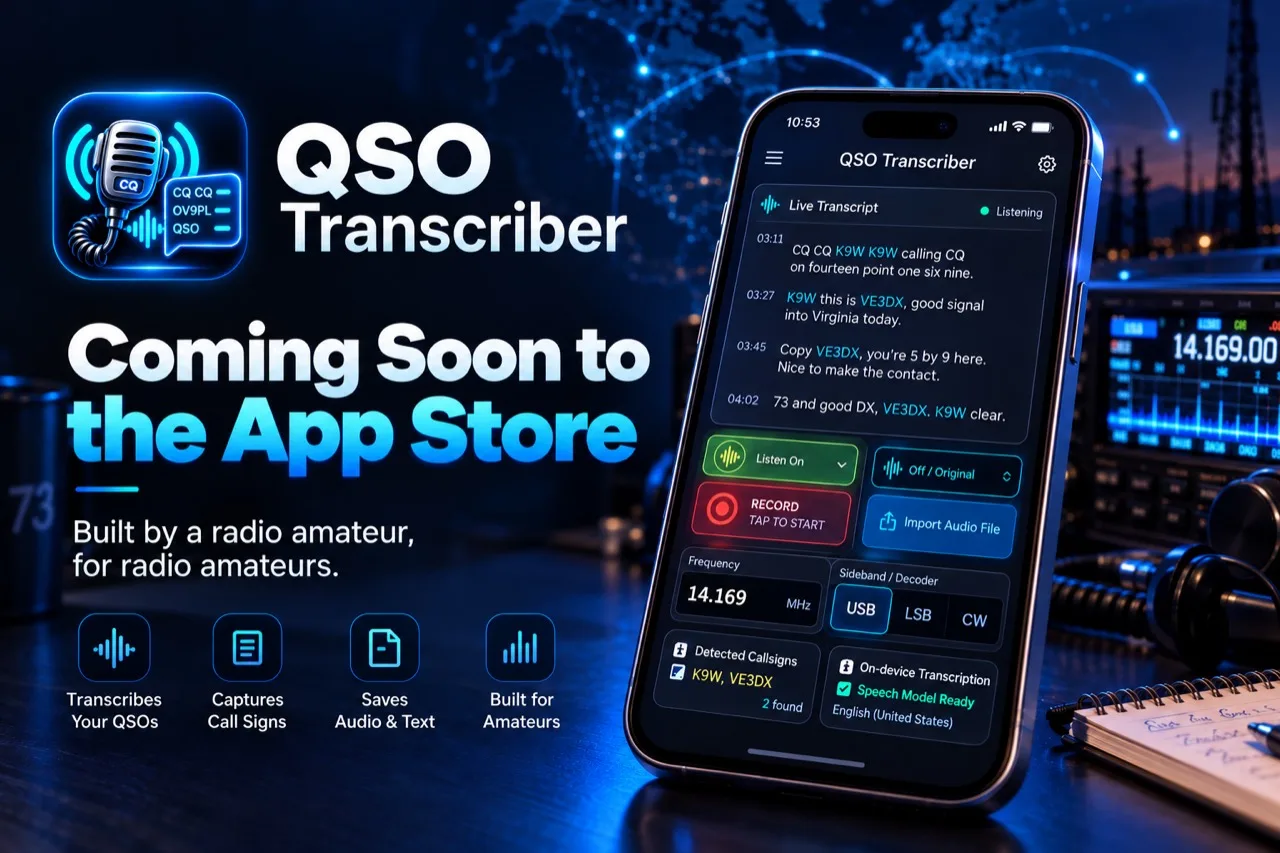
TL;DR: QSO Transcriber by Poul, OV9PL is an iPhone app (iOS 26 and later, coming to the App Store) that records or imports HF QSO audio, transcribes received speech with Apple on-device speech recognition, and runs a local QSO Context Engine that suggests callsigns, signal reports, names, and QTH details for the operator to check. The original audio and raw transcript stay intact, reviewed contacts save to a local logbook, and exports go out as ADIF or as an audio and text ZIP archive through the iOS share sheet. Nothing is uploaded for processing.
What Is QSO Transcriber?
QSO Transcriber is an iPhone app by Danish radio amateur Poul OV9PL that records or imports amateur radio QSO audio, transcribes received speech on-device, and proposes callsigns and log details for the operator to check before saving or exporting.
The project is independent, built by one operator for his own station, and framed by its author as subtitles for received audio with a recording to return to. The site states the app is coming to the App Store and is built for iPhone with iOS 26 or later.
Three design choices define it:
- On-device transcription. Speech recognition and QSO analysis run on the iPhone. The app doesn’t send recordings or transcripts to a server for processing.
- Original audio retained. The recording stays available, so uncertain passages can be replayed and checked against the text.
- Manual review of log fields. Suggestions carry confidence indicators and linked evidence, but a confidence indicator doesn’t verify a callsign. The operator listens, corrects, and decides what goes in the log.
Why Listening and Logging at the Same Time Is So Hard
Every new HF operator knows the feeling. You’re concentrating so hard on copying the other station callsign that the signal report slides past. By the time you have written something down, the conversation has moved on. Answering a CQ call starts to feel like an exam, and some of the enjoyment leaks out of being on the air.
Poul describes exactly this experience on the story page. After getting his first HF radio and looking forward to working operators in other countries, he found the listen, remember, and write cycle harder than expected. The worry about getting details wrong made calling CQ daunting, a feeling many operators recognise as microphone anxiety.
The difficulty is physical, not just psychological:
- Half duplex attention. On SSB you can’t listen and write at full speed simultaneously. One channel in, one channel out.
- Fading and interference. QRM and QSB carve holes in words. A prefix heard clearly at one minute is buried the next.
- Accents and phonetics. Unfamiliar accents, clipped phonetics, and pileup doubles turn one character swaps (B versus V, M versus N) into busted callsigns.
- Second language pressure. Much HF work happens in English between non native speakers, which raises the cost of every missed word.
Traditional logging solved the record problem but not the listening problem. Paper logs gave way to computer loggers, then to the ADIF standard in the mid 1990s for moving contacts between programs, then to confirmation systems such as eQSL.cc (2000), the ARRL Logbook of the World (2003), Club Log, and QRZ logbooks. All of them store what you decided the contact was. None of them help you decide what you heard. QSO Transcriber attacks that earlier step: capture the audio, turn it into checkable text, and only then write the log fields.
How QSO Transcriber Works: Record, Transcribe, Review
The homepage lays out a three stage pipeline, and the How It Works page demonstrates each stage on video. The flow is always the same regardless of source material.
+-----------------------------------------------------------------------------------+
|                        QSO TRANSCRIBER WORKFLOW                                   |
+-----------------------------------------------------------------------------------+
  01 / AUDIO                    02 / TRANSCRIPTION            03 / LOGBOOK
  Record or import              Transcribe + analyse          Check + save + export
  - Record RX audio             - Apple on-device speech      - Replay uncertain parts
  - Import MP3, M4A,            - QSO Context Engine          - Correct suggested fields
    WAV, CAF                      suggests callsigns,         - Save contact with audio
  - Original kept                 reports, names, QTH           and transcript
  - Optional DeNoise            - Confidence indicators       - ADIF log or ZIP archive
                                  + timestamps                  via iOS share sheet
01. Record or import audio
Work starts from a new recording made beside the radio or from an audio file already on hand. Supported import formats listed on the site are MP3, M4A, WAV, and CAF. The original file remains available throughout, so there’s always a ground truth to return to when the transcript looks doubtful.
An optional DeNoise pass can produce a second working copy of speech recordings before recognition. The site is honest about its limits: processing gives another version to work with, but it can’t recover speech that was never audible in the recording.
02. Transcribe the speech
Apple on-device speech recognition turns the audio into text. A local QSO Context Engine then reads that text as amateur radio language rather than generic prose, looking for callsigns, signal reports, operator names, QTH details, frequencies, modes, and equipment mentions. Matches are normalised where possible, for example reconciling a spoken phonetic string with standard callsign structure.
Two caveats are stated plainly on the site. First, QRM, QSB, and unfamiliar phonetics cause errors, so the transcript needs checking. Second, suggestions are suggestions: a confidence indicator marks how strongly the engine believes a match, but it doesn’t verify a callsign.
03. Check the log fields
The operator replays uncertain passages from timestamps, corrects the proposed details, and saves. Corrections never overwrite the source material: the original recording and the raw transcript stay separate from suggested and edited log information. A saved contact can be reopened later and corrected again.
Export offers two paths through the standard iOS share sheet, where the user picks the destination:
- ADIF log. Reviewed log fields export in Amateur Data Interchange Format for import into general loggers, contest software, and confirmation systems.
- Audio and text ZIP. A QSO archive can bundle the original audio with raw and enhanced transcripts plus structured QSO information, useful for training review or keeping a memorable contact with its voice intact.
Inside the App: Transcript, Suggested Fields, Contact Details, Logbook
The homepage tour walks through four screens that mirror the review task.
Timestamped transcript
Received speech appears as text that can be followed live or read back during playback. Callsign and report highlights flag candidate log details inside the prose, and timestamps jump straight to the matching audio. The practical effect is closer to subtitles for amateur radio than to a static dictation dump.
Suggested QSO fields
Detected callsigns, reports, names, and QTH entries appear with confidence indicators and the timestamped passages they came from, each with playback. Tapping back to audio from a single suggested character is the core verification gesture of the whole app: hear it, read it, then decide.
Contact details
The checked record holds callsigns, frequency, band, mode, UTC start and end times, duration, and sent and received signal reports. Because a saved QSO can be reopened, a contact logged in a hurry during a pileup can be repaired calmly the next morning without losing the audit trail.
Saved QSOs logbook
Contacts live in a searchable, sortable local logbook. Each entry keeps its log details together with its recording and transcript, so a first DX contact on a new band or a long enjoyable ragchew can be revisited after the details fade. For Poul this archival side is explicit: a log entry records that a contact happened, while the voice brings back the memory.
At the Station: Four Practical Helps
The site groups the operating benefits into four items worth quoting in full because they set expectations accurately.
- Callsign suggestions. Local analysis finds candidate callsigns in the transcript and normalises possible matches. Uncertain characters still get checked against audio before logging.
- Original recording and transcript. Corrections to log fields leave source material intact. Nothing is lost by editing.
- Optional noise reduction. DeNoise processing offers an alternate copy to work from. It doesn’t resurrect inaudible speech.
- ADIF and archive export. Reviewed fields move to other logging software as ADIF, while a ZIP export preserves audio, transcripts, and QSO information together.
Taken together, the pitch is modest and credible. The tool gives the operator room to enjoy the conversation, especially when calling CQ still feels daunting, rather than promising machine perfect copy.
Privacy by Design: Audio and Analysis Stay on the iPhone
Privacy is the strongest architectural statement on the site, and the privacy page (effective 11 October 2026) spells it out in unusual detail for a one person project.
- No cloud transcription. Recordings, transcripts, callsign suggestions, and saved QSO data are processed on the iPhone. The app uploads none of that material for transcription or analysis, and the website never receives radio recordings.
- No accounts, ads, or tracking SDKs. The policy states there’s no developer operated cloud processing, no account system, no advertising, no tracking SDK, no analytics SDK, and no external callsign lookup.
- Apple models download separately. On-device speech needs Apple speech language models, which may require an explicit download first. The model request itself carries no recordings, transcripts, or QSO records.
- Local retention and deletion. App data lives on the phone until a QSO is deleted or the app is removed. Local data is excluded from automatic device backups, so removing the app removes its local data. Exported copies live under the destination service terms and must be deleted separately.
- Website contact without storage. The contact form doesn’t submit or store entries on the site. It composes a draft in the visitor own email app, which the visitor reviews and sends. Correspondence received by email is kept as long as reasonably needed for support and can be subject to deletion requests.
The honest trade follows directly: because nothing leaves the phone, there is no server side callsign database, no cluster lookup, and no cross device sync. What you gain in privacy you pay for in manual checking.
Demonstrations: M0MCX, a Pileup Import, and Live KiwiSDR Copy
The How It Works page carries three videos that show the app handling real amateur audio rather than studio speech.
- Listening to M0MCX. A genuine recording from M0MCX plays inside the app while speech becomes text and detected callsigns are collected automatically. The narration warns that noise, fading, interference, accents, and varying signal strength challenge Apple speech to text, which is why the QSO Context Engine layer exists.
- Importing a QSO recording. A pileup recording demonstrates the import path: listen to the original, read the processed transcript beside it, check suggested callsigns, reports, and QTH, replay uncertain passages from timestamps, correct the fields, and save the reviewed contact with audio and transcript in the logbook.
- Live transcription from KiwiSDR. A teaser shows the app listening to a KiwiSDR receiver and transcribing as audio arrives, with the reminder that phonetics still get misheard and text still needs checking against audio.
A separate development note explains the QSO Context Engine method: real amateur recordings are compared against transcripts and proposed fields by hand, errors guide changes, and testing repeats. The loop is drawn as five steps from on-air audio through listening, extraction, manual correction, a new engine version, and further testing. The output remains suggestions for the operator to review, and the author notes there is still work to do.
The Story: From First HF Radio to Freeform Sketch to Working App
The story page gives the project its human context. After early struggles with simultaneous listening and note taking, Poul sketched the concept in Apple Freeform: an iPhone beside the radio showing a scrolling transcript with highlighted callsigns, recording controls, and QSO setup fields. The target details were the same ones operators already chase on paper: callsigns, signal reports, names and QTH, frequencies and modes, and equipment mentioned in passing.
That sketch grew into the working app, which can transcribe while listening or process an imported file, with local analysis proposing contact details. The author keeps stress on operator responsibility: speech recognition struggles with weak signals, QRM, QSB, accents, and phonetics, a plausible callsign can still be wrong, and the person at the microphone decides what enters the log.
Poul identifies himself as OV9PL from Roskilde, Denmark, working in IT with a computer science background centred on user friendly design and usability. He develops the app alone, starting from a tool he wanted at his own station. Two personal notes stand out. First, getting on the air takes courage, particularly in another language, and even experienced operators hit exchanges that are hard to copy. Second, the archive matters as memory: an enjoyable conversation, a first contact on a band, or a valued station deserves to be reheard later. Feedback from fellow operators is explicitly invited through the contact page.
QSO Transcriber Compared With Other Logging and Copy Aids
To place the app, compare it with what amateurs already use to capture contacts.
| Feature | QSO Transcriber (OV9PL) | Paper Notebook | General Cloud Transcribers | General Ham Loggers (HAMRS, Polo, QRZ) | SDR Recording + Manual Review |
|---|---|---|---|---|---|
| Keeps original RX audio | Yes, recording plus imports (MP3, M4A, WAV, CAF) | No | Sometimes, on vendor servers | No, log fields only | Yes, IQ or audio files |
| Speech to text included | Yes, Apple on-device | No | Yes, cloud models | No | No, manual ear copy |
| Callsign aware analysis | Yes, QSO Context Engine with confidence and evidence | No | No, generic prose | No, typed entry with lookup | No |
| Timestamped replay of doubts | Yes, tap passage to hear it | No | Sometimes | No | Manual file seeking |
| ADIF export | Yes | No, retype | No | Yes | No |
| On-device privacy, no account | Yes, no cloud, ads, or tracking SDKs | Yes, fully offline | No, uploads and accounts | Mixed, many need accounts | Yes, local files |
| Rig control and cluster spots | No | No | No | Often, CAT plus spots | Sometimes via SDR software |
| Platform | iPhone, iOS 26 and later | Any | Mostly cross platform | Mostly cross platform | PC focused |
| Availability | Coming to the App Store | Immediate | Immediate | Immediate | Immediate |
The table shows the gap it fills. General loggers handle CAT control, spots, and awards tracking but never heard the QSO. Cloud transcribers hear everything but understand nothing about callsigns and keep copies on vendor servers. SDR recorders keep perfect audio but leave all comprehension to the operator. QSO Transcriber sits between them: audio aware, callsign aware, and private, at the cost of narrower platform support and no rig integration.
Practical Tips: Getting the Cleanest Transcript at Your Station
- Feed audio cleanly. A patch lead from a fixed level output (line out, record out, or accessory socket) beats a microphone pointed at the speaker. Keep levels below clipping and keep the phone clear of RF fields.
- Record both sides of the exchange. The engine works on received speech. Note your own sent report separately so the logged pair stays consistent.
- Treat highlights as leads. Tap every highlighted callsign back to audio, especially single character differences such as B and V, M and N, or 1 and 7.
- Replay from timestamps. When a report or name looks odd, jump to that second and listen twice before correcting rather than trusting the text.
- Run DeNoise as a second opinion. Compare the processed copy against the original instead of replacing it. If a word is absent in both, it is absent.
- Export early, confirm later. Push reviewed fields to ADIF for the main station logger promptly, then keep the ZIP archive for memorable contacts and training review.
Limitations to Know Before You Rely On It
- Recognition errors are normal. Noise, fading, accents, and phonetic variation defeat general speech models regularly. Expect partial copy on weak or crowded signals.
- Plausible doesn’t mean correct. A well formed but wrong callsign is the most dangerous output. Verification against audio is mandatory, never optional.
- Speech models need downloading. Apple language models may require a separate download before offline transcription works.
- iPhone only. The app targets iPhone with iOS 26 or later. There’s no Android version and no desktop companion.
- No external lookup. With no cloud callsign database, the app can’t confirm whether a suggested callsign is allocated or active.
- Not yet released. At the time of writing the site says the app is coming to the App Store, so store listing, pricing, and final requirements may change.
Who Should Try It and Who Should Skip It
Try it if you are a new HF operator fighting microphone anxiety, operate often in a second language, chase DX or contest exchanges worth double checking, train newcomers as an Elmer and want replayable examples, or simply like keeping the voice of a memorable QSO alongside the log entry.
Skip it if you run Android only, need CAT rig control or cluster integration in the same tool, want automatic verified logging with no review step, or need cloud sync across multiple station computers. This is a listening and note taking aid with a human in the loop, not an autonomous logger.
Frequently Asked Questions
What is QSO Transcriber?
QSO Transcriber is an iPhone app by Poul OV9PL that records or imports QSO audio, transcribes received speech on-device, and suggests callsigns and log details for operator review and ADIF export.
Does QSO Transcriber upload my recordings to a server?
No. Recognition and QSO analysis run on the iPhone. The app has no developer cloud processing, accounts, ads, tracking, or analytics, and exports only go where you send them.
Which audio formats and exports are supported?
Imports cover MP3, M4A, WAV, and CAF. Exports include reviewed log fields as ADIF plus optional audio and text ZIP archives shared through the iOS share sheet.
Can the app verify a callsign for me?
No. It proposes candidates with confidence indicators and linked audio evidence, but a confident suggestion can still be wrong. Always check uncertain characters by ear before logging.
When and where can I get QSO Transcriber?
The official site says the app is coming to the App Store for iPhone with iOS 26 or later. Watch https://qsotranscriber.com/ for the release announcement and contact link.
Sources and Further Reading
- QSO Transcriber official site: qsotranscriber.com
- How it works (M0MCX demo, import demo, KiwiSDR live transcription): qsotranscriber.com/how-it-works
- The story behind QSO Transcriber (Poul OV9PL): qsotranscriber.com/the-story-behind-qso-transcriber
- Contact Poul OV9PL: qsotranscriber.com/contact
- Privacy policy (effective 11 October 2026): qsotranscriber.com/privacy
- Apple on-device speech recognition (Speech framework): developer.apple.com/documentation/speech
- Amateur Data Interchange Format (ADIF) specification: adif.org
- KiwiSDR wideband web SDR receiver: kiwisdr.com
- QRZ.com callsign database and logbook: qrz.com
73 de 9M2PJU


Post Comment