amateur radio
open source
Technology
9M2PJU, amateur radio, AMBE, Codec 2, Codec2-mod, David Rowe, DD8SF, deep learning, digital voice, DMR, DroidStar, FARGAN, Felix Schäfer, ham radio, M17, M17 Project, machine learning, neural vocoder, OpenRTX, SP5WWP, VK5DGR, Wojciech Kaczmarski
9M2PJU
0 Comments
M17 Project Tests Codec 2 Neural Enhancer: Elevating Open Source Digital Voice with FARGAN
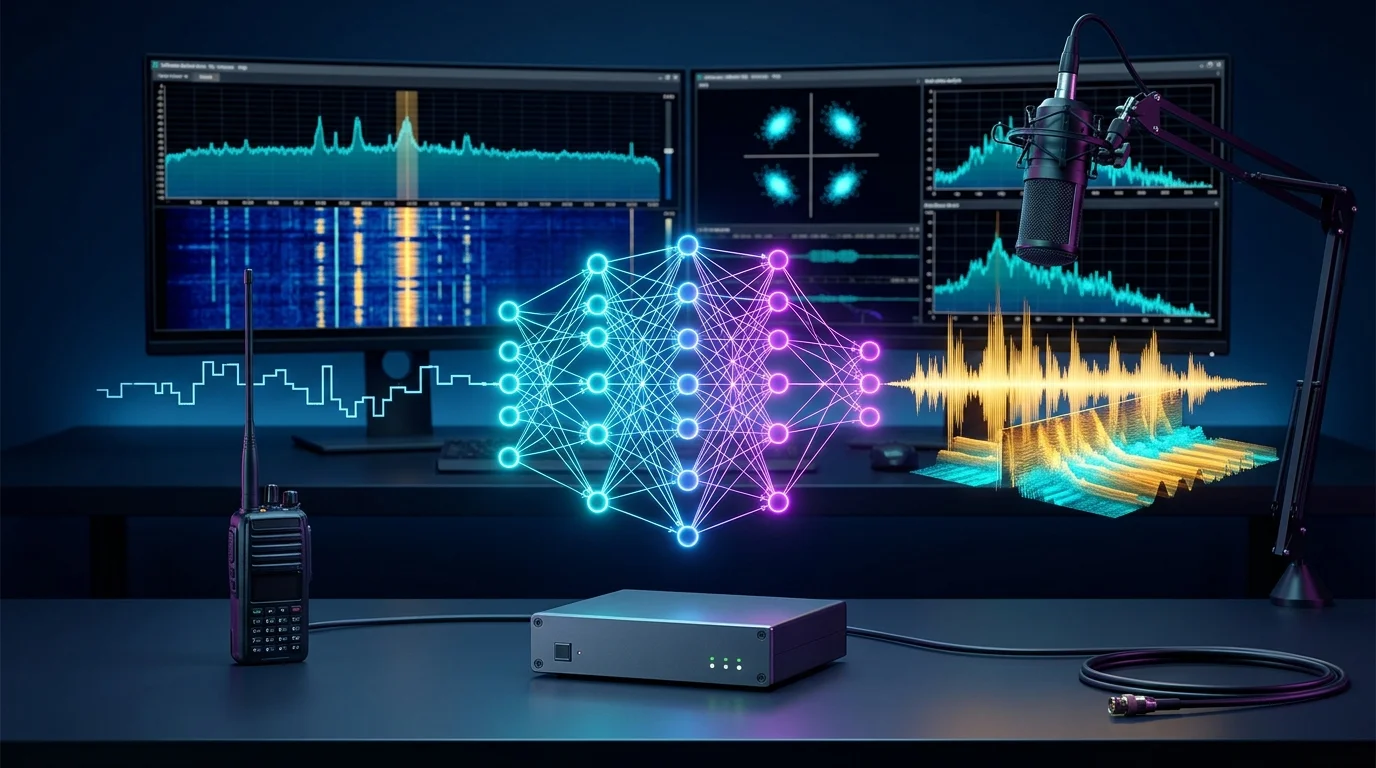
TL;DR: Quick Summary
The M17 Project has published new initial tests applying the FARGAN neural vocoder to David Rowe VK5DGR’s open source Codec 2 speech codec. Led by M17 founder Wojciech Kaczmarski (SP5WWP) and building on research by Felix Schäfer (DD8SF), the system replaces the receiver-side LPC oscillator synthesizer with a deep learning Generative Adversarial Network (GAN). Transmitters continue sending standard 3200 bps Codec 2 bitstreams over existing M17 4FSK RF channels. Receivers equipped with modern processors (smartphones, PCs, and SDR base stations) tap the incoming acoustic parameters to synthesize natural, buzz-free audio, including 16 kHz wideband spectral reconstruction.
What Is the M17 Codec 2 Neural Enhancer?
The M17 Codec 2 Neural Enhancer is an experimental receiver-side speech synthesis architecture that uses a Generative Adversarial Network (GAN) to reconstruct high-fidelity voice from standard 3200 bps Codec 2 frame parameters without altering the over-the-air radio protocol.
For more than two decades, digital voice in amateur radio has suffered from a painful compromise. Proprietary systems like DMR, D-STAR, System Fusion (YSF), and P25 rely on closed-source AMBE (Advanced Multiband Excitation) vocoder hardware from Digital Voice Systems, Inc. (DVSI). Hams wanting open source radio turned to David Rowe VK5DGR’s pioneering Codec 2 and the M17 Project.
Yet skeptics often leveled a familiar critique: “Codec 2 sounds robotic,” “it sounds no better than AMBE,” or “analog FM still sounds clearer.”
On October 13, 2026, Wojciech Kaczmarski (SP5WWP), creator and lead architect of the M17 Project, published an eye-opening technical report: Codec2 neural enhancer tests. By decoupling the transmission protocol from the audio synthesis engine, M17 demonstrates how modern deep learning can turn a narrow 3.2 kbps RF stream into rich, room-filling 16 kHz wideband voice.
+-----------------------------------------------------------------------------------+
|                        M17 NEURAL ENHANCER ARCHITECTURE                           |
+-----------------------------------------------------------------------------------+

 TRANSMITTER (Handheld / Base)                     RECEIVER (Phone / PC / SDR)
 +-----------------------------+                  +-------------------------------+
 |  Microphone Audio (8 kHz)   |                  |  Over-The-Air RF Reception    |
 +--------------+--------------+                  +---------------+---------------+
                |                                                 |
                v                                                 v
 +-----------------------------+                  +-------------------------------+
 | Codec2-mod LPC Encoder      |                  | Demodulate 4FSK Frame         |
 | (Extracts Pitch, Energy,    |                  | Extract Codec 2 Parameters    |
 |  LPC Spectral Coefficients) |                  | (Identical 3200 bps Bitstream)|
 +--------------+--------------+                  +-------+---------------+-------+
                |                                         |               |
                v                                 [Standard Mode]  [Neural Mode]
 +-----------------------------+                          |               |
 | 4FSK 3200 bps RF Bitstream  |                          v               v
 | Transmitted over RF Channel |                   +-------------+ +-------------+
 +--------------+--------------+                   | Traditional | | FARGAN GAN  |
                |                                  | Codec 2 LPC | | Neural      |
                +=================================>| Synthesizer | | Synthesizer |
                                                   +------+------+ +------+------+
                                                          |               |
                                                          v               v
                                                    Robotic 8 kHz   Natural 16 kHz
                                                    Narrowband      Wideband Voice
Why Traditional Digital Voice Sounds Robotic: The Classical Vocoder Bottleneck
To understand why neural enhancement represents a massive leap forward, one must understand how low-bitrate digital speech synthesis works.
Analog FM transmits voice by modulating radio carrier frequency directly with continuous audio waveforms. It sounds warm and natural, but it demands 12.5 kHz or 25 kHz of channel bandwidth and consumes significant RF power when signals weaken into background hiss.
Digital voice systems squeeze human speech into a sliver of that bandwidth (typically 3 kHz to 9 kHz RF channels carrying 2400 to 4800 bits per second). At 3200 bps, there is insufficient data capacity to transmit uncompressed PCM audio or even modern perceptual audio like MP3 or AAC.
Instead, codecs like Codec 2 and AMBE use the classical source-filter model of human speech:
- Vocal Tract Analysis (Linear Predictive Coding / LPC): The encoder analyzes 20 ms to 40 ms slices of speech to determine the shape of the speaker’s vocal tract. It models the resonances (formants) as an all-pole linear filter, transmitting Line Spectral Pairs (LSPs) or reflection coefficients.
- Pitch Detection (F0): The encoder measures the speaker’s fundamental vocal cord vibration frequency.
- Voicing Classification: The encoder classifies each frame as voiced (vowels like “ah”, “ee”, “oh”, driven by vibrating vocal folds) or unvoiced (consonants like “s”, “t”, “sh”, driven by turbulent air passing through teeth and lips).
- Energy Level: A compact gain value representing acoustic loudness.
At the receiving end, traditional decoders must synthesize speech from scratch using this mathematical abstraction.
Herein lies the bottleneck: classical synthesizers use a simple glottal pulse train for voiced speech and white noise for unvoiced speech. Feeding an artificial periodic buzz through an LPC filter produces intelligible words, but the result sounds synthetic, rigid, and metallic. Human vocal cords don’t produce perfect mathematical impulses. They exhibit complex organic damping, phase non-linearities, breath turbulence, and subtle micro-tremors that simple mathematical oscillators fail to replicate.
Because proprietary AMBE and open source Codec 2 share this same foundational source-filter architecture, both hit the same acoustic ceiling at low bitrates.
The Neural Revolution: What Is FARGAN?
During the 2025 M17 Conference, researcher Felix Schäfer (DD8SF) presented a paper titled Applications of Neural Vocoding Techniques in Amateur Radio. Schäfer demonstrated that machine learning algorithms, trained on vast corpora of human speech, could infer natural vocal characteristics directly from parametric representations.
Building on Schäfer’s groundwork, Wojciech Kaczmarski selected FARGAN as the reference neural synthesizer.
FARGAN (Fast Audio Reconstruction Generative Adversarial Network) was introduced in 2024 by audio researchers Jean-Marc Valin, Jan Büthe, and Ahmed Mustafa (Amazon Audio Research / IEEE). Jean-Marc Valin is well known across open source audio engineering as the co-creator of the Opus audio codec, Speex, and the LPCNet neural vocoder. Valin has also collaborated closely with David Rowe VK5DGR on FreeDV’s deep learning HF digital voice engines (such as RADE and rade_c).
Unlike massive text-to-speech diffusion models that require datacenter GPU clusters and introduce seconds of latency, FARGAN was engineered specifically for lightweight, real-time edge processing:
- Low Computational Complexity: FARGAN requires roughly 1 GFLOPS of processing power. A typical modern smartphone or PC CPU core can run it in real-time using under 5% of a single core.
- Generative Adversarial Network (GAN) Architecture: During training, a generator network attempts to synthesize natural speech waveforms from acoustic features, while a discriminator network attempts to differentiate generated speech from authentic human recordings. This adversarial tension forces the generator to capture subtle phonetic textures, glottal pulse dynamics, and phase relationships.
- Frequency-Domain Linear Prediction (FDLP) & Sub-band Processing: FARGAN processes audio in sub-bands, allowing it to maintain sharp temporal resolution for transients (like consonant plosives) while cleanly modeling harmonic pitch structures.
Wojciech trained the neural network using the open LibriSpeech corpus (an extensive English speech dataset derived from audiobooks) and mated it to Codec2-mod, the M17 Project’s optimized C implementation of Codec 2. Codec2-mod runs with significantly higher computational efficiency than the reference Codec 2 codebase, making parameter extraction clean and deterministic.
The Masterstroke: Receiver-Side Enhancement Without Protocol Changes
The most consequential technical design choice in Wojciech Kaczmarski’s experiment is where the neural network lives:
The neural synthesizer operates exclusively on the receiver side. The over-the-air RF bitstream remains 100% untouched.
In traditional amateur radio engineering, upgrading voice quality historically meant defining a new transmission standard, creating incompatible packet formats, and rendering existing transceivers obsolete.
The M17 Neural Enhancer sidesteps this entirely:
- Transmitters Stay Lightweight: An operator speaking into a low-cost handheld radio (like a TYT MD-380 running OpenRTX or a custom Module17 rig) doesn’t need a neural network processor. The transmitter simply encodes audio using standard Codec2-mod at 3200 bps and sends normal M17 4FSK packets.
- Backwards Compatibility: Any existing M17 radio with a basic microcontroller continues to receive and decode the transmission using standard Codec 2 LPC synthesis. Nothing breaks.
- Listener-Side Super-Resolution: An operator listening via an SDR receiver, a PC console (such as
mvoice), or a smartphone app (such as DroidStar) can enable the FARGAN neural synthesizer. The client software takes the raw decoded Codec 2 frame parameters and feeds them into the local GAN instead of the old LPC oscillator.
Reconstructing 16 kHz Wideband Audio from 8 kHz RF Data
Standard Codec 2 operates at an 8 kHz audio sampling rate, yielding a hard acoustic bandwidth limit of 4 kHz (standard communications voice).
In Wojciech’s test samples, FARGAN was configured to synthesize speech at 16 kHz audio sampling.
How can a receiver output 16 kHz wideband speech when the transmitter only sent 8 kHz acoustic parameters?
Because human speech follows predictable physical acoustic rules. When a human vocal tract produces a vowel or consonant, higher-frequency harmonics and fricative energy (between 4 kHz and 8 kHz) correlate directly with fundamental pitch, formant shapes, and lower-band energy.
Having analyzed thousands of hours of speech during training, the neural network performs spectral bandwidth extension. It hallucinates and reconstructs the missing upper spectral harmonics with remarkable fidelity. The listener hears crisp, open, broadcast-like voice audio from an RF channel carrying only 3200 bits per second!
Analyzing the Audio Samples: Before and After
In his technical announcement, Wojciech published five audio samples demonstrating the progression from raw microphone input to neural synthesis:
| Audio Sample | Description | Perceptual Character | Technical Mechanism |
|---|---|---|---|
| Sample 1: Reference 16 kHz | Clean, uncompressed source audio | Studio-grade, natural human voice | Original recording from LibriSpeech corpus. |
| Sample 2: Resampled 8 kHz | Source audio downsampled to 8 kHz | Narrowband telephony sound | Standard communications passband cutoff at 4 kHz. |
| Sample 3: Codec 2 3200 bps | Traditional M17 digital voice output | Intelligible, but buzzy and robotic | Standard LPC filter excited by periodic pulse trains. |
| Sample 4: FARGAN 8 kHz | Neural synthesis at 8 kHz | Smooth, natural, buzz eliminated | FARGAN GAN replaces LPC oscillator using identical parameters. |
| Sample 5: FARGAN 16 kHz | Neural synthesis with spectral extension | Wideband, crisp, open high-end | GAN reconstructs missing 4-8 kHz harmonics from 3.2 kbps stream. |
When comparing Sample 3 (the standard Codec 2 sound hams hear today) against Sample 4 and Sample 5, the difference is striking. The artificial “kazoo” buzz and mechanical undertones vanish. Vocal timbre smooths out into natural human speech, while the 16 kHz sample restores breath and presence that classical digital voice codecs discard.
You can listen to all five original WAV audio files directly on the M17 Project announcement post.
Comparison: Codec 2 Neural Enhancer vs Existing Digital Voice Technologies
To see how the M17 neural enhancer fits into the broader digital voice landscape, consider this comparison against current amateur radio modes:
| Feature / Metric | M17 Neural Enhancer (FARGAN) | Standard M17 (Codec 2 3200) | DMR / Fusion / D-STAR (AMBE) | P25 Phase 1 (IMBE) | Analog FM (12.5 kHz) |
|---|---|---|---|---|---|
| Licensing & Patents | 100% Open Source (GPL / Apache) | 100% Open Source | Proprietary Patent-Encumbered (DVSI) | Proprietary / Legacy Patent | Open / Unencumbered |
| Over-The-Air Bitrate | 3200 bps | 3200 bps | 3600 bps (Voice + FEC) | 7200 bps (Voice + FEC) | N/A (Analog) |
| Audio Bandwidth | Up to 16 kHz (Wideband) | 4 kHz (Narrowband) | 3.4 kHz (Narrowband) | 3.4 kHz (Narrowband) | ~3 kHz to 3.4 kHz |
| Synthesizer Technology | Deep Learning GAN (FARGAN) | Classical LPC + Pulse Train | Classical Multi-Band Excitation | Improved Multi-Band Excitation | Continuous RF Demodulation |
| Hardware Requirement (TX) | Low-cost MCU (STM32, ESP32) | Low-cost MCU (STM32, ESP32) | Hardware AMBE chip or licensed blob | Hardware IMBE chip | Basic analog circuitry |
| Hardware Requirement (RX) | Smartphone / PC / Modern DSP | Low-cost MCU (STM32) | Hardware AMBE chip | Hardware IMBE chip | Basic FM discriminator |
| Robotic Buzz Artifacts | Virtually Eliminated | Noticeable | Noticeable (“digital warble”) | Noticeable (“vocoder rasp”) | None (White noise when weak) |
| Extensible at Receiver | Yes (Drop-in model updates) | Requires firmware re-flash | No (Hardcoded in ASIC silicon) | No (Hardcoded in ASIC silicon) | No |
Deployment Realities: Where Can This Run?
A common question among operators is whether handheld transceivers can run neural vocoders directly.
Embedded Microcontrollers (STM32 / OpenRTX Handhelds)
Currently, popular open source handhelds (like the TYT MD-380 or Radioddity GD-77 running OpenRTX, or standalone boards like Module17) rely on microcontrollers such as the STM32F4 or STM32F7. While these ARM Cortex-M chips handle classical Codec 2 encoding and decoding with ease, they lack the vectorized floating-point hardware and RAM required for real-time neural GAN inference.
Handhelds will continue utilizing standard Codec 2 synthesis for direct radio-to-radio listening. Because the RF frames are identical, a handheld user can transmit to a repeater, and everyone listening on client software or networked systems will hear the enhanced voice.
Smartphones, Tablets, and PCs (DroidStar, mvoice, SDRs)
Smartphones running Android or iOS, Raspberry Pi 4/5 single-board computers, and desktop computers possess abundant computing muscle. A modern smartphone ARM Cortex core running NEON SIMD instructions can execute FARGAN neural synthesis with negligible battery impact.
Wojciech specifically noted plans to experiment with DroidStar and mvoice. For Android users running the DroidStar 9M2PJU Mod, integrating a neural vocoder backend would allow phones to decode M17 reflector audio with studio-quality wideband sound over cellular or WiFi connections.
Repeaters and WebSDR Gateways
Repeaters and internet gateways running on Linux hosts (such as Raspberry Pi or x86 servers) can run neural enhancement at the network level. An M17 reflector or AllStarLink/BrandMeister cross-mode bridge could optionally synthesize neural wideband audio for streaming web dashboards, Broadcastify feeds, or WebSDR listeners.
Why This Matters for Open Source Amateur Radio
For thirty years, commercial manufacturers used proprietary vocoders to lock amateur radio into vendor silos. Hams were told that pristine digital voice required specialized, closed-source hardware ASICs manufactured by a single corporation.
AMBE chips like the AMBE-2000 and AMBE-3000 are frozen in time. They’re hardwired silicon designs from the late 1990s and early 2000s. They can’t be updated with deep learning algorithms, can’t perform neural bandwidth extension, and can’t adapt to modern acoustic advances without discarding the radio hardware.
Open source protocols like M17 and codecs like Codec 2 represent an entirely different paradigm. Because every layer of the stack is software-defined, open, and modular, the community can adopt advanced advances from academic machine learning research the moment they appear.
By proving that a lightweight neural vocoder running on a phone or computer can transform an unencumbered 3200 bps amateur radio bitstream into wideband audio, Wojciech Kaczmarski and the M17 Project have demonstrated the decisive advantage of open standards: proprietary hardware stagnates, but open software continually evolves.
What Comes Next for M17 and Codec 2?
Wojciech outlined several immediate next steps in the experimental pipeline:
- Adversarial Fine-Tuning: Applying additional adversarial training cycles with a low learning rate to polish transient phonemes and eliminate subtle residual metallic artifacts.
- Corpus Diversity: Expanding training datasets beyond LibriSpeech English to incorporate diverse accents, languages, female and male pitch ranges, and real-world background noise environments (mobile shacks, wind noise, emergency sirens).
- Bit Error Robustness: Testing FARGAN against real-world off-the-air Codec 2 streams subjected to bit errors, fading channels, and packet jitter.
- Integration into DroidStar and mvoice: Bringing compiled FARGAN inference models into active M17 software clients so operators worldwide can test the neural synthesizer in everyday QSOs.
Amateur radio operators interested in testing, training datasets, or following ongoing development can participate in the M17 Discord and Matrix channels and track the Codec2-mod GitHub repository.
Frequently Asked Questions (FAQ)
What is the M17 Codec 2 Neural Enhancer?
It’s an experimental receiver-side software synthesizer that uses the FARGAN deep learning neural network to convert standard 3200 bps Codec 2 parameters into natural, high-fidelity voice.
Does the neural enhancer require a new radio or protocol change?
No. Transmitters send standard M17 4FSK radio frames carrying unmodified 3200 bps Codec 2 bitstreams. Existing radios continue decoding audio normally, while equipped receivers can enable neural synthesis.
Can a handheld radio like the TYT MD-380 run the neural enhancer?
Not directly on current microcontroller hardware. Microcontrollers like the STM32 lack the compute throughput for GAN inference. Handhelds transmit standard signals, while smartphones, PCs, and SDR base stations perform the neural decoding.
How does the enhancer produce 16 kHz audio from an 8 kHz stream?
FARGAN performs spectral bandwidth extension. Trained on thousands of hours of human speech, the neural network predicts and reconstructs the missing 4 kHz to 8 kHz acoustic harmonics directly from lower-frequency speech parameters.
When will the neural enhancer be available in client apps like DroidStar?
Wojciech Kaczmarski has completed initial proof-of-concept tests. Next steps include fine-tuning the model to reduce metallic artifacts and packaging the inference engine for client software like DroidStar and mvoice.
Sources and Further Reading
- M17 Project: Codec2 neural enhancer tests – Wojciech Kaczmarski (SP5WWP) official announcement and WAV audio samples.
- M17 Project Official Website – Open source digital radio protocol documentation and hardware specifications.
- Codec2-mod GitHub Repository – M17 Project’s optimized C implementation of Codec 2.
- FARGAN: A Fast, Low-Complexity Neural Vocoder for Audio Enhancement / Compression – IEEE paper by Jean-Marc Valin, Jan Büthe, and Ahmed Mustafa (Amazon Audio Research).
- Felix Schäfer (DD8SF) Research – Applications of Neural Vocoding Techniques in Amateur Radio, presented at M17 Conference 2025.
- David Rowe VK5DGR Rowetel Blog – The home of Codec 2, FreeDV, and open source digital voice development.
- DroidStar 9M2PJU Mod – All-in-one Android digital voice client supporting M17, DMR, YSF, P25, and NXDN.
73 de 9M2PJU


Post Comment