amateur radio
open source
Technology
433 MHz, 868 MHz, 915 MHz, 9M2PJU, amateur radio, Elecrow ThinkNode M9, EmComm, GPL-3.0, H3 hexagons, ham radio, LilyGO T-Deck Plus, lora, LoRa coverage map, MatterMap, MatterMesh OS, mattermeshos.com, Meshcore, off-grid mesh, openstreetmap, passive RF mapping, Protomaps, T-Deck Max
9M2PJU
0 Comments
MatterMesh OS and MatterMap: Passive, Privacy-First LoRa MeshCore Coverage Mapping Without a Phone
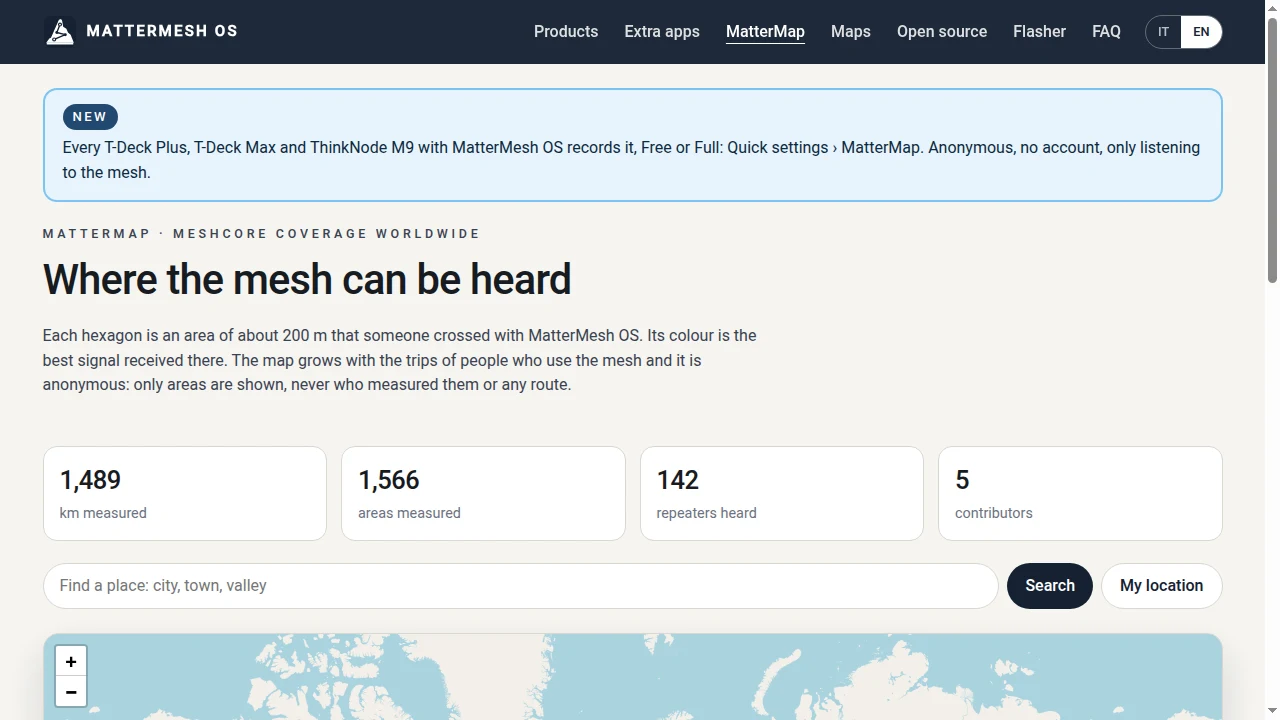
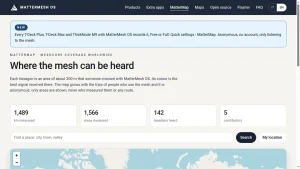
TL;DR: MatterMesh OS (mattermeshos.com) is a free, GPL-3.0 operating system built on MeshCore for standalone LoRa handhelds (LilyGO T-Deck Plus, T-Deck Max e-ink, and Elecrow ThinkNode M9). Its newest addition, MatterMap (mattermeshos.com/coverage/), turns those handhelds into passive, zero-ping RF coverage mappers that log real MeshCore packets and dead zones onto anonymous 200-metre H3 hexagons with no phone app, no account, a 500-metre home privacy buffer, and an open CSV upload API any MeshCore firmware can use.
Anyone who has ever deployed a mountain-top LoRa repeater knows the hardest part isn’t soldering the solar regulator or waterproofing the mast. It is answering a basic RF engineering question afterwards: where does the network actually reach on the ground, and where are the dead zones?
Traditional LoRa wardriving approaches carry two annoying drawbacks. Active range-test beacons chew through precious airtime and regional duty cycles, cluttering shared mesh channels with synthetic test pings. Worse, most coverage mappers require tethering your LoRa radio to a smartphone app over Bluetooth, creating an account, and uploading GPS tracks that can inadvertently expose your home QTH or daily commute.
MatterMesh OS – the open-source, keyboard-driven MeshCore operating system we previously introduced in our MatterMesh OS launch overview – has now tackled that problem head-on with MatterMap. Built directly into the handheld firmware and backed by an open developer specification, MatterMap maps real-world MeshCore coverage completely passively while your radio sits in your pocket.
This guide dives into how MatterMesh OS and MatterMap work together, unpacks the passive H3 hexagon architecture and privacy safeguards, walks through the open #MMCOV1 CSV and resumable HTTPS API for firmware developers, covers the latest MatterMesh OS upgrades (including 433 MHz T-Deck Plus support and browser-rendered offline topographic maps), and compares MatterMap against active range testing and RF propagation simulations.
Last updated: November 2026.
What Are MatterMesh OS and MatterMap?
MatterMesh OS is a free, GPL-3.0 standalone operating system for MeshCore LoRa handhelds (LilyGO T-Deck Plus, LilyGO T-Deck Max, and Elecrow ThinkNode M9), and MatterMap (mattermeshos.com/coverage/) is its integrated, passive, crowdsourced RF coverage map that aggregates received LoRa signal quality onto anonymous 200-metre H3 hexagonal cells without sending pings or requiring a smartphone.
Unlike companion-only LoRa nodes that act as dumb Bluetooth modems for a phone, MatterMesh OS turns dedicated keyboard handhelds into self-contained off-grid communicators. All three supported boards run encrypted device-to-device MeshCore chat, contact lists with live RSSI and hop counts, lock-screen message reception with instant Enter reply, signed Wi-Fi firmware updates, and built-in maps, weather radar, file manager, and CLI tools:
- LilyGO T-Deck Plus (2.8-inch colour touchscreen + trackball): Full colour maps, emoji chat bubbles, three UI themes (Alpine Light, Night Ridge, Expedition), and support for 433 MHz, 868 MHz, and 915 MHz LoRa bands selectable on first boot.
- LilyGO T-Deck Max (sunlight-readable e-ink): Ultra-low-power monochrome display built for multi-day alpine or backcountry trips, complete with physical keyboard and offline voice dictation.
- Elecrow ThinkNode M9 (key-driven, non-touch): Rugged, glove-friendly navigation engineered entirely around physical keys without relying on a touchscreen.
MatterMap extends all three devices – in both the Free GPL-3.0 edition and the Full edition – into autonomous RF survey instruments.
How MatterMap Works: Passive Listening on 200-Metre H3 Hexagons
MatterMap is engineered around a strict radio-etiquette principle: listen only, never transmit. When you toggle MatterMap on from the handheld’s Quick Settings shade, the internal GPS wakes automatically and begins recording a compact local CSV log once it acquires a valid fix.
+-------------------------------------------------------------------+
| Standalone Handheld (T-Deck Plus / T-Deck Max / ThinkNode M9)     |
|                                                                   |
|  [Own LoRa Radio RX] ---> Packet Received?                        |
|                             |-- YES -> Log "P" row (SNR/RSSI/hop) |
|                             |-- NO (30s) -> Log "N" dead-zone row |
|  [Internal GPS Fix]  ---> Fresh fix check (age x speed <= 100 m)  |
|  [Home Zone Filter]  ---> Drop rows inside 500 m home radius      |
|                                  |                                |
|                                  v                                |
|                   [Local SD / Flash CSV (#MMCOV1)]                |
+----------------------------------|--------------------------------+
                                   |
                   (Back on Wi-Fi - Resumable HTTPS)
                                   |
                                   v
+-------------------------------------------------------------------+
| MatterMap Server (mattermeshos.com/coverage/)                     |
|  - Rejects >300 km/h GPS jumps & acc > 100 m                      |
|  - Strips 300 m around first and last recorded points             |
|  - Bins samples into Uber H3 Resolution-9 Hexagons (~200 m)       |
|  - Deletes raw upload after 7 days; publishes anonymous hex map   |
+-------------------------------------------------------------------+
Several subtle engineering choices make MatterMap’s dataset far cleaner than naive wardriving maps:
- Zero extra mesh airtime: Because the radio only logs packets already traversing the local MeshCore network (adverts, flood messages, repeater relays), running MatterMap adds zero congestion and works safely on strict European 868 MHz duty-cycle allocations.
- Explicit dead-zone mapping (
Nrows): A common flaw in passive RF maps is survivorship bias – empty map space could mean “no signal” or simply “nobody walked there.” MatterMap solves this by writing a"nothing heard"(N) row every 30 seconds whenever the device has a valid GPS fix and hasn’t heard a single packet. On the web map, those hexagons render distinctly from unmeasured territory, showing repeater builders exactly where coverage drops off. - Own-radio-only rule: Packets forwarded over Bluetooth or Wi-Fi from a companion bridge are ignored. Only RF frames demodulated directly by the handheld’s local LoRa transceiver count as ground truth.
- Anti-drift GPS freshness filter: No sample is written without a GPS fix, and rows with estimated accuracy worse than 100 metres are dropped. A cached fix may only be reused while
fix age x speed <= 100 m(capped at 10 seconds when speed is unknown, and never older than 30 seconds). That prevents a packet heard right before entering a road tunnel or concrete parking structure from being stamped onto the wrong hexagon. - H3 Resolution-9 aggregation: On the server, valid samples are binned into H3 resolution-9 hexagons (roughly 200 metres across), coloured by the best signal quality observed in that cell (Good, Weak, Marginal, or Nothing Heard). New uploads appear on the live global map within roughly 5 minutes.
Built-In Privacy Protections
Radio operators are rightly cautious about public maps that tie callsigns, node IDs, and timestamps to home addresses. MatterMap bakes privacy into both the firmware and the ingestion pipeline:
- No accounts, no callsigns, no tracks: There is no login system and no per-user or per-trip map view. Visitors to
mattermeshos.com/coverage/see only aggregated hexagonal zones and verified repeater positions. - Dual spatial fuzzing: On the device, users configure a home exclusion zone (500 metres by default) where nothing is ever written to disk. On the server, an additional 300-metre radius around the first and last point of every uploaded recording is automatically stripped before aggregation.
- Non-reversible device identifier: Uploads identify the hardware solely via the first 12 lowercase hex characters of
SHA-256("mmcov:" + MAC_HEX)– never the raw MAC address or MeshCore public key. The server uses that hash exclusively for upload resumption and rate limiting and never publishes it. - 7-day raw data purge: Once samples are merged into the aggregate H3 cells, raw uploaded CSV recordings are deleted after 7 days.
- Anti-spoof repeater dots: Repeaters only appear as named dots on the map when a flood packet’s last-hop hash uniquely matches a single known repeater within 200 km of the recording. Short 1-byte hashes shared by multiple repeaters are deliberately not trusted.
Inside the Open #MMCOV1 Developer Protocol and Upload API
One of the best decisions by the MatterMesh OS team is opening MatterMap to the entire MeshCore ecosystem. Documented in English at mattermeshos.com/coverage/developers/, any third-party MeshCore firmware (whether running on a Heltec, RAK WisBlock, Seeed Wio, or custom ESP32/nRF52 board) can record and upload coverage using a clean, lightweight CSV format.
The #MMCOV1 CSV Format
Files are UTF-8 with LF line endings and rotate automatically once they exceed 1.5 MB (the server accepts up to 2 MB per upload, representing 50 to 100 hours of typical mesh traffic). The header identifies the format, board slug, firmware version, and hashed device ID, followed by 13 comma-separated fields per sample:
#MMCOV1,wio-l2,solo-2.0,3f9a0c21b7e4
1794470012,45.85660,9.39770,8,1,R,P,7.5,-92,a3,1,2,F
1794470042,45.85702,9.39811,8,1,R,N,,,,,,
#RPT,9f8e7d6c5b4a,45.91020,9.41200,MonteBarro-RPT,1794469900
#END
Each sample row carries t,lat,lon,acc,age,src,kind,snr,rssi,hop,hb,len,rt:
t,lat,lon,acc,age: UTC Unix timestamp, 5-decimal coordinates, estimated accuracy in metres (HDOP x 5), and GPS fix age (0-30 s).srcandkind:R(device’s own radio) andP(packet received) orN(nothing heard in 30 s).snrandrssi: Signal-to-noise ratio (dB, 1 decimal) and received signal strength (integer dBm).hop,hb,len,rt: Last-hop repeater hash, hash length in bytes (1-3), path length in hops, and routing type (Ffor flood,Dfor direct). Optional#RPTlines at the footer supply repeater coordinates and names from heard adverts before closing with#END.
Three-Step Resumable HTTPS Upload
Because microcontroller Wi-Fi connections in mountain huts or mobile hotspots drop frequently, the upload API is chunked and fully resumable over plain HTTPS with no OAuth tokens required:
- Begin (
POST /api/coverage/begin): Sends JSON metadata (dev,board,fw,name,rows,bytes) and receives a 24-hex uploadidplus the currentreceivedbyte offset. - Stream Chunks (
PUT /api/coverage/<id>?offset=<bytes>): Uploads raw UTF-8 CSV slices up to 12 KB per chunk (aligned on complete rows). Duplicate offsets are acknowledged idempotently; gaps return HTTP409. - Finalise (
POST /api/coverage/<id>/end): Triggers server-side sanitisation, H3 binning, and returns the count of kept rows and mapped cells.
What Else Is New Across MatterMesh OS
Beyond MatterMap, mattermeshos.com has matured into a remarkably polished platform for off-grid LoRa operators:
- Browser-rendered offline topographic maps (
mattermeshos.com/maps/): Instead of hunting down broken tile mirrors, you select regions in desktop Chrome or Edge, and your own computer renders OpenStreetMap + Protomaps vector data with trails, alpine huts, contour lines, and SRTM/Copernicus terrain shading directly onto your T-Deck’s SD card (maps/folder). The tool even highlights an important embedded-storage detail: format SD cards as FAT32 (16 KB or 32 KB clusters) rather than exFAT (128 KB clusters), since thousands of ~20 KB map tiles waste roughly 3x the space on exFAT. (Note: the offline map generator is currently in live testing starting with Italy, with USB direct upload marked as coming soon.) - 8-language physical keyboard switching: Supports Deutsch, English, Español, Français, Italiano, Português, Русский, and Українська. Enable multiple layouts in Settings and cycle on the fly with
Alt + Space, with accented characters accessible via dead-key presses. - 433 MHz T-Deck Plus support & Launcher compatibility: Alongside 868 MHz and 915 MHz, the 433 MHz T-Deck Plus hardware variant is fully supported, and standalone
.binimages are published foresptool(0x10000) or bmorcelli’s SD-card Launcher (tested on v2.9.1). - 10-Euro lifetime Extra Apps suite: While core MeshCore chat, maps, weather radar, CLI, file manager, and MatterMap remain free and GPL-3.0, a one-time 10-Euro per-device licence unlocks seven specialist RF and field tools (plus future extra apps):
- RPT Scanner & RPT Diagnostic: Discover nearby repeaters with signal/hop telemetry, inspect routing paths, and open a remote repeater console.
- RX Log, Noise Floor, and Spectrum: Inspect every raw packet with path/SNR, track ambient RF noise over time for repeater site selection, and view a waterfall of adjacent-frequency interference.
- Trails and Flights: Offline GPX trail navigation with elevation profiles, and nearby aircraft plotting (heading, altitude, speed) on the T-Deck Plus and ThinkNode M9.
How MatterMap Compares to Other Mesh Coverage Approaches
| Approach | Airtime / Duty-Cycle Impact | Phone App Required? | Maps Dead Zones (N rows)? |
Privacy Safeguards | Open to Other Firmwares? |
|---|---|---|---|---|---|
| MatterMap (MatterMesh OS) | Zero (strictly passive RX) | No (runs standalone on handheld) | Yes (every 30 s with GPS fix) | 500 m home zone, 300 m trip-end trim, H3 hexes, 7-day raw purge | Yes (open #MMCOV1 CSV + HTTPS API) |
| Phone-Tethered Wardriving Apps | Low to Moderate (often pings) | Yes (Bluetooth phone + screen) | Rarely | Varies; often tied to user/node ID | Usually tied to one app ecosystem |
| Active Range-Test Beacons | High (periodic TX bursts) | Optional | Indirectly (missing sequence numbers) | Broadcasts live GPS coordinates over RF | Protocol-dependent |
| RF Simulations (SPLAT! / Radio Mobile) | Zero (desktop software) | No | Models theoretical shadow zones | Full local privacy | N/A (theoretical terrain model only) |
The cleanest workflow for serious mesh builders combines RF terrain modelling before climbing the hill with MatterMap passive ground-truth surveys afterwards to verify real-world foliage attenuation, urban multipath, and repeater antenna patterns.
Getting Started With MatterMesh OS and MatterMap
- Flash your handheld: Visit mattermeshos.com, connect your LilyGO T-Deck Plus, T-Deck Max, or Elecrow ThinkNode M9 over USB using Chrome or Edge, and flash the free GPL-3.0 edition straight from the built-in web flasher (or download the
.binforesptool/ Launcher). - Set your band and home privacy zone: Choose your regional LoRa band (433, 868, or 915 MHz) on first boot, then configure your 500 m home exclusion radius before recording.
- Toggle MatterMap on the trail: Pull down Quick Settings and switch on MatterMap. The internal GPS activates automatically and starts logging once locked – slip the radio into a jacket pocket or backpack lid and hike as usual.
- Upload over Wi-Fi: Once back on Wi-Fi, open Settings > Coverage Map to push your recording. Within roughly 5 minutes, your anonymised 200-metre H3 hexagons appear on mattermeshos.com/coverage/ and can be cached back onto your SD card for offline reference.
Honest Limitations and Field Considerations
No crowdsourced RF tool is magic, and a few practical constraints apply today:
- Quiet networks map slowly: Because MatterMap refuses to transmit pings, areas with very little ambient MeshCore traffic will record mostly
"nothing heard"(N) cells unless repeaters or peers are actively beaconing during your walk. - 200-metre H3 cell averaging: Resolution-9 hexagons are great for privacy and regional planning, but in steep alpine valleys or dense urban canyons, LoRa line-of-sight can flip from solid copy to zero signal in 20 metres. Treat coloured hexes as high-confidence probability zones rather than guaranteed indoor coverage.
- Offline map generator scope: The browser-based topographic tile builder at
mattermeshos.com/maps/is currently in testing with Italy available first; operators outside Italy will need to watch for additional country rollouts or use standard online/cached tiles in the meantime. - 1-byte repeater hash ambiguity: In dense regional meshes where multiple repeaters share a 1-byte path hash, MatterMap deliberately withholds individual repeater dots rather than guessing – a sound engineering call, though it means some repeaters won’t show a pin until longer hashes or unique regional matches are heard.
Why MatterMesh OS and MatterMap Matter
Off-grid LoRa mesh networks only become dependable emergency and backcountry infrastructure when operators can measure real coverage without spamming the airwaves or compromising personal privacy. By pairing a polished, phone-free MeshCore operating system with MatterMap’s passive, zero-ping H3 coverage platform and open #MMCOV1 API, MatterMesh OS sets a high bar for how community RF tools should be engineered.
Whether you carry a T-Deck Plus on 433/868/915 MHz, an e-ink T-Deck Max for multi-day SOTA summits, or maintain your own MeshCore firmware, MatterMap is well worth enabling on your next outing.
73 from 9M2PJU.
Sources and Further Reading
- MatterMesh OS Official Website
- MatterMap Global MeshCore Coverage Map
- MatterMap for Developers –
#MMCOV1Format and Upload API - MatterMesh OS Browser Offline Map Generator
- MeshCore Open-Source LoRa Mesh Project on GitHub
- MatterMesh OS Community on Reddit (r/MattermeshOS)
- MatterMesh OS Launch Overview on hamradio.my
- FieldMesh MeshCore Off-Grid Firmware on hamradio.my


Post Comment