Why a Lie Repeated Often Can Become “Truth”: A Psychological Breakdown
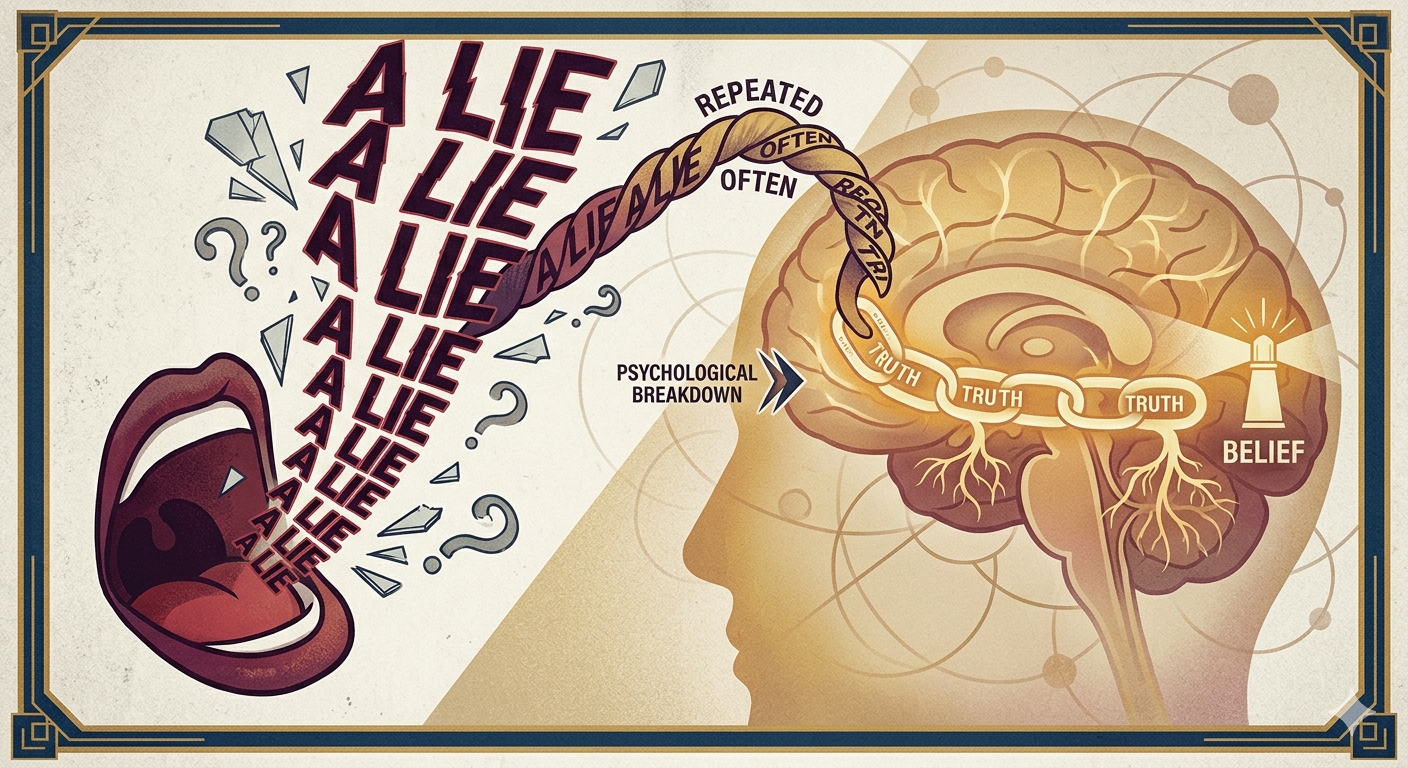
Ever heard the saying, “A lie told a thousand times becomes the truth”? It is not just a throwaway line. The human brain has a ‘bug’ that makes us fall for repetition. Let us break down why.
1. Illusory Truth Effect – “Wait, That Sounds Familiar”
What it is: The more often we hear a statement, the more likely our brain is to judge it as true, even if it is false. Facts or nonsense, the rule still applies.
Why it happens:
Our brain loves shortcuts. When information is repeated, it becomes familiar. The brain translates familiar = true because fact checking takes effort. Psychologists call this cognitive fluency. Information that is easy to process feels more ‘correct’.
- Everyday example: An ad says “9 out of 10 doctors recommend this”. You hear it 3 times a day during your commute. Eventually you assume it is true, even though you never saw the study.
- Social media: Conspiracy theories, fake news, made-up quotes. The first time it hits your FYP you laugh. By the tenth time, you start thinking “huh, that actually makes sense”.
The dangerous formula: Repetition + No fact checking + Emotion = A new “truth”
2. Confirmation Bias and Echo Chambers – “See, I Told You”
Once we start ‘believing’ the false thing because we hear it often, the brain hunts for evidence that supports it. Evidence that contradicts it? The brain auto ignores it.
In WhatsApp groups or on TikTok, if everyone around you repeats the same thing, you think “everyone can’t be wrong”. In reality, you are stuck in an echo chamber, a room that only repeats the same voice back at you.
3. Source Amnesia – Remember the Message, Forget the Messenger
Even scarier, our brain is great at remembering what was said but terrible at remembering who said it. After two weeks, you remember “sugar causes all cancers” but forget you read it from a random comment on Facebook. The info stays, the source credibility disappears.
How This Connects to the Dunning-Kruger Effect
Now let us talk about people who are “too confident with little knowledge”. This is the Dunning-Kruger Effect: people with low competence tend to overestimate their ability, because they do not have enough knowledge to realize what they do not know.
How do these two combine into a big problem?
| Level of Knowledge | What Happens | Impact of Illusory Truth |
|---|---|---|
| Knows a little | Dunning-Kruger: Very confident because they cannot see the gaps in their own knowledge. They feel “I already understand everything” | When they hear a false claim repeated, they accept it immediately because there is no knowledge base to challenge it. “Sounds logical” |
| Shares it back | Because they are confident, they share the wrong info enthusiastically. They become an unqualified ‘speaker’ | They become the source of repetition for others. The cycle starts: wrong → repeat → confident → share → repeat again |
| Rejects correction | Weak “meta-cognition”. They do not realize they do not know. So when an expert corrects them, they assume “the expert is biased too” | The illusory truth has become part of their identity. Pulling it out = pulling out their ego. That is why it is hard |
Real example:
- Someone watches 5 TikToks saying “drinking lemon water in the morning melts fat”.
- Illusory Truth: After the 5th video, they believe it 100%.
- Dunning-Kruger: Because they never studied physiology or fat metabolism, they do not know how complex the process is. So they are convinced “I did my research”.
- They make their own video repeating the same thing + “trust me bro”. 10k people believe it. The cycle lives on.
Why Do People With ‘Little Knowledge’ Get Hit Easier?
- No ‘fact immune system’: Experts have lots of references in their heads. When they hear something weird, an “alarm” goes off – “wait, this contradicts 3 papers I read”. Beginners do not have that alarm.
- Fluency vs Accuracy: A novice brain judges truth by “is it easy to understand”. Wrong explanations are usually simple and sound good. Correct explanations are often complex. So the wrong one feels more ‘true’.
- Confidence = Charisma: Dunning-Kruger makes someone speak with extreme confidence. And studies show humans tend to trust people who are confident, not people who are correct. So a confident lie > a hesitant truth.
How Do We Fight It? 4 ‘Mind Vaccines’
- The 24 Hour Rule: When you hear a new ‘fact’ that shocks you, do not share it right away. Wait 24 hours. If it is true, it can wait. If it is false, it usually gets debunked by then.
- Check the Source, Not the Comfort: Ask “who said it?” and “what is their evidence?”. If the source = “everyone says so”, that is a red flag.
- Recognize Your Own Dunning-Kruger Box: The field you think is easiest to understand is often the field you know the least about. Real experts always say “it depends” because they see the nuance.
- Expose Yourself to Opposing Views: Deliberately follow 1 or 2 credible accounts that disagree with you. It is uncomfortable, but that is how you break the echo chamber.
Conclusion: Something wrong becomes ‘true’ not because it turns into a fact. It happens because our brain loses to repetition. When this combines with Dunning-Kruger, we get the most dangerous mix: people who are wrong, confident, and eager to spread it.
So next time you think “this feels right because I hear it all the time”, pause. It might just be the illusory truth poking you. Real knowledge starts when we are brave enough to say “I do not know, let us check together”.










Post Comment