Echoes from the 1960s: When Listening to the Radio Required a License
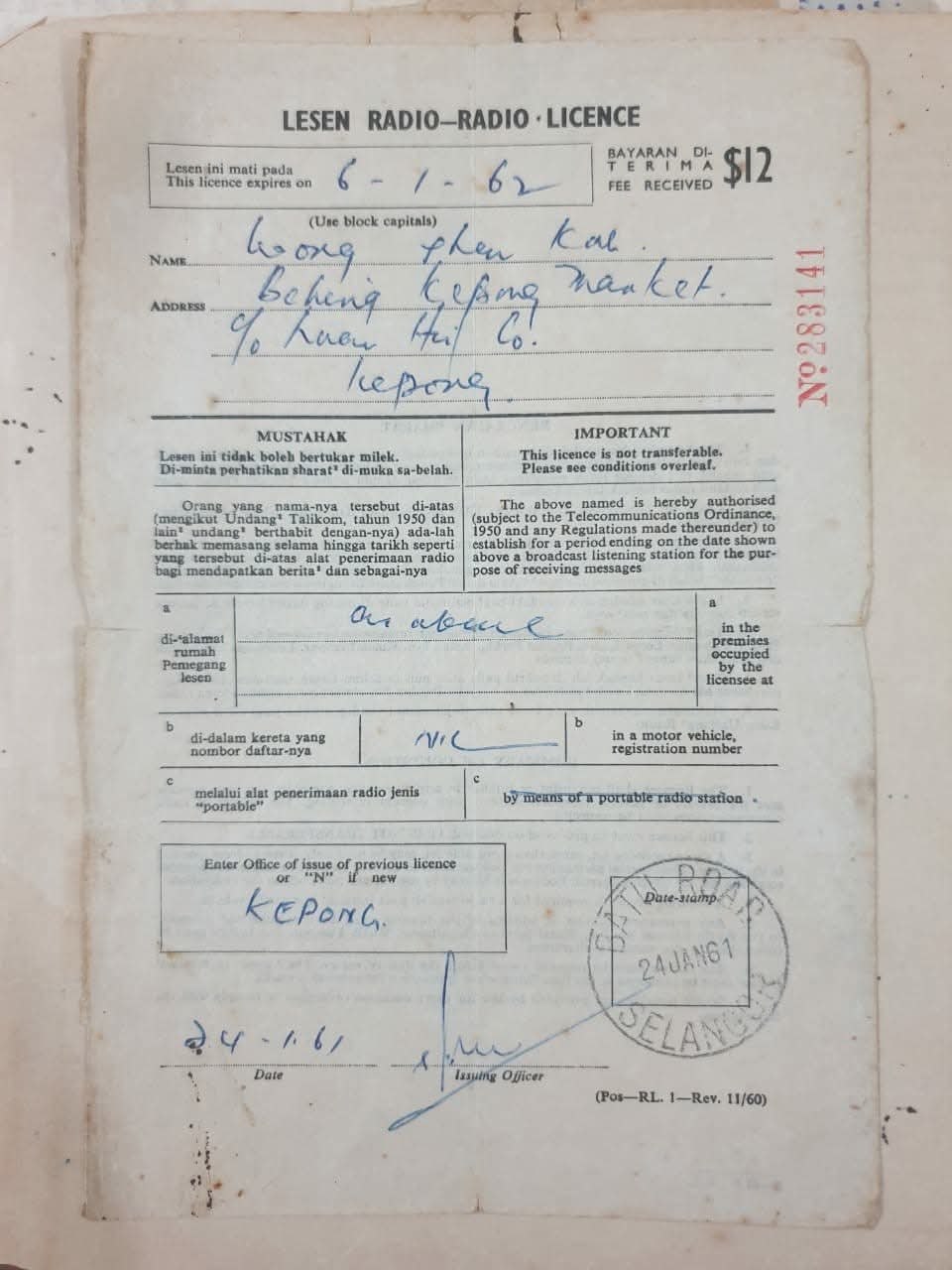
In today’s era of endless streaming, digital nodes, and instant global communications, it is easy to take the open airwaves for granted. Whether we are firing up a modern transceiver or just connecting a smartphone to a Bluetooth speaker, the air is thick with free information. But a fascinating piece of local history recently crossed my desk that serves as a stark reminder of how different things used to be: a genuine Radio Broadcast Receiving License (Lesen Radio) from 1961.
For those of us deeply invested in the world of RF, telecommunications, and radio discipline, this fading piece of paper is a brilliant snapshot of our broadcasting heritage right from the dawn of the Malaysian era.
The Artifact: A Snapshot of 1960s Selangor
Taking a close look at this document reveals a lot about the administrative side of early technology in the country:
- The Cost of Listening: The license fee was $12. Because the Malaya and British Borneo dollar used at the time was eventually replaced 1:1 by the new national currency in 1967, this is the exact historical equivalent of MYR 12. While that might not sound like much now, in 1961, it was a fairly significant annual sum to pay simply for the privilege of operating a receiver.
- The Legislation: The document explicitly notes it is subject to the Telecommunications Ordinance, 1950. Long before we were configuring digital modes or managing automated radio nets, the authorities maintained a strict registry of who was tuning into the news and entertainment.
- Local Geography: The handwritten details trace back to an address “behind Kepong market,” and the official date stamp from January 24, 1961, originates from the Batu Road office in Selangor, a major artery we know today as the bustling Jalan Tuanku Abdul Rahman in Kuala Lumpur.
Why Tax the Receiver?
It might seem absurd today to pay a tax just to own a radio, but in the mid-20th century, building and maintaining the massive infrastructure required for public broadcasting was incredibly expensive. This included the physical transmission towers, the studios, and the complex engineering.
Instead of relying entirely on commercial advertising, the government funded these national communications through the end-user. If you wanted to catch the latest news bulletins, enjoy the evening musical programs, or stay updated during emergencies, you had to pay your dues. The form even has specific check-boxes to declare whether the radio was kept in a house, a motor vehicle, or used as a “portable” station.
The Evolution of the Airwaves
Holding a document like this really puts the evolution of our communications into perspective. Back then, a family gathering around a glowing, tube-powered receiver in Kepong to listen to a crackling broadcast was a heavily regulated luxury.
Today, the landscape of Selangor and the rest of the world is blanketed in invisible, high-speed signals. We have moved from paying a government fee just to listen, to an era where anyone can build, host, and transmit across open-source networks. It is a testament to how far telecommunications technology and accessibility have come over the last six decades.
It makes you appreciate the freedom of the frequencies we operate on today.
73 de 9M2PJU
References & Further Reading
- National History: The Federation of Malaya transitioned into the larger Federation of Malaysia on September 16, 1963. You can read more about this historical timeline via the Sabah State Library: Malaysia Day.
- Currency History: The Malaya and British Borneo dollar was replaced by a new Malaysian currency in 1967. While introduced as the “Malaysian Dollar,” it was officially rebranded as the Ringgit in August 1975. Learn more about this timeline at Study.com: Ringgit History.
- Geographical History: The historical Batu Road was officially renamed Jalan Tuanku Abdul Rahman in 1960 to honor Malaysia’s first Yang di-Pertuan Agong. For additional details on its post-independence development, see Grokipedia: Jalan Tuanku Abdul Rahman.


1 comment