General Interest
Technology
corner drop damage, cracked phone screen, dropping phone on concrete, dropping phone on grass, dropping phone on wood, how to protect phone from drops, phone case drop protection, phone survival guide, prevent shattered phone screen, safe phone drop distance, smartphone drop height, smartphone screen durability, tempered glass screen protector
9M2PJU
0 Comments
Safe Drop Heights for Your Smartphone Explained
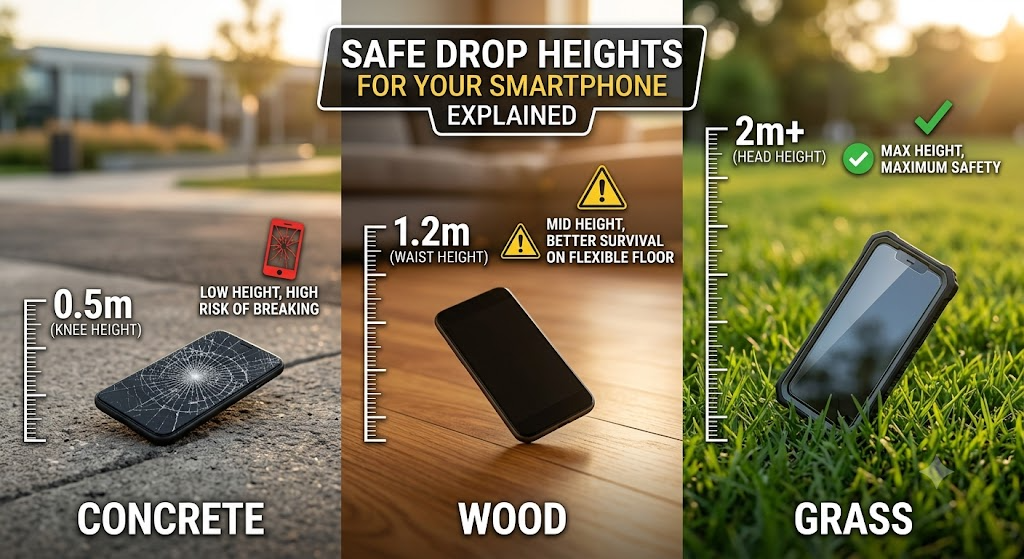
Have you ever experienced that sudden, heart stopping moment? Your phone slips right out of your hand, and time seems to completely freeze. You hold your breath as your expensive device plummets toward the ground. We have all been there. It is a universal human experience to fumble a phone, panic, and then slowly turn it over to see if the glass screen has survived the fall. Sometimes, you get lucky and pick it up completely intact. Other times, you are left staring at a shattered screen that will cost a small fortune to repair.
But why does a phone survive a tumble from your ear one day, but shatter from a tiny drop out of your pocket the next day? You can relax, because the answer is not just random luck. It all comes down to a mix of gravity, the specific angle of the fall, and most importantly, the exact type of floor your phone hits. We are going to have a laid back chat about what really happens when your device takes a dive. Without getting bogged down by complicated math or dense physics formulas, we will explore how high your phone can safely fall depending on the surface it lands on.
The Hidden Secret of Dropping Things
Before we talk about exact heights, we need to understand a very simple concept. The secret to your screen remaining intact is not always about the drop itself. Instead, it is all about the sudden stop at the bottom. Think about jumping into a swimming pool versus jumping onto a solid concrete sidewalk. The height might be exactly the same, but the landing feels very different.
When your smartphone falls, it builds up energy. When it hits the floor, all of that energy has to go somewhere instantly. If the floor is soft, the floor absorbs the energy. If the floor is extremely hard, the floor refuses to absorb anything. Because the energy has nowhere else to go, it travels right back into your phone. That sudden shock is exactly what causes the delicate glass screen to crack under the pressure.
So, let us look at the three main types of surfaces you interact with every single day. We will break down exactly how much danger they pose to your digital lifeline.
1. Concrete, Asphalt, and Ceramic Tiles
These surfaces are the absolute worst enemies of any modern smartphone. We are talking about outdoor sidewalks, parking lots, and the lovely ceramic tiles in your kitchen or bathroom.
-
The safe drop height without a protective case: Below your knees. This is usually around 0.5 meters or less.
The real story: Concrete and ceramic tiles are incredibly rigid and dense materials. They are completely unforgiving. They do not bend, they do not compress, and they certainly do not have any bounce to them. When your phone hits a concrete driveway, the concrete does not absorb even a tiny fraction of the impact energy. Your device and its thin glass screen are forced to take one hundred percent of the shock. This is the exact reason why parking lots claim so many smartphone lives.
Relaxed advice: If you are walking down the street, getting out of your car, or standing in your tiled kitchen, you need to be highly aware of your grip. Even a simple drop from your pants pocket is usually more than enough to leave you staring at a cracked screen. If your phone is completely naked without a case, you should treat it like a fragile egg whenever you are standing on concrete. Keep a tighter grip, and avoid trying to juggle your phone along with your car keys and coffee cup.
2. Hardwood and Laminate Floors
Moving indoors, we often find ourselves surrounded by wooden floors. Hardwood, parquet, and laminate flooring are incredibly common in modern living rooms and bedrooms. These fall firmly into the middle ground of danger.
-
The safe drop height without a protective case: Waist level or dining table height. This sits right around 1 meter to 1.5 meters.
The real story: Wooden floors might feel incredibly hard when you walk on them barefoot, but wood is actually quite fascinating. Because wood comes from trees, it has a natural cellular structure that provides a tiny bit of flexibility. It acts like a very stiff, microscopic spring. When your phone drops onto a hardwood floor, the wood actually flexes ever so slightly. That tiny bit of flex is just enough to absorb a good chunk of the kinetic energy from the fall.
Relaxed advice: If your phone gets knocked off the dining room table or slips out of your hand while you are sitting on the couch, you can usually breathe a massive sigh of relief. The screen rarely shatters from this specific height on wood. You might end up with a small scuff or a minor scratch on the metal frame, but the glass usually survives the ordeal. Of course, this does not mean you should throw your phone at the floor for fun, but you certainly do not need to panic if it takes a tumble in the living room.
3. Dirt, Grass, and Thick Carpets
Finally, we reach the safest environments for your favorite device. Mother Nature provides some of the best smartphone cushions in the world, and thick indoor carpets do a great job mimicking that natural softness.
-
The safe drop height without a protective case: Chest height or even head height. This ranges from 1.5 meters to well over 2 meters.
The real story: Soil, grass, and plush carpets are your phone’s best friends. These surfaces are soft, porous, and highly compressible. They act as excellent natural shock absorbers. When your phone strikes a grassy lawn, the ground gives way and creates a literal physical cushion. This slows down the impact over a slightly longer period of time. Because the blow is softened so efficiently, the actual force hitting the glass on your phone is surprisingly weak.
Relaxed advice: Dropping your phone while taking outdoor photos at the park or playing a game on your living room rug is usually a very safe bet. However, you still need to be a little bit careful outside. The grass itself is perfectly safe, but you always have to watch out for hidden hazards. A small, sharp stone hiding in the dirt can bypass the soft soil entirely. If that single tiny rock hits the glass directly, it concentrates all the pressure into one spot and can still cause a nasty crack.
The Danger of the Corner Drop
Now that we understand the floors, we need to talk about how the phone actually lands. The angle of the impact plays a massive role in whether your phone lives or dies.
If your phone drops and lands perfectly flat on its back, the energy of the fall is spread out evenly across the entire surface of the device. This distribution makes it much easier for the phone to handle the shock. It is exactly like laying flat on a bed of nails instead of stepping on a single nail.
However, phones almost never land perfectly flat. Because of how we hold them, they usually tumble through the air and strike the ground right on one of the four corners. The corners are the absolute most sensitive parts of a smartphone. When a phone lands on a sharp corner, all of the dropping force is concentrated into a tiny space. This extreme pressure easily overwhelms the strength of the glass, causing it to instantly shatter outward like a spider web.
Simple Ways to Protect Your Device
We cannot simply turn off gravity, and dropping things is just a normal part of being a human being. We get distracted, our hands get sweaty, and accidents happen. But you can set your phone up for success so you can live a much more stress free life. You do not have to wrap your phone in bubble wrap, but a few simple additions make a world of difference.
First, you want to pick a good case. You should look for a case that has a raised lip around the screen and thick bumpers on the corners. Remember how we just talked about the dreaded corner drop? If your phone lands on a corner while wearing a case, the silicone or rubber material takes the beating instead of the glass. The raised lip ensures that if the phone falls flat on its face, the rubber touches the ground instead of your actual screen.
Second, you should absolutely use a screen protector. A tempered glass screen protector is a brilliant invention. Yes, the protector might crack when it falls onto the pavement. But that is exactly what it is designed to do. It sacrifices its own life to absorb the shock, saving your actual screen from disaster. Replacing a screen protector costs very little money, while replacing an entire phone screen can completely ruin your monthly budget.
Final Thoughts
At the end of the day, you really do not need to stress too much about your device. Slap a decent rubber or silicone case on your phone, put a piece of protective glass over the screen, and be mindful of what kind of floor you are standing on. If you are outside on the concrete, just hold onto it a little bit tighter. If you are sitting on the grass, you can relax entirely.
Smartphones are engineered to make our lives easier, more connected, and a lot more fun. They are absolutely not meant to give us constant anxiety or mini heart attacks every time we pull them out of our pockets. Understand your surroundings, protect your device sensibly, and go enjoy your day without worrying about gravity taking its toll.











Post Comment