amateur radio
history
9M2, amateur radio history, Bersekutu Bertambah Mutu, British Empire prefixes, British Malaya, callsign history, colonial radio, DXCC, Federation of Malaya, IARU, kuala lumpur, Malayan Amateur Radio Transmitters Society, Malayan Emergency, Malayan history, Malayan Union, Malaysian amateur radio, MARTS, Merdeka, Negaraku, Penang, Persekutuan Tanah Melayu, QSL card, Tunku Abdul Rahman, VS2, VS3
9M2PJU
0 Comments
Persekutuan Tanah Melayu: Federation of Malaya History and Amateur Radio
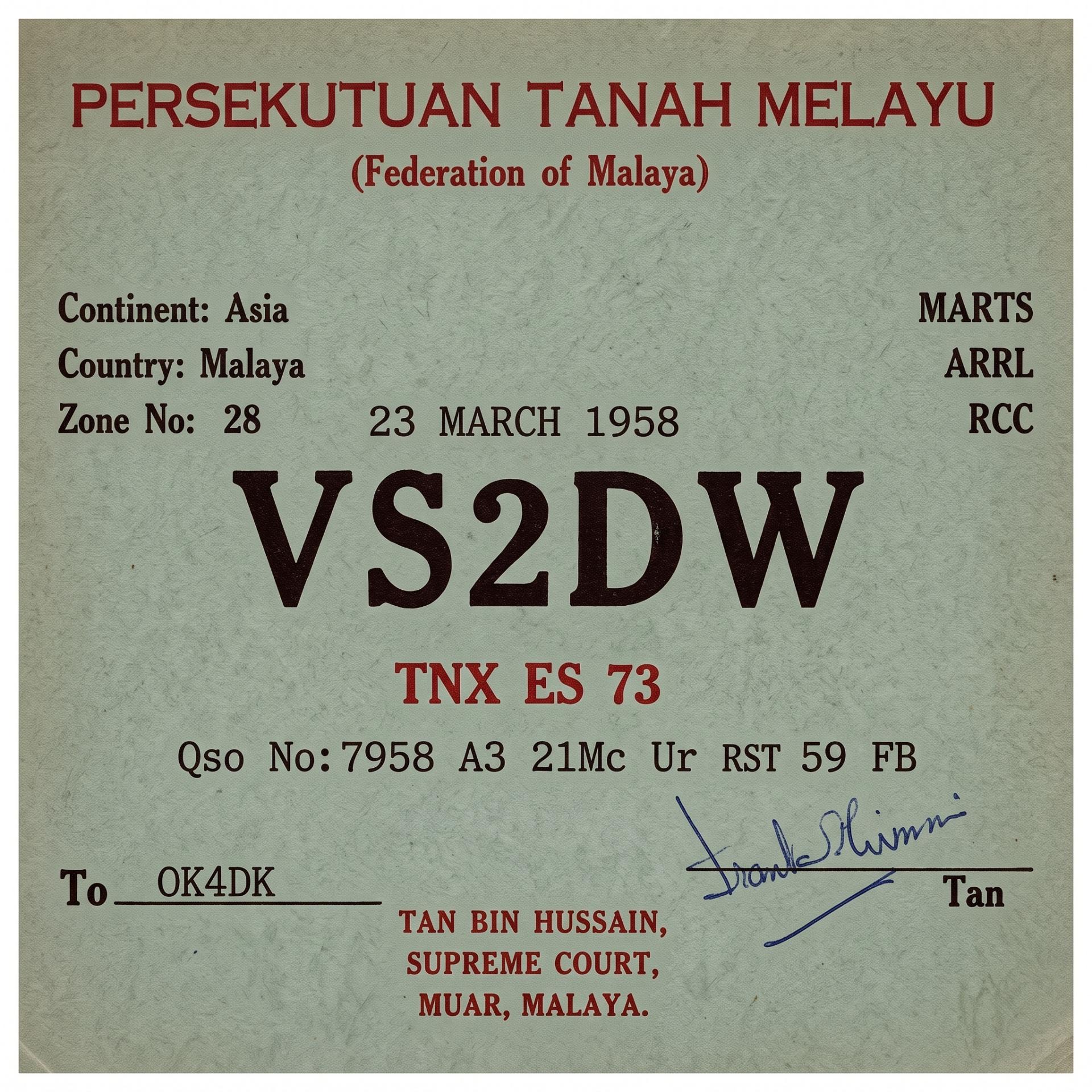
The Federation of Malaya (Persekutuan Tanah Melayu, 1948-1963) was the political cradle of modern Malaysian amateur radio. This is the story of how MARTS was founded during the Malayan Emergency, how the colonial VS2 and VS3 callsigns became 9M2 at Merdeka, and why every Malaysian ham carries a piece of this history in their callsign.
If you hold a Malaysian amateur radio licence today, your callsign begins with 9M2 (Peninsular Malaysia), 9M6 (Sabah), or 9M8 (Sarawak). Those three short prefixes are the end of a long story that runs through British Malaya, the Malayan Union, the Malayan Emergency, and a country that no longer exists on the map: Persekutuan Tanah Melayu, the Federation of Malaya.
This article is about that country, the fifteen years from 1948 to 1963 when the Federation of Malaya was born, fought a communist insurgency, gained independence, and finally became Malaysia. It is also about how amateur radio grew up inside that story, how the Malayan Amateur Radio Transmitters’ Society (MARTS) was founded in the middle of it, and why the callsign on your licence card is a small piece of Malayan political history.
For the wider prefix trail that this article sits inside, see our companion piece From VS1 to VT1: British Empire Amateur Radio Prefixes and Callsign History. For the early pioneers who were already on the air before the Federation existed, see Early Radio Amateur Activities in Malaya.
What Was Persekutuan Tanah Melayu?
Persekutuan Tanah Melayu, in English the Federation of Malaya, was a country in Southeast Asia that existed from 1 February 1948 until it was superseded by the Federation of Malaysia on 16 September 1963. Its motto was Bersekutu Bertambah Mutu, “Unity is Strength”, and from 1957 its anthem was Negaraku, “My Country”.
The Federation comprised eleven states: the nine Malay states (Perak, Selangor, Negeri Sembilan, Pahang, Johor, Kedah, Kelantan, Terengganu, and Perlis) plus the two Straits Settlements of Penang and Malacca. Singapore, despite its traditional ties to Malaya, was excluded and administered separately as a British crown colony.
It is important to understand the three layers, because amateur radio callsigns map directly onto them:
- 1948-1957: The Federation was a protected state of the United Kingdom. The Malay states were British protectorates; Penang and Malacca remained British colonial territories. Callsigns in this period used the colonial VS2 and VS3 prefixes.
- 1957-1963: The Federation became a sovereign, independent state on 31 August 1957. This is the moment the 9M2 prefix was born.
- 1963 onward: The Federation merged with Sabah, Sarawak, and Singapore to form Malaysia. (Singapore left the federation in 1965.) The 9M2 prefix for the peninsula was retained, while Sabah took 9M6 and Sarawak took 9M8.
From Malayan Union to Federation of Malaya
The Federation of Malaya did not appear out of nowhere. It was the British government’s second attempt at reorganising Malaya after the Second World War, and it was a direct reaction to the failure of the first.
On 1 April 1946, the British established the Malayan Union, a single crown colony that combined the nine Malay states with Penang and Malacca. The Malayan Union stripped the Malay Rulers of their symbolic sovereignty and opened citizenship broadly to non-Malays. It met fierce opposition from Malay nationalists led by Dato’ Onn Jaafar, who had founded the United Malays National Organisation (UMNO) in 1946 specifically to oppose it.
Faced with a Malay boycott, rising Chinese radicalism, and growing communist militancy, the British abandoned the Malayan Union. A British-Malay Working Committee met between June and December 1946 and produced a hundred-page “Blue Book”. The result was the Federation of Malaya Agreement, signed on 21 January 1948 at King House by the Malay Rulers and Sir Edward Gent on behalf of the British government. The Federation of Malaya came into being eleven days later, on 1 February 1948.
The Federation restored the symbolic positions of the Malay Rulers, tightened citizenship requirements, and for the first time united the Malay states under a single federal structure. It was conceived, in the words of historians, as a “delicately blended governmental structure” reconciling colonial interests, emergent nationalism, and the rival claims of Malaya’s ethnic communities. It was the anvil on which modern Malaysia was forged.
The Malayan Emergency (1948-1960)
The Federation was born into crisis. Within months of the Agreement being signed, the Malayan Communist Party launched an armed insurgency against the colonial government. The Malayan Emergency began in June 1948 and would last until July 1960, making it almost exactly coterminous with the Federation’s independent life.
The Emergency is not a footnote to this story. It shaped the entire environment in which amateur radio operated during the Federation years:
- Radio was a strategic technology. The colonial government tightly controlled radio equipment, frequencies, and licences. A transmitting licence was not handed out lightly when the jungle next door held an insurgency that used clandestine radio.
- Morse code was a military skill. British and Commonwealth signals units operating in Malaya relied heavily on CW (continuous wave) telegraphy, because voice operation was too loud for jungle patrols and often less reliable in the difficult propagation conditions. The Royal Signals pamphlet Some Notes on Wireless in Malaya explicitly required signallers to know Morse at “not less than eight words per minute”. The same CW culture flowed into the amateur community.
- SIGINT was active. Australian Army signals operators from 101 Wireless Regiment were deployed from 1952 to hunt for Malayan Communist Party transmissions, first in Singapore and later, from 1959, at Batu Uban on Penang Island. The very island where MARTS was founded was also a signals intelligence base.
- Broadcasting was political. The British had set up Radio Malaya on 1 April 1946, the day the Malayan Union launched, partly to counter amateur and informal information sharing. Radio Malaya’s main function until independence in 1957 was, in the words of Malaysian researchers, “to help the government to control the social and political confusion that followed the war and the communist [insurgency]”.
Against this tense backdrop, a small group of enthusiasts still found room to build an amateur radio community.
Amateur Radio Before the Federation: The VS2 and VS3 Pioneers
Amateur radio was first introduced into Malaya in the late 1920s, well before the Federation existed. The early pioneers used the colonial VS prefix block assigned to British territories in Southeast Asia:
- VS1 was for Singapore and the Straits Settlements.
- VS2 was for the Federated Malay States (Perak, Selangor, Negeri Sembilan, Pahang).
- VS3 was for the Non-Federated Malay States (Johor, Kedah, Kelantan, Terengganu, Perlis, and Penang).
Among the earliest operators on record were R.E. Earle, VS1AB, active from 1928 to 1930; G.M. Salt, VS2AF, who commenced in 1930 from Glenmarie Estate, Batu Tiga, Selangor; T.G. Laver, VS2AC, from Masai, Johor; A.N. Randall, VS3AB, from Johor Bahru; and Reg. Hollis-Bee, VS2AG, of the Public Works Department, operating from Kuala Kangsar, Perak. In 1932, VS2AF and VS2AB successfully worked each other on 56 MHz over a distance of ten miles, an early VHF achievement for Malaya.
Jim Macintosh, VS2AA, came on the air in January 1934 and is one of the legendary figures of pre-war Malayan amateur radio. Using only 5 watts, he established two-way contact with five of the six continents on 40 metre CW within his first month. Before the year was out, never using more than 20 watts, he had earned his WAC (Worked All Continents) and WBE (Worked All British Empire). The first WAC for Malaya had been made earlier by A.N. Randall, VS3AB.
These were the callsigns and the operators that the Federation of Malaya inherited when it was formed in 1948. VS2 and VS3 are the direct ancestors of today’s 9M2. For the full prefix table and the political story behind each row, see From VS1 to VT1: British Empire Amateur Radio Prefixes.
MARTS: Born in Penang During the Emergency, 1952
The Second World War had scattered Malaya’s pre-war amateur community, but post-war enthusiasts soon began to regroup. The Perak Radio Society and the Selangor Radio Society were both formed in 1947, the year before the Federation itself.
The decisive moment came in the middle of 1952, four years into the Federation and four years into the Emergency. According to the surviving founder member 9M2BS (Eu), a group of British radio enthusiasts living in Penang, influenced by the activities of the Radio Society of Great Britain (RSGB), held an “eye-ball QSO” (a face-to-face meeting) at the QTH of VS2DV to discuss establishing a radio amateur club on the island. The club was to run on the same model as the RSGB, which had been founded in 1913 and incorporated in 1926.
The decision was made to register the club as the Malayan Amateur Radio Transmitters’ Society at the Posts and Telegraph Department in the Straits Settlement of Penang Island. The callsign block given to qualified members was VS2.
The founding group, who remained in office for many years after, were:
- Eu Khuan Kew, VS2BS
- J.E. Hemphil, VS2CR
- S.A. Faulkner, VS2DB
- C.E. Salton, VS2DV
MARTS’ chief function in its early years was to act as a central bureau for QSL cards, handling both inward and outward confirmation-of-contact cards between Malayan stations and amateurs overseas. In an era before email and online logbooks, the QSL bureau was the institutional backbone of international amateur radio, and MARTS gave Malaya a place in that global network.
Over time, MARTS expanded at the expense of the smaller local societies, which wound up one by one. The tendency was for hams to consolidate around a single national body, exactly as its founders had envisaged. Veteran operator 9M2FK (Eshee), ex-VS2, who was licensed in 1956, recalled that MARTS in its early embryonic stage was dominated by British enthusiasts, with the Malayan membership growing steadily through the late 1950s and 1960s.
Today MARTS is the national society for amateur radio in Malaysia and the sole Malaysian member of the International Amateur Radio Union (IARU) Region 3. The society founded in Penang in 1952, inside the Federation of Malaya, inside the Malayan Emergency, is the same society that issues your callsign directory and runs the national repeater linking system today. For the full chronicle, see The Evolution of Amateur Radio in Malaysia: A Chronicle of MARTS.
Merdeka: VS2 Becomes 9M2, 31 August 1957
The single most important event in Malaysian amateur radio history falls squarely inside the Federation period: independence on 31 August 1957.
On that day, Tunku Abdul Rahman, the Federation’s first Prime Minister, led the crowd at the Merdeka Stadium in Kuala Lumpur in the cry of “Merdeka! Merdeka! Merdeka!” The Federation of Malaya became a sovereign state, and the colonial era formally ended.
For amateur radio, Merdeka meant a new international identity. The International Telecommunication Union (ITU) allocates callsign prefix blocks to countries, and a country that gains independence receives a fresh block. When Malaya became independent, the colonial VS2 and VS3 prefixes were retired and replaced with the new 9M2 prefix for the entire peninsula.
In the words of MARTS’ own history: “It was only after Malaya became independent on 31st August, 1957, that the call-signs VS2 were changed to 9M2 till today.”
This is why every Peninsular Malaysian amateur today signs 9M2. The prefix is not a colonial leftover. It is a Merdeka callsign. It was earned at independence and has been continuously held ever since. The founder members of MARTS who had operated as VS2BS, VS2CR, VS2DB, and VS2DV became 9M2BS, 9M2CR, 9M2DB, and 9M2DV. The same operators, the same society, the same bands, a new country, a new prefix.
A useful way to think about it: if you collect old QSL cards, a card dated before 31 August 1957 from Kuala Lumpur or Penang will show VS2 or VS3. A card dated after that date from the same city will show 9M2. The political transition is printed right there on the card.
From Federation of Malaya to Malaysia, 1963
The Federation of Malaya did not end at independence. It continued as an independent country for nearly six more years, until 16 September 1963, when it merged with Sabah, Sarawak, and Singapore to form the Federation of Malaysia. (Singapore separated from Malaysia in 1965.)
This 1963 expansion is what gave Malaysian amateur radio its full modern prefix geography:
| Region | Old colonial prefix | Modern prefix |
|---|---|---|
| Peninsular Malaysia (former Federation of Malaya) | VS2 / VS3 | 9M2 |
| Sabah (former British North Borneo) | ZC5 | 9M6 |
| Sarawak | VS4 | 9M8 |
| Singapore (separate crown colony, then Malaysia 1963-1965) | VS1 | 9V1 (after 1965) |
| Brunei (never part of Malaysia) | VS5 | V8 |
So the 9M2 you hold is specifically the inheritance of the Federation of Malaya, the eleven-state polity of 1948-1963. The 9M6 and 9M8 prefixes belong to the territories that joined in 1963 to make Malaysia. The 9V1 prefix belongs to Singapore, which walked its own path. Each prefix is a frozen political boundary.
Why This History Still Matters to Malaysian Hams
It would be easy to treat Persekutuan Tanah Melayu as a dry chapter in a school textbook. For amateur radio operators, it is anything but. Here is why this history is worth knowing:
- Your callsign is a political document. The 9M2 prefix exists because of the 1957 Merdeka and the 1948 Federation. Knowing this turns a routine operating identifier into a connection to your country’s founding.
- MARTS is a Federation-era institution. The society that represents you at the IARU was founded in 1952 in Penang, during the Emergency, by operators who signed VS2. When you renew your MARTS membership, you are continuing a chain that began inside the Federation of Malaya.
- QSL cards are primary sources. A VS2 card from 1955 and a 9M2 card from 1958 from the same operator are a visible record of independence. For DXers and award hunters, the VS2/VS3 entities are deleted DXCC history, and chasing them on old cards is a way of touching that era.
- The Emergency shaped Malayan radio culture. The heavy CW emphasis, the tight licensing regime, the military signals presence, and the SIGINT operations on Penang all left marks on how amateur radio developed in the region. The jungle-patrol Morse culture of the Royal Signals is a direct cousin of the CW tradition that Malaysian hams carried forward.
- It explains the prefix map. Why is Sabah 9M6 and not 9M2? Because Sabah was British North Borneo (ZC5), not part of the Federation of Malaya, and only joined in 1963. The prefix map is the political map.
A Note on the Sources
The political history of the Federation of Malaya is well documented in the Federation of Malaya Agreement 1948, the Federation of Malaya Order in Council 1948, and the standard historical literature on British Malaya. The amateur radio history draws on the MARTS official history, the MARTS 40th anniversary record from 1997, the surviving founder member 9M2BS (Eu), and veteran operator 9M2FK (Eshee). The Malayan Emergency signals context draws on the Royal Signals pamphlet Conduct of Anti-Terrorist Operations in Malaya 1957 and the Australian Signals Directorate’s declassified account of its SIGINT contribution from 1952 to 1962.
Closing
Persekutuan Tanah Melayu lasted only fifteen years, from 1948 to 1963, and only six of those as an independent country. Yet inside that short window, Malaysian amateur radio was born as an organised national community. The pioneers of the 1920s and 1930s gave it its first callsigns. The Federation of Malaya gave it its society, MARTS, founded in 1952. Merdeka in 1957 gave it its modern 9M2 prefix. And the 1963 formation of Malaysia gave it the full 9M2/9M6/9M8 geography we use today.
The next time you key the mic and sign 9M2, remember that you are signing a Merdeka callsign, inherited from a country called Persekutuan Tanah Melayu that fought an insurgency, founded a society in Penang, and declared independence on 31 August 1957. Bersekutu Bertambah Mutu. Unity is Strength.
If you want to dig deeper, read our companion articles on British Empire amateur radio prefixes VS1 to VT1, early radio amateur activities in Malaya, and the evolution of MARTS. To look up any current Malaysian callsign, use the Malaysian Ham Radio Callsign Search, and to get your own 9M2 licence, follow our Guide to Obtain an Amateur Radio License in Malaysia.

Post Comment