From VS1 to VT1: British Empire Amateur Radio Prefixes and Callsign History
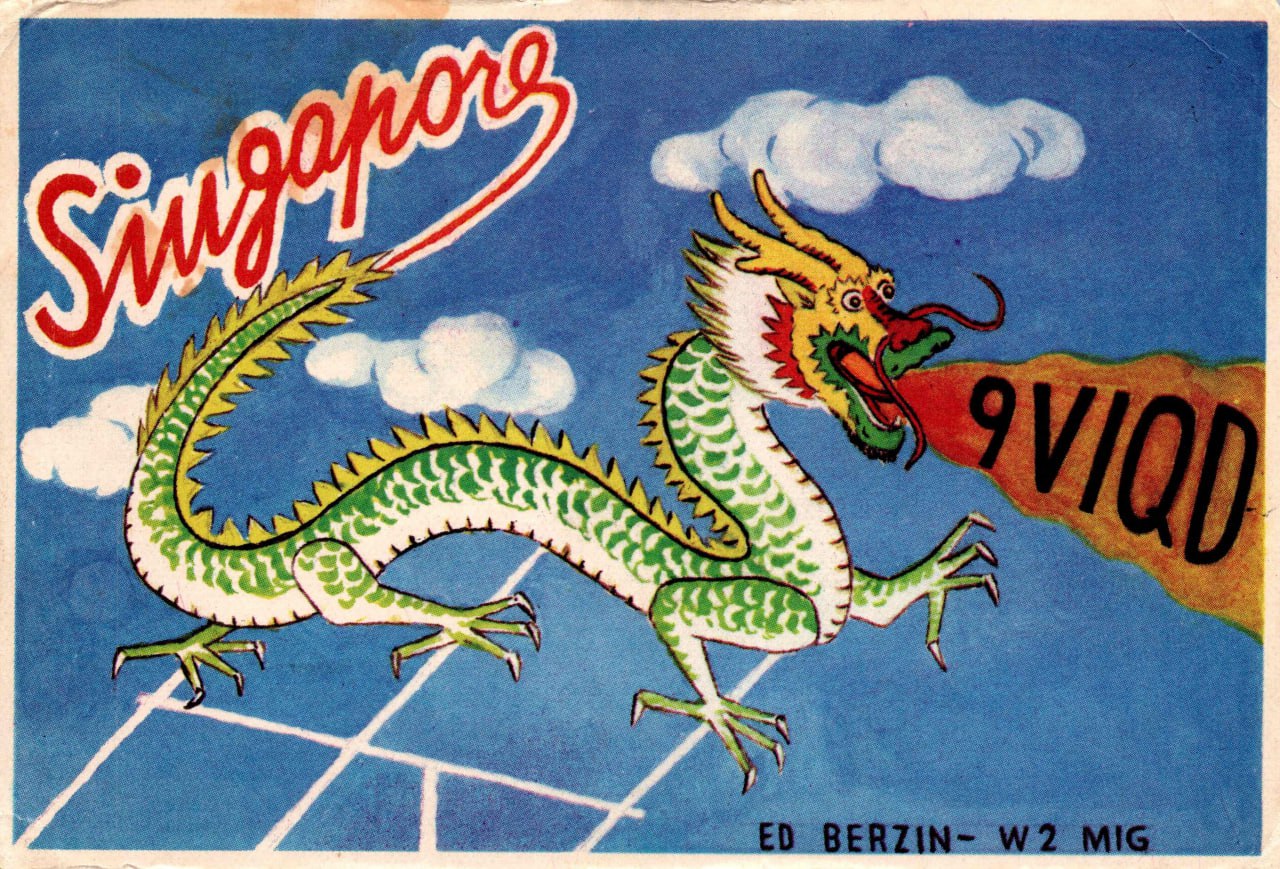
Explore the history of British Empire amateur radio prefixes from VS1 to VT1, including Malaya’s VS2 and VS3, the VS9 Arabian series, VT1 Kuwait, and how colonial callsign allocations shaped modern ham radio prefixes across Singapore, Malaysia, Hong Kong, Ceylon, and the Gulf.
Amateur radio callsigns are more than operating identifiers. They are small fragments of political history, geography, administration, and radio regulation. A prefix printed on an old QSL card can tell us not only where a station operated, but also when that place belonged to a particular colonial system, what authority issued the licence, and how the amateur radio world understood that territory at the time.
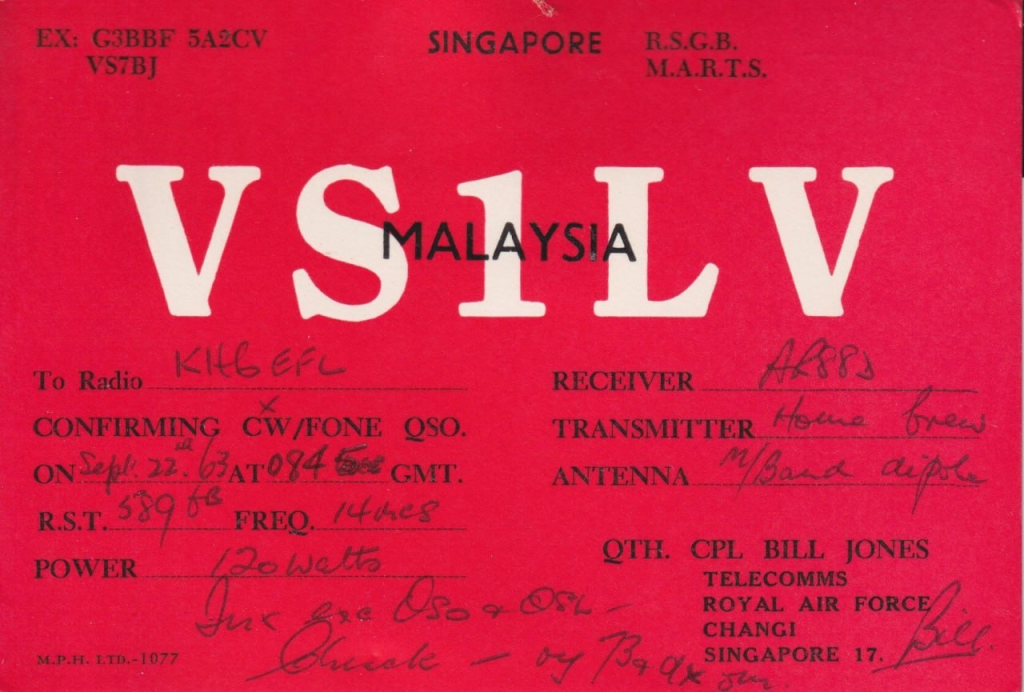
Among the most interesting examples are the old British Empire prefixes from VS1 to VT1. Many of these callsigns are no longer issued, but they remain important to radio historians, DXers, QSL collectors, and operators who want to understand how today’s familiar prefixes evolved. If you collect vintage QSL cards, chase deleted DXCC entities, or simply want to understand why a Malaysian station signs 9M2 today, this prefix trail is where the story begins.
For Malaysian amateurs in particular, this history is close to home. The old VS2 and VS3 prefixes are direct predecessors of today’s 9M2 callsigns, and the same colonial allocation system also gave us VS4 (Sarawak), ZC5 (British North Borneo), and VS5 (Brunei). You can look up any current Malaysian callsign on the Malaysian Ham Radio Callsign Search page, or learn how to get your own 9M2 callsign in our Guide to Obtain an Amateur Radio License in Malaysia.
A Prefix System Shaped by Empire
During the early and middle decades of the twentieth century, the British Empire covered territories across Asia, the Middle East, Africa, the Pacific, and the Caribbean. Radio administration followed imperial and colonial structures. As a result, many territories used callsign prefixes beginning with VS or VT, allocated under British authority through the International Telecommunication Union (ITU) prefix block system.
These prefixes appeared on QSL cards, station logs, DX bulletins, and award records. Today, they help us identify stations from places whose names, borders, and administrations have changed dramatically. For a parallel look at how another colonial-era prefix system worked, see our article on Soviet Amateur Radio Call Signs: USSR Prefixes from 1926-1991.
Some examples include:
| Old Prefix | Territory at the Time | Modern Prefix / Status |
|---|---|---|
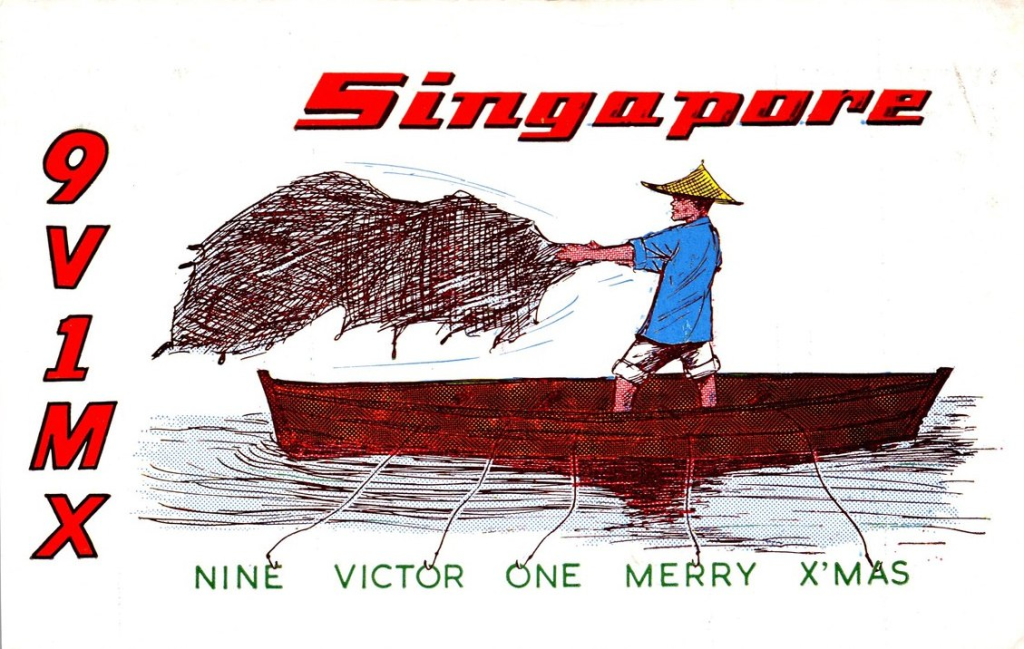
| VS1 | Singapore and Straits Settlements | 9V1 |
| VS2 | Federated Malay States | 9M2 |
| VS3 | Non-Federated Malay States | 9M2 |
| VS4 | Sarawak (also appears on British North Borneo QSLs) | 9M8 |
| ZC5 | British North Borneo (Sabah) | 9M6 |
| VS5 | Brunei | V8 |
| VS6 | Hong Kong | VR2 |
| VS7 | Ceylon | 4S7 |
| VS8 | Bahrain Islands | A9 |
| VS9A | Aden | 7O |
| VS9M | Maldive Islands | 8Q |
| VS9O | Sultanate of Muscat and Oman | A4 Oman |
| VS9K | Kamaran Island | Yemen-related history |
| VS9P | Perim Island | Yemen-related history |
| VS9S | Socotra Island | Yemen-related history |
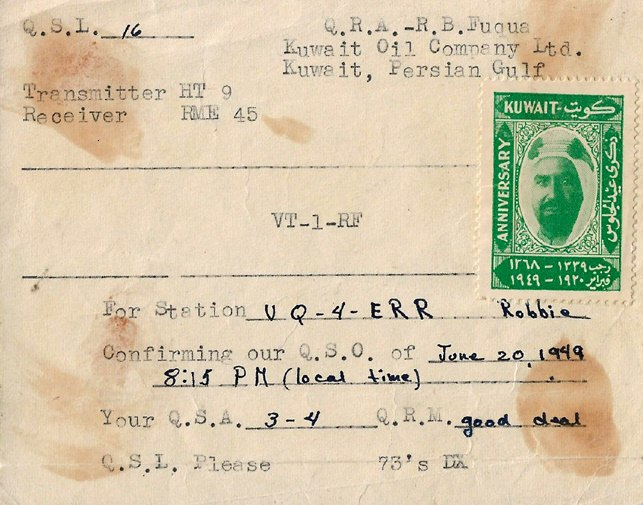
| VT1 | Kuwait | Later MP4K, now 9K |
This list is not simply a callsign reference. It is a map of how radio followed political change.
How ITU Prefix Allocation Worked
The ITU assigns callsign prefix blocks to countries, and each country then distributes prefixes to its territories, colonies, and administrative regions. In the British case, the V block was largely assigned to the British Empire, with sub-blocks carved out for different regions:
- VAA-VSZ, United Kingdom and territories (VS was used for many Asian and Middle Eastern colonies)
- VRA-VRZ, Hong Kong and other territories (VR2 is Hong Kong today)
- VTA-VWZ, British India and adjacent territories (VT1 was assigned to Kuwait, administered from India)
This is why a station in 1950s Kuwait signed VT1 rather than a VS prefix, Kuwait was initially administered by the British from India, so it received a prefix from the Indian VT block. The same logic explains why Malaya used VS2/VS3 (from the VS block assigned to British territories in Southeast Asia) while Kuwait used VT1 (from the Indian block).
When a territory gained independence, joined a new federation, or was transferred to a different administration, its prefix changed. The ITU would allocate a new block to the newly independent country, and the old colonial prefix would be retired. This is why every prefix change in the table above corresponds to a political event, independence, federation, or reorganisation.
Malaya, Sarawak, Singapore, and Brunei
For readers of hamradio.my, the most meaningful entries are naturally those connected to this region.
VS2 was used in the Federated Malay States (Perak, Selangor, Negeri Sembilan, and Pahang), while VS3 represented the Non-Federated Malay States (Johor, Kedah, Kelantan, Terengganu, Perlis, and Penang). These prefixes belong to the radio history that eventually leads to modern Malaysian callsigns under 9M2. The Malaysian Amateur Radio Transmitters’ Society (MARTS) was founded by operators using these very prefixes, including VS2BS (Eu Khuan Kew), VS2CR (J.E. Hemphil), VS2DB (S.A. Faulkner), and VS2DV (C.E. Salton).
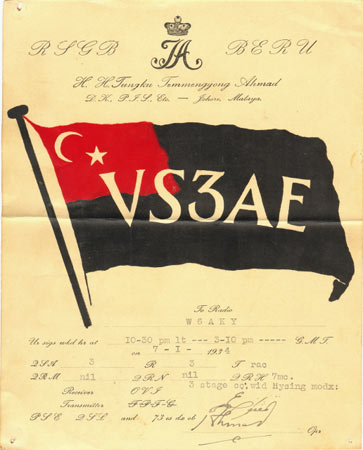
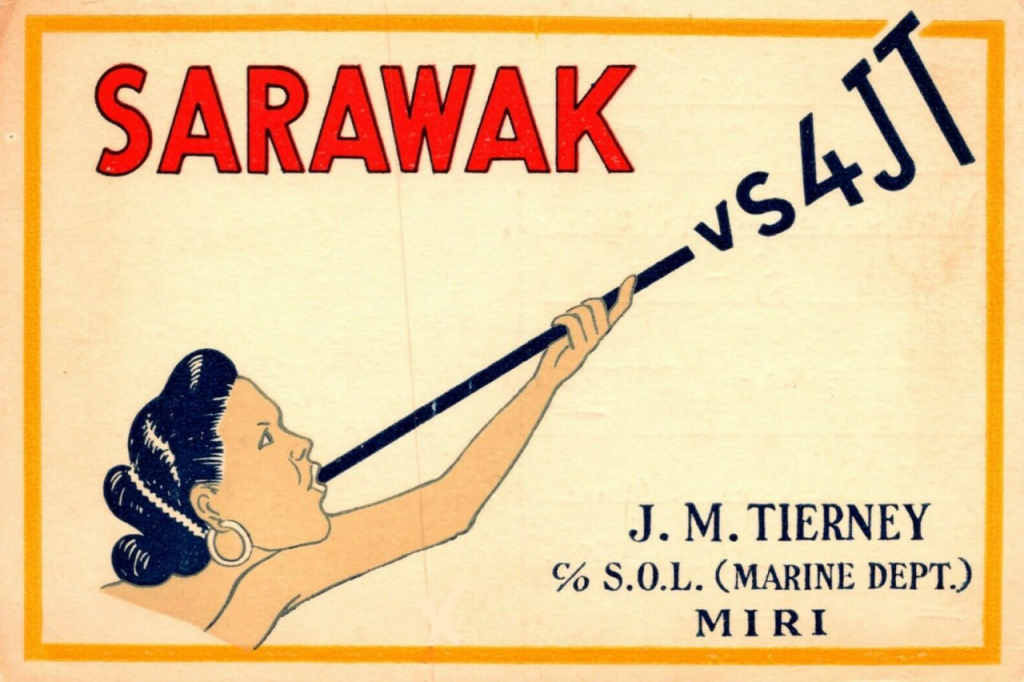
VS4 was used in Sarawak, now part of East Malaysia using 9M8. ZC5 was used in British North Borneo (now Sabah), which today uses 9M6. Note that VS4 also appears on some British North Borneo QSL cards, reflecting how callsign administration in the Borneo territories was not always cleanly separated. VS1 was used for Singapore and the Straits Settlements, today represented by 9V1. VS5 belonged to Brunei, now using V8.
These changes remind us that amateur radio in this region did not begin with the modern prefix system. It passed through colonial administration, wartime disruption, independence movements, federation, and national telecommunications development. For a deeper look at what radio licensing looked like in this era, see our article Echoes from the 1960s: When Listening to the Radio Required a License, and for the story of a Royal Signals veteran who operated the 9M2RH Melaka club station during the transition period, read Gordon Gibson G3ZFZ: Royal Signals Veteran and 9M2RH Melaka Club Station Operator.
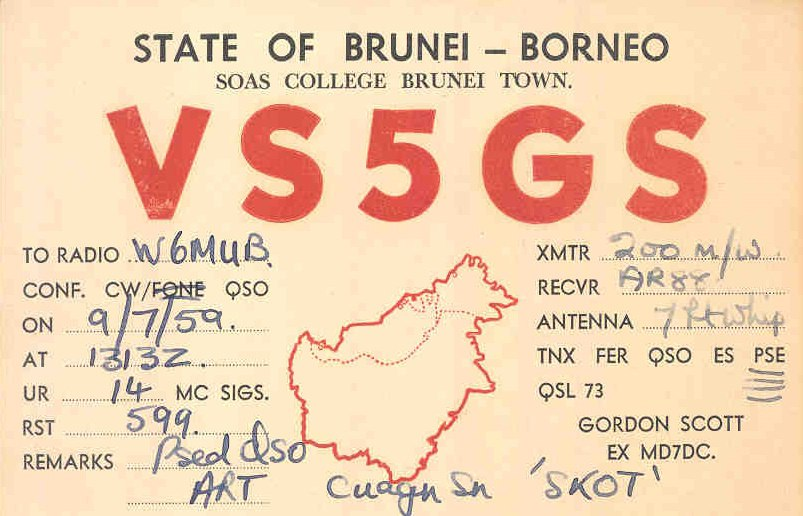
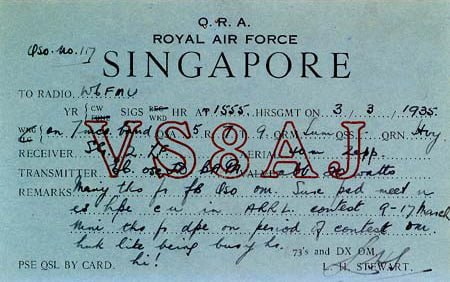
Every old VS QSL card from this region is therefore more than a contact confirmation. It is a document of Southeast Asian radio heritage.
Timeline: When the Prefixes Changed
Understanding when each prefix changed helps you date an old QSL card and place it in the correct DXCC period. Here is a timeline of the key transitions:
| Date | Event | Prefix Change |
|---|---|---|
| Pre-1940s | British colonial period | VS1-VS8, VS9 series, VT1 in use |
| 1947 | India independence | VT block reorganised; VT1 Kuwait later moved to MP4K |
| 1948 | Federation of Malaya formed | VS2/VS3 continue under British administration |
| 1957 | Malaya independence | Transition begins; 9M2 prefix allocated by ITU in 1959 |
| 1959 | ITU allocates 9M block to Malaya | VS2/VS3 → 9M2 (gradual transition) |
| 1963-09-16 | Malaysia formed (Malaya + Sabah + Sarawak + Singapore) | VS4 Sarawak and ZC5 North Borneo absorbed into 9M system |
| 1963-09-16 | Singapore joins Malaysia | VS1 → 9M4 (temporarily) |
| 1965-08-09 | Singapore separates from Malaysia | 9M4 → eventually 9V1 (from 1966-02-01) |
| 1966-02-01 | Singapore gets own ITU prefix | 9V1 prefix officially allocated |
| 1971 | Trucial States become UAE | MP4D/MP4T → A6 |
| 1971 | Bahrain independence | VS8/MP4B → A9 |
| 1971 | Qatar independence | MP4Q → A7 |
| 1971 | Oman reorganisation | VS9O/MP4M → A4 |
This timeline shows that a single QSL card can be dated to within a few years just by knowing which prefix was in use. A card signed VS2 must be from before roughly 1959-1963; a card signed 9M2 from the same station would be from after the ITU allocation.
The Middle East and the VS9 Series
The VS9 series is especially fascinating because it covered several territories around Arabia, the Gulf, and the Indian Ocean.
Aden used VS9A. The Maldive Islands used VS9M (the RAF Gan club station signed VS9MB). The Sultanate of Muscat and Oman used VS9O, confirmed by the 1958 QSL card of Peter Rackham, G3IRQ, who operated from deep inside the Sultanate. It is important not to confuse this with the Trucial States (also called “Trucial Oman”), which were a separate group of sheikhdoms on the Persian Gulf coast that later became the United Arab Emirates; the Trucial States used the MP4D and MP4T prefixes (now A6), not a VS9 prefix. Other rare or historically significant VS9 locations included Kuria Muria Islands, Kamaran Island (VS9K), Perim Island (VS9P), Masirah Island, and Socotra Island (VS9S).
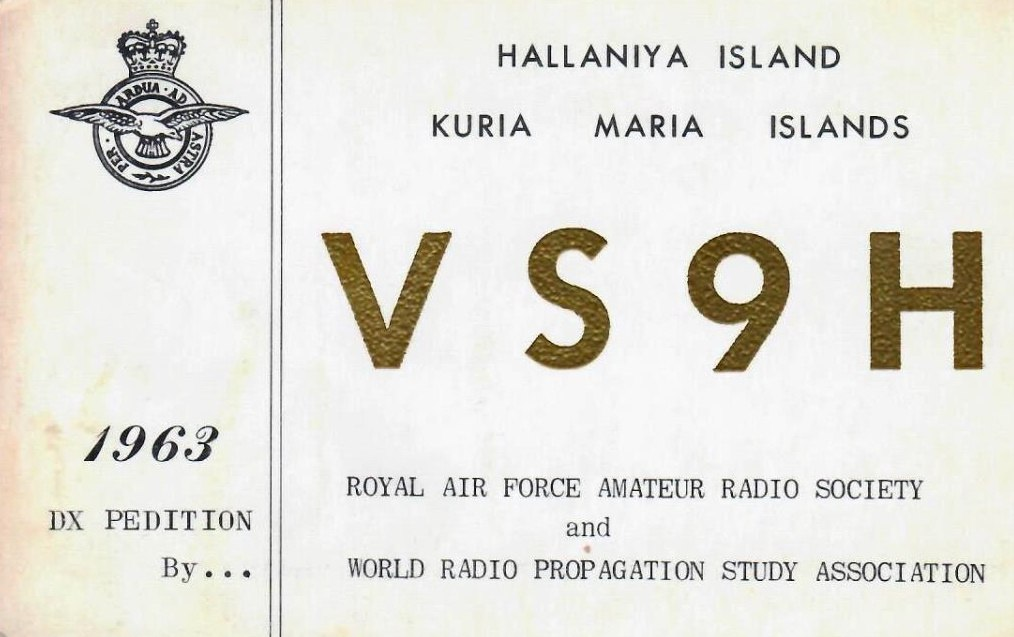
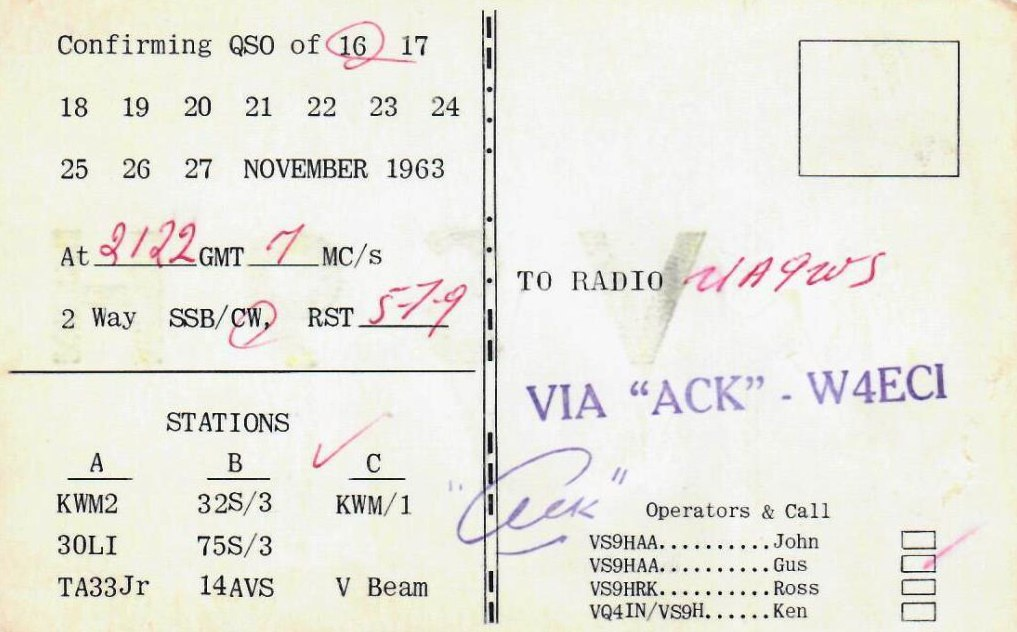
To a DXer, these names are exciting because some represent rare geographic entities. Several VS9 sub-prefixes correspond to deleted DXCC entities, places that no longer exist as separate countries in the DXCC list. To a historian, they show how amateur radio reflected imperial shipping routes, military stations, protectorates, island dependencies, and strategic outposts.
How to Read an Old VS QSL Card
If you find an old QSL card with a VS or VT prefix, here is a practical guide to identifying it correctly:
- Read the prefix carefully. VS1, VS2, VS3, VS4, VS5, VS6, VS7, VS8, VS9 (with a suffix letter), and VT1 each map to a specific territory. Do not assume “VS = Malaysia”, VS6 is Hong Kong, VS7 is Ceylon, VS8 is Bahrain.
- Check the date. The prefix alone tells you the territory, but the date tells you whether it is a valid DXCC entity. A VS4 Sarawak card from 1962 counts for the deleted Sarawak entity; a card from 1964 would already be West/East Malaysia.
- Look at the QTH and postal address. Old cards often list the town, colony, or Straits Settlement. This confirms the prefix mapping and can reveal whether the operator was in a Federated or Non-Federated Malay State.
- Note the operator name and callsign suffix. Many colonial-era operators were British expatriates, military personnel, or petroleum company employees. The VS8AA Bahrain card, for example, was operated by Roy Fleming (W6DQD) of the Bahrain Petroleum Company.
- Cross-reference with deleted entity lists. Resources like the AC6V old prefix list and the Ham Gallery deleted country pages can confirm whether your card counts for a deleted DXCC entity.
Common Mistakes in Identifying Old Prefixes
When reading old QSL cards or prefix references, several common mistakes come up repeatedly:
- Confusing VS9O (Sultanate of Oman) with the Trucial States. “Trucial Oman” is a historical name for the Trucial States, which became the UAE, a completely different country from the Sultanate of Oman. VS9O was the Sultanate of Oman; the Trucial States used MP4D/MP4T.
- Assuming VS8 was used in Singapore. VS8 was Bahrain. Singapore used VS1 only. Some outdated references conflate the two, but every primary source, including the 1939 DXCC country list and Ham Gallery’s VS8AA 1937 Bahrain QSL, confirms VS8 = Bahrain.
- Treating VS4 as Sarawak-only. While MARTS documents VS4 as the Sarawak prefix, VS4 also appears on British North Borneo QSL cards. Callsign administration in the Borneo territories was not always cleanly separated.
- Confusing VS9B with a separate prefix. VS9B is likely a misreading of the callsign VS9MB (the RAF Gan Maldives club station). The documented Maldives prefix is VS9M.
- Assuming VT1 is a VS prefix. VT1 (Kuwait) comes from the Indian VT block, not the VS block. Kuwait was initially administered from British India, which is why it received an Indian-block prefix.
Why Modern Operators Should Care
It is easy to think of old prefixes as collector trivia. They are much more than that.
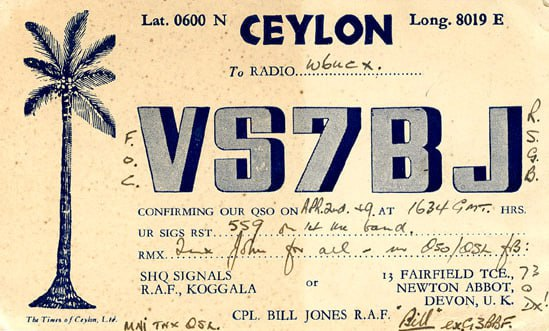
First, they help us read old QSL cards accurately. A card marked VS2 is not just “old Malaysia” in a general sense. It belongs to a specific administrative period and geographic context. The same applies to VS6 Hong Kong, VS7 Ceylon, or VT1 Kuwait.
Second, they improve DX history. Many award records, deleted entities, and historical country lists depend on understanding how prefixes changed over time. A serious DXer benefits from knowing that a modern prefix may have older predecessors. The ARRL DXCC List, ClubLog prefix database, and various award programmes all rely on this historical layering.
Third, they connect amateur radio to world history. Callsigns changed because countries became independent, colonies were reorganised, territories were renamed, and international allocations were updated. The logbook becomes a quiet record of political transformation, every prefix change marks a moment when a territory’s political status shifted.
Finally, this history strengthens our identity as radio amateurs. We are part of a technical hobby, but also a cultural one. Our signals cross borders, and our callsigns carry the memory of those borders. To learn more about the operator behind this site, visit the About 9M2PJU page.
The QSL Card as Historical Evidence
Old QSL cards are among the most valuable sources for this kind of history. They often show the callsign, operator name, town, colony, equipment, frequency, mode, and postal route. Some cards include maps, flags, colonial emblems, or handwritten notes that reveal how operators understood their location at the time.
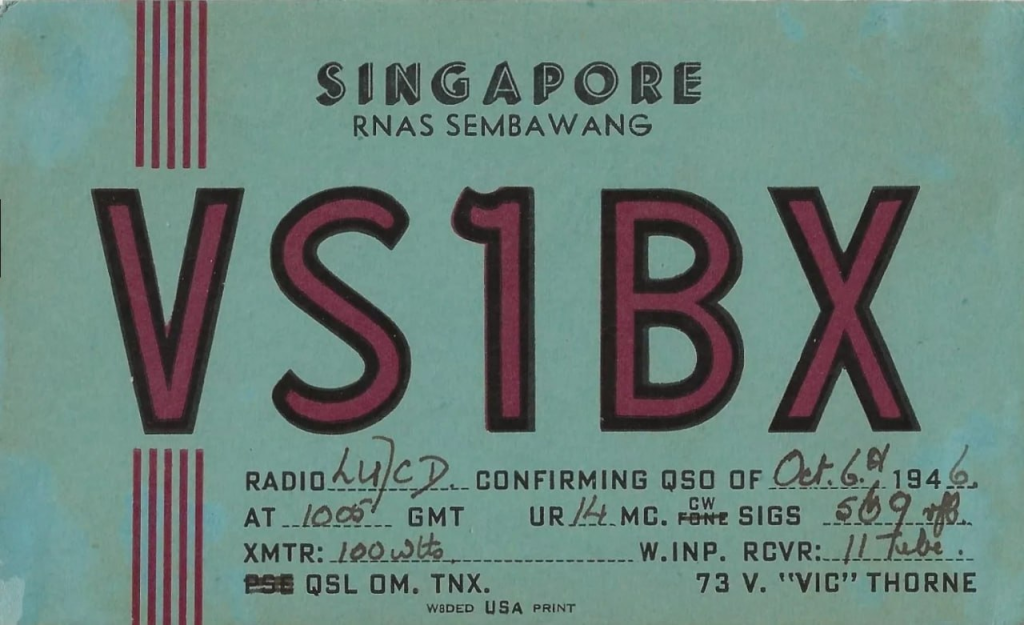
For Malaysia and neighbouring countries, these cards preserve details that may not appear in official radio documents. They show real stations, real contacts, and real operators keeping the amateur spirit alive under very different circumstances, often operating with homemade transmitters, crystal-controlled frequencies, and wire antennas strung between colonial-era buildings.
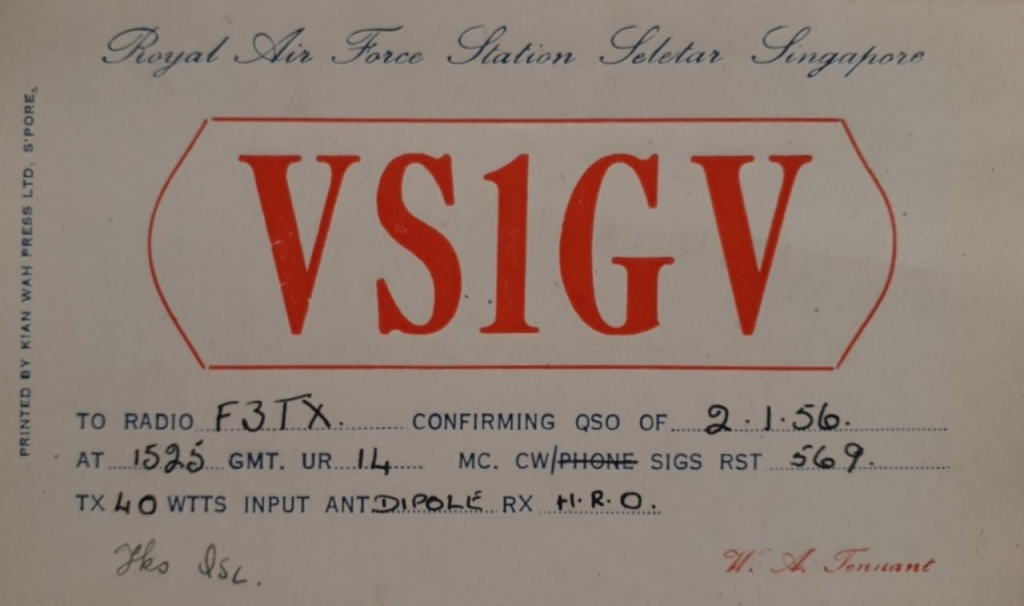
A VS2 or VS3 card is not merely nostalgic. It is part of the documentary record of amateur radio in Malaya, alongside the 1961 Malayan radio license that governed receiving equipment in that era.
Notable Callsigns from the Prefix Era
The prefixes in the table above are not abstract codes. Each one was carried by a real operator at a real station, often in extraordinary circumstances. The callsigns below, drawn from QSL card collections, contest logs, and historical magazines, illustrate how the British Empire prefix system worked in practice, and how individual operators moved between territories, prefixes, and even countries as history unfolded around them.
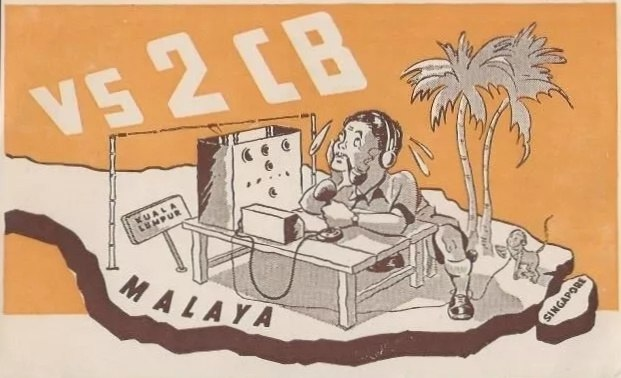
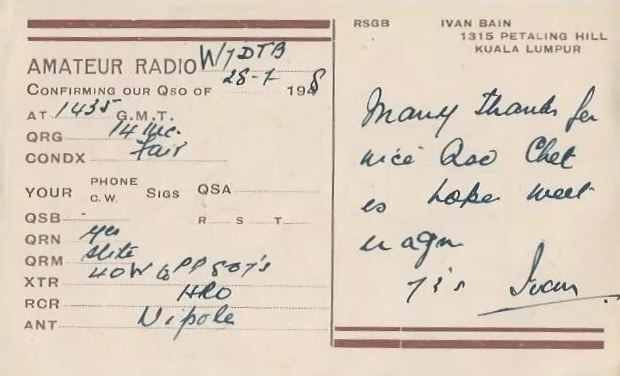
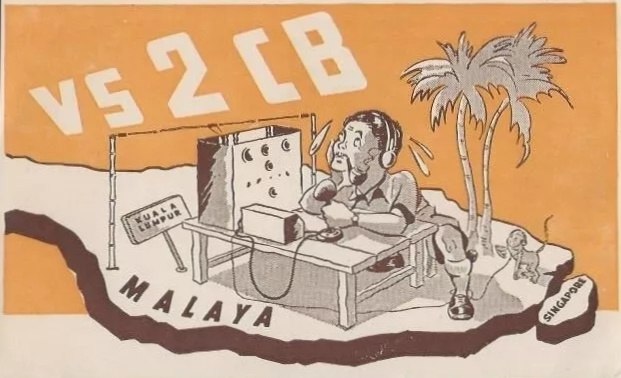
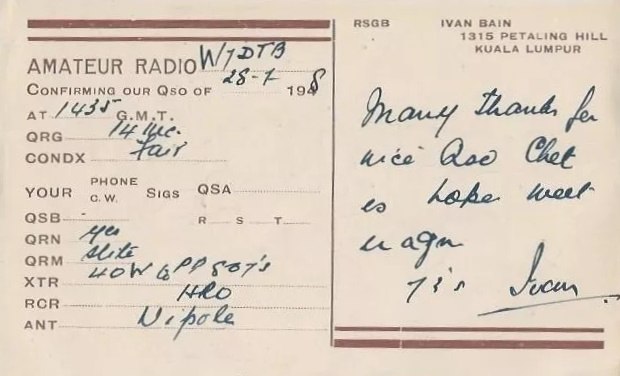
VS2CB, Ivan Bain, Kuala Lumpur
One of the earliest licensed amateur operators in Malaya, Ivan Bain held the personal callsign VS2CB and was based in Petaling Hill, Kuala Lumpur. He was among the first volunteers from the Department of Wireless staff trained in 1928-1929, alongside S. Thirunvakarasu and Harbak Singh (VS2AZ). These pioneers established the first government wireless stations across the Federated Malay States, each with its own station callsign, VS2AH (Kuala Lumpur), VS2AG (Kuantan), VS2AM (Mentakab), VS2AK (Kuala Lipis), and VS2AL (Temerloh). Bain’s personal QSL card, dated 1948, is one of the earliest surviving VS2 cards in the Ham Gallery collection.
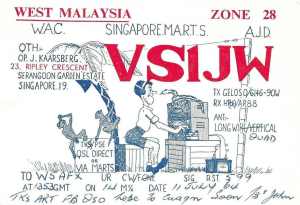
VS1JW, Singapore, Straits Settlements
VS1JW was a Singapore-based station active in 1964, during the brief period when Singapore was part of Malaysia (1963-1965). The VS1 prefix continued to be used for stations in Singapore even after federation, distinguishing them from 9M2 stations in Peninsular Malaysia. The QSL card, collected by W6YA, shows the MARTS QSL bureau routing that connected Singapore operators to the wider DX community. Many VS1 stations of this era were operated by British expatriates and military personnel stationed in Singapore.
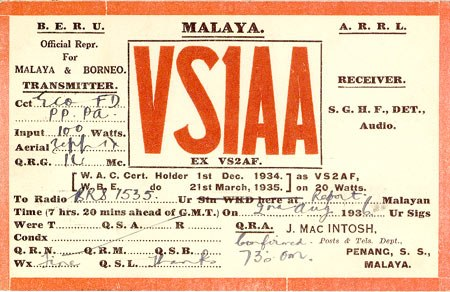
VS1AA, Jim Macintosh, Singapore
VS1AA was operated by Jim Macintosh, one of the earliest licensed amateur radio operators in the Straits Settlements. Macintosh also held VS2AA in the Federated Malay States, making him one of the few operators to hold callsigns under two different Malayan prefixes. He was a contributor to the design of the Windom antenna, a single-wire-fed dipole that became one of the most widely used amateur antennas of the pre-war era. In 1937, VS1AA was the first to describe a multiband version of the Windom antenna, capable of operating on 80, 40, 20, and 10 metres with a Collins-filter match to a valve amplifier. His QSL cards, dated 1936 and 1937, are among the earliest surviving VS1 cards in the Ham Gallery collection. Macintosh was also a founding member of the Malayan Amateur Radio Society, alongside W.J.A. Mallon, A.N. Farquharson, and Dr. Byron.
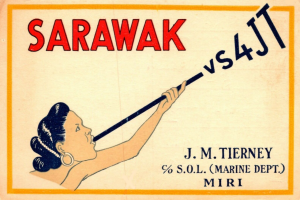
VS4JT, Sarawak, and the VS4JT/VS5 Operation
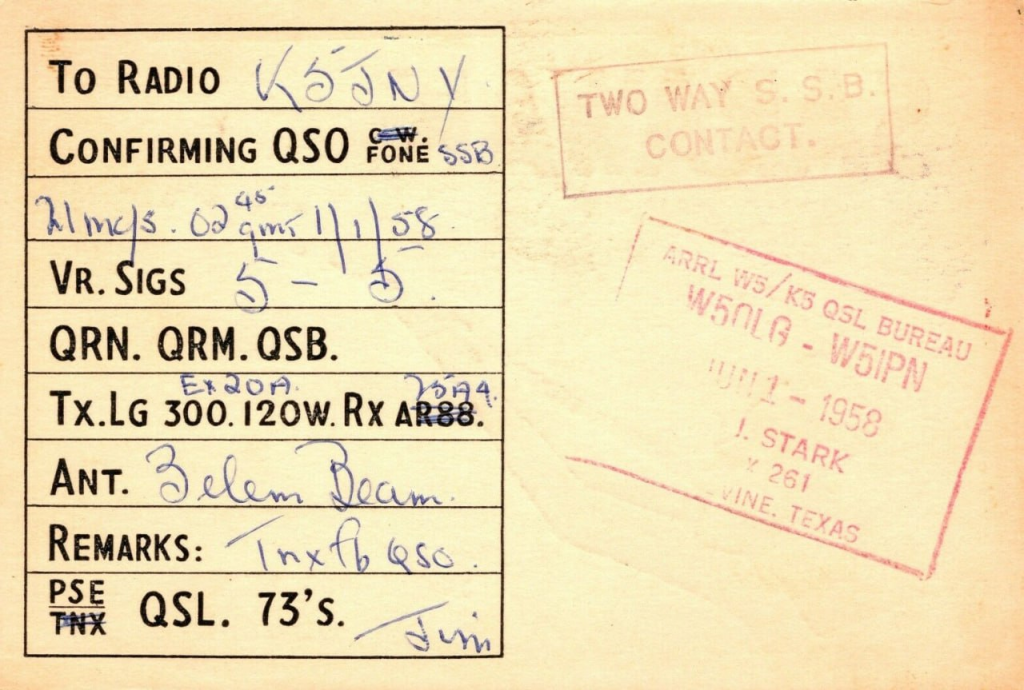
VS4JT was a Sarawak-based station with QSL cards dated 1957 and 1959 in the Ham Gallery collection. The operator also operated as VS4JT/VS5 from Brunei, making this a rare example of a single operator activating two different British Borneo territories under two different prefixes. The IOTA (Islands on the Air) programme credits VS4JT/VS5 as a Borneo island activation. This is the prefix system in action: the same operator, the same equipment, but a different colonial administration and therefore a different callsign.
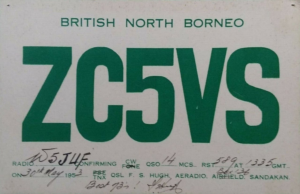
ZC5VS, British North Borneo, 1953
ZC5VS was a British North Borneo station active in 1953, with a QSL card collected by OH2VZ in the Ham Gallery. British North Borneo (now Sabah) was one of the most sought-after DXCC entities, and ZC5VS is among the earliest ZC5 callsigns on record, alongside ZC5VR (1952) and ZC5JM (1956). Stations in this rare DX location often ran low power with makeshift antennas, making each contact a notable achievement.
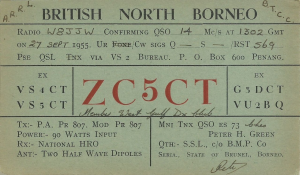
ZC5CT, P. H. Green, G3DCT (ex-VU2BQ)
ZC5CT was operated by P. H. Green, whose home callsign was G3DCT and who had previously held VU2BQ in India. Green was an electronic engineer who arrived on Labuan Island, British Borneo, in February 1954 to maintain a radio station for a British coastal survey company. As the survey moved him across Borneo, he held three different colonial prefix callsigns, all with the same “CT” suffix: VS5CT (Brunei), VS4CT (Sarawak), and ZC5CT (British North Borneo). His 1955 QSL card, from the estate of W8JIN, is in the Ham Gallery. He documented his experiences in the August 1956 issue of Short Wave Magazine in an article titled “Operating from a DX Paradise.” The 1961 Swiss magazine Old Man listed ZC5CT with QSL via G3DCT, confirming that cards were routed through his home callsign after he returned to the UK.
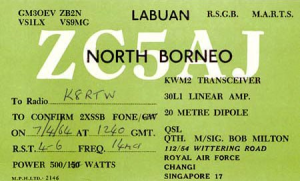
ZC5AJ, British North Borneo, 1964
ZC5AJ was a British North Borneo station with QSL cards dated 1964, collected by W9GAI and K8RTW. The IOTA programme credits ZC5AJ as a Borneo island activation from Labuan. British North Borneo became part of Malaysia on 16 September 1963, after which the ZC5 prefix was formally replaced by 9M6 and 9M8. However, some operators continued using their old ZC5 callsigns during the transition period, which is why cards dated 1964 still appear with the ZC5 prefix. These late ZC5 cards are of particular interest to DXCC collectors because they sit right at the boundary between the deleted British North Borneo entity and the new East Malaysia entity.
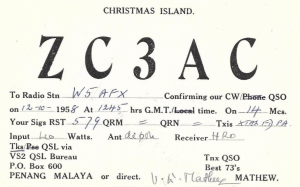
ZC3AC, V. E. Mathew, Christmas Island
ZC3AC was operated by Vadakathu Easow Mathew, a wireless operator from Kerala, India, who arrived on Christmas Island in 1939. He manned the Marconi DX radio station transmitting on 14,015 kHz CW. During the Japanese attack on Christmas Island in 1942, ZC3AC was shut down and the emergency transmitter was buried at Grants Well. Mathew returned to the island after the war, married in 1948, and resumed operating. In 1958, W4LYV sent him a new crystal (14,034 kHz) and VS1JF handled some of his QSL cards. He later operated as VK9MV from 1959 with a 40-watt transmitter. His QSL card, from the collection of W8UAS, is in the Ham Gallery. The Christmas Island Archives documents his remarkable story as part of the island’s wartime history.
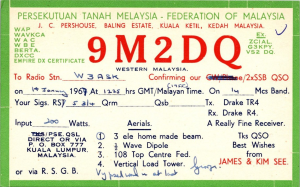
9M2DQ, James Pershouse, Kedah
9M2DQ was James Pershouse (J. C. Pershouse), a rubber plantation manager in Kedah who previously held VS2DQ from Pulau Langkawi. He was one of the most serious DXers in Peninsular Malaysia during the 1960s. At his Kedah station he ran a switchable terminated rhombic antenna, among the most efficient and directive HF antennas ever built, requiring enormous real estate that a rubber plantation could provide, paired with Drake transceivers. When he fell ill, he and his wife Daisy moved to Penang, where he settled for a triband beam Yagi. He hosted Tunku Abdul Rahman, Malaysia’s first Prime Minister, who operated from 9M2DQ’s station in Langkawi around 1958, contacting stations across Penang, Kuala Lumpur, Melaka, Muar, and Kota Bharu. Pershouse also hosted the first SEANET Convention in Penang in 1971.
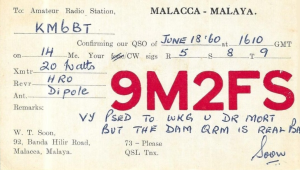
9M2FS, The Wee Family of Melaka
9M2FS was Wee Thiam Soon (silent key), the patriarch of what may be the single family with the most amateur radio callsigns in Malaysian history. Based at 92 Bandar Hilir Road, Melaka, the Wee family held no fewer than ten callsigns: 9M2FS (father, Wee Thiam Soon), 9M2GW (son George Wee), 9M2VT (George’s wife Valerie), 9M2WE (daughter Irene Wee), 9M2BD (Irene’s husband Alex), 9M2NW (daughter Nellie Wee), 9M2TM (Nellie’s husband Chong), 9M2WB (son Jerry Wee), 9M2JW (daughter Jannie Wee), and 9M2SL (Jannie’s husband Sunny). The family could have formed their own club.
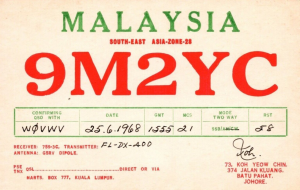
9M2YC, Chong Yin Chee, Penang
9M2YC was Koh Yeow Chin, based at Batu Pahat, Johore has long been one of the most active amateur radio in Malaysia, and 9M2YC was part of the Johore amateur radio community in 1960s.
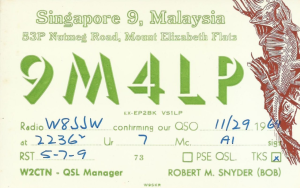
9M4LP, Singapore, 1965
9M4LP was active in 1965, during the period when Singapore was part of Malaysia (1963-1965). The 9M4 prefix was used for stations in Singapore after federation, replacing the old VS1 prefix. The IOTA programme credits 9M4LP as a Singapore island activation. The 1965 ARRL DX Competition results note 9M4LP as a notable contact on 40 metres, and the Potomac Valley Radio Club 25th Anniversary history lists 9M4LP among the distinguished DX stations worked by its members. After Singapore separated from Malaysia in August 1965, the 9M4 prefix was replaced by 9V1.
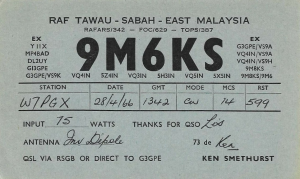
9M6KS, Ken, G3GPE (HSC #255), Sabah
9M6KS was operated by Ken, G3GPE, a member of the High Speed Club (HSC #255) whose callsign trail included DL2UY, YI1X (Iraq), MP4BAD (Trucial States, now UAE), GI3GPE (Northern Ireland), VQ4IN (Kenya), and 9M6KS (Sabah, East Malaysia). This is a classic example of a British operator whose career carried him across the declining Empire and into the post-colonial era, with each new territory bringing a new prefix. The 1965-66 Old Man magazine QSL address list includes 9M6KS, confirming active operation from Sabah during that period.
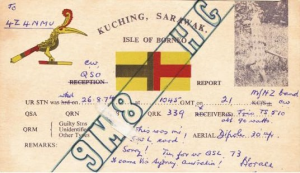
9M8HG, Horace Gray, Kuching, Sarawak
9M8HG was Horace Gray, from Kuching, Sarawak, born in 1898. Horace was responsible for establishing the first continuous telephone line stretching 600 kilometres from Kuching to the Baram, before joining the wireless telegraph and telephone department as an operator. He won the World DX Contest in 1932 running only 5 watts, an extraordinary achievement that speaks to both his skill and the favourable propagation conditions from Borneo. He was known for mailing QSL cards via registered post with outstanding postage affixed to the envelopes. His QSL cards, dated 1976 and 1979, are in the Ham Gallery collection. W8SU, who contributed the biographical notes to the Ham Gallery, wrote: “Here is a marvelous DX’er, true gentleman and always kind to the ones who needed a new one.” Horace is a silent key. The callsign 9M8HG was later reissued to Haji Hassan Haji Abdul Ghani of Kuching.
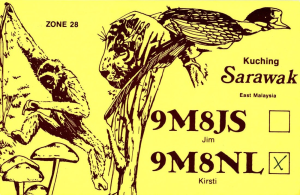
9M8JS and 9M8NL, Jim and Kirsti Smith, Sarawak
9M8JS was Jim Smith, VK9NS, one of the most legendary DXpedition operators in amateur radio history. Born in Leith, Edinburgh, Scotland, Smith was first licensed in 1947 as VS1BQ in Singapore. Over the following decades he operated from dozens of DXCC entities, including CAR (VU4 Nicobar), DL2TH (Germany), HZ1AB (Saudi Arabia), MP4BER (Trucial Oman), 9V1PR (Singapore), P29JS (Papua New Guinea), VR4BJ (Solomon Islands), H44BJ (Solomon Islands), C21AA (Niue), T3KJ/T3AJ (Kiribati), VK9YS/VK9XS/VK9NS (Norfolk Island), VK0JS (Heard Island), A35MR (Tonga), A51JS (Bhutan), A52JS (Bhutan), S21U/S21ZA (Bangladesh), WR1Z/KH9 (Wake Island), H40AB (Temotu), and many others. He was inducted into the CQ DX Hall of Fame in April 1986 and was #81 on the IOTA Honour Roll. He founded the Heard Island DX Association (HIDXA) in 1980.
His wife Kirsti Smith, VK9NL, operated as 9M8NL from Sarawak alongside Jim’s 9M8JS. Together they put rare DXCC entities on the air, including Heard Island as VK0NS and VK0NL in 1983. Kirsti’s callsign trail also included 5W1DK (Samoa), VK0NL (Heard Island), P29KJ (Papua New Guinea), VK9NL/KH1, VK9NL/JW (Svalbard), VK9NL/Willis, and T30NL (Western Kiribati). Jim passed away on 10 February 2009 at the age of 80. The 1982 Swiss amateur radio magazine Old Man noted that VK9NS and his wife operating from 9M8 was a highlight of the DX season. Their combined callsign list represents one of the most extensive DXpedition records in amateur radio history.
Preserving the Prefix Trail
Modern amateur radio should not forget these prefixes. The hobby is moving quickly into SDR, digital modes, remote stations, satellites, and internet-linked systems. Yet the foundation remains the same: a callsign, a signal, and a contact between people.
Knowing the history of prefixes such as VS1 to VT1 gives today’s operators a deeper appreciation of the callsigns we use now. It reminds us that 9M (Malaysia), 9V (Singapore), V8 (Brunei), VR2 (Hong Kong), 4S7 (Sri Lanka), A9 (Bahrain), 8Q (Maldives), and 9K (Kuwait) all sit on layers of earlier radio history.
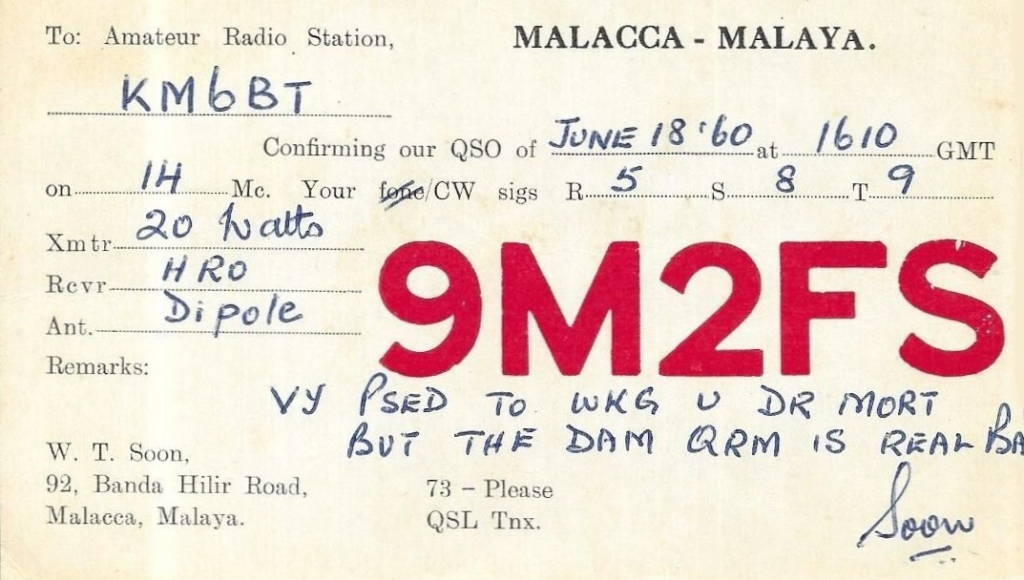
For Malaysian amateurs, the story of VS2 and VS3 is part of our own inheritance. It connects the present-day 9M community with the earliest organised amateur activity in Malaya and the wider British-administered radio world. The same spirit of international friendship that drove VS2BS to reach out across the ether in the 1940s continues today every time a 9M2 station calls CQ.
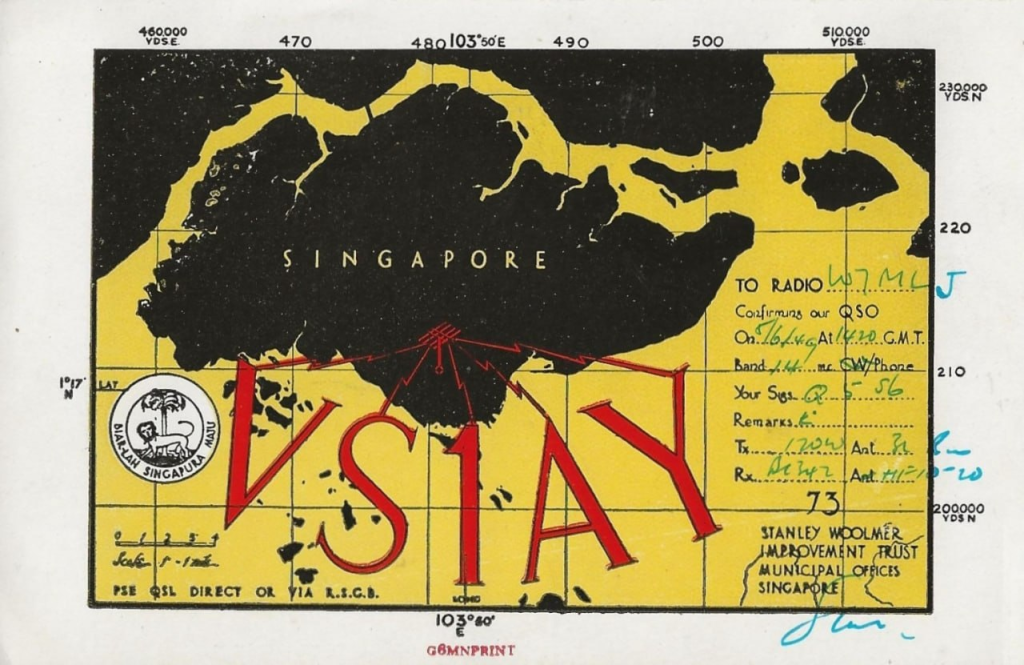
The next time you see an old QSL card bearing a VS prefix, pause before treating it as just a collectible. That small prefix may carry a whole chapter of radio history.
Frequently Asked Questions
What does the VS prefix mean in amateur radio?
The VS prefix was part of the V callsign block assigned by the ITU to the United Kingdom and its territories. Sub-blocks within VS were allocated to specific British colonies and territories in Asia, the Middle East, and the Indian Ocean, for example, VS1 for Singapore, VS2/VS3 for Malaya, VS6 for Hong Kong, and VS8 for Bahrain. Most VS prefixes were retired when the territories gained independence and received their own ITU prefix blocks.
What is the difference between VS2 and VS3 in ham radio?
VS2 was used in the Federated Malay States (Perak, Selangor, Negeri Sembilan, and Pahang), while VS3 was used in the Non-Federated Malay States (Johor, Kedah, Kelantan, Terengganu, Perlis, and Penang). Both were British colonial prefixes that preceded the modern 9M2 prefix used in Peninsular Malaysia today.
When did Malaysia change from VS2 to 9M2?
The ITU allocated the 9M prefix block to the Federation of Malaya in 1959, following independence in 1957. The transition from VS2/VS3 to 9M2 was gradual. When Malaysia was formed on 16 September 1963 (combining Malaya, Sabah, Sarawak, and Singapore), the 9M prefix system was extended across the new federation. Singapore briefly used 9M4 before separating in 1965 and receiving the 9V1 prefix in 1966.
What is VT1 in amateur radio?
VT1 was the first post-World War II amateur radio prefix for Kuwait. It came from the VT block assigned to British India, because Kuwait was initially administered from India. Kuwait was later transferred to British military government and given the MP4K prefix, and finally received the 9K prefix after independence.
Was VS9O used in Oman or the UAE?
VS9O was used in the Sultanate of Muscat and Oman (now the Sultanate of Oman, prefix A4). It was not used in the Trucial States, which were a separate group of sheikhdoms that became the United Arab Emirates (UAE, prefix A6). The Trucial States used the MP4D and MP4T prefixes. “Trucial Oman” is a historical name for the Trucial States/UAE, not for the Sultanate of Oman, this is a common source of confusion.
Are old British Empire prefixes still used today?
No. All VS and VT colonial prefixes have been retired and replaced by the independent countries’ own ITU prefix allocations. However, the old prefixes remain important for DXCC deleted entity credit, QSL card collecting, and amateur radio history research.
How can I date an old QSL card with a VS prefix?
The prefix itself tells you the territory, and the date on the card tells you the DXCC period. A VS2 card must be from before the 9M2 transition (roughly pre-1963); a VS4 Sarawak card counts for the deleted Sarawak entity only if dated on or before 15 September 1963. Cross-reference the prefix and date with the AC6V old prefix list or ClubLog prefix changes database.
References
- MARTS History – Malaysian Amateur Radio Transmitters’ Society, official history page documenting VS1-VS5 and ZC5 prefixes used in Malaya, Sarawak, Brunei, and British North Borneo.
- AC6V Amateur Radio Old Prefixes & Deleted Entities – Comprehensive reference list of historical amateur radio prefixes and their modern equivalents.
- Ham Gallery – Deleted Country: Sarawak – QSL card gallery confirming VS4 prefix usage in Sarawak before September 1963.
- Ham Gallery – Oman VS9O QSL Card – 1958 QSL card from VS9O (Peter Rackham, G3IRQ), confirming VS9O was used in the Sultanate of Muscat and Oman.
- ClubLog – 8Q, VS9M Maldive Islands – Documents the VS9M prefix usage in the Maldives, including RAF Gan club station VS9MB.
- ClubLog – Prefix Changes over the Years – Comprehensive database of prefix changes including VS9A to 7O (Yemen), MP4M to A4 (Oman), MP4T to A6 (UAE).
- DX-CHAT: Looking Back at VT1 – Discussion confirming VT1 was the first post-WWII prefix for Kuwait, later MP4K, then 9K.
- Ham Gallery – Deleted Country: PDR Yemen – Confirms VS9A, VS9P, VS9S were used for Aden, Perim Island, and Socotra Island respectively.
- DX Information Centre – Call-Sign History – Official ITU call-sign allocation history showing VP-VS and VT-VW blocks assigned to British territories.
- Wikipedia – Amateur Radio Call Signs – General reference for ITU prefix allocations including VSA-VSZ (UK) and VRA-VRZ (Hong Kong).
- Wikipedia – Amateur radio callsigns of the Middle East – Confirms VS9O/MP4M → Oman (A4) and MP4D/MP4T → United Arab Emirates (A6), clarifying the distinction between the Sultanate of Oman and the Trucial States.
- Wikipedia – Trucial States – Confirms the Trucial States (also called “Trucial Oman”) were the precursor to the United Arab Emirates, a separate entity from the Sultanate of Muscat and Oman.
- ClubLog – Singapore and Malaysia – Documents the VS1 → 9M4 → 9V1 prefix transition for Singapore and the 9M2 prefix for Malaysia.
73 from 9M2PJU
If you spot any factual error, outdated information, or missing detail in this article, please leave a comment below or contact me directly. Amateur radio history is built from QSL cards, logbooks, magazine archives, and personal recollections, and many of these sources are incomplete or contradictory. Your correction, addition, or QSL card scan will help make this record more accurate for future operators and historians.





1 comment