Multi-Band 6 Atomic Timekeeping: History, Engineering, and Standard Radio Wave Reception Guide
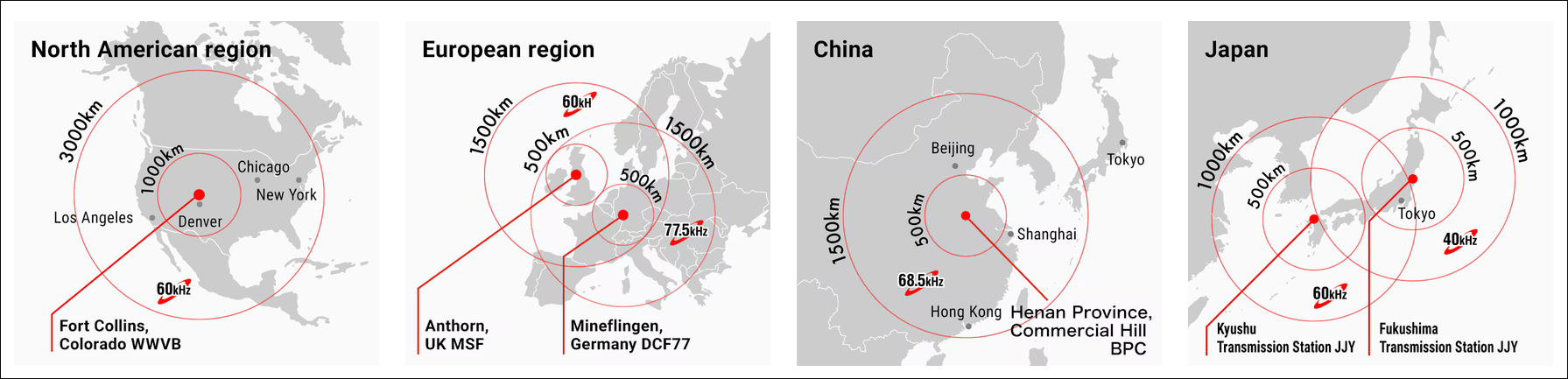
TL;DR: Multi-Band 6 is a terrestrial radio-controlled timekeeping technology that synchronizes wristwatches with national atomic clock standards over low-frequency (LF) radio waves. Operating across six transmitter sites in Japan (JJY 40/60 kHz), North America (WWVB 60 kHz), Europe (DCF77 77.5 kHz, MSF 60 kHz), and China (BPC 68.5 kHz), Multi-Band 6 delivers autonomous sub-second accuracy without cellular networks, smartphone apps, or GPS power penalties.
What Is Standard Radio Wave Reception and Multi-Band 6?
Standard radio wave reception is a wireless time-synchronization method where radio receivers decode amplitude-modulated, low-frequency (LF) time signals broadcast by national metrology institutes to discipline local quartz oscillators to atomic accuracy. In consumer horology, “Multi-Band 6” represents the engineering standard pioneered by Casio that equips wristwatches with miniature multi-frequency receiver antennas and microprocessors capable of tuning to all six dedicated longwave time transmitters operating worldwide.
+-----------------------------------------------------------------------------+
|                     Multi-Band 6 Signal Processing Chain                    |
+-----------------------------------------------------------------------------+
 [National Metrology Standard] (Cesium Beam & Hydrogen Maser Clocks)
        │
        ▼
 [LF Radio Transmitter Station] (WWVB, DCF77, MSF, JJY40, JJY60, BPC)
        │
        ▼ (Groundwave & Nighttime Ionospheric Skywave Propagation)
        │
 [Watch Ferrite Loopstick Antenna] (Miniature High-Permeability Core)
        │
        ▼
 [Multi-Frequency Tuning Tank] (Switched LC Resonance: 40, 60, 68.5, 77.5 kHz)
        │
        ▼
 [Direct-Conversion / Heterodyne Receiver IC] (Envelope Demodulation & AGC)
        │
        ▼
 [MCU Time Code Decoder] (Pulse-Width Demodulation, BCD Parsing & Parity Check)
        │
        ▼
 [Internal Timekeeping Engine] (Quartz Drift Disciplining & Stepper Motor Drive)
Every quartz watch relies on an internal quartz crystal vibrating at 32,768 Hz. While inherently reliable, temperature swings, battery voltage fluctuations, and crystal aging cause standard quartz movements to drift by 15 to 30 seconds every month. Multi-Band 6 solves this fundamental limitation by referencing primary frequency standards – primary cesium atomic clocks and hydrogen masers maintained by government metrology laboratories such as NIST (United States), PTB (Germany), NICT (Japan), NPL (United Kingdom), and NTSC (China).
These institutions generate standard time signals with a frequency uncertainty of less than one part in 10 to the 14th power. By receiving and decoding these time frames automatically during the early morning hours, a Multi-Band 6 watch resets its internal counter daily, maintaining zero perceptible drift across its entire operating lifespan.
The Evolution: From Single-Band to Multi-Band 6
Terrestrial radio-controlled timekeeping developed over several decades of advances in semiconductor miniaturization, longwave antenna design, and international frequency coordination.
+-----------------------------------------------------------------------------+
|                Chronological Evolution of Radio Wristwatches                |
+-----------------------------------------------------------------------------+
 1990: Junghans Mega 1 (World's first radio-controlled wristwatch - DCF77 only)
   │
 1995: Casio introduces Wave Ceptor desktop and wall clocks
   │
 2000: Casio WVA-300 / FKT-100 (Casio's first single-band wristwatches)
   │
 2001: Dual-Band Wave Ceptor (Automatic switching between JJY 40 kHz & 60 kHz)
   │
 2002: Casio "The G" GW-100 / GW-300 (First radio-controlled G-Shock)
   │
 2005: Multi-Band 5 (5 transmitters: JJY40, JJY60, WWVB, DCF77, MSF)
   │
 2008: Multi-Band 6 Launch (BPC 68.5 kHz added for complete global LF coverage)
   │
 Modern: Integration with Tough Solar, Tough Movement auto-hand alignment, and hybrid systems
The Early Pioneers (1990 – 1999)
The German clockmaker Junghans released the world’s first radio-controlled wristwatch, the Junghans Mega 1, in 1990. Designed in collaboration with frog design, the Mega 1 integrated a longwave antenna directly into its leather strap because the internal metal case of early wristwatches shielded low-frequency RF signals. It tuned exclusively to Germany’s DCF77 transmitter at 77.5 kHz.
During the mid-1990s, Casio entered the radio-controlled market with stationary clocks before miniaturizing receiver circuits to fit inside wristwatch cases. In 1999, Japan’s Communications Research Laboratory (now NICT) inaugurated the Otakadoya-yama LF station at 40 kHz, providing Japan with its first dedicated terrestrial longwave time broadcast.
The Single and Dual-Band Era (2000 – 2004)
In 2000, Casio released the WVA-300 and FKT-100, marking the launch of the Wave Ceptor product line. These early models were single-band devices tied to regional markets: Japanese models received JJY 40 kHz, European models received DCF77 77.5 kHz, and later North American models received WWVB 60 kHz.
In October 2001, NICT opened a second transmitter in Japan at Mount Hagane operating on 60 kHz to eliminate dead zones in western Japan and Okinawa. Casio responded by engineering dual-band receivers that dynamically scanned and selected between 40 kHz and 60 kHz based on signal strength. In 2002, Casio released the GW-100 (and subsequent GW-300), the first G-Shock models featuring radio reception combined with shock resistance and solar charging.
The Multi-Band 5 Breakthrough (2005)
By 2005, Casio developed an ultra-compact multi-band receiver IC with switched LC tank circuits capable of locking onto five transmitters across three continents:
- JJY40 (Fukushima, Japan – 40 kHz)
- JJY60 (Kyushu, Japan – 60 kHz)
- WWVB (Colorado, United States – 60 kHz)
- DCF77 (Mainflingen, Germany – 77.5 kHz)
- MSF (Anthorn, United Kingdom – 60 kHz)
Models such as the GW-5600J, GW-9000 Mudman, and PAW-1300 Pro Trek brought smooth cross-continental time calibration to international travelers.
Multi-Band 6 and the Inclusion of China (2008 – Present)
In 2007, the National Time Service Center (NTSC) of the Chinese Academy of Sciences completed construction of the BPC time broadcast station in Shangqiu, Henan Province, transmitting at 68.5 kHz.
Casio redesigned its analog front-end filter and digital demodulator to accommodate BPC’s unique 20-second frame structure and 68.5 kHz carrier. In 2008, Casio launched Multi-Band 6 across flagship series including the GW-6900, GW-M5610, Riseman GW-9200, and Oceanus OCW-S1400. Multi-Band 6 remains the universal benchmark for terrestrial atomic timekeeping.
The Global Transmitter Network: The 6 Multi-Band Stations
Multi-Band 6 watches interact with six high-power low-frequency transmitters distributed across the Northern Hemisphere.
| Station | Frequency | Location | Operating Agency | Transmit Power/ERP | Frame Length | Modulation Type | Range |
|---|---|---|---|---|---|---|---|
| JJY40 | 40.0 kHz | Mount Otakadoya, JP | NICT (Japan) | 50 kW (13 kW ERP) | 60 Seconds | AM Pulse-Width | ~1,000 km |
| JJY60 | 60.0 kHz | Mount Hagane, JP | NICT (Japan) | 50 kW (21 kW ERP) | 60 Seconds | AM Pulse-Width | ~1,000 km |
| WWVB | 60.0 kHz | Fort Collins, CO, USA | NIST (United States) | 70 kW ERP | 60 Seconds | AM/BPSK (17 dB) | ~3,000 km |
| DCF77 | 77.5 kHz | Mainflingen, Germany | PTB (Germany) | 50 kW (30 kW ERP) | 60 Seconds | AM / Phase Mod | ~2,000 km |
| MSF | 60.0 kHz | Anthorn, Cumbria, UK | NPL (United Kingdom) | 17 kW ERP | 60 Seconds | AM Fast On-Off | ~1,500 km |
| BPC | 68.5 kHz | Shangqiu, Henan, CN | NTSC (China) | 100 kW (45 kW ERP) | 20 Seconds | AM Pulse-Width | ~1,500 km |
1. JJY – Mount Otakadoya (40 kHz) and Mount Hagane (60 kHz), Japan
Operated by the National Institute of Information and Communications Technology (NICT), JJY broadcasts from two separate mountain summits to ensure total coverage across the Japanese archipelago:
- Otakadoya-yama (Fukushima Prefecture): Operates on 40 kHz with an antenna height of 250 meters. It covers eastern Japan, Tohoku, and Hokkaido.
- Hagane-yama (Fukuoka/Saga Prefecture border): Operates on 60 kHz from a 200-meter umbrella top-loaded antenna. It covers western Japan, Kyushu, Shikoku, the Ryukyu Islands, and parts of South Korea and coastal China.
JJY transmits a 60-second time frame using amplitude modulation with carrier reduction (100% full power vs. 10% reduced power). Frame synchronization markers appear at seconds 0, 9, 19, 29, 39, 49, and 59.
2. WWVB – Fort Collins, Colorado, United States (60 kHz)
Operated by the National Institute of Standards and Technology (NIST), WWVB transmits from a dedicated site north of Fort Collins, Colorado. With dual top-loaded vertical dipole antennas delivering 70 kW ERP, WWVB covers the contiguous United States, southern Canada, and northern Mexico.
WWVB broadcasts a 60-second Binary Coded Decimal (BCD) frame by reducing carrier power by 17 dB (down to 14% power) at the beginning of each second:
- Binary ‘0’: 200 ms reduced power, followed by 800 ms full power.
- Binary ‘1’: 500 ms reduced power, followed by 500 ms full power.
- Position Marker (P): 800 ms reduced power, followed by 200 ms full power.
In 2012, NIST added Phase-Shift Keying (BPSK) phase modulation to WWVB for specialized high-sensitivity utility receivers, while preserving full legacy amplitude modulation for consumer atomic watches.
3. DCF77 – Mainflingen, Germany (77.5 kHz)
Operated by the Physikalisch-Technische Bundesanstalt (PTB) and Media Broadcast GmbH, DCF77 is Europe’s primary time standard. Located 25 kilometers southeast of Frankfurt, its 50 kW transmitter reaches up to 2,000 kilometers, covering Germany, France, Italy, Spain, Poland, Scandinavia, and the British Isles.
DCF77 encodes time data by dropping carrier amplitude to 15% at the start of each second for either 100 ms (logical ‘0’) or 200 ms (logical ‘1’). Second 59 contains no modulation, serving as a clean minute marker. DCF77 also incorporates pseudorandom phase-modulation spread spectrum encoding for industrial telemetry.
4. MSF – Anthorn, Cumbria, United Kingdom (60 kHz)
Maintained by the National Physical Laboratory (NPL) and operated by Babcock International from Anthorn Radio Station, MSF serves the British Isles and northwestern Europe.
MSF uses on-off keying (100% carrier suppression) with fast edge transitions. Each second can encode two distinct data bits via dual carrier cuts: Bit A occurs at the start of the second (100 ms to 300 ms offsets), while Bit B provides DUT1 corrections and parity confirmations.
5. BPC – Shangqiu, Henan Province, China (68.5 kHz)
Operated under a public-private partnership between the National Time Service Center (NTSC) and Henan BPC Time Service Corp, BPC operates from Shangqiu on 68.5 kHz with 100 kW power.
Unlike the 60-second frames used by Western stations, BPC uses a unique 20-second transmission frame (transmitting three complete frames per minute). Each second contains four-state pulse width modulation encoding 2 bits per second. BPC broadcasts on a scheduled cycle (transmitting 21 hours daily with maintenance windows) and incorporates proprietary framing elements.
Low-Frequency Radio Physics: Groundwaves, Skywaves, and Nighttime Reception
The worldwide operation of Multi-Band 6 relies directly on the unique electromagnetic propagation characteristics of the Low-Frequency (LF) spectrum (30 kHz to 300 kHz).
+-----------------------------------------------------------------------------+
|                     Day vs. Night LF Radio Wave Propagation                  |
+-----------------------------------------------------------------------------+
 DAYTIME CONDITIONS:
  [Ionosphere D-Layer Present] (Intense Solar UV Ionization)
       │
       ▼ (Severe RF Absorption of Skywave Signals)
  [Transmitter] ════════ Groundwave Only (~500 - 1,000 km) ════════► [Watch]

 NIGHTTIME CONDITIONS:
  [D-Layer Disappears] ──► [E-Layer & F-Layer Act as Reflective Ceiling]
       │                                                                │
       ▼                                                                ▼
  [Transmitter] ─── Skywave Hop (1,500 - 3,000 km) ───► [Watch Receiver]
       ════════════ Groundwave Stable Component ═══════════►
Why LF Beats VHF/UHF and HF for Horology
- Curvature Following (Groundwaves): LF radio waves diffract around geographical contours and follow the conductive surface of the Earth. A 60 kHz groundwave propagates hundreds of kilometers past the optical line-of-sight horizon without requiring repeaters.
- Structural Penetration: The wavelength of a 60 kHz signal is 5,000 meters. These massive wavelengths pass through residential walls, timber, glass, and roofing materials with minimal attenuation compared to microwave GPS (1.5 GHz) or cellular signals.
- Ultra-Narrow Bandwidth: Time synchronization requires only 1 to 2 bits per second. Low transmission bitrates allow receiver IF filters with bandwidths as narrow as 10 Hz, delivering extraordinary signal-to-noise ratios even under microvolt-level field strengths.
Ionospheric Mechanics: Why Calibration Happens at Night
During daylight hours, solar ultraviolet radiation ionizes the lower atmosphere, creating the ionospheric D-region (altitude 60-90 km). The high collision frequency between free electrons and neutral molecules in the D-layer absorbs LF radio waves, extinguishing long-distance skywave signals.
After sunset, solar ionization ceases and the D-layer quickly recombines and vanishes. The higher E-region (90-120 km) and F-region (150-400 km) then form a sharp reflective electromagnetic boundary. LF waves reflect between the upper ionosphere and the ground in efficient “hops”, doubling or tripling transmitter range from 1,000 km out to 3,000 km.
In addition, urban radio noise from electric motors, industrial machinery, and consumer electronics drops significantly between midnight and 5:00 AM. Multi-Band 6 watches use this window by attempting automated synchronization sequentially at 00:00, 01:00, 02:00, 03:00, 04:00, and 05:00 local time. As soon as one attempt achieves complete parity verification, further scans stop to preserve battery power.
Inside the Watch: Antennas, Receiver ICs, and Decoding Engines
Fitting an autonomous 6-frequency longwave radio receiver into a 45 mm watch case rated for 200-meter water resistance represents a masterpiece of micro-electronic engineering.
+-----------------------------------------------------------------------------+
|                   Internal Multi-Band 6 Hardware Architecture               |
+-----------------------------------------------------------------------------+
               [Miniature Ferrite Bar Loopstick Antenna]
                                   │
                                   ▼
 [Analog Front End] ──► [Capacitive Switching Matrix (40/60/68.5/77.5 kHz)]
                                   │
                                   ▼
 [Low-Noise Amplifier] ──► [Bandpass Filter] ──► [AGC & Envelope Detector]
                                   │
                                   ▼
 [Digital Baseband] ────► [Pulse Width Discriminator & Timecode Framing]
                                   │
                                   ▼
 [Watch Microcontroller] ──► [Parity / Checksum Validation & RTC Slew]
1. The Miniature Ferrite Bar Loopstick Antenna
A standard half-wave dipole for 60 kHz would span 2.5 kilometers in length. To capture LF magnetic flux inside a watch case, engineers utilize a ferrite loopstick antenna.
- Core Material: High-permeability manganese-zinc (MnZn) or nickel-zinc (NiZn) magnetic ferrite rod, measuring approximately 15 mm to 20 mm in length.
- Winding: Hundreds of turns of ultra-fine Litz wire (multi-strand individually insulated copper wire) wound around the core to suppress AC skin-effect losses at longwave frequencies.
- Placement Challenges: The antenna must be isolated from the stainless steel backplate, metal bezels, and solar panels. Metal components act as a shorted turn that dampens the antenna’s magnetic field. G-Shock cases position the ferrite rod along the top edge (12 o’clock position) encased inside shock-absorbing resin.
2. Multi-Frequency Resonant Tuning
To receive four distinct carrier frequencies (40.0 kHz, 60.0 kHz, 68.5 kHz, and 77.5 kHz) using a single physical antenna, the receiver module incorporates a switched capacitor array.
The antenna inductance (L) forms a parallel resonant LC tank with an internal bank of precision variable capacitors (C):
f0 = 1 / (2π · √(L · C))
When the watch switches home cities or scans for available signals, the microcontroller activates solid-state FET switches that add or remove discrete capacitance values, shifting the tank’s resonant peak precisely onto the selected station’s carrier.
3. Ultra-Low Power Heterodyne Receiver IC
The receiver IC operates with extreme power economy. In standby sleep mode, the analog front end draws virtually zero current. During active signal acquisition:
- The Low-Noise Amplifier (LNA) boosts microvolt-level antenna signals.
- Automatic Gain Control (AGC) normalizes wide dynamic variations caused by ionospheric fading.
- Direct envelope detectors or low-IF downconverters extract the baseband pulses.
- Active power consumption during the 2 to 7 minute decoding window is limited to approximately 3 to 5 mA, smoothly supplied by the rechargeable solar cell (CTL1616 / ML2016).
4. Parity and Checksum Validation
To prevent a corrupted time value from adjusting the watch, the firmware enforces strict multi-stage data verification:
- Pulse Width Timing: Each incoming pulse must match defined tolerances (e.g. 100 ms, 200 ms, 500 ms, or 800 ms within ±30 ms).
- Minute / Marker Identification: The decoder detects position markers and empty seconds to establish the start of the frame.
- Parity Check: The BCD-encoded values for minutes, hours, day of year, year, and daylight saving time (DST) must satisfy matching parity bits.
- Frame Consistency: Many modules require decoding two consecutive matching frames before committing the new timestamp to the real-time clock (RTC) registers.
Once successful, the watch illuminates the “RCVD” or “GET” indicator on the digital display or parks the second hand over the “Y” (Yes) marker on an analog dial.
Multi-Band 6 vs. Modern Alternatives: Bluetooth, GPS, and Cellular
The horological landscape offers multiple methods for synchronizing time. Comparing these technologies highlights why Multi-Band 6 remains the gold standard for independent, resilient timekeeping.
| Feature / Parameter | Multi-Band 6 (LF) | Bluetooth Low Energy | GPS / GNSS Satellite | Cellular / NTP (Smartwatch) |
|---|---|---|---|---|
| Signal Source | Terrestrial LF Mast | Smartphone Relay | Satellite (1.5 GHz) | Cellular Tower / Wi-Fi |
| Direct Infrastructure | Government Atomic Standard | Phone OS & App Cloud | Atomic Clocks (Space Segment) | Cloud Time Servers (NTP) |
| Smartphone Dependency | None (100% Standalone) | Mandatory App & BLE | None (100% Standalone) | Frequent Phone Tethering |
| Power Consumption | Very Low (3-5 mA/2m) | Low (BLE Burst TX/RX) | High (30-60 mA/min) | Extreme (Daily Charging) |
| Battery Operational Life | 10 to 20+ Years | 2 to 10 Years | 10 to 20 Years | 1 to 3 Days |
| Indoor Reception | Excellent at Night | Excellent (via Phone) | Poor (Line of Sight) | Good (via Cellular/Wi-Fi) |
| Global Coverage | Major Northern Regs | Global (with Phone) | Worldwide Outdoors | Global (with Cell Signal) |
| Subscription / App EOL | Zero EOL Risk | High App Sunset Risk | Zero EOL Risk | High Platform Sunset Risk |
| EMP / Offline Resilience | Exceptional | Low | Moderate | Very Low |
1. Multi-Band 6 vs. Bluetooth Sync
Bluetooth-enabled watches connect to proprietary smartphone applications (such as Casio Watches or G-Shock Connected) to grab internet NTP time. While convenient and globally available, Bluetooth introduces critical vulnerabilities:
- App Obsolescence: When phone operating systems upgrade (iOS/Android) or manufacturers discontinue companion apps, the watch loses sync capability.
- Privacy and Permissions: Smartphone apps often require continuous background location permissions, accounts, and Bluetooth tracking.
- Autonomous Reliability: Multi-Band 6 has zero software dependencies. A Multi-Band 6 watch built in 2008 syncs identically today and will continue syncing for decades as long as LF masts transmit.
2. Multi-Band 6 vs. GPS Satellite Timekeeping
GPS/GNSS timepieces (such as the Seiko Astron, Citizen Satellite Wave, or Casio GPS Hybrid Wave Ceptor) receive 1.5 GHz microwave signals from orbital atomic clocks.
- Advantages of GPS: Worldwide outdoor coverage, including oceans, polar regions, and the Southern Hemisphere.
- Disadvantages of GPS: GPS can’t penetrate indoor rooms, basements, or heavy urban canyons. GPS receiver chipsets consume substantial power (30 to 60 mA), requiring larger solar cells, thicker watch cases, and open sky exposure.
3. Multi-Band 6 vs. Smartwatches
Smartwatches offer interactive features but fail on longevity, requiring charging every 24 to 72 hours and becoming obsolete within 3 to 5 years. A solar Multi-Band 6 watch is an enduring, self-sustaining instrument that functions autonomously for decades.
Practical Reception Tips & Out-of-Range Solutions
To ensure reliable daily atomic synchronization with your Multi-Band 6 timepiece, apply the following field-tested operating practices.
+-----------------------------------------------------------------------------+
|                          Optimizing Watch Placement                         |
+-----------------------------------------------------------------------------+
 [Window Facing Transmitter Direction]
        │
        ▼
 [Place Watch on Non-Metallic Surface (Wood/Glass)]
        │
        ▼
 [Orient 12 o'Clock Top Bezel Toward the Window / Transmitter]
        │
        ▼
 [Maintain 2+ Meters Separation From Switch-Mode Chargers, PCs, & LED Drivers]
Optimizing Physical Placement
- Orient the Antenna: The internal ferrite rod is aligned along the top (12 o’clock) edge of the watch. Point the 12 o’clock marker toward the geographical direction of your nearest transmitter.
- Window Line-of-Sight: Position the watch on a window sill facing outdoors. Modern low-emissivity (Low-E) insulated window glass containing metal oxide coatings can attenuate LF signals; if sync fails, test near an open window or non-metallic exterior wall.
- Eliminate Local RFI / EMI: Keep the watch at least 2 meters away from laptops, switching USB-C chargers, television sets, Wi-Fi routers, and unshielded LED power supplies, which emit broadband switching noise across the 40 kHz – 80 kHz band.
Synchronizing Outside Transmitter Footprints
If you reside outside official transmitter footprints (e.g. in Southeast Asia, Australia, New Zealand, South America, or Africa), you can still calibrate Multi-Band 6 watches using local LF signal generators:
- Browser-Based Audio Simulators: Web applications like 9M2PJU WebTimeSignal or Web JJY use the Web Audio API to drive standard computer earphones. The earphone’s voice coil acts as an inductive loop, radiating a 13.33 kHz 3rd-harmonic or 20 kHz fundamental that mixes to 40 kHz or 60 kHz near the watch’s antenna.
- Smartphone Apps: Mobile apps (such as Clock Wave on iOS or Radio Wave Sync on Android) generate pulse-width modulated audio tones through phone speakers or plugged-in earbud coils.
- ESP32 / Raspberry Pi Micro-Transmitters: Dedicated open-source micro-transmitters use square-wave GPIO PWM harmonics filtered through a small wire loop to broadcast standard JJY, WWVB, or DCF77 timeframes across a room.
Frequently Asked Questions (FAQ)
How does Multi-Band 6 differ from Multi-Band 5?
Multi-Band 6 includes the BPC transmitter in Shangqiu, China (68.5 kHz), alongside JJY40, JJY60, WWVB, DCF77, and MSF. Multi-Band 5 watches can’t synchronize in China or receive BPC signals.
Why does Multi-Band 6 sync at night instead of during the day?
Solar radiation creates the ionospheric D-layer during the day, absorbing LF radio waves. At night, the D-layer disappears, allowing long-distance skywave reflection while ambient urban electrical interference drops to minimum levels.
Can a Multi-Band 6 watch synchronize in countries without transmitters?
Yes. Users outside transmitter range can synchronize their watches using audio coil simulators (like 9M2PJU WebTimeSignal or mobile apps) or hardware micro-transmitters that broadcast local LF time frames.
How much battery power does a Multi-Band 6 radio calibration consume?
A standard 2 to 7 minute calibration cycle consumes approximately 3 to 5 mA of current. When paired with solar charging (Tough Solar), this represents less than 1% of the storage capacitor’s daily reserve.
Does Multi-Band 6 adjust automatically for Daylight Saving Time (DST)?
Yes. Transmitters broadcast dedicated DST status bits within their time frames. When the watch’s home city is set to a region observing DST in auto mode, it updates automatically.
Sources and Further Reading
- NIST WWVB Radio Station Information – National Institute of Standards and Technology official technical portal
- PTB DCF77 Time Signal Service – Physikalisch-Technische Bundesanstalt DCF77 specification
- NICT JJY Standard Radio Waves – National Institute of Information and Communications Technology official portal
- NPL MSF 60 kHz Time Signal – National Physical Laboratory standard frequency reference
- NTSC National Time Service Center (China) – Chinese Academy of Sciences BPC operational authority
- ITU-R Recommendation TF.768 – Standard-frequency and time-signal emissions
- Casio Multi-Band 6 Technology Guide – Official Casio horology engineering overview
73,
9M2PJU

Post Comment