MCMC Appendix C: The Statutory Declaration of Wireless Secrecy Explained
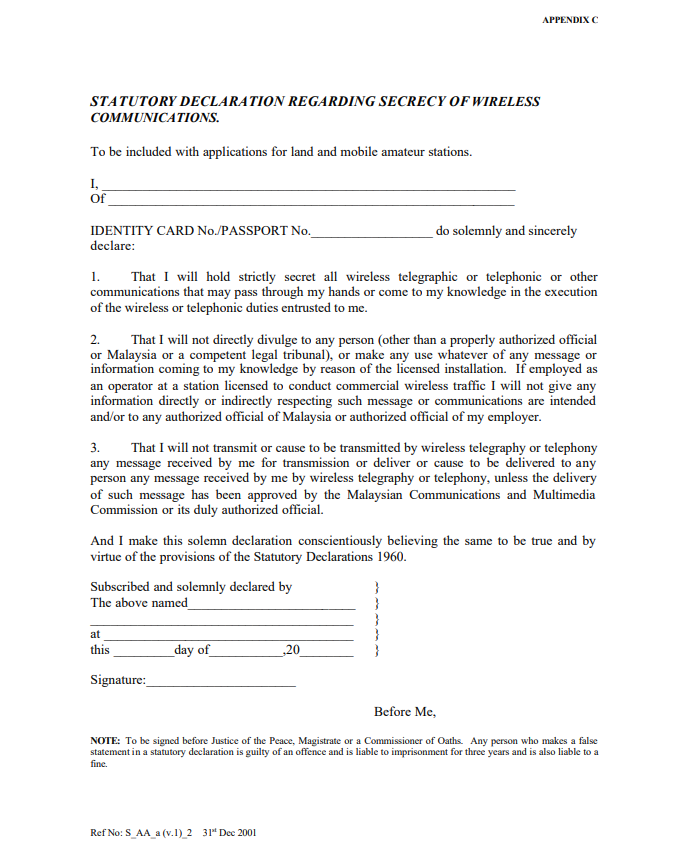
When applying for an Amateur Station Apparatus Assignment (ASAA) in Malaysia, the paperwork can feel overwhelming. Amidst the technical specifications, equipment homologation, and station diagrams, there’s one legal document that every prospective ham must sign in front of a Commissioner of Oaths: the Statutory Declaration Regarding Secrecy of Wireless Communications, commonly known as Appendix C.
Many new operators rush through this document, treating it as just another bureaucratic hurdle. This single page forms the legal foundation of how you must behave on the airwaves. It isn’t a polite request; it’s a legally binding oath under the Statutory Declarations Act 1960.
Understanding exactly what you’re swearing to when you stamp your signature on Appendix C is critical to protecting your licence and staying on the right side of the Malaysian Communications and Multimedia Commission (MCMC).
Last updated: August 2026.
The Core Promises of Appendix C
When you sign this document, you are legally binding yourself to three strict rules regarding the interception and transmission of radio signals.
1. Absolute Secrecy of Intercepted Traffic
The first clause requires you to hold strictly secret all wireless telegraphic or telephonic communications that pass through your hands or come to your knowledge.
As an amateur radio operator, your antenna will inevitably pick up signals that aren’t meant for you. Whether it is commercial traffic, maritime communications, or unencrypted local services, the rule is simple: if the message isn’t directed at you or the general public, you must treat it as classified. You can’t record it, you can’t publish it online, and you can’t discuss it.
2. The Prohibition on Divulging Information
The second clause goes a step further. It explicitly forbids you from directly divulging any intercepted message to a third party or making any use whatsoever of the information you overheard.
The only exceptions to this rule are if you are reporting the intercept to a properly authorised official in Malaysia (such as the MCMC or emergency services) or if you are compelled by a competent legal tribunal. In the amateur radio world, this means the old adage applies perfectly: what happens on the RF spectrum, stays on the RF spectrum.
3. The Ban on Third-Party Traffic
The final clause is arguably the most important for daily operations. You swear that you won’t transmit, or cause to be transmitted, any message received by you on behalf of a third party, unless explicitly approved by the MCMC.
This is a fundamental pillar of the global amateur radio service. Amateur frequencies are strictly for self-training, technical investigation, and intercommunication between licensed amateurs. If hams were allowed to act as a free relay service for unlicensed individuals or commercial businesses, the amateur bands would quickly become saturated with commercial traffic, destroying the hobby.
The Consequences of Breaking the Oath
So, what actually happens if an operator decides to ignore Appendix C and transmit third-party communications or leak intercepted traffic?
Because you signed this as a Statutory Declaration, the consequences are severe and are enforced under the Communications and Multimedia Act (CMA) 1998:
- Licence Revocation: The MCMC has the full authority to immediately suspend or permanently revoke your ASAA. You’ll lose your callsign and your legal right to transmit.
- Equipment Confiscation: Enforcement officers, often accompanied by the Royal Malaysia Police (PDRM), can raid your station and confiscate all transmitting apparatus involved in the breach.
- Fines and Imprisonment: Violating the CMA 1998 carries heavy criminal penalties. Depending on the severity of the breach, operators can face massive fines and potential imprisonment.
The document clearly states that making a false statement at the time of signing the declaration itself is an offence punishable by up to three years in prison and a fine.
The Takeaway for Malaysian Hams
Appendix C isn’t just a formality. It’s a vital legal mechanism that protects the integrity of the amateur radio bands in Malaysia. By enforcing strict secrecy and banning third-party traffic, the MCMC ensures that our frequencies remain free from commercial exploitation and malicious interference.
Treat your station with the professionalism it demands. Keep your transmissions restricted to licensed operators, respect the privacy of the spectrum, and your amateur radio journey will be a long and rewarding one.
Sources and Further Reading
- Malaysian Communications and Multimedia Commission (MCMC) Official Portal
- Communications and Multimedia Act 1998 (PDF)
73 from 9M2PJU