MISP: The Open Source Threat Intelligence Platform for Collecting and Sharing IOCs
MISP threat intelligence work starts with a painful truth: every security team sees the same phishing domains, malware hashes and attacker infrastructure, but most teams defend alone. The Malware Information Sharing Platform (MISP) fixes that by giving analysts one structured place to store indicators, enrich them with context, correlate them automatically, and share them with trusted partners in minutes instead of email threads.
TL;DR: MISP is a free, AGPL licensed open source threat intelligence platform from CIRCL Luxembourg for collecting, correlating, automating and sharing IOCs. It combines events and attributes with galaxies, taxonomies, feeds, warning lists, granular sharing controls, instance sync, a full REST API with PyMISP, enrichment modules, and STIX plus IDS exports. Install on Ubuntu 24.04 with the stock installer or run the misp-docker images, join a trusted community, and automate feeds into Suricata, Zeek, SIEM and SOAR.
What MISP Is
MISP is a free open source threat intelligence platform that collects indicators of compromise, links them into correlated events, adds shared context with galaxies and taxonomies, and synchronizes that knowledge securely between trusted organizations.
The homepage at misp-project.org states the goal directly: turn threat intelligence into decisive action. Instead of scattered spreadsheets and chat messages with hashes, MISP stores each observation as a typed attribute inside an event, tags it with a machine readable vocabulary, checks it against everything else in the database, and publishes it to exactly the audience you choose. One analyst’s phishing URL becomes every partner’s blocked domain before the next wave lands.
MISP is built by and for incident responders. The project is led by CIRCL, the Luxembourg Computer Incident Response Center, and developed with CERTs, CSIRTs, military teams, financial ISACs and researchers worldwide. The software is AGPL licensed, the data models are open standards at misp-standard.org, and the knowledge bases for galaxies and taxonomies are public domain so commercial and open source tools can interoperate.
Why Sharing Beats Detecting Alone
Every defender faces the same math. An attacker reuses infrastructure across victims: the same sender domain, the same payload hash with one byte changed, the same command and control IP block, the same lure document theme. The first organization to see it pays the full analysis cost. Everyone else could block it for free if the knowledge moved fast enough.
Without a sharing platform, that movement fails for practical reasons:
- Indicators arrive as unstructured text in emails, PDFs and chat, and die there.
- No common vocabulary exists, so one team’s “high confidence” means something different to another team.
- Analysts fear leaking victim names, customer data or internal hostnames along with the IOC.
- Exports for firewalls, IDS and SIEM are manual, slow and inconsistent.
- Trust is binary: either you share everything with everyone or you share nothing.
MISP answers each point with a concrete mechanism: structured attributes, taxonomies, sharing groups and distribution levels, automatic sanitization helpers like warning lists, one click exports, and a sync protocol between instances that respects the original distribution. For background on the discipline itself, see cyber threat intelligence and threat intelligence overviews, plus the classic definition of an indicator of compromise.
Core Concepts: Events, Attributes, Objects and Sightings
Understanding four building blocks makes the rest of MISP click.
Events bundle related indicators
An event groups everything known about one incident, campaign or report: the phishing email, its attachments, URLs, IPs, hashes, notes and references. Events carry a distribution setting, a threat level, an analysis state (initial, ongoing, completed) and a date. Sharing happens at event granularity, but sensitive fields can be handled individually.
Attributes are the typed facts
Attributes are single values with a type and a category: md5, sha256, domain, ip-dst, url, email-src, mutex, regkey, and dozens more. Types matter because correlation, validation and export all depend on them. A domain can feed an RPZ firewall feed. A free text comment can’t.
Key attribute flags:
- IDS flag: marks values safe for automated blocking exports.
- Distribution: can narrow or widen sharing per attribute inside an event.
- Sightings: analysts record that they saw an indicator in the wild, which builds confidence over time.
- Proposals and comments: collaborators suggest corrections without editing the original.
- Decay and expiration: aging indicators lose value automatically instead of blocking forever.
Objects model complex things
Objects describe multi field entities like files, emails, network sessions, vulnerabilities, credentials and attack patterns. A file object holds filename plus multiple hashes plus size in one correlated unit. A vulnerability object holds CVE ID plus CVSS plus affected products. Object templates keep everyone describing the same concept the same way, which is what makes STIX export and cross tool comparison work.
Galaxies add adversary context
Galaxies are shared knowledge bases for threat actors, ransomware families, tools, techniques, MITRE ATT&CK tactics, exploit kits and preventive measures. Tagging an event with an ATT&CK technique like T1566 Phishing or a named actor cluster turns a lonely hash into a story: who uses it, how, and what to hunt next. Galaxies update from community repositories without touching your private events.
Taxonomies, Feeds and Warning Lists
Three supporting systems keep MISP data clean and actionable.
Taxonomies standardize labels
Taxonomies are shared vocabularies: Traffic Light Protocol (TLP), estimative language, incident classification, sector tags, and many national models. Because tags are machine readable, automation can route TLP:AMBER items to analysts while auto blocking TLP:CLEAR network indicators. Custom taxonomies cover internal handling rules without forking the software.
Feeds pull public intelligence in
Default feeds ingest OSINT blocklists, sandbox outputs, abuse trackers and partner collections on a schedule. Each feed maps to attributes with caching rules, so a 500,000 line list doesn’t drown the database. Correlation then matches local events against feed data automatically.
Warning lists stop self inflicted outages
Warning lists flag values that must never be auto blocked: RFC 1918 addresses, public DNS resolvers, major SaaS domains, top Alexa sites. Before an export or a correlation alert fires, MISP checks these lists. This single feature has saved more weekends than any other in the platform.
Correlation: Where MISP Earns Its Keep
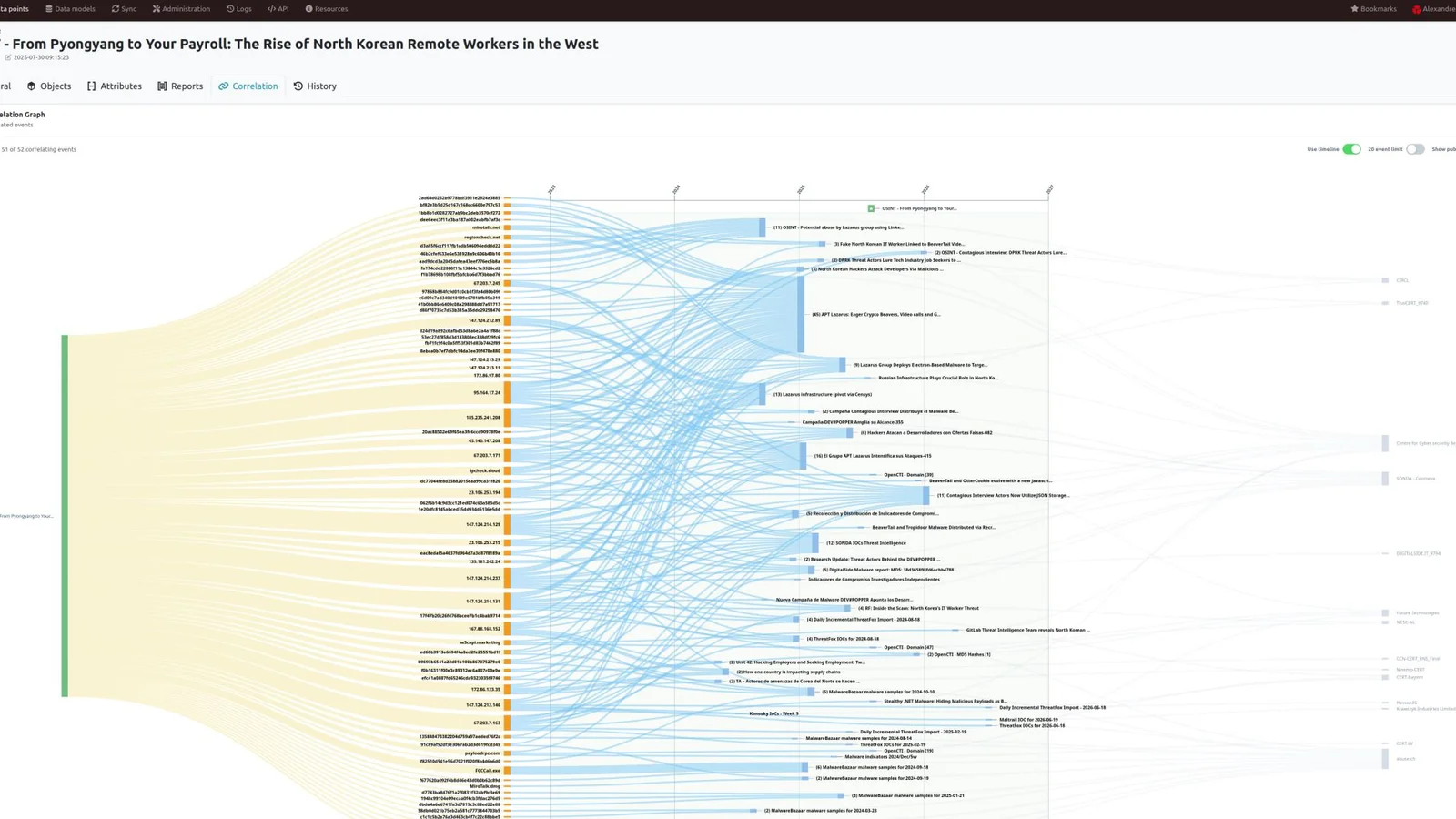
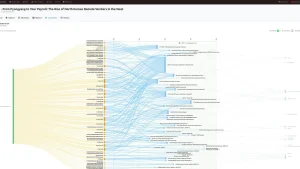
The featured image for this guide shows the MISP correlation view: one value connected to every event that contains it. When a new attribute arrives, MISP searches all existing data for matches, including smart variants:
- Exact matches on hashes, IPs, domains and emails.
- CIDR overlap for network ranges.
- Fuzzy hash similarity for lookalike malware.
- Related values through object relationships and galaxy links.
Analysts pivot from one event to every related event, build event graphs, and see the campaign behind isolated alerts. Over-correlation is controlled per attribute: disable correlation on noisy values, use thresholding, and rely on warning lists for infrastructure everyone shares.
The 2.5 series improved correlation performance and added recorrelation tooling, and the v3.0 early access interface makes pivoting through graphs a first class workflow while keeping the API and sync protocol stable.
Sharing Model: Precise Control Instead of All or Nothing
MISP people often say the sharing model is the real product. Five distribution levels plus custom sharing groups cover most policies:
| Level | Who receives it | Typical use |
|---|---|---|
| Your organisation only | Nobody leaves the instance | Internal investigation drafts |
| This community only | Local instance users | Victim sensitive cases |
| Connected communities | Local plus synced instances | Trusted partner exchange |
| All communities | Every synced peer | Broad malware campaigns |
| Sharing group | Named list of organisations | Sector ISAC or bilateral pact |
| Inherit event | Follows the parent event | Default for most attributes |
Mechanics that make this safe in practice:
- Sync between instances pushes and pulls events, attributes, galaxies, taxonomies and sightings on schedule with conflict handling.
- Delegated publishing lets a community host publish on behalf of members through a pseudo anonymous path.
- Notifications can be GnuPG or S/MIME signed and encrypted per user preference.
- Every action is logged for audit, with transports for central monitoring.
- Communities range from national CIRCL operated circles to sector ISACs and closed bilateral links.
Start restrictive, widen as trust builds. The most successful communities publish small, high quality events often rather than dumping bulk feeds once.
Automation and Integration: API, PyMISP, Modules and Streaming
MISP assumes machines do the repetitive work.
- OpenAPI REST API: every UI action maps to an API call with granular restSearch filters. The built in API client helps compose and test queries in the browser.
- PyMISP: the official Python library for fetching events, adding attributes, managing tags, pushing sightings and scripting bulk jobs.
- misp-modules: Python expansion, import and export services. Query a sandbox, enrich a domain with passive DNS, resolve an IP to ASN, or convert a report to objects without touching core code. The 3.x module releases added dozens of expansion modules.
- Workflows: visual pipelines that auto tag, quarantine, notify or publish based on rules.
- Streaming: ZeroMQ and Kafka publish new events, attributes, sightings and tag changes for SOAR and detection engineering.
- Dashboards: composable views for SOC triage, feed health and community activity.
Typical pipeline: mail gateway extracts URLs, PyMISP script creates a draft event, enrichment modules add resolutions and screenshots, workflow tags TLP and confidence, analyst confirms, sync publishes to the sharing group, and subscribers auto export to firewalls within minutes.
Import and Export: Open Standards Without Lock In
MISP speaks the formats your stack already uses.
Exports include MISP JSON and XML, STIX 1 and 2 via the maintained misp-stix library, OpenIOC, CSV, plain text, YARA context, Suricata and Snort rules, Zeek intel, RPZ zones, and forensic cache formats. The MISP standard format stays backward compatible so scripts written years ago keep working.
Imports accept MISP, STIX, CSV, sandbox JSON, URLs, batches and free text. The free text importer is underrated: paste a vendor report, and MISP proposes structured attributes and objects for review. Combined with the CTI documentation from OASIS, teams can move between MISP and STIX native tools without retyping intelligence.
Installing MISP: Practical Paths
The download page lists every supported route. Three cover almost everyone.
Option 1: Stock installer on Ubuntu 24.04
Recommended for production 2.5 instances. Provision a clean Ubuntu 24.04 host with at least 4 CPU cores, 8 GB RAM and 100 GB disk for a small community instance, then run the stock installer from the MISP project. The script installs MariaDB or PostgreSQL, Redis, PHP workers, CakePHP frontend, background jobs and GnuPG handling. Harden afterwards: TLS only, mail relay auth, backup cron, and admin review of default roles.
Option 2: Docker for labs and evaluation
Use misp-docker for a fast lab or a controlled production deploy behind your own reverse proxy. Images track MISP core plus misp-modules. Pin tags, persist the database and config volumes, and keep the modules container updated alongside core.
Option 3: Configuration management at scale
Ansible, Puppet and RPM routes exist for fleets: ansible-MISP, puppet-misp and MISP-RPM. Useful when MISP must match site baselines for logging, SSO and backup agents.
Whatever path you pick, plan for workers and cron: correlation, feed fetch, sync and email notification all run as background jobs. Monitor queue depth on the admin dashboard and size workers before adding large feeds.
Operating MISP Day to Day
A healthy instance follows a rhythm:
- Triage: review new events, confirm automatic correlations, merge duplicates, set analysis state.
- Enrich: run expansion modules on unknowns, attach sandbox reports, tag ATT&CK techniques and actor galaxies.
- Decide: adjust distribution, set IDS flags only on blocking safe values, add sightings from sensor hits.
- Publish and sync: release to the sharing group, watch sync status, answer proposals from partners.
- Expire: let decay retire stale IOCs, review false positives against warning lists.
- Audit: export logs to SIEM, review role permissions quarterly, rotate sync and API keys.
Role based access control supports everything from open internal labs to tightly regulated community hubs. Pair it with SSO, enforce MFA at the proxy, and keep a break glass local admin for outages.
MISP for Radio Amateurs and Community Networks
This is HamRadio.my, so here is the honest crossover. MISP isn’t radio software, but clubs that run public infrastructure face the same threats as small enterprises: phishing against committee members, compromised WordPress sites, abused repeaters with internet gateways, and mesh nodes exposed to scanning.
Practical uses that fit volunteer capacity:
- Track phishing domains impersonating your club, event or callsign lookup service, and share them with neighboring clubs through a small sharing group.
- Feed firewall and DNS RPZ exports from MISP into the Raspberry Pi or VPS that hosts your club site, wiki and About page linked services.
- Correlate abuse reports across Field Day, contest and emergency communications networks instead of handling each in isolation.
- Use sightings from packet or mesh gateways to confirm which indicators still fire before blocking subnets that might carry legitimate traffic.
Start with one instance, two trusted partner organizations, and a single well curated feed. The discipline of structured sharing transfers directly from signal reporting: accurate, timestamped, sourced observations beat vague warnings.
MISP Versus Alternatives
| Platform | Model | Strengths | Limits | Best fit |
|---|---|---|---|---|
| MISP | Self hosted sharing hub, AGPL | Correlation, sync, sharing groups, STIX plus IDS exports, huge community | Requires hosting and tuning, PHP stack | CERTs, ISACs, SOCs that share |
| OpenCTI | Self hosted knowledge platform | STIX 2 native graph, rich connectors | Heavier stack, sharing less fine grained | Teams centered on STIX modeling |
| TheHive plus Cortex | Case plus analyzers | Case management, analyzer ecosystem | Not a sharing community platform | IR teams needing cases |
| AlienVault OTX | Hosted community | Zero hosting, easy start | Cloud hosted, coarse control | Solo analysts wanting quick pulses |
Many teams run MISP plus one of the others: MISP for collection and sharing, OpenCTI for deep graph analysis, TheHive for casework. The open formats make that combination practical instead of a migration project.
Honest Limitations
- Hosting burden: database tuning, workers, backups and upgrades are yours. Budget admin time before adding big feeds.
- Learning curve: distribution, sharing groups, taxonomies and galaxies take a week of real use to internalize.
- Data quality risk: syncing low quality feeds creates noise and false blocks. Curate sources and use warning lists aggressively.
- Version churn: 2.5.x moves fast and 3.0 reshapes the UI. Pin versions, read the changelog, test modules after upgrades.
- Not a SIEM or firewall: MISP produces intelligence. Detection and blocking still happen in Suricata, Zeek, EDR and SIEM.
Getting Started in an Afternoon
- Deploy the lab with misp-docker or the Ubuntu 24.04 installer and complete the admin setup wizard.
- Create one organisation, one sharing group with yourself, and one test event with five attributes from a public report.
- Enable one small reputable feed and one warning list, then watch correlation link your test event.
- Install PyMISP locally, list events through the API, and add a sighting programmatically.
- Export the test event as Suricata rules and as STIX 2, and inspect both outputs.
- Invite one trusted peer instance, sync the test sharing group, then delete the test data and start real collection.
Supporting pages worth bookmarking: features, data models, modules, tools, documentation and the MISP training materials.
Sources and Further Reading
- MISP project homepage
- MISP features and functionalities
- Download and install MISP
- Stock install guides
- MISP data models
- MISP communities
- Default MISP feeds
- MISP modules directory
- MISP tools directory
- MISP core software on GitHub
- misp-modules on GitHub
- PyMISP on GitHub
- misp-docker images
- MISP standard format
- OASIS CTI documentation for STIX
- CIRCL Luxembourg
- MITRE ATT&CK framework
- Cyber threat intelligence overview
- Threat intelligence overview
- Indicator of compromise explained
- HamRadio.my homepage
- About 9M2PJU on HamRadio.my
73 de 9M2PJU







Post Comment