amateur radio
history
Adi Indrayanto, amateur radio Indonesia, AMPR.ORG, AMPRNet, APRS, ARC ITB, BBS, BPPT, Firman Siregar, history of internet Indonesia, INASAT, INHEREN, IPTEKNET, ITB, JARDIKNAS, JASIPAKTA, LAPAN, LAPAN TUBSAT, Onno W. Purbo, ORARI, OSCAR, packet radio, PaguyubanNet, TCP/IP, TNC, YB1BG, YC1DAV
9M2PJU
0 Comments
How Amateur Radio Built the Indonesian Internet: PaguyubanNet, Packet Radio and the Pioneers of 1986-1994
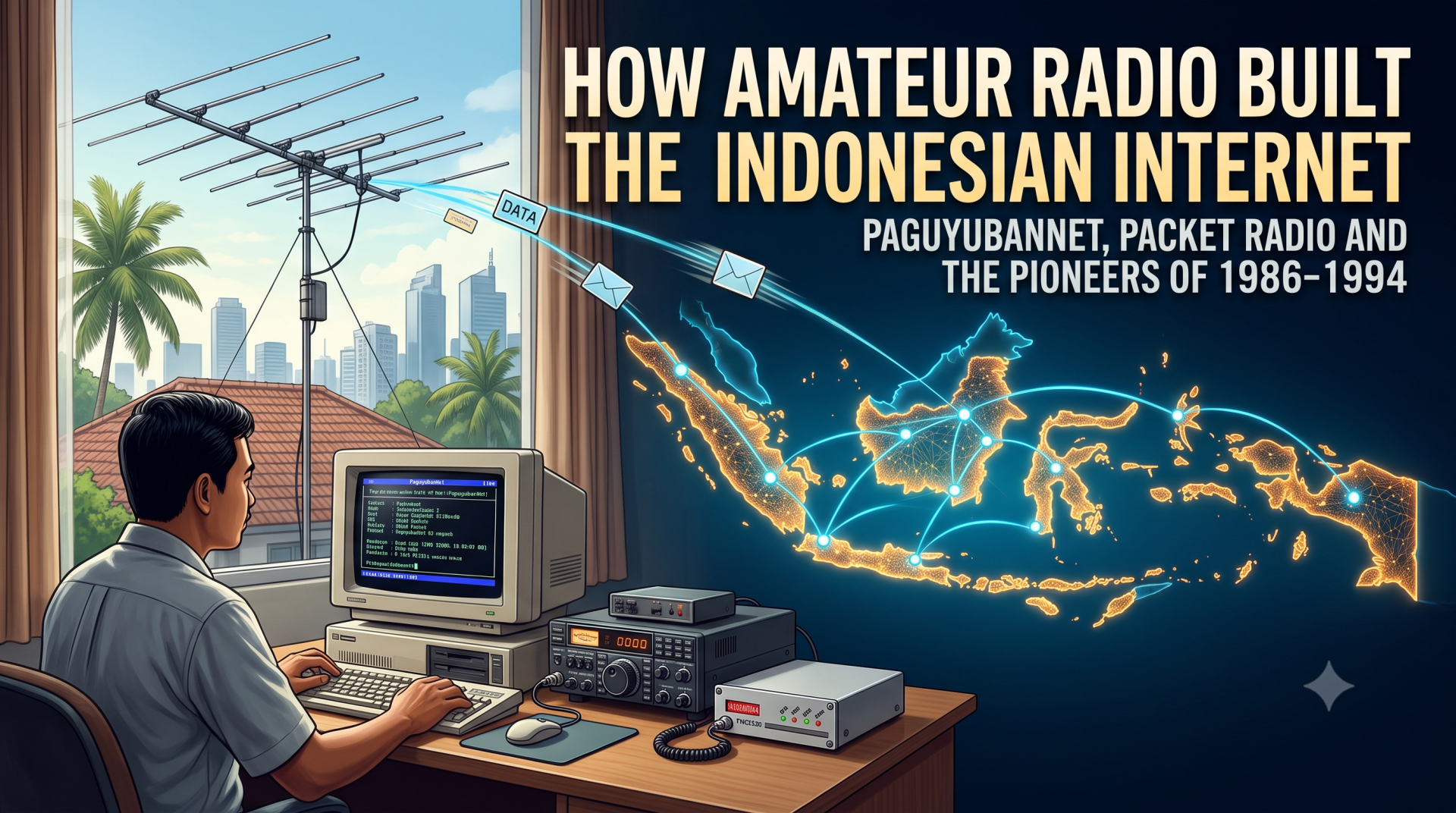
Most people picture the Internet arriving in Indonesia through fibre cables, telco switches and a few big routers in Jakarta. The real story is stranger and far more interesting. The first threads of the Indonesian Internet were woven not by telecommunications engineers in air-conditioned rooms, but by amateur radio operators bouncing data off low-orbit satellites, pushing 1200 baud packet radio through walkie-talkies, and arguing about TCP/IP routing on the 40 metre HF band. Long before there was a commercial ISP in Indonesia, there was PaguyubanNet, a “network of friends” built largely on amateur radio infrastructure, and it is the direct ancestor of the Indonesian Internet we use today.
This article traces that story, from the Amatir Radio Club at ITB in 1986, through the first TCP/IP packet radio gateways at BPPT and LAPAN, to Randy Bush’s historic ping to IPTEKNET on 7 June 1994, and on into the AI3 satellite era that wired Indonesian universities into the global research network. It is a story that every ham, every network engineer, and every Indonesian who ever typed ping should know.
Why Amateur Radio Came First
In the mid-1980s, Indonesia had no public Internet. International telephone calls were expensive, leased lines to the outside world were rare and costly, and the only people who routinely maintained data links across oceans were amateur radio operators. Hams had been doing store-and-forward email over radio for years, through the global Bulletin Board System (BBS) network, and they had a working international message relay system long before most countries had a domestic one.
Amateur radio also had one quiet but enormous advantage that almost nobody outside the hobby knew about: a dedicated block of Internet Protocol addresses. In the 1970s, American ham Hank Magnuski, KA6M secured what is now the 44.0.0.0/8 netblock, 16.7 million IP addresses reserved worldwide for amateur radio use. This network is called AMPRNet (AMateur Packet Radio Network), also written 44Net, and its hosts live under the AMPR.ORG domain. Indonesia’s slice of that block is 44.132.0.0/16, and the man who first coordinated it was Robby Soebiakto, YB1BG.
So when a handful of young Indonesian engineers wanted to learn how computer networks actually worked, amateur radio was the only place they could do it for real, with real international links, real routing, and real TCP/IP, instead of just reading about it in a textbook.
The Amatir Radio Club ITB, 1986: Where It Started
The earliest writings on the Internet in Indonesia trace directly back to amateur radio activity in 1986, specifically at the Amatir Radio Club (ARC) ITB in Bandung. The club had two pieces of equipment that mattered: a Kenwood TS-430 single sideband (SSB) HF transceiver owned by Harya Sudirapratama, YC1HCE, and an Apple II computer owned by Onno W. Purbo, YC1DAV.
With that combination, a radio and a computer, a group of ITB students began learning packet radio from the senior hams of the era. The students included Harya Sudirapratama (YC1HCE), J. Tjandra Pramudito, YB3NR, and Suryono Adisoemarta (then holding the US call N5SNN). Their teachers were the established Indonesian hams Robby Soebiakto, YB1BG, the late Achmad Zaini, YB1HR, and Yos, YB2SV, and the classroom was the 40 metre amateur band (7 MHz), where they discussed how to build computer networks over radio using packet radio technology.
This was not a casual hobby. Packet radio, using a Terminal Node Controller (TNC) as a modem and the AX.25 link protocol, was the same technology that hams worldwide were using to run real TCP/IP over the air. The ARC ITB group was effectively learning, hands-on, the same protocols that the global Internet would soon run on.
Robby Soebiakto, YB1BG: The Packet Switching Pioneer
Of all the names from this era, Robby Soebiakto, YB1BG stands out. Working at PT. USI IBM in Jakarta, he was the recognised expert among Indonesian hams in data communications over packet switching, the technique of breaking data into addressed packets and relaying them node by node, which is exactly how the Internet works.
Robby did three things that shaped the entire trajectory of Indonesian networking:
- He introduced TCP/IP to Indonesian amateur radio. He was the first to seriously push TCP/IP over packet radio in the Indonesian ham community, the same protocol family that the global Internet runs on.
- He coordinated Indonesia’s first IP addresses for the AMPRNet, the 44.132 block, becoming the country’s first AMPRNet coordinator.
- He mentored Onno W. Purbo. In 1988, through personal letters, Robby urged Onno, who was then in Hamilton, Ontario, Canada, to study TCP/IP-based networking, telling him that the future of computer networking worldwide would be built on TCP/IP. That single push set Onno on the path to becoming Indonesia’s most prolific writer and teacher of Internet technology.
Robby also built an amateur satellite gateway at his home in Cinere, south Jakarta. Using the OSCAR (Orbiting Satellite Carrying Amateur Radio) satellites, he established faster data links between Indonesia and Canada, allowing knowledge to flow between Onno in Canada and the Indonesian ham community through radio rather than expensive telephone calls. The Indonesia-Canada link ran on PC/XT compatible computers and 2 metre walkie-talkies, with the OSCAR satellites acting as the international relay.
The TCP/IP packet radio techniques Robby pioneered were then picked up by his colleagues at BPPT (the Agency for the Assessment and Application of Technology), LAPAN (the Indonesian National Institute of Aeronautics and Space), UI (University of Indonesia) and ITB, and these institutions became the backbone of PaguyubanNet between 1992 and 1994.
Onno W. Purbo, YC1DAV: From Canada to Bandung
Onno W. Purbo is the name most Indonesians associate with early Internet education, and for good reason. After Robby’s letters convinced him to focus on TCP/IP, Onno went on to write a long shelf of books on computer networking and Internet technology in Bahasa Indonesia, deliberately aimed at “memandakan rakyat Indonesia”, making Internet technology accessible to ordinary Indonesians.
Onno later took over from Robby as the national coordinator of AMPRNet Indonesia (the 44.132 block), a role he held from the late 1990s. He also coordinated ORARI (Organisasi Amatir Radio Indonesia) activities through the [email protected] mailing list, one of the main channels through which Indonesian hams organised themselves online in the early 2000s.
His callsign has moved over the years, YC1DAV in the early ITB era, then YC0MLC later, but his role as the bridge between the amateur radio world and the Indonesian Internet world has been constant.
LAPAN, BPPT and JASIPAKTA: The First Real Gateways
While the ITB group was experimenting, the research institutions were building the first practical gateways.
At LAPAN Ranca Bungur, researcher Muhammad Ihsan, working with his director Ibu Adrianti and in cooperation with DLR (the German Aerospace Center), developed a packet radio network on the 70 cm and 2 metre bands starting around 1992-1993. This network was known as JASIPAKTA and was supported by DLR. Muhammad Ihsan operated the relay that connected ITB in Bandung to the Internet gateway at BPPT in Jakarta. He would later become a driving force behind Indonesia’s indigenous satellites, LAPAN TUBSAT and INASAT.
At BPPT, Firman Siregar operated the packet radio gateway on the 70 cm band. The hardware was modest by any standard: a PC 386 running NOS (the KA9Q NOS TCP/IP stack) on top of DOS, acting as a real TCP/IP packet radio router. This was IPTEKNET in its earliest form, the network that would soon carry Indonesia’s first international Internet connection.
7 June 1994: The Ping That Changed Everything
The moment most often cited as the birth of the Indonesian Internet is 7 June 1994. On that day, Randy Bush, operating from Portland, Oregon, USA, sent a ping to IPTEKNET in Indonesia and reported the result to his colleagues at the US National Science Foundation (NSF).
Randy Bush was no casual operator. He had been chosen by the US National Academy of Sciences to catalyse and design the Indonesian national Internet, IPTEKNET, the same role he had performed for the first networking in Peru. His report, documented at nsrc.org (the Network Startup Resource Center), recorded that Indonesia’s first IP connection ran over a 64 Kbps leased line and that the ping took about 750 milliseconds from the United States.
A 64 Kbps leased line and a 750 ms round trip across the Pacific sounds painfully slow today, but in 1994 it was a working international Internet link, and it was the first one Indonesia had. Everything that followed, the commercial ISPs, the .id domain, the broadband rollouts, the mobile data explosion, grew from that single ping reply.
ITB Joins In: A 286 and a Borrowed TNC
ITB was a relative latecomer to PaguyubanNet, and its early equipment reflected that. When Suryono Adisoemarta returned to Indonesia at the end of 1992, members of ARC ITB, including Basuki Suhardiman, Aulia K. Arief and Arman Hazairin, with support from Adi Indrayanto, set about building a packet radio gateway at ITB. The machine was a used 286 computer with the large 5.25 inch floppy disks that have long since disappeared from production. The TNC (Terminal Node Controller) that served as the radio modem was not even ITB’s own, it was borrowed from Muhammad Ihsan at LAPAN.
Institutions already connected, such as UI, BPPT, LAPAN and PUSDATA DEPRIN, had far better facilities. But ITB’s gateway was enough to bring the institute into PaguyubanNet, and ITB would soon punch well above its weight.
Suryono Adisoemarta’s credentials were ideal for the job. While studying at the University of Texas at Austin, he had connected the Austin amateur radio TCP/IP network to the Internet gateway for the first time, in the Chemical and Petroleum Engineering building at UT Austin, bringing the entire Austin ham TCP/IP community onto the global TCP/IP network. He later held the Indonesian call YD0NXX and became a driving force behind amateur satellite technology and the Automatic Packet Reporting System (APRS) in Indonesia, the same system that lets you watch ham stations’ positions on a live map at aprs.fi.
PUSDATA DEPRIN and Pak Putu: Government Gets Online
Another key figure, known simply as Pak Putu, developed PUSDATA at the Department of Industry (DEPRIN) under minister Tungki Ariwibowo and ran the BBS at pusdata.deprin.go.id. In the early BBS era, Pak Putu was instrumental in popularising email in Jakarta, supported by a minister who genuinely loved computers and the Internet. Tungki Ariwibowo is recorded as the first Indonesian minister to personally answer his own email, a small but telling detail about how seriously that ministry took the new medium.
The First Indonesian Mailing List: [email protected], 1987
Long before there was an Indonesian Internet to speak of, there was an Indonesian community online, abroad. Around 1987-1988, a small group of Indonesian students in the United States, led by Eka Ginting (then studying at the University of Seattle), set up the first Indonesian mailing list using a server at the University of California, Berkeley. The address was [email protected], and it is widely regarded as the origin of Indonesian mailing lists on the Internet.
The list began as an exchange of information among Indonesian students overseas and later expanded into social and political discussion. It demonstrated something that would prove central to the Indonesian Internet’s later growth: the real driver was not the hardware or the protocol, but the community. People talking to each other, by email, across borders, was the killer application, and amateur radio had been doing exactly that, store-and-forward, for years before the wired Internet caught up.
From 1200 Baud to AI3: ITB Becomes a Hub
ITB’s packet radio gateway started life at 1200 bps, the standard speed of early packet radio over VHF FM. In 1995, ITB obtained a 24 hour, 14.4 Kbps connection to RISTI Telkom as part of IPTEKNET, a huge step up from 1200 baud, and it continued to provide free Internet access to the PaguyubanNet community.
The real leap came in September 1996, when ITB joined the Asia Internet Interconnection Initiatives (AI3), an international research project started in 1995 by the WIDE Project and JSAT Corporation in Japan. AI3 stood up its testbed network in October 1996 with partners in Indonesia (ITB), Hong Kong and Thailand, each connected by a 1.5 Mbps satellite link to a hub station at the Nara Institute of Science and Technology (NAIST) in Japan, which in turn connected to the WIDE Internet backbone. For an institute that had been running a borrowed TNC on a used 286 only three years earlier, a 1.5 Mbps international research link was a transformation.
ITB later added connections to TelkomNet and the IIX (Indonesia Internet Exchange) at 2 Mbps, and became a central node of AI3 Indonesia, which by 1997-1998 linked more than 25 Indonesian educational institutions together and to the world.
JARDIKNAS and INHEREN: Internet for the Schools
By the time this story was being written down in 2009, the educational network had grown far beyond the universities. JARDIKNAS (Jaringan Pendidikan Nasional) and INHEREN (Indonesian Higher Education Network), operated by the Ministry of Education (DIKNAS), connected more than 15,000 Indonesian schools to the Internet. The same impulse that had driven the ARC ITB students to learn packet radio in 1986, the belief that networking technology could educate and connect a nation, had scaled from a borrowed TNC to a national schools network.
The Legacy: What Amateur Radio Gave the Indonesian Internet
The through-line of this history is unmistakable. Almost every foundational element of the early Indonesian Internet came from, or was learned through, amateur radio:
- TCP/IP over radio, the core skill, was a ham technique before it was a telco technique in Indonesia.
- AMPRNet 44.132, Indonesia’s first coordinated IP address block, was an amateur radio allocation.
- OSCAR satellites provided the first practical international data relay for the Indonesian community.
- Packet radio BBS networks gave Indonesian hams years of store-and-forward email experience before commercial email existed.
- APRS, the system that puts ham positions on a live map, grew out of the same packet radio culture and is still active today.
- The people, Robby Soebiakto, Onno W. Purbo, Suryono Adisoemarta, Muhammad Ihsan, Firman Siregar, Adi Indrayanto, and the rest, were almost all licensed amateur radio operators first and network engineers second.
The next time you open a browser in Jakarta, Bandung or Bali, spare a thought for the hams who, in 1986, sat around a Kenwood TS-430 and an Apple II on the 40 metre band, and started the conversation that became the Indonesian Internet.
Further Reading and Sources
- OnnoCenter Wiki, “7 Juni 1994 ping pertama ke Indonesia”, http://www.onnocenter.or.id/wiki/
- OnnoCenter Wiki, “Gambaran Teknologi Packet Radio” (Robby Soebiakto YB1BG, AMPRNet 44.132, Onno W. Purbo YC1DAV)
- OnnoCenter Wiki, “AMPRNet” (44.0.0.0/8, Hank Magnuski KA6M, AMPR.ORG)
- Network Startup Resource Center (nsrc.org), Randy Bush IPTEKNET reports
- VOI.id, “Internet Masuk Indonesia dalam Sejarah Hari Ini, 7 Juni 1994”
- Kompas Cek Fakta, “Sejarah Ping Pertama ke Indonesia” (7 June 1994, IPTEKNET, 64 Kbps, 750 ms)
- APNIC Foundation, “AI3 – Asian Internet Interconnection Initiatives” (WIDE Project, JSAT, 1995, October 1996 testbed, NAIST-ITB KU-band link)
- ISOC INET’97 Proceedings, “Sustainable Collaborative Efforts in Internet Development in Asia: AI3 Phase II”
- OnnoCenter Wiki, “Sejarah Internet Indonesia: Mailing List Indonesia” ([email protected], 1987-1988)
- Wikibooks bahasa Indonesia, “Sejarah Internet Indonesia/Orang Indonesia di Luar Negeri” (Eka Ginting, Janus Garuda Indonesia, 1987)
- ARDC, “44Net” (44.0.0.0/9, 44.128.0.0/10, amateur radio allocation)
- QSL.net YB0EMJ, “AMPRNet” (Indonesian national coordinator Onno W. Purbo YC1DAV)
- aprs.fi, live APRS map (Suryono Adisoemarta YD0NXX and APRS in Indonesia)






Post Comment