RAD950: Worldwide HF Weak-Signal DX From a Handheld, No Laptop Required
FT8 changed amateur radio in 2017 by making reliable contacts at minus 20 dB routine. It also froze a workstation into the workflow: a computer running WSJT-X, a sound card interface, CAT control, and a mains-powered HF transceiver. For a new operator, the cheapest honest entry point is several hundred dollars and a desk.
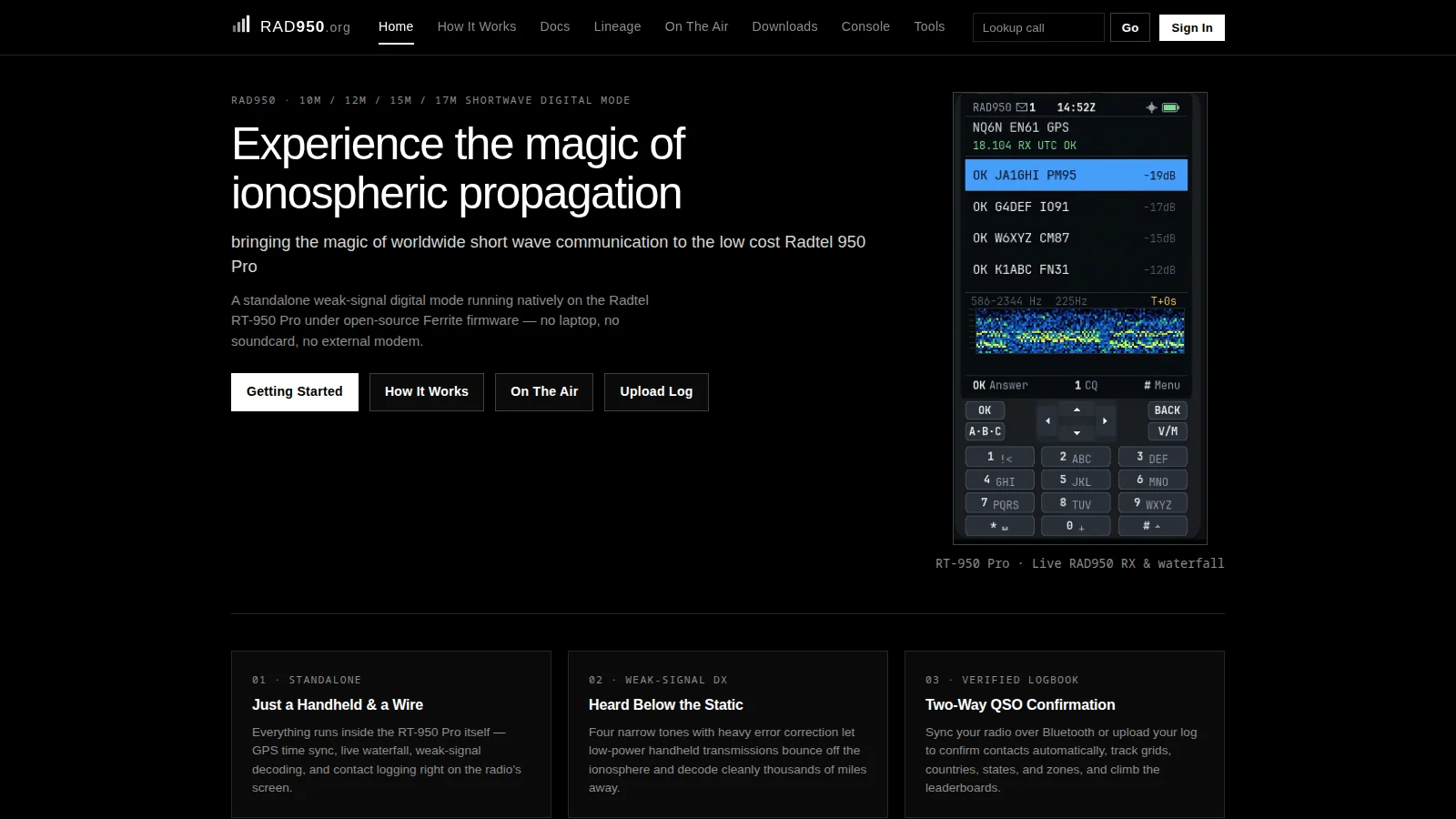
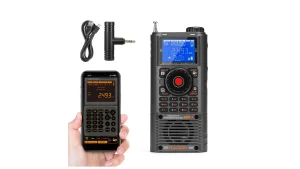
RAD950 asks what happens if you keep the weak-signal physics and throw away the workstation. It’s a complete HF data mode, modem and logbook that runs inside a Radtel RT-950 Pro handheld, a radio that sells for well under a hundred dollars. The whole station is the radio, a wire antenna, and a GPS fix.
The mode appeared in November 2026, created by Matt NQ6N, with the protocol published as an MIT-licensed Rust crate and the handheld firmware built on Alex Harvey’s Ferrite. Everything needed to judge it is public: a normative specification with golden test vectors, bench measurements from a spectrum analyzer, a browser flasher, a desktop app for people who already own a rig, and a website that tracks spots and confirmations.
TL;DR: RAD950 is a free weak-signal HF mode that runs on a Radtel RT-950 Pro handheld with no computer, sound card or interface. It sends 8.8 second 4-FSK bursts in GPS-locked 10 second UTC slots on 17m, 15m, 12m and 10m, using a 64-bit payload protected by CRC-14 and LDPC(184,78) to complete a contact in 30 seconds. The modem is MIT licensed, the firmware is a noncommercial Ferrite build, a desktop app covers existing HF stations, and 17m, 15m and 12m need an external low-pass filter to meet harmonic limits.
What RAD950 is
RAD950 is a free, open source weak-signal HF mode that runs entirely inside a Radtel RT-950 Pro handheld, sending 8.8 second 4-FSK bursts in GPS-locked 10 second UTC slots so two stations with no computer between them can complete a QSO on 17m, 15m, 12m or 10m. It’s the RAD950 weak-signal HF mode in the literal sense: the modem, the waterfall, the decoder, the callsign and grid packing, and the logbook all execute on the radio’s own microcontroller.
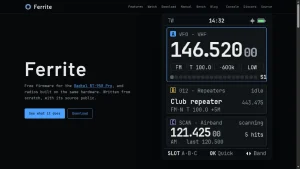
Three repositories carry the project. The protocol and modem live at RAD950-Mode/rad950 under the MIT licence, and the same Rust code compiles both into the handheld firmware and into a host SDR example. The firmware at RAD950-Mode/ferrite is a RAD950 build of Ferrite, Alex Harvey’s source-available firmware for the RT-950 Pro, distributed under the PolyForm Noncommercial License 1.0.0. The website at rad950.org handles downloads, flashing, spots, logs and a machine-readable operating guide.
The published versions at the time of writing are desktop app v0.1.4 and firmware Ferrite 0.9.3, build 6017913, a 937 KB image across four SPI flash parts. The repository was created on 21 November 2026, so everything here is days old and still moving.
Why a handheld can reach another continent
Ten metres through seventeen metres are the bands where a five watt signal and a length of wire can work the world when the ionosphere cooperates. The obstacle is the operator’s ears: voice at five watts disappears into the noise long before the ionosphere gives up, which is why weak-signal modes spend bandwidth and computing power instead of watts.
The radio itself is sold as a 27 MHz handheld with 2.3 to 30 MHz receive, and RAD950 uses its PLL to place a clean 4-FSK carrier on the amateur bands instead. RAD950 makes three choices that fit a small microcontroller. It concentrates all the energy into 150 Hz, the same principle that let continuous wave telegraphy cross the Atlantic in 1901. It uses continuous-phase 4-FSK, so the power amplifier runs at constant envelope and the PLL steps cleanly between four tones 50 Hz apart. And it wraps 64 payload bits in enough forward error correction to decode when the signal is well below the noise floor.
The published sensitivity is minus 15.3 dB blind and minus 18.3 dB referenced to 2,500 Hz, from the project’s lineage page. A 2,500 Hz reference is the convention WSJT-X uses for FT8, which reports decodes around minus 21 dB, so FT8 still wins by roughly 3 dB while occupying a third of the bandwidth. The optional RAD950-60 cycle pushes blind decoding to minus 19 or minus 20 dB by repeating the burst five times and folding the results, which is the mode to reach for when the band is nearly closed.
Where the idea comes from
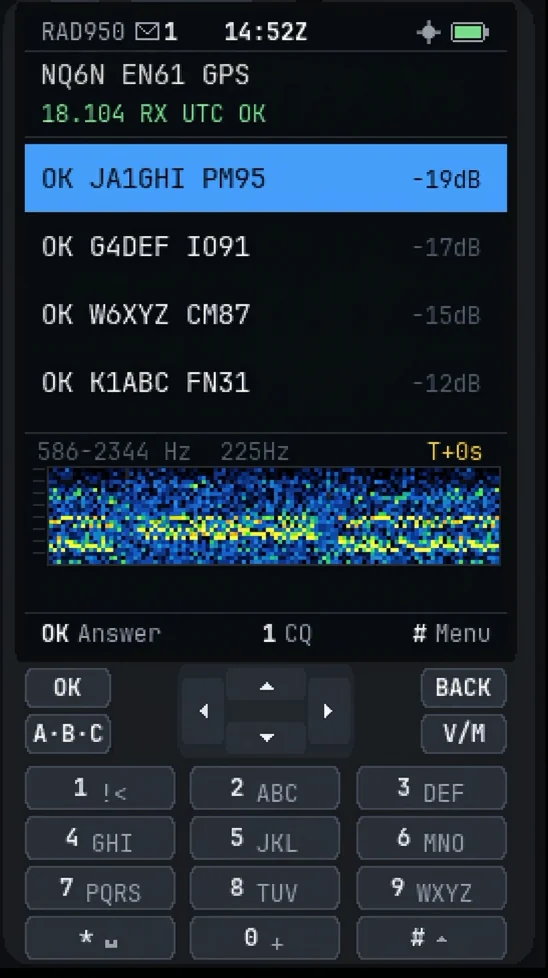
The project publishes its own technical lineage, and it is more than decoration. Samuel Morse and Alfred Vail assigned the shortest patterns to the most common letters in 1838, an intuitive form of entropy coding a century before information theory existed. Émile Baudot replaced dots and dashes with fixed-length 5-bit codewords at a constant symbol rate, and radioteletype paired that coding with 2-FSK so the carrier shifted between mark and space instead of switching on and off.
Claude Shannon’s 1948 paper established that a channel still carries information well below the noise floor, provided you trade bit rate for structured redundancy. Robert Gallager’s 1962 thesis supplied LDPC codes that approach that limit, and the idea sat unused until the 1990s. Peter Martinez G3PLX, Pawel Jalocha SP9VRC and then Joe Taylor K1JT turned those tools into modes hams actually operate, with synchronised slots and compact callsign packing.
RAD950 sits at the end of that line: 28-bit callsigns, 15-bit Maidenhead grids, UTC slot discipline and LDPC decoding, with every parameter re-cut for a 12.6 KB decoder on a microcontroller and a direct PLL transmitter.
The protocol, field by field
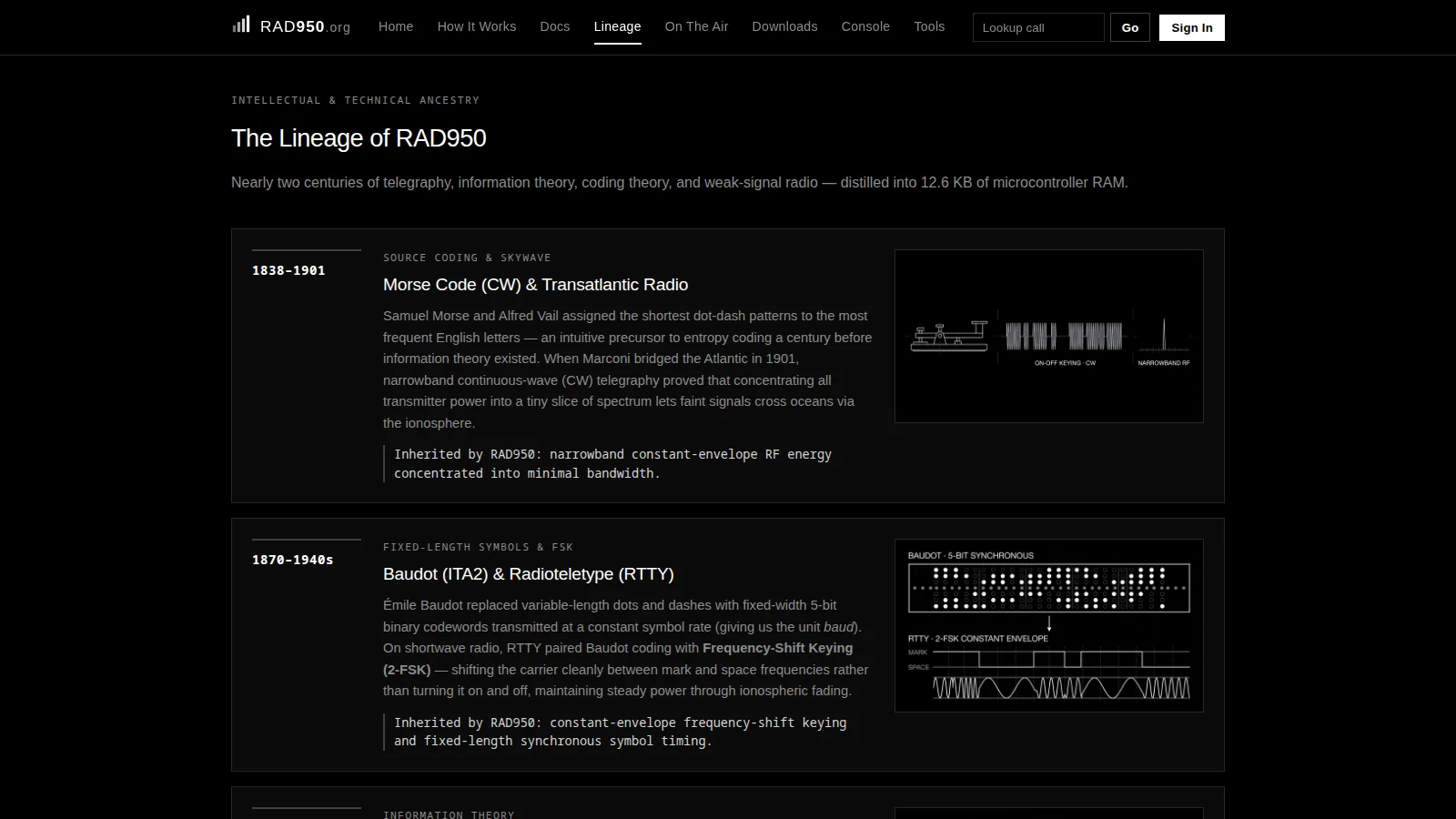
The specification is unusually complete for a project this young. It publishes the parity-check matrix, the interleaver permutation, the CRC polynomial and two golden test vectors with the expected 110 tone sequence, so an independent implementation can be checked symbol by symbol.
| Frame | 64-bit layout | Purpose |
|---|---|---|
| CQ | 1 bit type, 28 bit sender, 15 bit grid, 4 bit power, 16 bit reserved | Calling, with an optional numeric suffix in the low four reserved bits |
| RX | 1 bit type, 28 bit sender, 28 bit recipient, 5 bit SNR, 1 bit ACK | Signal report, or the confirmed report when ACK is set |
| ExtFrag | 1 bit type, 6 bit marker, 2 bit kind, 2 bit index, 8 bit tag, 45 bit payload | Messages and distress fragments |
The physical layer numbers explain why the mode survives fading. A symbol lasts 80 ms, with a 10 ms raised-cosine ramp into a 70 ms steady tone, which keeps key clicks and splatter low. Each frame is 110 symbols: 18 sync symbols in three clusters of six, and 92 data symbols carrying 184 coded bits.
| Parameter | Value |
|---|---|
| Modulation | Continuous-phase 4-FSK, Gray mapped |
| Symbol rate | 12.5 baud (80 ms per symbol) |
| Tone spacing | 50 Hz, 150 Hz occupied per signal |
| Burst length | 8.8 s (110 symbols), starting at UTC + 400 ms |
| Slot grid | 10 s UTC slots, even and odd parity |
| Sync | Three 6-symbol clusters at symbols 0, 18 and 104 |
| Interleaver | Stride 37 over 184 bits, spreading neighbours about 3 s apart |
| Forward error correction | LDPC(184, 78), PEG construction, girth 6, no 4-cycles |
| Decoder | Integer normalised min-sum, scale 0.75, up to 35 iterations |
| Integrity check | CRC-14, polynomial 0x2757, initial value 0x3FFF |
| Subchannels | 8 tones from 600 to 2175 Hz, 225 Hz steps, default 1500 Hz |
| Receiver search | 585.9 to 2332 Hz, 150 FFT bins at 11.72 Hz, 8 tracks per slot |
The subchannel plan is the practical detail that makes the mode usable in a crowd. Eight signals fit inside a 3 kHz USB passband at 225 Hz spacing, the receiver tracks up to eight of them at once with linear drift correction, and the transmitter picks a subchannel that wasn’t occupied in the previous slot. Two stations answering the same CQ land on different tones instead of destroying each other.
Clocks decide everything
A weak-signal mode with 10 second slots lives or dies on time. RAD950 transmits 400 ms into the slot, and the receiver searches a window of plus 80 to plus 720 ms, which is about plus or minus 320 ms around nominal. Arrive outside that window and the signal is invisible no matter how strong it is.
The firmware refuses to transmit until its timing uncertainty is under 150 ms. Each clock source has a budget:
| Source | Behaviour |
|---|---|
| GPS | Live fix anchored to the NMEA burst edge, 50 ms base uncertainty, and the crystal is calibrated while locked |
| Crystal holdover | After a valid fix, 50 ms plus one 20th of elapsed seconds, reaching the 150 ms gate at about 33 minutes |
| OTA slot sync | Locks to the arrival timing of any decoded RAD950 burst, for indoor use without a view of the sky |
| WWV or CHU | Tunes 10 MHz and locks the second tick from a square-law AM envelope detector, immune to BFO offset |
| USB or Bluetooth | Host pushes NTP time over the link |
There is a second clock problem that has nothing to do with UTC. The RT-950 Pro’s SI4732 receiver chip has a crystal tolerance that puts a 1500 Hz signal several hundred hertz low on 17m and 10m. The fix is a per-radio calibration in the setup screen, RX corr, which trims the BFO until a known 1500 Hz signal sits at 1500 Hz. Without it, stations on subchannels 0 to 3 fall below the 586 Hz decode floor and vanish.
A QSO takes 30 seconds
The exchange is three slots and no more. The caller sends CQ, the responder sends a report with ACK clear, and the caller sends the confirmed report with ACK set. Then both stations log.
| Rule | Behaviour |
|---|---|
| Turn taking | After transmitting in slot N, listen in slot N+1 |
| Parity | Reply on the opposite parity from the slot the CQ was heard in, so auto-CQ stations never collide |
| Expiry | A peer session lives for 30 slots, five minutes |
| Retries | Stop calling after four attempts, keep the session alive for a late confirmation |
| Linger | Stay on the window for two slots after ACK so a faded confirmation can be retried |
| Relay guard | At most three transmissions per rolling 60 seconds on hardware that switches an RF relay |
| Suffix | Numeric suffixes 1 to 15 identify separate rigs or antennas from one callsign |
The RT-950 Pro is a handheld with a transmit and receive switch, and three closures a minute is already generous for a relay rated for voice use.
Four ways to work the band
The radio offers four operating modes. Monitor decodes everything and classifies each station as a new grid, a new grid on this band, or already worked. Run calls CQ on alternating slots whenever no reply is pending, and answers automatically. Pounce lets you pick a station from the heard list and answer on the next slot.
The fourth one is for unattended hunting. Auto-answer has three tiers, new grid only, new grid on this band, or anything needed, and it ranks competing CQs by new grid first, then new band grid, then new call, then strongest signal. It never works the same callsign twice on a band, and it drops back to monitor after logging so it can hunt again.
Rendezvous at the top of the hour
Spotting networks assume the internet. RAD950 includes a schedule so portable stations can find each other without one: five minute windows at fixed minutes past each UTC hour, one band per window.
| UTC minutes | Band | Dial (USB) |
|---|---|---|
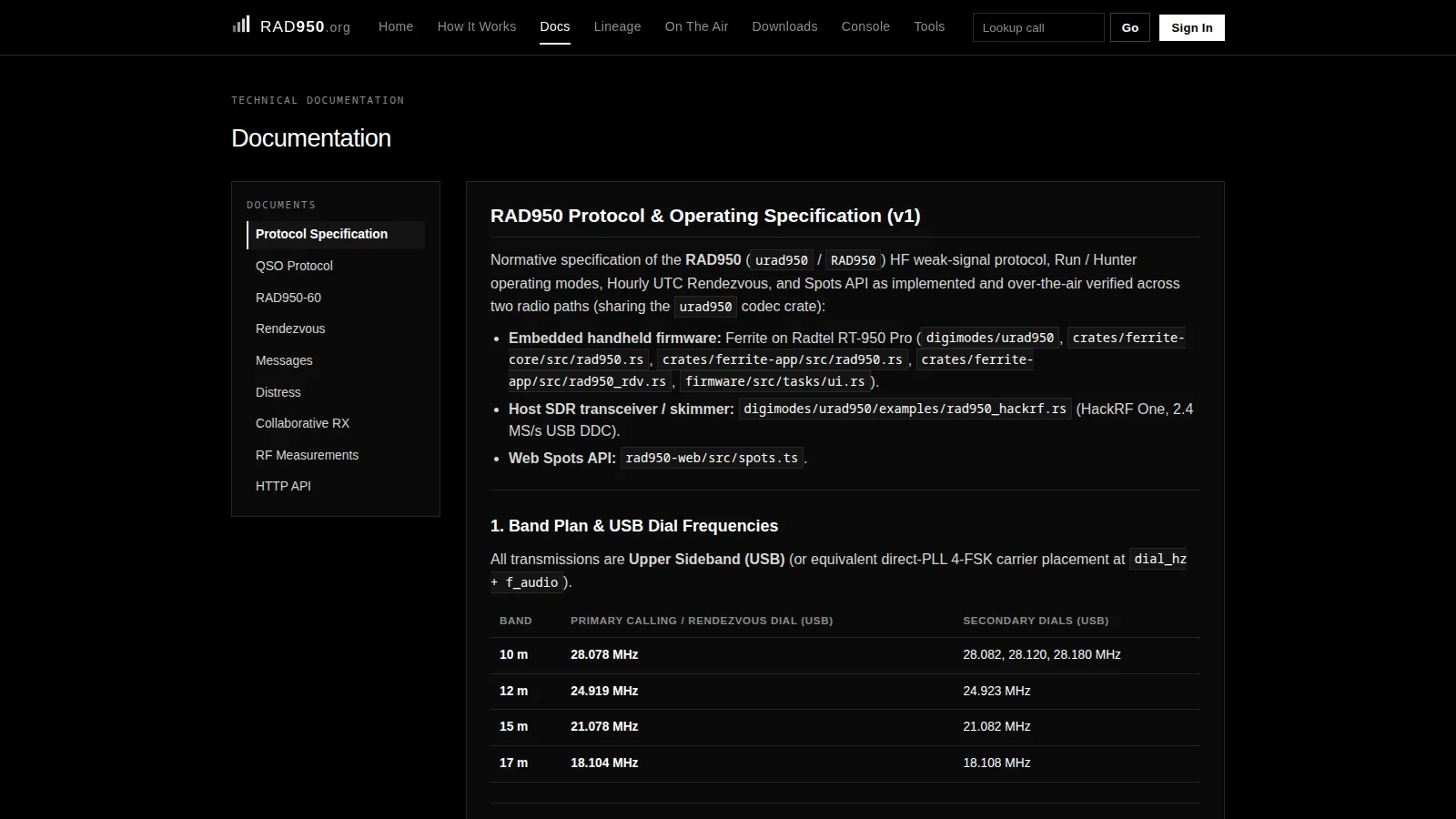
| :00 to :04 | 10 m | 28.078 MHz |
| :15 to :19 | 12 m | 24.919 MHz |
| :30 to :34 | 15 m | 21.078 MHz |
| :45 to :49 | 17 m | 18.104 MHz |
Stations that arm call-and-listen transmit on even slots and listen on odd slots, which reserves the reply slot for whoever answers. Congestion is handled by a deterministic draw seeded from the callsign and the slot. So every station computes the same pseudorandom decision without any coordination. The chance of calling drops from 50 percent to 25 percent at four or five occupied subchannels, and to 12.5 percent at six or more.
Nothing to type but your callsign
The operating flow on the handheld is four steps. Open RAD950 from the tools menu, enter callsign and grid, pick a band or turn on rendezvous, then press CQ or highlight a station and press Answer.
Band selection moves through the four calling dials, and the protocol document lists a set of secondary dials for crowded days, including 28.082, 28.120 and 28.180 MHz on ten metres. All eight audio subchannels sit inside the passband above whichever dial you choose, so a group can spread out without retuning the radio.
RAD950-60 for the last few dB
When 8.8 seconds isn’t enough, the optional 60 second cycle repeats the identical burst five times inside one UTC minute and folds all five into a single spectrogram before decoding. The folded buffer is 116 by 150 cells, 10,875 bytes, which fits inside the 13 KB decoder union the firmware already reserves.
The last ten seconds of the minute are reserved for amplifier cooldown and decode turnaround, with no transmission. The published crossover is minus 18.5 dB, below which standard 10 second RAD950 stops producing contacts and the 60 second cycle still returns a few per hour. Standard receivers decode strong RAD950-60 signals from the first burst alone, so the mode degrades instead of breaking.
What the bench says about the radio
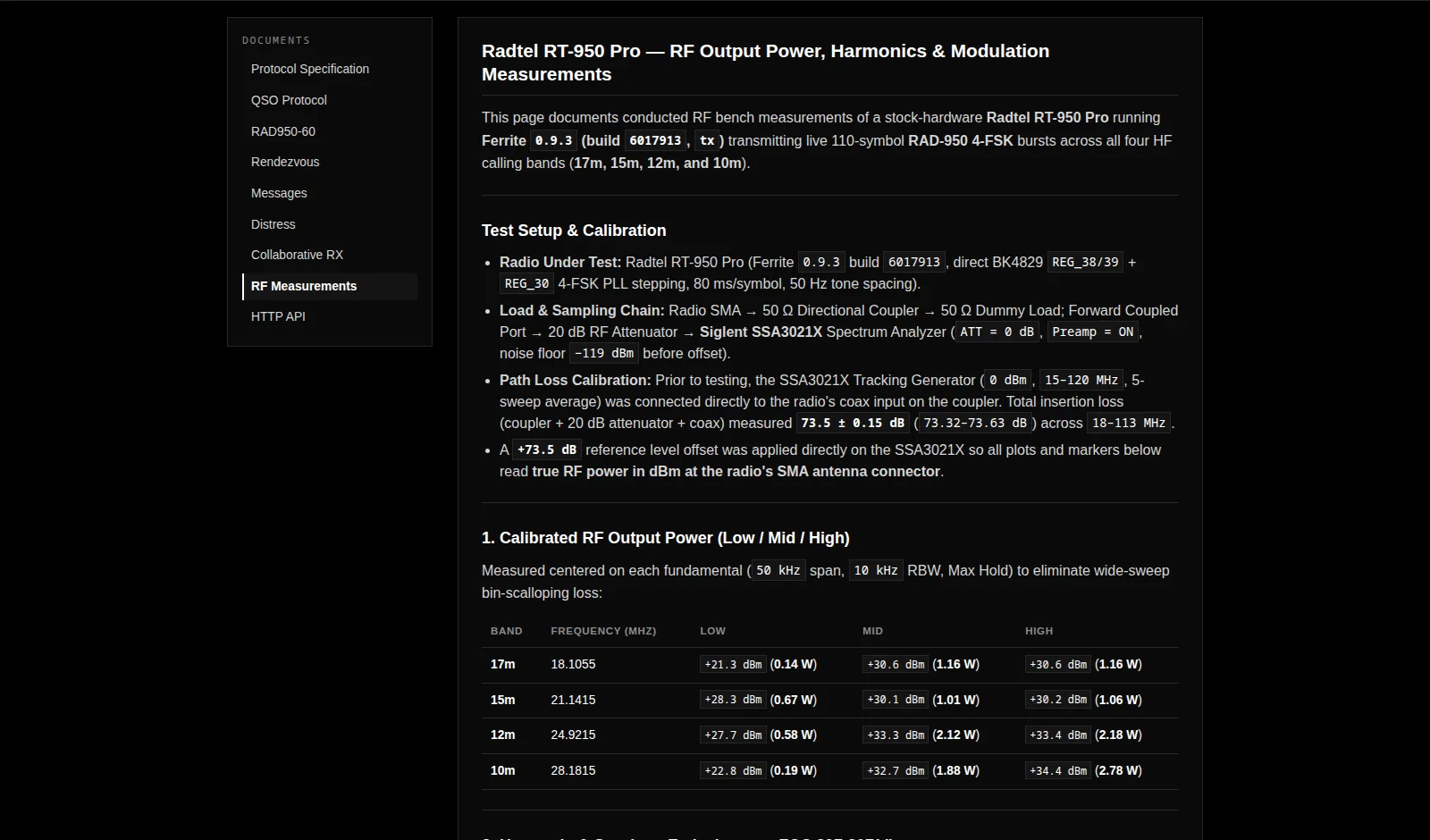
The project published conducted measurements on a stock RT-950 Pro running Ferrite 0.9.3, taken through a directional coupler into a dummy load and a Siglent SSA3021X with a calibrated 73.5 dB path. That is more measurement discipline than most commercial radios get.
| Band | Low | Mid | High |
|---|---|---|---|
| 17 m | 0.14 W | 1.16 W | 1.16 W |
| 15 m | 0.67 W | 1.01 W | 1.06 W |
| 12 m | 0.58 W | 2.12 W | 2.18 W |
| 10 m | 0.19 W | 1.88 W | 2.78 W |
Harmonic suppression is the number that matters here, because the RT-950 Pro’s internal HF path passes 18 to 64 MHz so the radio can also cover 6 metres. That design choice puts the second harmonic of 17 metres at 36 MHz, 15 metres at 42 MHz and 12 metres at 50 MHz inside the radio’s own filter.
| Band | Second harmonic | Third harmonic | Verdict bare |
|---|---|---|---|
| 17 m | minus 14.1 dBc | minus 35.4 dBc | Needs a filter |
| 15 m | minus 28.2 dBc | minus 49.3 dBc | Needs a filter |
| 12 m | minus 28.6 dBc | minus 54.7 dBc | Needs a filter |
| 10 m | minus 42.4 dBc | minus 50.6 dBc | Borderline clean |
FCC Part 97.307(d) asks for spurious and harmonic emissions at least 43 dB below the fundamental. So a bare RT-950 Pro on 17 metres fails by a wide margin. The fix is cheap: a 30 MHz QRP low-pass filter between radio and antenna, which the measurement page recommends for the three lower bands and for peace of mind on ten. Anyone running this mode without one is splattering a harmonic that other operators can hear, which matters more than usual in a mode that depends on weak signals being decodable.
Close-in performance is good. The occupied bandwidth at minus 26 dBc measured 315 Hz for four tones 50 Hz apart, shoulders sat at minus 38 to minus 40 dBc at plus or minus 500 Hz, and the sweep from 15 to 120 MHz found no non-harmonic spurs.
Flashing it from a browser
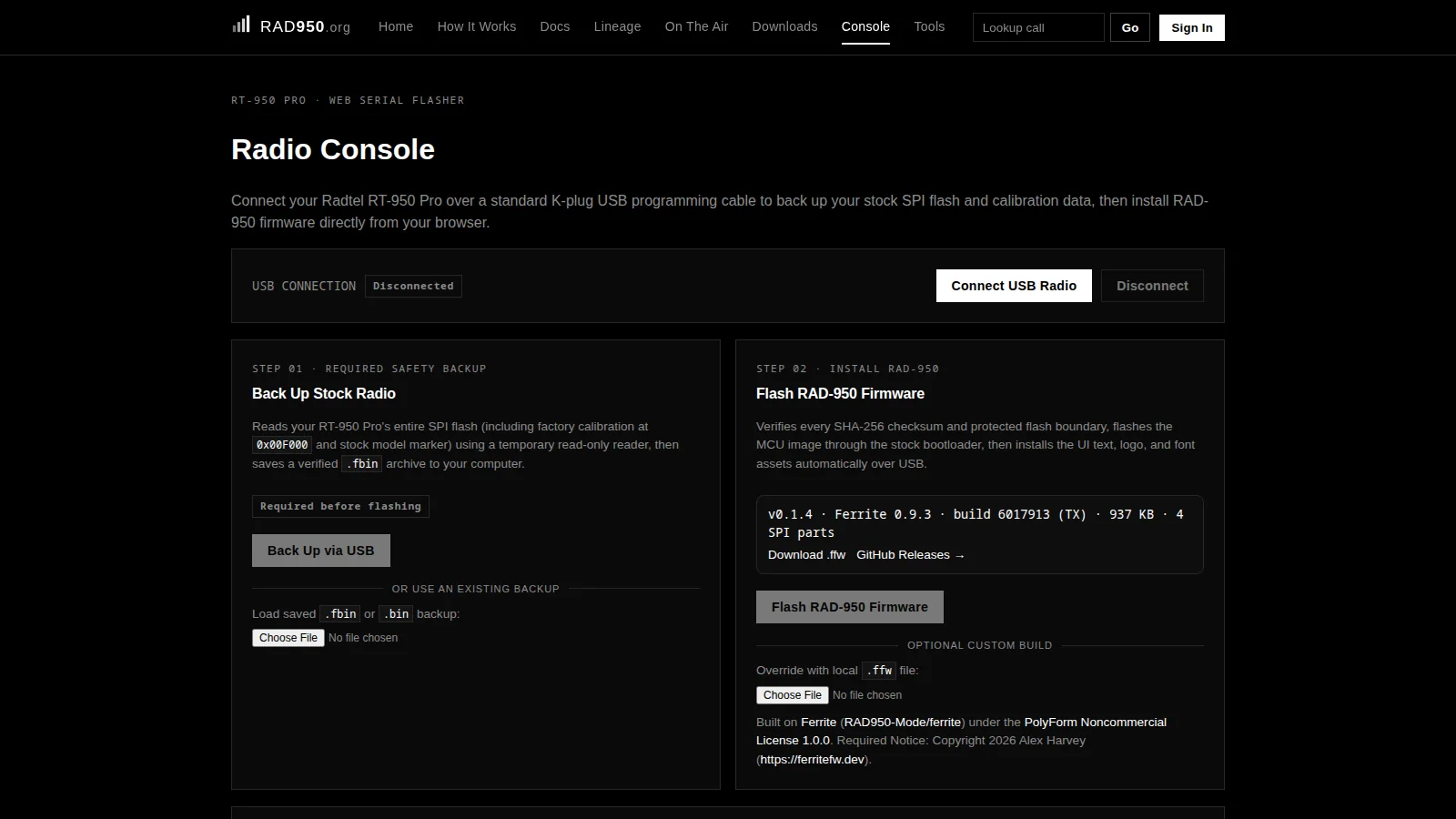
There is no toolchain to install. A Chromium browser, a Kenwood K1 style USB programming cable, and the radio console page are enough, which means the setup works on a borrowed laptop or a Chromebook.
The console enforces a backup first. It reads the entire SPI flash through a temporary read-only reader, including the per-unit factory calibration at 0x00F000 and the stock model marker, and saves a verified .fbin archive. That backup is the difference between a radio you can return to stock and a brick, so the page treats it as a required step rather than advice.
Flashing verifies every SHA-256 checksum and protected flash boundary, writes the MCU image through the stock bootloader, then installs the UI text, logo and font assets over USB. The firmware package is the 937 KB, four-part image mentioned earlier. A CLI path exists as well, with a Python flashing script that can take the same backup before writing.
The desktop side
Not everyone wants to operate from a handheld keypad, and not everyone owns an RT-950 Pro. The desktop app, v0.1.4, runs the same modem on macOS, Windows and Linux with a GUI panafall and an optional terminal interface for headless stations.
| Backend | Use |
|---|---|
| Sound card plus Hamlib | Any HF transceiver in USB or USB-DATA mode, with rigctld for CAT and PTT |
| TCI | ExpertSDR, Thetis, SunSDR, Hermes Lite 2, and RemoteHamRadio LocalMate |
| USB RT-950 Pro | The handheld itself, tuned and keyed from the computer |
| HackRF One | Direct RF transmit and receive for lab work and beacons |
The safety defaults are sensible. Dry transmit starts on, so the app plans transmissions without keying until you switch to live. A watchdog stops unattended transmission after six minutes. An optional CW identifier sends the callsign and the site address on the first CQ slot and every ten minutes, scaled to fit inside a 10 second slot. Completed contacts write standard ADIF and an ALL.TXT, and can upload to the site automatically.
On the air: spots, statistics and cooperative receive
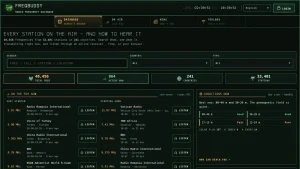
The website is more than a download page. Live spots plot every reception report as a great-circle arc over a solar greyline map, with distance, SNR and transmit power efficiency, filterable by band and by time window up to seven days. A stats page tracks confirmed QSOs, unique grids, DXCC entities, states and zones, and leaderboards rank stations by contacts, grids and distance.
Spots can come from the radio itself over Bluetooth, or from a headless skimmer through POST /api/spots with a personal r950_ key that is hashed server side. A batch takes up to 100 spots, each one carrying callsigns, grids, frequency, band, SNR, power code and frame type. Two stations on one callsign are kept apart by the numeric suffix, and self-spots are rejected on both client and server.
There is also cooperative receive. The tools page combines the receive data from several nearby RT-950 Pros connected over Bluetooth in the browser, which is a straightforward way to beat local noise without building a second station.
The last unusual artifact is SKILL.md, a machine-readable operator guide written for AI assistants, covering setup, clocking, firmware, the desktop app and remote control. It’s a practical way to let someone paste a link into a chatbot and get correct answers about a mode with a dozen system-specific gotchas.
Licensing: MIT modem, noncommercial firmware
The split matters if you plan to reuse any of this. The protocol and modem crate is MIT licensed, so it can be embedded in commercial products with attribution. The handheld firmware is a build of Ferrite under the PolyForm Noncommercial License 1.0.0, with a required notice for Alex Harvey, so it is for noncommercial amateur use and can’t be sold as part of a product.
The desktop app is MIT, and it uses the same core crate as the firmware, which is why a protocol change lands in both places at once. For anyone considering a port to another radio, the MIT crate plus the published parity-check matrix and test vectors are the useful starting point.
Where it fits, and where it does not
| RAD950 | FT8 | JS8Call | WSPR | CW | |
|---|---|---|---|---|---|
| Station needed | Handheld with firmware | PC, interface, HF rig | PC, interface, HF rig | PC, interface, HF rig | Radio and key |
| Typical power | 1 to 3 W handheld | 5 to 100 W | 5 to 100 W | 0.1 to 5 W | 5 to 100 W |
| Contact type | Full QSO, 30 s | Full QSO, about 1 min | Free text QSO | One-way beacon | Full QSO |
| Timing | GPS-locked 10 s slots | PC clock, 15 s slots | PC clock, 15 s slots | PC clock, 2 min slots | None |
| Bandwidth | 150 Hz per signal | 50 Hz | 50 Hz | 6 Hz | 100 to 500 Hz |
| Published floor | minus 18.3 dB ref, minus 20 dB in 60 s mode | about minus 21 dB | about minus 21 dB | about minus 28 dB | Ears |
| Logging | On radio, uploads to site | On PC | On PC | Database | Paper or PC |
The case for RAD950 is portability and cost, not raw sensitivity. A handheld, a wire, and a clear sky won’t beat a 100 W station with a beam, and it isn’t meant to. What it does is put a legitimate weak-signal HF mode in a jacket pocket for the price of a good meal, on bands that still open.
The limits are real too. The standalone version exists for one radio model, the RT-950 Pro, because the firmware is written against its SI4732 receiver and BK4829 PLL. It sends data, not voice. It covers four bands. It needs a clock, and indoors that means a WWV lock, another station’s burst, or a USB connection. It needs a low-pass filter on three of the four bands to be legal and polite. The spotting network was empty when I looked, which is what a three day old mode looks like. And the whole project is version 0.1.x, so expect firmware churn and a bug list.
Sources and Further Reading
- RAD950.org
- How RAD950 works
- Protocol and operating specification
- RF output power and harmonic measurements
- Lineage of RAD950
- Get on the air
- AI operator skill file
- RAD950 protocol and modem (MIT)
- Ferrite firmware RAD950 build
- Ferrite firmware project
- Protocol and modem releases
- Costas, the FT8 app that ranks stations
- Glissando, a musical weak-signal mode
- VarAC and HF digital chat
- WeeChat Radio for HF and VHF chat
- FCC Part 97 rules
- WSJT-X by Joe Taylor K1JT
- Radtel RT-950 Pro product page
73 de 9M2PJU.



Post Comment