NeoAPRS: Free Multi-Radio APRS Client for FM, LoRa and HF Over Mercury
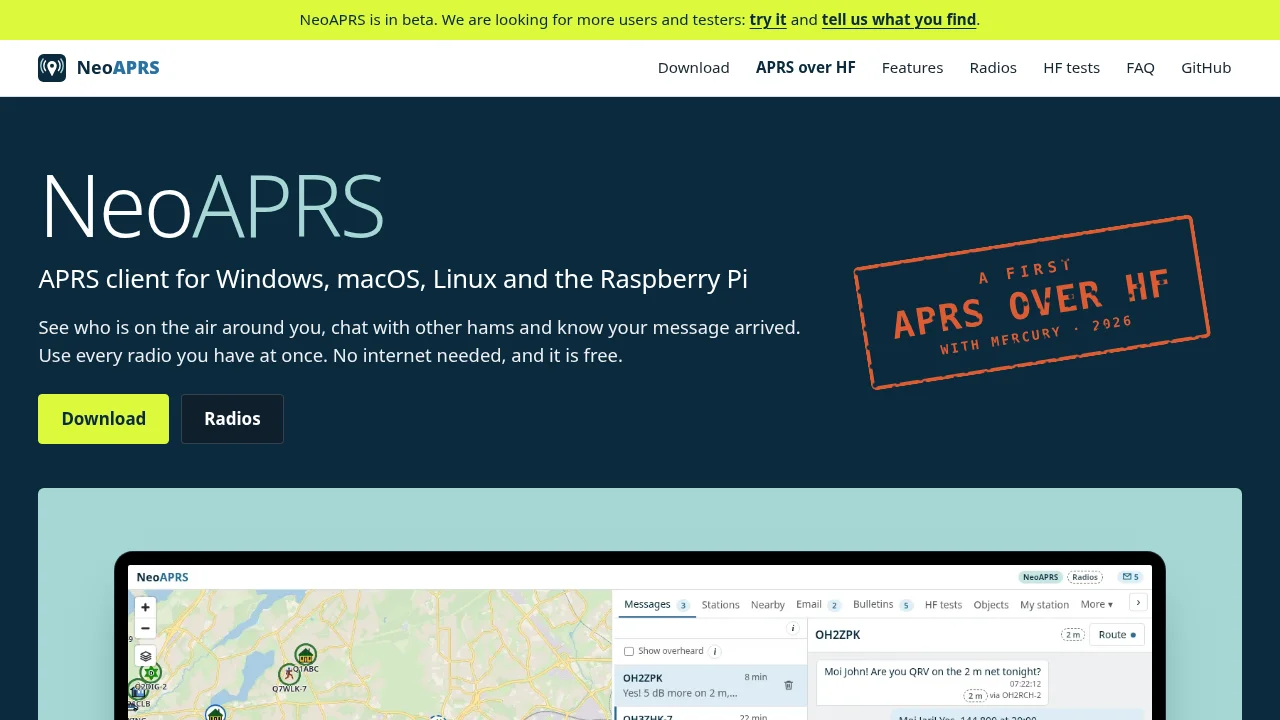
Running APRS across more than one band usually means running a pile of disconnected software. You end up with an ageing Windows program for your 2 m mobile rig, a separate web dashboard for a LoRa APRS board, and a third stack if you ever try HF packet on 30 m. If a local VHF digipeater goes dark during an exercise, you switch windows, retype callsigns, and lose the thread of the conversation.
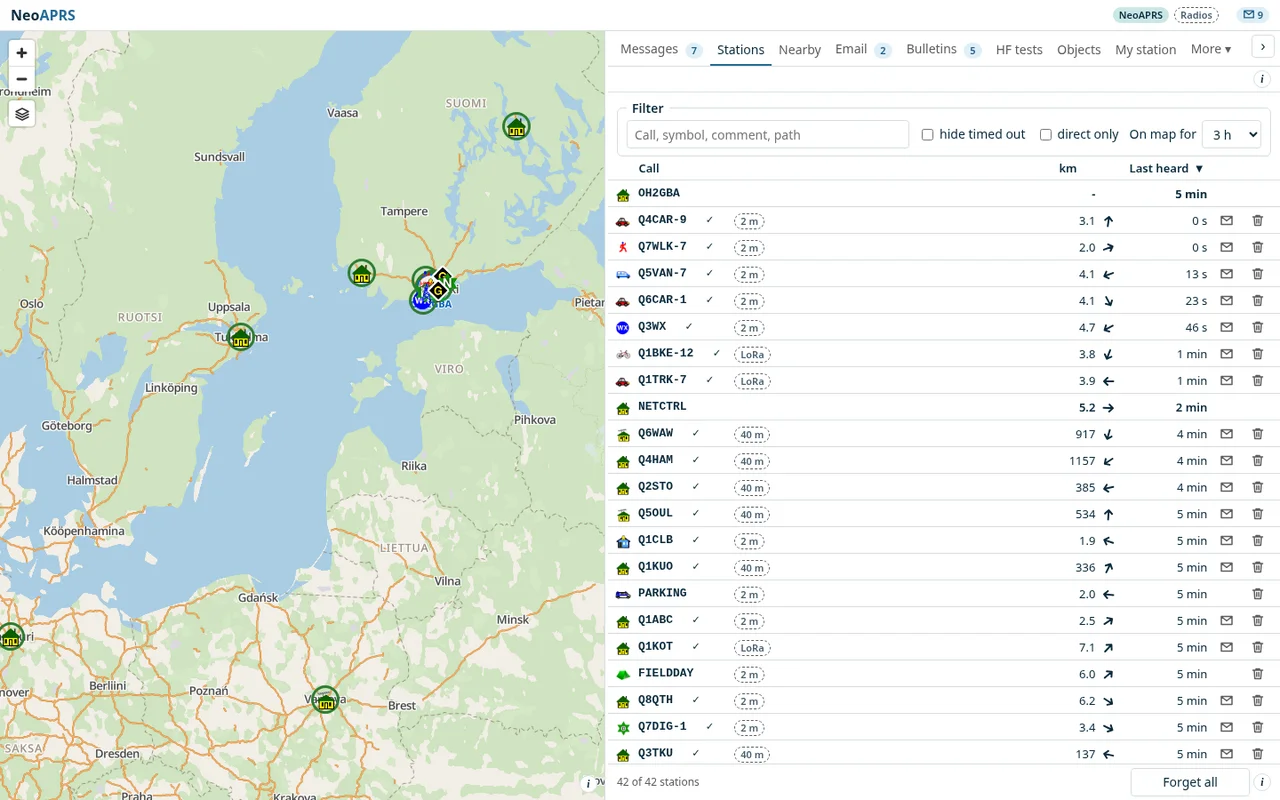
NeoAPRS takes a different approach. Written by OH2GBA and released under the GNU GPL v3, this free APRS client runs on Windows, macOS, Linux, and the Raspberry Pi, and treats every radio in your shack as an equal feed into one map, one station list, and one message log. You can attach a VHF KISS TNC, a sound-card rig, a LoRa APRS board, and an HF SSB transceiver at the same time.
The headline addition is native APRS over HF using Rhizomatica’s Mercury modem. Instead of 1980s 300-baud AFSK with zero error correction, NeoAPRS bundles Mercury’s DATAC3 OFDM waveform directly inside the application. An SSB transceiver and a sound card are enough to exchange APRS messages below the noise floor with no internet, no digipeaters, and no separate modem daemon to configure.
TL;DR: NeoAPRS is a free, GPL v3 APRS client by OH2GBA for Windows, macOS, Linux, and 64-bit Raspberry Pi OS. It unifies FM VHF/UHF radios (KISS TNCs, built-in Direwolf, and receive-only Yaesu FTM feeds), LoRa APRS boards, and HF SSB transceivers on one map and message list. Its built-in Mercury HF modem uses the 9-carrier OFDM DATAC3 waveform with LDPC(2048, 1024) error correction to decode 123-byte APRS frames down to minus 4 to minus 5 dB SNR in 3 kHz, verified on 6 m at 1 W over 40.8 km.
What NeoAPRS is
NeoAPRS is a free, open-source APRS client for Windows, macOS, Linux, and the Raspberry Pi that connects FM VHF/UHF radios, LoRa APRS boards, and HF SSB transceivers into one shared map, station table, and messaging interface. As a modern NeoAPRS APRS client, it runs either as a desktop window or as a headless background service on port 7303 that you open from any phone, tablet, or laptop on your local network.
The project lives at neo.oh2gba.eu with source code and release packages on GitHub under GNU GPL v3 or later. At the time of writing, the current release is v0.23.1 (22 November 2026), shipping with Mercury 1.9.25 built in. The interface supports nine languages (English, German, Spanish, Finnish, French, Italian, Japanese, Dutch, and Brazilian Portuguese) and includes a one-button updater that verifies signed SHA256SUMS.sig files before applying a release.
One map for FM, LoRa and HF
Under the hood, NeoAPRS runs a Python asyncio daemon that supervises every configured radio and serves the web UI. Since v0.20.2, the architecture treats all radio types as equal peers. Every decoded packet gets tagged with the radio that heard it, then flows into one station book, one map, and one message thread.
+-------------------------------------------------------------------+
|                     NeoAPRS Daemon (Python asyncio)               |
|                                                                   |
|  +------------------+  +------------------+  +-----------------+  |
|  | FM VHF/UHF Radio |  | LoRa APRS Board  |  | Mercury HF      |  |
|  | - KISS TNC       |  | - CA2RXU / DL9SAU|  | - Built-in      |  |
|  | - Built-in       |  | - TCP / USB / BT |  |   DATAC3 OFDM   |  |
|  |   Direwolf       |  | - 250 B frames   |  | - 123 B frames  |  |
|  | - Yaesu FTM RX   |  +--------+---------+  | - LBT spectrum  |  |
|  +--------+---------+           |            +--------+--------+  |
|           |                     |                     |           |
|           +---------------------+---------------------+           |
|                                 v                                 |
|        Unified Station Book, Map, Messages, Weather & Objects     |
|        Addressed Gateways (per-radio rate limits & hold state)    |
|                                 |                                 |
|              Desktop App Window or Browser (port 7303)            |
+-------------------------------------------------------------------+
Because HF, VHF FM, and LoRa have completely different air-time economics, NeoAPRS attaches rule tables to each radio type rather than forcing one global setting across all bands.
- FM VHF/UHF: Allows standard digipeater paths, fill-in digipeating, SmartBeaconing for mobile operation, and receive-only iGate forwarding.
- LoRa APRS: Supports frames up to 250 bytes, caps fixed-station position intervals at 30 minutes or slower, and keeps SmartBeaconing active for mobile trackers.
- Mercury HF: Drops digipeater paths (every station on the frequency hears the burst directly, and each hop would burn 7 bytes out of the 123-byte payload budget), disables fill-in digipeating and SmartBeaconing, and enforces a 30-minute floor with a randomised pause on position transmissions.
- Addressed gateways: A station running both VHF and HF can pair its radios as an addressed gateway so messages cross between a local 2 m network and an HF channel, rate-limited to at most 4 frames in 5 minutes onto HF so VHF chatter can’t flood the HF frequency.
Beyond APRS stations, the map supports OpenStreetMap vector data via Protomaps, station trails, Maidenhead locator grids, day/night terminator overlays, weather station cards with 24-hour and 7-day graphs, custom objects and items, and optional ADS-B aircraft and AIS ship layers beside your amateur stations.
Supported radios and TNCs
NeoAPRS avoids locking you into one vendor’s proprietary hardware. If you already own a KISS TNC, a sound-card interface, or an ESP32 LoRa APRS board, it probably works out of the box.
| Radio or hardware | Connection | Notes |
|---|---|---|
| Any FM radio + sound card (Digirig, AIOC, SignaLink) | USB audio + PTT | Direwolf APRS modem built in on Windows and Linux |
| Any SSB radio + USB sound card (Digirig, SignaLink, rig USB) | USB audio + CAT/VOX | Mercury DATAC3 modem built in, no separate install |
| Kenwood TH-D7, TM-D700, TS-2000; TNC-2 clones (MFJ-1270B/1274/1278) | Serial (9600 bps) | Standard KISS mode |
| Kenwood TM-D710, TH-D72 | Serial or USB | Standard KISS mode |
| Kenwood TH-D74, TH-D75 | USB or Bluetooth | Built-in KISS TNC |
| Mobilinkd TNC3, TNC4 | USB, Bluetooth, or BLE | Portable VHF/UHF KISS TNC |
| BTech UV-PRO, Vero VR-N76, Radioddity GA-5WB | Bluetooth | Direct Bluetooth KISS link |
| PicoAPRS V4 | Bluetooth, USB-C, or TCP | Standalone transceiver/TNC |
| NinoTNC, TNC-Pi, TNC-X, Kantronics KPC-3+ | USB or RS-232 serial | Any standard KISS TNC |
| Yaesu FTM-100, FTM-300, FTM-400, FTM-500; non-KISS TNCs (PK-232) | Serial | Receive-only mode plots heard stations on the map |
| Yaesu FTX-1 | Rig USB cable | Dedicated USB sound-card setup |
LoRa APRS boards (CA2RXU iGate/Tracker, DL9SAU, esp32_loraprs) |
Network (TCP), USB, or Bluetooth | Works alongside FM and HF radios |
| GPS receiver | gpsd or serial |
Feeds live position and SmartBeaconing |
| Dummy FM / Dummy HF radio | Software only | Lets you test the interface with no hardware attached |
Having a dedicated receive-only radio type for the Yaesu FTM series and older non-KISS TNCs like the PK-232 is a practical touch. Yaesu’s mobile rigs have long frustrated APRS operators because their serial output dumps human-readable text rather than KISS frames; NeoAPRS parses that feed directly so those radios can still populate your map.
APRS over HF with the Mercury modem
Traditional HF APRS on 30 m runs 300-baud AFSK with a 200 Hz shift and no forward error correction. That waveform dates back to 1980s packet radio and struggles badly on ionospheric channels. Skywave signals arrive over multiple paths separated by milliseconds of delay spread, combined with Doppler shifts up to about 1 Hz and deep selective fading. At 300 baud, a symbol lasts 3.33 ms. So a 2 ms multipath delay smears 60% of each symbol into its neighbour. With no FEC, a single corrupted bit destroys the entire AX.25 frame.
NeoAPRS replaces 300-baud AFSK with the broadcast plane of Mercury, an open-source HF data modem developed by Rhizomatica on top of David Rowe’s FreeDV codec2 OFDM raw-data modes. Specifically, NeoAPRS uses DATAC3, a low-SNR forward-link OFDM waveform, feeding unconnected AX.25 UI frames into Mercury’s KISS-over-TCP broadcast port while supervising the modem’s PTT, BUSY, SNR, and spectrum WebSocket interfaces.
DATAC3 waveform parameters
OH2GBA published a full engineering technical note verifying every parameter directly from the Mercury source tree (ofdm_mode.c, ofdm.c, and H_1024_2048_4f.h).
| Parameter | Value | Engineering note |
|---|---|---|
| Sample rate | 8000 Hz | Real audio interface |
| Centre frequency | 1500 Hz | Standard Mercury audio centre |
| Carriers | 9 OFDM carriers | Spaced 62.5 Hz apart (orthogonal) |
| Occupied bandwidth | 562.5 Hz | 1219 Hz to 1781 Hz in USB audio passband |
| Useful symbol duration | 16 ms | 128 samples |
| Cyclic prefix (guard) | 6 ms | 48 samples; absorbs up to 2 ms+ multipath delay spread |
| Total symbol period | 22 ms | 45.45 baud per carrier |
| Modulation | Gray-coded QPSK | 2 bits/symbol on data rows; BPSK on pilot rows |
| Modem frame structure | 5 symbols (110 ms) | 1 pilot row + 4 data rows; 29 frames per packet |
| Preamble and postamble | 1 modem frame each (110 ms) | Distinct pseudo-random sequences mark burst start and end |
| Forward error correction | LDPC(2048, 1024) | Rate 1/2, up to 100 decoder iterations |
| Integrity check | CRC-16 + 40-bit unique word | Frame boundary allows up to 9 bit errors |
| Payload capacity | 126 bytes (123 bytes APRS limit) | 1024 information bits including CRC-16 |
| Burst duration | 3.19 s payload (3.80 s on air) | Net payload rate 316 bit/s (321 bit/s with CRC) |
| Frequency acquisition | Plus or minus 50 Hz | Joint timing and frequency search |
| AWGN decoding cliff | Minus 4 to minus 5 dB SNR | Measured in 3 kHz bandwidth (99% delivery at minus 3.8 dB) |
Channel access and suggested HF frequencies
Because each DATAC3 burst occupies 3.80 seconds on the air, polite channel sharing matters. NeoAPRS reads Mercury’s live spectrum over its WebSocket UI connection to run listen-before-talk carrier sense, holding off transmission whenever another signal is present in the passband. For VOX-keyed rigs without CAT PTT, it also supports a short lead-in tone so the transmitter keys cleanly before the preamble starts.
NeoAPRS ships with suggested meeting frequencies inside IARU Region 1 digimode segments (and fetches updates from the project server so frequencies can adjust without a software release):
| Band | Suggested USB dial frequency |
|---|---|
| 80 m | 3.5850 MHz USB |
| 40 m | 7.0541 MHz USB |
| 20 m | 14.1070 MHz USB |
| 6 m | 50.6200 MHz USB |
(Note: 10.1462 MHz remains in the internal list for legacy compatibility, though it is no longer one of the four primary suggested channels.)
Comparing HF APRS waveforms
Putting DATAC3 beside the two existing HF APRS waveforms shows why OH2GBA picked it for NeoAPRS. The SNR figures below come from the NeoAPRS technical note (combining the ideal BFSK bound, SCS’s published RPR figures, and OH2GBA’s rebuilt codec2 AWGN measurements).
| Feature | 300-baud AFSK | SCS Robust Packet (RPR) | Mercury DATAC3 (NeoAPRS) |
|---|---|---|---|
| Modulation | 2-FSK, 200 Hz shift | 8-carrier OFDM, DBPSK/DQPSK | 9-carrier OFDM, coherent QPSK |
| Symbol / guard time | 3.33 ms / none | 20 ms (50 baud), pulse-shaped | 16 ms + 6 ms cyclic prefix |
| Occupied bandwidth | Approx. 500 Hz | Approx. 500 Hz | 562.5 Hz |
| Forward error correction | None (FCS error detection only) | Convolutional, rate 1/2 or 3/4 | LDPC(2048, 1024) + CRC-16 |
| Net bit rate | 300 bit/s (raw) | 200 or 600 bit/s | 316 bit/s (126 B in 3.19 s) |
| Required SNR (3 kHz) | Approx. +2 dB or higher | +7 to +10 dB (vendor typical) | Minus 3.8 dB (99% AWGN delivery) |
| Hardware / licence | Any TNC or Direwolf (open) | Proprietary SCS TNC hardware only | Any SSB radio + sound card (GPL v3) |
On white noise alone, DATAC3 buys roughly 6 dB over the ideal bound for 300-baud AFSK and around 11 dB over typical RPR numbers, without requiring a proprietary hardware TNC. On a multipath HF channel with 2 ms delay spread, the 6 ms cyclic prefix widens that gap further. The trade-off is fixed air time: every DATAC3 frame takes 3.8 seconds whether you send a 20-byte ACK or a 120-byte position report, which is why NeoAPRS enforces strict beacon intervals and disables HF digipeating.
The 4 November 2026 on-air test
On 4 November 2026, OH2GBA and OH2GAX ran the first documented on-air APRS exchange over the Mercury modem. It happened organically during a routine 2 m APRS chat relayed through local digipeaters. When the VHF path at OH2GAX dropped out, both operators switched to their Mercury radios on 6 m USB inside NeoAPRS and continued the exact same conversation thread over a 40.8 km path.
To measure link margin, both stations stepped their power down during the 20-minute session: OH2GBA dropped from 100 W through 50 W, 25 W, and 10 W down to 5 W into a small balcony antenna, while OH2GAX stepped from 45 W to 10 W, 5 W, and finally 1 W.
OH2GBA sent 9 messages and all 9 were delivered and acknowledged (7 on the first try, 1 on the second, and 1 on the fourth while stepping power down to 5 W). OH2GAX sent 12 messages and every single one decoded on the first try. At 1 W, OH2GAX’s signal was decoded at a reported SNR of minus 3 dB, down from +6 to +7 dB at full power. Every reply waited for the other station’s 3.8-second burst to finish, with zero collisions recorded.
How NeoAPRS compares to other APRS clients
Operators looking for a replacement for UI-View32 on modern Windows, or a single station controller for a Raspberry Pi, have several established options.
| Feature | NeoAPRS | Xastir | YAAC | APRSIS32 / UI-View32 |
|---|---|---|---|---|
| Operating systems | Windows, macOS, Linux, Raspberry Pi | Linux, macOS (X11), Cygwin | Windows, macOS, Linux (Java) | Windows only (UI-View32 discontinued) |
| Headless web UI | Built in (port 7303 + access key) | No | No (desktop GUI) | No |
| Built-in VHF sound-card modem | Yes (Direwolf on Windows/Linux) | External Direwolf needed | External Direwolf needed | External modem needed |
| Built-in HF OFDM modem | Yes (Mercury DATAC3) | No | No | No |
| LoRa APRS integration | Native (TCP, USB, Bluetooth) | Via KISS bridge | Via KISS/serial port | Via KISS bridge |
| Yaesu FTM RX-only parser | Built in | Limited | Plugin/config | Limited |
| Licence | GNU GPL v3 | GNU GPL v2 | Open source (custom/GPL libs) | Closed / freeware |
Xastir and YAAC remain battle-tested workhorses with decades of plugin history, and Direwolf is still the gold standard standalone TNC (which NeoAPRS itself bundles for FM sound-card duty). NeoAPRS stands out when you want a zero-dependency install on a modern OS, a browser UI you can open from a tablet in the shack, or integrated HF weak-signal APRS without wiring up three separate programs.
Installing NeoAPRS on desktop or Raspberry Pi
OH2GBA packages NeoAPRS for every major platform on the GitHub Releases page. All release files carry signed SHA256SUMS.sig checksums and GitHub build provenance attestations (gh attestation verify FILE --repo oh2gba/neoaprs).
Desktop installs
- Windows 11: Run
NeoAPRS-Setup.exe. No administrator rights are required. Because the installer is unsigned, Windows SmartScreen will show a warning; choose More info then Run anyway. It opens in a window with a system tray icon. - macOS (Apple Silicon, macOS 14+): Open
NeoAPRS-arm64.dmgand drag NeoAPRS into Applications. On first launch, right-click the app and choose Open (or approve it in System Settings > Privacy & Security). - Linux PC (Ubuntu 22.04+, Debian 12+, Fedora 36+): Download
NeoAPRS-x86_64.AppImage, mark it executable, and run it:
chmod +x ~/Downloads/NeoAPRS-x86_64.AppImage
~/Downloads/NeoAPRS-x86_64.AppImage
Headless Raspberry Pi or Linux server
Running NeoAPRS as a headless service next to your radio on a 64-bit Raspberry Pi lets you operate from your phone or laptop anywhere on your LAN:
wget https://github.com/oh2gba/neoaprs/releases/latest/download/neoaprs_arm64.deb
sudo apt install ./neoaprs_arm64.deb
neoaprs db set web/network true
neoaprs service install --linger
If you run a firewall such as ufw, allow port 7303/tcp. Then print the Pi’s hostname, IP address, and browser access key:
hostname; hostname -I; neoaprs db get web/keyOpen http://NAME.local:7303 (or http://192.168.x.x:7303) in a browser, enter the access key, and run through the first-time wizard for your callsign, position, and radios. If you don’t have a radio plugged in yet, pick a Dummy FM or Dummy HF radio to explore the interface safely. As of v0.23.1, a dedicated RX only toggle sits at the top right of every tab so you can silence transmissions instantly while testing.
Honest limits and open questions
OH2GBA’s technical note spells out what is proven and what still needs on-air validation. Keep these constraints in mind before deploying NeoAPRS for critical work:
- Active beta software: At v0.23.1, features and UI controls are still moving quickly, and Windows 10 hasn’t yet been formally tested (only Windows 11).
- Skywave HF isn’t yet characterised on air: All timing, carrier-sense, and retry curves come from a software Watterson fading simulator. The only published on-air test so far is the 20-minute 6 m path over 40.8 km. Real ionospheric skywave performance on 80 m, 40 m, and 20 m with heavy QRM and hidden terminals still needs operator logs.
- Hidden terminals and channel capacity: Carrier sense cuts collisions sharply among stations that hear each other, but HF skip zones create hidden terminals that can’t hear each other’s bursts. OH2GBA’s modelling puts beacon loss at around 4% with 10 hidden stations, 8% with 20, and 19% with 50 on a single channel.
- Frequency stability on 6 m: DATAC3 acquires signals within plus or minus 50 Hz. Modern HF transceivers meet that easily below 30 MHz, whereas at 50 MHz it demands roughly 1 ppm stability.
- No legacy HF interoperability: Mercury DATAC3 won’t decode 300-baud AFSK or SCS Robust Packet frames directly. Bridging between networks requires a multi-radio gateway station.
- Approximate SNR meter: Mercury’s internal SNR estimator reads 1 to 2 dB low above 0 dB and saturates around +12 dB, so treat on-screen SNR numbers as directional rather than calibrated lab figures.
Why this matters for EmComm and everyday operating
When a flood or power outage takes down local mobile towers and 2 m digipeaters, an emergency net still needs the exact tools operators already practise with: station positions on a map, acknowledged text messages, bulletins, and map objects for shelters or blocked roads. Shifting that workflow onto a regional NVIS 80 m or 40 m HF channel without changing software, without an internet connection, and with a waveform that decodes 3 dB below the noise at QRP power solves a real field problem.
If you have an SSB transceiver and a Digirig or USB audio interface sitting on the desk, NeoAPRS is worth an afternoon of testing. Check the HF tests tab inside the app to coordinate a sked on 80 m, 40 m, 20 m, or 6 m, and send your band, distance, and power logs back to OH2GBA so the skywave numbers get measured on real antennas.
73 de 9M2PJU.




Post Comment