amateur radio
Technology
amateur radio repeaters, CC0, chirp, CTCSS, D-STAR, DCS, DMR, free repeater API, Fusion, M17, Malaysian amateur radio, NXDN, open data, Open Repeater, OpenRepeater, P25, radio clubs, repeater database, repeater directory, repeater mapping, repeater programming, YSF
9M2PJU
0 Comments
OpenRepeater: The Free Amateur Radio Repeater Directory We Can Build Together
You find a new repeater while travelling, stop the car, pull out the handheld, and start looking for the details: output frequency, input offset, CTCSS tone, DCS code, mode, location, and whether the machine is still on the air. The information may live in an old club PDF, a forum post, a logging program, or the memory of another operator.
That scattered information wastes time. It also makes amateur radio less welcoming to visitors, new licensees, and operators who move between regions. A repeater directory works best when the people who build, maintain, and use repeaters keep it current.
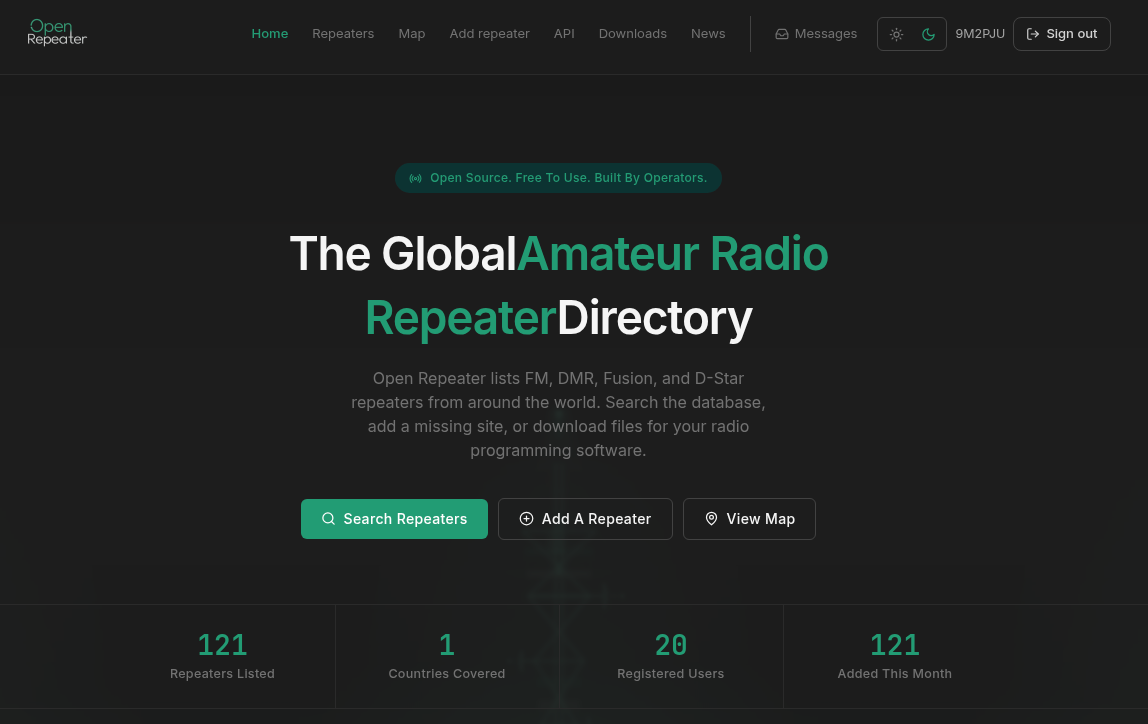
Open Repeater is a free community directory built around that idea. You can search repeater listings without an account, view them on a map, download data in several formats, and submit missing or incorrect information after creating a free account. The site covers FM, DMR, D-Star, Fusion, M17, NXDN, P25, YSF, AX.25, FreeDV, and other repeater modes.
The directory is still young. That makes every accurate listing useful. If your club operates a repeater, if you maintain a site, or if you have reliable details about a machine in your area, upload the information and help create a public reference that operators and developers can use.
Last updated: August 2026.
Why Amateur Radio Needs Shared Repeater Data
Repeaters are local infrastructure with regional value. A club may publish a frequency on its website, a national organisation may maintain a separate list, and a radio programming community may carry an older copy. Those sources can disagree after a frequency change, a new tone, a hardware replacement, a site move, or a period of downtime.
The operator who needs the information often has no way to tell which copy is current. A traveller programming a radio before a long drive faces the same problem as a new licensee trying to find a local net. An emergency communications team faces a higher cost when a stale listing sends operators to an inactive machine.
A shared directory gives the community one place to correct the record. It also gives software projects a common source instead of forcing every developer to scrape club pages or maintain a private spreadsheet.
The quality of that directory depends on participation. No central service can know the current tone, status, trustee, or coverage of every repeater unless operators contribute those details.
What Open Repeater Provides
Open Repeater puts the basic repeater workflow in one website:
- Search, by callsign, frequency, band, mode, country, city, or distance from a location.
- Map view, with pins that open repeater details such as frequency, tone, and offset.
- Detailed listings, with fields for callsign, frequency, offset, CTCSS, DCS, mode, band, country, city, coordinates, coverage, owner, website, digital network, status, and verification date where available.
- Submissions, through a manual form or CSV upload after free registration and email verification.
- Downloads, in CSV, JSON, GPX, and KML formats.
- Developer access, through a read-only REST API for public repeater data and community news.
- Error reporting, so an operator can point out a stale or incorrect entry.
Searching the site, opening the map, and downloading data do not require an account. Open Repeater reserves account creation for actions that change the database, such as adding a listing or suggesting a correction. That is a sensible starting point for an open directory because the public can read the data before deciding to contribute.
The homepage currently shows Malaysian listings including 9M4RPJ, 9M4RPJ-DMR, 9M4RSE, 9M4RZA, 9M4RDM, and 9M4RWR. Those entries show the value of regional participation. A directory becomes more useful when operators in Malaysia, Southeast Asia, and every other underrepresented region add the repeaters that international visitors cannot find elsewhere.
Search Before You Upload
Start with the search page. Look up the callsign, frequency, city, and nearby region. Then open the detail page and compare the listing with information from the repeater trustee, the club website, a current codeplug, or a radio check.
An existing entry may contain enough information but still need a correction. Check these fields:
| Field | What to confirm |
|---|---|
| Callsign | The current callsign used by the repeater or station |
| Receive frequency | The frequency your radio listens to |
| Transmit offset | The input relationship and sign, such as minus or plus |
| CTCSS or DCS | The tone or code required to access the machine |
| Mode | FM, DMR, D-Star, Fusion, M17, NXDN, P25, or another supported mode |
| Band | 2 metres, 70 centimetres, 23 centimetres, or the correct band |
| Location | City, site name, coordinates, and country |
| Status | Active, inactive, or another status supported by the directory |
| Network | BrandMeister, Yaesu Wires-X, D-Star reflector, AllStarLink, or other network when relevant |
| Verification | The date and source of your last reliable check |
The detail page for a Malaysian FM entry shows how much practical information a listing can carry: 70 centimetres, 439.750 MHz, a minus 5 MHz offset, a 103.5 Hz CTCSS tone, the Shah Alam area, and an active status. A visitor can use that information to program a radio, then confirm the machine on the air.
Add Your Local Repeater
Open Repeater asks contributors to create a free account and verify their email address before using the submission page. The form accepts manual entries and CSV uploads, so a club with a prepared spreadsheet can contribute more than one listing without retyping every row.
Use this process for a clean submission:
- Search for an existing entry and avoid creating a duplicate.
- Confirm the current details with the repeater owner, trustee, club committee, or a reliable on-air test.
- Enter the callsign, frequency, offset, tone, mode, band, location, and status.
- Add the digital network, owner, website, coverage, or notes when you have permission and reliable information.
- Review every number before submitting, especially the decimal frequency and tone.
- Check the published entry after moderation and report any remaining error.
A Submission Checklist for Repeater Trustees
Repeater trustees can prepare a small data sheet before uploading. The following fields give other operators enough information to start a QSO without publishing unnecessary operational detail:
- Callsign and common station name.
- Receive frequency and transmit offset.
- CTCSS tone, DCS code, or digital access details.
- Mode, band, and digital network.
- City, region, country, and an approximate public location.
- Active or inactive status.
- Coverage estimate, if the trustee wants to publish one.
- Club or owner website.
- Date of the last verification.
Keep private access credentials, alarm details, passwords, equipment serial numbers, and security-sensitive site information out of a public listing. A repeater directory needs useful operating data, not a map of every detail of a communications site.
Downloads for Radios, Maps, and Apps
The downloads page exports the directory in four formats:
| Format | Useful for |
|---|---|
| CSV | Spreadsheets, data cleanup, and CHIRP-compatible workflows |
| JSON | Websites, mobile apps, scripts, and dashboards |
| GPX | GPS units and navigation software |
| KML | Google Earth, mapping projects, and visual inspection |
The directory can serve both people and machines. An operator can browse a map before a trip. A club can download a spreadsheet for a local review. A developer can build an application that shows repeaters near the user’s position. A field team can carry a GPX file in a navigation device.
The CHIRP project has made cross-brand radio programming easier for years. A clean CSV export gives operators a practical bridge from shared community data to a handheld codeplug. Users should still review the import before writing it to a radio. A software import cannot know whether a repeater is reachable from your exact location or whether the trustee has changed the access rules.
A Free Read-Only API for Repeater Projects
Open Repeater also publishes a read-only REST API. The base URL is:
https://www.openrepeater.org/api/v1The current documentation lists these endpoints:
| Endpoint | Purpose |
|---|---|
GET /repeaters |
List public repeaters with country, band, mode, status, and pagination filters |
GET /repeater/{id} |
Return one approved or public repeater by UUID |
GET /country/{code} |
Return repeaters for an ISO 3166-1 alpha-2 country code |
GET /search |
Search by callsign, city, frequency, or geographic radius |
GET /news |
List community news posts |
GET /news/{id} |
Return one news post by UUID |
The API accepts an X-API-Key header or an Authorization: Bearer header. The site also documents an API key in the query string for browser testing. Keep keys on your server when you build a public website or app. Do not commit a personal key to a public Git repository.
After you register and obtain a key, a text search looks like this:
curl -H "X-API-Key: or_your_key_here" \
  "https://www.openrepeater.org/api/v1/search?q=9M4RPJ"
A geographic query can look like this:
https://www.openrepeater.org/api/v1/search?lat=3.0738&lng=101.5183&radius=50The API returns public or approved listings. The documentation gives a maximum result limit of 200 for repeater lists and includes response headers for the rate limit, remaining requests, reset time, and errors.
Open Data Needs Open Access
The API is a useful start, but its current access model limits what the community can build. Open Repeater currently requires a registered account and personal API key for API calls, with a limit of 30 requests per key per day.
Thirty requests can support a small experiment or a personal script. It does not support a public map that refreshes, several independent apps, a club dashboard, or a service that needs to cover many countries. A public API also creates a difficult choice for developers: ask every visitor to create an account, expose a shared key in browser code, or give up on the integration.
The amateur radio community should ask Open Repeater to keep the API free and make access broad enough for real projects. Useful improvements could include:
- Anonymous read-only access with fair-use rate limits.
- Free keys with higher limits for public, non-commercial applications.
- A documented bulk snapshot for developers who do not need live queries.
- Stable UUIDs, a published schema, API versioning, and change dates.
- Conditional requests such as
ETagorLast-Modifiedso clients do not download unchanged data. - Clear attribution and reuse rules for applications, clubs, and research.
- A transparent status page for API capacity and outages.
Rate limits protect a small server. Spam controls protect a community service. Those goals deserve support. An account wall for ordinary public reads, a low daily limit, or unclear reuse language should not become permanent barriers to a directory whose purpose is to share repeater information.
The best outcome is a free API that developers can use without begging for permission, while sensible technical controls prevent abuse. That is the standard an open amateur radio data service should aim for.
The CC0 Promise Needs Clear Terms
Open Repeater advertises its repeater data as CC0 1.0, including on the homepage, About page, downloads page, and footer. CC0 is the right direction for public infrastructure data because it lets operators copy, transform, map, and combine the information without building a permission system around every reuse.
The current Terms of Use contain a conflict that the project should resolve. The site says the database is CC0, but the terms also say that site content belongs to Open Repeater and its contributors unless stated otherwise, and that users may not resell or commercially redistribute the database without written permission. The terms also describe the data as reference material and place responsibility for accuracy on the contributor.
Those statements do not give developers a clear answer. Open Repeater should align the licence, terms, API documentation, and download pages so a user can understand the permitted reuse in one place. Until the wording is aligned, anyone planning commercial redistribution should ask Open Repeater for written clarification.
This is a fixable documentation problem. A clear CC0 statement, a short attribution recommendation, a privacy policy for submissions, and a public change log would give the project a stronger foundation. Open data works best when the legal and technical instructions tell the same story.
Why Malaysian and Southeast Asian Operators Should Contribute
Regional data gaps punish the operator who travels. A repeater may serve a city, a highway, a mountain route, or a club network, yet remain invisible to anyone outside the local group. New licensees may have no idea which machines welcome visitors or which digital network connects a region.
Malaysian operators can start by adding the repeaters they know in Peninsular Malaysia, Sabah, Sarawak, and Labuan. The current site already shows examples using the 9M4 prefix. More complete information can help operators plan road trips, public service events, SOTA and POTA travel, emergency exercises, and club visits.
The same request applies across Southeast Asia. Operators in Singapore, Brunei, Indonesia, Thailand, the Philippines, Vietnam, and other countries should add local machines and correct old entries. A directory with a strong regional base gives developers better data and gives visitors a reason to keep using the service.
For Malaysian licensing and callsign background, see the Guide to Obtain an Amateur Radio License in Malaysia and the Malaysian Amateur Radio Callsign Search. Open Repeater can complement those resources by carrying the operating details that a licence guide does not provide.
A Practical Club Workflow
A club does not need a large committee or a custom database to maintain its local listings. One data steward can keep a master spreadsheet, ask trustees for changes, and upload corrections when the club confirms them.
Use a small maintenance cycle:
- Collect the current list from each repeater trustee.
- Compare it with the entries on Open Repeater.
- Test frequencies and tones where the club can do so without disrupting users.
- Mark inactive machines instead of deleting useful history.
- Update the directory after a site move, controller change, tone change, or network migration.
- Put the Open Repeater link on the club website and in the local repeater guide.
The club can also publish the date of its last review on its own website. That gives readers context without pretending that a directory entry stays correct forever.
What Developers Can Build
Shared repeater data creates room for small tools that no single club can justify building alone:
- A mobile map that shows repeaters near the operator’s current location.
- A trip planner that exports nearby machines to GPX.
- A regional codeplug preparation tool that lets the operator review channels before import.
- A dashboard that compares active and inactive repeaters by band and mode.
- A club page that embeds its local listings and links back to the public directory.
- A coverage planning tool that combines published coordinates and approximate coverage with terrain data.
- A search assistant for emergency communications teams preparing a deployment area.
Every project should respect API limits, cache responses, identify its source, and handle stale data. A repeater directory is a reference layer. It does not replace the trustee, the regulator, a current on-air check, or a radio operator’s judgment.
Sensible Moderation Without Gatekeeping
An open directory still needs standards. Spam, duplicate rows, invented frequencies, private information, and abusive traffic can make a dataset useless. Server capacity also matters for a small volunteer project.
Open Repeater says staff and administrators review submissions in the admin queue, and its site describes listings as reviewed before publication. Its Terms also say the service cannot guarantee that every frequency, tone, or location is correct and that contributors remain responsible for the information they submit. Treat moderation as a publication check, not a technical certification.
A fair moderation system should:
- Explain which fields a submission needs.
- Tell the contributor whether an entry is pending, approved, rejected, or changed.
- Give a reason for rejection when the problem is fixable.
- Provide a visible way to report stale data.
- Keep public reading and ordinary downloads open.
- Apply rate limits based on server load, not personal preference.
Those controls help the directory. They do not require a maze of rules around basic repeater facts. The project can protect data quality and server capacity while keeping participation broad.
Verify Before You Trust a Listing
Use Open Repeater as a starting point for radio programming and trip planning. Confirm the data before relying on a repeater for an important contact or an emergency operation.
- Check the repeater trustee’s website or club notice.
- Listen before transmitting.
- Confirm the offset and tone with an operator who uses the machine.
- Follow the amateur radio rules in your country and the access requirements of the repeater.
- Use an approximate public location when an exact site coordinate would create a security or privacy concern.
- Report corrections after a real change instead of leaving another operator to discover the error.
The Open Repeater Terms also ask users to check details with the trustee and follow local regulations. That is good practice for any directory, including one with a large user base.
Frequently Asked Questions
Is Open Repeater free to use?
Yes. Public searching, map browsing, and downloads are free. A free account is needed to add a repeater or manage a submission, and the REST API currently needs a registered account and personal API key.
Do I need an account to search for a repeater?
No. Search the directory, open listing pages, view the map, and download available data without signing in.
How do I add a repeater?
Create a free account, verify the email address, open the Add repeater page, and enter the information manually or upload a CSV file. Search first so you can correct an existing listing instead of creating a duplicate.
What formats can I download?
Open Repeater offers CSV, JSON, GPX, and KML. The site describes CSV as spreadsheet and CHIRP compatible, JSON as useful for apps and web projects, GPX as GPS waypoints, and KML as suitable for Google Earth and Maps.
Is the API unrestricted?
No. The current read-only API requires a free account and API key, and the documentation states a limit of 30 requests per key per day. That is enough for experiments, but the project should consider higher free limits, bulk snapshots, or fair-use public reads for broader community use.
Is the data definitely CC0?
The site advertises the database as CC0 1.0, but the Terms also restrict commercial redistribution without written permission. Open Repeater should align those statements. Read the current terms and ask the project before using the data in a commercial product.
Are all listings verified?
Open Repeater reviews submissions, but it does not guarantee that every frequency, tone, or location remains correct. Check with the trustee or on the air, then report stale information.
Add One Repeater Today
Open Repeater has the right basic idea: put repeater information in a public directory, give operators useful downloads, and provide an API that developers can build on. The community can decide whether the project becomes a small website with a handful of entries or a dependable open data layer for amateur radio around the world.
Search for your local repeater. Correct one field if it is stale. Add the machines your club maintains. Download the data and test it in your workflow. Share the directory with the operator who keeps asking for the local tone.
The more accurate information operators contribute, the less time the next traveller spends hunting through old PDFs and private groups. The more developers use the data, the stronger the case for a free API with clear CC0 terms and access broad enough for everyone.
Start here: OpenRepeater.org.
Sources and Further Reading
- Open Repeater homepage – Search, map, supported modes, submissions, downloads, and the project’s CC0 statement.
- About Open Repeater – Project purpose, community submissions, and free/open data description.
- Submit a repeater – Account, email verification, manual entry, and CSV upload workflow.
- Open Repeater downloads – CSV, JSON, GPX, and KML export formats.
- Open Repeater API documentation – Authentication, endpoints, example requests, response fields, and rate limits.
- Open Repeater moderation – Admin review process for new listings.
- Open Repeater Terms of Use – Accuracy, user submissions, acceptable use, and current reuse language.
- Creative Commons CC0 1.0 – Reference for the public-domain dedication named by Open Repeater.
- CHIRP – Cross-platform radio programming software and documentation.
73 from 9M2PJU
If you maintain a repeater, find a missing Malaysian or Southeast Asian listing, or build a tool using Open Repeater data, share the link in the comments. Community-maintained information improves when operators compare notes and correct the record.


Post Comment