Morse Code Ninja Practice Library: Free Farnsworth CW Training from 15 to 100 WPM for Hams Learning Morse
TL;DR: Quick Summary
Morse Code Ninja is a free online CW school by Kurt Zoglmann AD0WE, and its practice page is the part you will live on: a filterable library of drills sorted from easier to harder covering letters, numbers, Farnsworth timing, words, QSO exchanges, callsigns, sentences, contest exchanges and speed racing, every drill downloadable or streamable from 15 to 100 wpm with rapid fire and mind melt variants, plus podcasts, send practice, bulk ZIP downloads, a practice guidance flowchart and a path to 100 wpm QRQ. Newcomers start with the Farnsworth video course at 20/10, 25/10 or 30/10 wpm with immediate feedback, then graduate to the library, short stories and the Long Island CW Club community. If you want to learn Morse for POTA pileups, SOTA summits or ragchews instead of just passing a test, open the practice page and press play today.
What Is the Morse Code Ninja Practice Library?
The Morse Code Ninja practice page is a free filterable library of Morse training audio that takes a ham from first character to contest speed without paying for anything.
In practice it is one page with a speed and type filter, a table sorted easier to harder, YouTube stream links, individual download links per drill per speed, podcast feeds and bulk ZIP downloads for offline training. The drills span single letters with phonetic pronunciation, rapid fire and mind melt variants, letter number mixes, punctuation and prosigns, top 100 to 500 words with wide Farnsworth spacings, QSO exchanges, real callsigns, sentences, contest exchanges and speed racing sets. Speeds run 15 to 50 wpm per drill on the page with bulk downloads reaching 15 to 100 wpm including QRS slow code. The site is run by Kurt Zoglmann AD0WE of Kansas, who also writes the advice essays on instant character recognition, publishes the course videos, and maintains open source rendering software so you can make your own Ninja format audio.
New Here: Start with the Farnsworth Course, Not the Library
Jumping straight into the library on day one is the classic beginner mistake. The library assumes you know the characters. The course teaches them.
The free video course runs at 20/10, 25/10 or 30/10 wpm, meaning 20 wpm characters with long Farnsworth gaps for an overall 10 wpm pace, across 260 lessons that introduce T, A, E, N, O and the rest one at a time with single, double and triple character drills plus words and real former US callsigns using only characters taught so far. The house rules are short: lessons in order, say each answer aloud in the one second pause, move on at 70 to 90 percent, two 15 minute sessions a day instead of one long grind, never count dits and dahs, use closed captions to see and hear the answer, and if you can count the elements you need a faster character speed. Private podcast RSS feeds and ZIP downloads in MP4, AAC and MP3 carry the whole course offline.
How to Use the Practice Page in 5 Minutes
- Open https://morsecode.ninja/practice/index.html and pick the filter for your level: Characters if new, Words or QSO once letters stick, Call Signs before your first activation.
- Pick a speed bracket: 15 to 20 wpm to start, Farnsworth gaps keeping characters fast while spacing stays generous.
- Press a YouTube link to stream with captions, or grab the ZIP for the car and the trail.
- Log in to YouTube so it remembers your place across sessions.
- When a drill feels easy at 70 to 90 percent, step one speed up rather than replaying it endlessly.
The recommendation engine, popularity filter and Deutsch options help once the basics bore you rather than beat you.
The Drill Ladder: What Each Type Trains
| Drill family | What it trains | When to use it |
|---|---|---|
| Single letters, phonetic, rapid fire, mind melt | Instant character recognition under shrinking gaps | Daily, until no counting happens |
| Letter number mixes and punctuation prosigns | Contested character sets with ? / BT BK | Before logging and net control |
| Top 100 to 500 words at 6x to 8x spacing | Word rhythm with training wheels spacing | Bridging letters to real copy |
| QSO exchanges | The standard ragchew and activation template | Before first on air QSO |
| Call Signs | Real callsign shapes at speed | Before pileups and SOTA |
| Sentences and short stories | Continuous copy with context priming | Building stamina past words |
| Contest exchanges | Serial numbers and fast repeats | Before your first sprint |
| Speed racing | Copying above comfort speed | Breaking plateaus toward QRQ |
The rapid fire and mind melt variants shrink the gap between character and spoken answer toward one second and below, and the experimental Warp and ICR Territory sets push to half and two tenths of a second. That shrinking gap is the whole game: recognition must fit inside the silence between characters, 240 milliseconds at 15 wpm and 120 at 30.
The Method Behind It: Kill the Decode Monster
The site teaches one mental model worth stealing: recognition must become System 1 fast reflex, not System 2 analysis. Counting dits and dahs, replaying sounds in your head, translating through a lookup table, chasing perfection on each character while the next three go past: the author calls that the decode monster, a term credited to Ed AG7DT, and every drill is built to starve it.
How that cashes out in practice: learn at 20 wpm characters or faster even on day one, push to 25 or 30 wpm character speed the moment counting returns, let missed characters go instead of rewinding, try speed racing sets that force sound pattern hearing, and mix passive listening like dog walks with the radio murmuring underneath. Instant character recognition is defined on the site as complete sound pattern identification with no dissection, no replay and no translation, fast enough to leave room for mental dynamics, the assembly of characters into words, callsigns and meaning. The Conquering ICR essay and the instant recognition definition with millisecond tables are the deepest free treatments of this anywhere.
Short Stories, Podcasts and Bulk Downloads for Offline Hours
Sixty one short stories across Beginner, Intermediate, Advanced and Expert levels turn copy practice into narratives with contextual priming: you learn what a segment is about before the Morse starts, which lowers decoding load on unfamiliar words. Beginner stories average 12 minutes at 20 wpm, Expert pieces run 80. Everything spans 15 to 50 wpm with a revision controlled ZIP plus a kids story preview from 15 to 50 wpm.
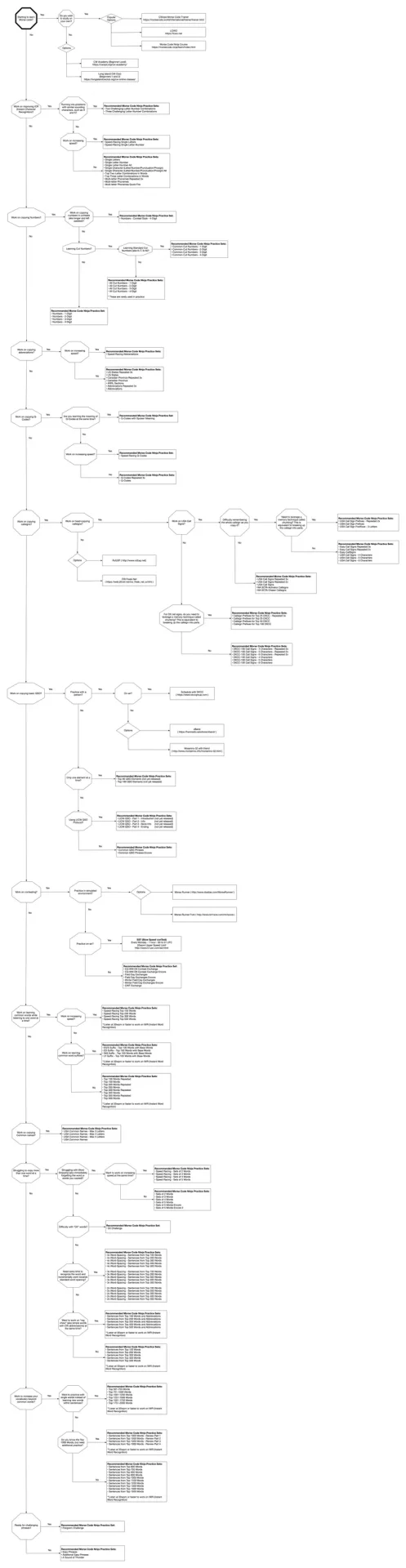
Podcasts mirror the course and drills through private RSS feeds you paste into any podcast app, and bulk downloads cover QRS slow code, Farnsworth sets and the full 15 to 100 wpm range for the shack computer, the car stereo and the trail. The practice guidance flowchart maps which drill family to use at each stage, and the advice page charts a learning approach to QRQ high speed operation.
Community and Next Steps: LICW, Advice and Reference
The Long Island CW Club pages connect the solo drills to live humans: classes, events and slow speed nets where the callsign practice pays off immediately. Advice essays cover the learning approach to QRQ, resources and reference pages answer the fiddly questions, and the contact page reaches AD0WE directly, including beta access to the unreleased next generation course with stepping stones to standard 20, 25 and 30 wpm. The open source Morse Code Ninja renderer on GitHub lets you generate your own Ninja format audio, which is also how the 8 mile hike tradition of listening to childhood stories in Morse started.
Comparison: Morse Code Ninja, Apps and Club Classes
| Attribute | Morse Code Ninja practice | Phone trainer apps | Live club classes |
|---|---|---|---|
| Cost | Free, no account for core library | Mixed, ads or unlocks common | Free to dues based |
| Method | Farnsworth with ICR theory spelled out | Varies, often Koch only | Instructor led |
| Depth | Letters to 100 wpm QRQ plus stories | Usually caps near 30 wpm | Follows class pace |
| Offline | ZIPs, podcasts, MP3 to 17 GB | Usually yes | Scheduled sessions |
| Feedback | Self checked with captions | Auto scored | Human ears |
| Best for | Self paced grinder with a plan | Five minute gaps in the day | Accountability plus on air debut |
The honest takeaway: apps win for spare minutes, clubs win for first QSO courage, and the Ninja library wins as the spine of a serious plan because no other free source goes as deep or explains the why as plainly.
Practical Ham Training Plans
- First month, zero to letters: course videos in order, 2 by 15 minutes daily, aloud answers, step up at 70 percent. Touch the library only for single letters rapid fire.
- Second month, letters to words: top 100 words at wide spacing, Build A Word series one to five letters, first callsign drills with real former calls.
- Pre activation: QSO exchanges plus callsign sets at target speed, then one LICW slow net. SOTA chasers learn summit to summit abbreviations early.
- Plateau breaker: speed racing one bracket above comfort, mind melt gaps, then drop back. The faster bracket makes the old speed feel roomy.
- Contest ready: contest exchanges plus rapid fire numbers, serials and question mark drills for repeats.
Honest Limitations
- Self checked, not scored. No app grades you, so honesty about that 70 percent rule is the whole system.
- YouTube centric. Streaming needs connection, offline means planning ZIP and podcast downloads ahead.
- Volume of choice can paralyze. Hundreds of drills tempt hopping. The flowchart plus one drill family at a time fixes it.
- Next generation course unreleased. The stepping stone course to standard timing is beta by contact only, not public yet.
- No sending coach here. This page trains ears. Pair it with a key, an oscillator and the send practice section for fists.
Why It Matters
Every CW revival thread ends the same way: more hams want the mode than finish learning it, and the dropouts cluster where methods go vague between letters and real contacts. A free library that names the gap, measures it in milliseconds, and ships a drill for each stage turns a personality trait called persistence into a procedure anyone can follow. For portable operators the payoff is concrete: a summit or park activation at 20 wpm doubles the stations worked per hour over SSB pileup chaos, with a wire antenna and five watts.
Frequently Asked Questions (FAQ)
What is the Morse Code Ninja practice page?
It’s a free filterable library of Morse training audio from letters to contest exchanges at 15 to 100 wpm, with streams, downloads, podcasts and bulk ZIPs for offline practice.
Where should a complete beginner start?
With the Farnsworth video course at 20/10 wpm in lesson order, not the library. Move to library drills once characters stick at 70 to 90 percent accuracy.
Do I need an account or payment?
No. The core library, course videos, podcasts and downloads are free with no account. YouTube login only remembers video position.
How do I stop counting dits and dahs?
Raise character speed to 20 to 30 wpm so counting fails, use rapid fire and mind melt gap drills, say answers aloud, and never rewind a missed character mid drill.
Can I practice offline on the trail?
Yes. Grab drill ZIPs, course MP3 packs or private podcast feeds for the phone. Bulk downloads cover QRS through 100 wpm for car and hiking hours.
Sources and Further Reading
- Morse Code Ninja Practice Library – Filterable drill library with speeds, downloads, podcasts and guidance flowchart.
- Morse Code Ninja Farnsworth Course – 260 lesson video course at 20/10, 25/10 and 30/10 wpm with downloads.
- Morse Code Ninja Advice – Learning approach to QRQ and training essays.
- Conquering ICR Essay – Instant character recognition method with System 1 and System 2 framing.
- Long Island CW Club – Classes and slow nets to take drills on air.
- Nancy Kott Instant Recognition Essay – The CWops hosted classic behind the ICR and IWR terms.
- CW Academy by CWops – Mentored classes complementing solo Ninja drills.
- Gordon Gibson G3ZFZ Profile – HamRadio.MY profile of a lifelong CW operator showing where the journey leads.
73 de 9M2PJU


Post Comment