UKRPT: Ask APRS for Your Nearest UK Repeater and Get an Answer in Seconds
Drive into a new town, key up on a calling channel, and hear nothing. Is the local repeater on 2 m FM, 70 cm DMR, D-STAR, or Fusion? What is the shift, the CTCSS tone, the colour code? UKRPT answers all of that over APRS. Send it a message from any APRS radio or app and it replies with the UK repeaters nearest to you, using the ETCC repeater list from ukrepeater.net.
TL;DR: UKRPT is a free APRS-IS message service by Jon Welch G7JJF that replies with the UK repeaters nearest to your last APRS position beacon, using official ETCC data from ukrepeater.net. Message UKRPT with text like 2M FM, 70CM DMR, DSTAR IO93LC, MORE, INFO GB3NF, or HELP from any APRS radio, APRSdroid, or aprs.fi, and each reply line gives callsign, output frequency, shift, CTCSS tone or DMR colour code, modes, distance, direction, and town. It works over RF wherever an iGate hears you.
What UKRPT Is
UKRPT is a free APRS-IS autoresponder that takes a short text query and answers with the nearest UK amateur repeaters to your last reported position, drawn from the RSGB ETCC repeater database at ukrepeater.net.
There is no app to install, no account to create, and no web form to fill in while driving. If your station already beacons its position to the APRS-IS network, you already have everything UKRPT needs. The service was built by Jon Welch G7JJF, runs on the APRS-IS backbone, and credits the Emerging Technology Co-ordination Committee (ETCC) repeater data that makes the answers authoritative.
Think of it as a repeater directory condensed into a text-message exchange. You ask in a few characters, it answers in a few lines, and every line is something you can punch straight into a radio.
Why a Repeater Lookup Over APRS Matters
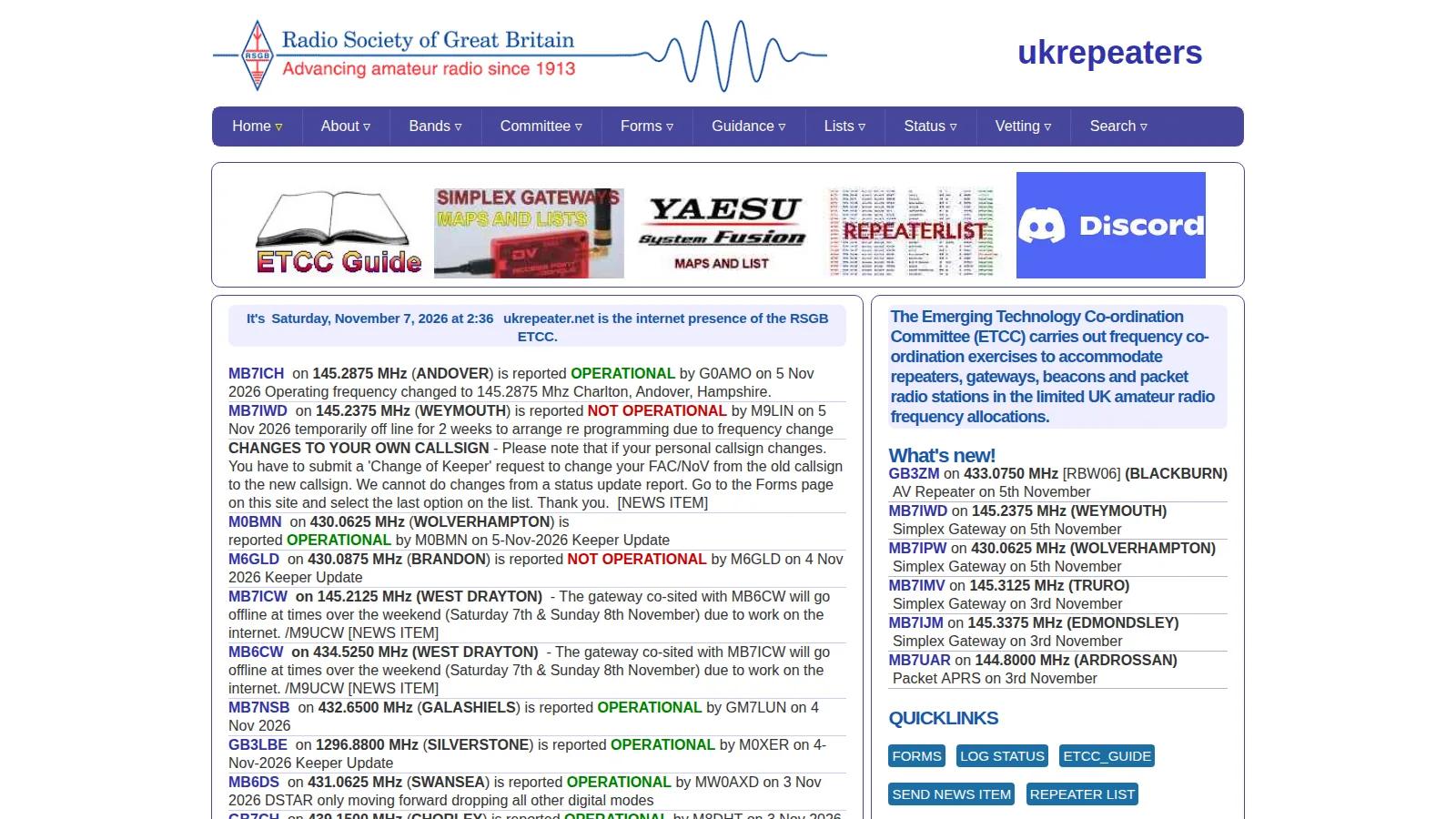
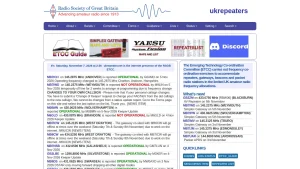
The UK repeater scene is dense, fragmented across bands and modes, and constantly changing. Keepers report repeaters operational or off air, frequencies shift after co-ordination changes, and new digital machines appear every month. The screenshot above shows a typical day on ukrepeater.net: keeper updates landing daily, simplex gateways going offline for a weekend of internet work, D-STAR machines dropping legacy modes.
That churn is exactly the problem UKRPT solves in the field:
- You are mobile. Pulling over to browse a repeater directory on a phone is slow and, in many places, illegal while driving. A two-word APRS message from the rig is faster and hands-free friendly.
- You have no data signal. Rural valleys, hilltops, and motorway dead zones kill mobile web. APRS over RF only needs one nearby iGate or digipeater to carry a 60-character message.
- You are on a hill with an HT. SOTA activators, Wainwright baggers, and portable operators carry a 5 W handheld, not a laptop. UKRPT meets that station where it is.
- You run a data-free shack workflow. Some operators keep the shack PC off and do everything from the radio. UKRPT fits that style.
- You want the keeper-current answer. Because the data comes from the ETCC list, the callsigns, frequencies, and modes match what the co-ordination committee actually holds, not a stale third-party copy.
It doesn’t replace ukrepeater.net. It puts the most useful slice of ukrepeater.net into your radio display at the moment you need it.
How UKRPT Works Under the Hood
The flow has four steps and no step requires typing your location:
- You beacon. Your tracker, handheld, mobile rig, or phone app sends a normal APRS position beacon. That beacon lands on the APRS-IS network with your callsign, coordinates, and timestamp.
- You message UKRPT. You address an APRS message to the service callsign UKRPT with a short query such as
2M FMorINFO GB3NF. - UKRPT looks you up. The service takes your callsign, pulls your most recent position beacon from APRS-IS, converts it to a search origin, and queries the ETCC repeater list for the closest matches to your filters.
- UKRPT replies. One or more APRS messages come back to your callsign with compact repeater lines, nearest first. Send
MOREfor the next batch.
Two details matter here. First, the position comes from your last beacon, not from the message itself, so beacon once after arriving somewhere new before asking. Second, RF works fine: transmit the message on your national APRS frequency (144.800 MHz in the UK and most of Europe, 144.390 MHz in North America), and any iGate that hears the packet bridges it into APRS-IS. The reply comes back the same way.
Sending Your First Query in 5 Minutes
You can use any tool that sends APRS messages: a Kenwood, Yaesu, or Icom APRS rig, a LoRa APRS tracker with messaging, APRSdroid on Android, or the message box on aprs.fi. The steps are the same:
- Confirm your station has beaconed recently. On aprs.fi, search your callsign and check the timestamp. If it is stale, send one fresh beacon.
- Address a new APRS message to
UKRPT. - Type
HELPas the message body and send. This is the safest first test because it asks for nothing location specific. - Watch for the reply messages. On a radio they appear as station messages; on aprs.fi they show in your message inbox.
- Now send a real query such as
2M FMand read the repeater lines. - If you want more results beyond the first batch, send
MORE.
If nothing comes back within a couple of minutes, check three things: your beacon is fresh and on APRS-IS, you addressed the message to exactly UKRPT, and your RF packet is reaching an iGate (try a WIDE1-1 path or move to higher ground).
Command Reference
Every query is a short text line. Case doesn’t matter, but keep the format tight because APRS messages cap at 67 characters.
| Command | Example | What you get back |
|---|---|---|
<band> <mode> |
2M FM |
Nearest 2 m FM analogue repeaters |
<band> <mode> |
70CM DMR |
Nearest 70 cm DMR repeaters |
<mode> <locator> |
DSTAR IO93LC |
D-STAR repeaters near that Maidenhead square, not your beacon |
MORE |
MORE |
Next batch of results after any search |
INFO <callsign> |
INFO GB3NF |
Full detail line for one repeater |
HELP |
HELP |
Built-in usage summary |
Band words include 2M, 70CM, 6M, 4M, and microwave bands where the ETCC holds entries. Mode words include FM, DMR, DSTAR, FUSION (System Fusion / C4FM), and NXDN. Combine them freely: 2M FM, 70CM FM, 2M DSTAR, 70CM DMR, 23CM FM. Appending a Maidenhead locator such as IO93LC overrides your beacon position for that one query, which is handy when planning a trip from home.
A few realistic queries and what they mean in plain English:
2M FM– “I am here, give me the closest 2 m analogue voice machines.”70CM DMR– “I am here, give me the closest 70 cm DMR machines for my codeplug.”DSTAR IO93LC– “Ignore where I am, what D-STAR machines sit near Leeds (IO93LC)?”MORE– “Show me the next few after the ones you just sent.”INFO GB3NF– “Tell me everything you hold on GB3NF specifically.”HELP– “Remind me of the command syntax.”
How to Read a UKRPT Reply Line
Each repeater arrives as one dense line engineered to fit APRS message limits. A typical line packs seven facts:
| Field | What it tells you | Example fragment |
|---|---|---|
| Callsign | The repeater identity | GB3NF |
| Output frequency | The frequency you listen on, in MHz | 439.6375 |
| Shift | Repeater offset direction and size | -7.6, +, -0.6 |
| Access | CTCSS tone in Hz for analogue, colour code for DMR | 94.8, CC1 |
| Modes | What the machine speaks | FM, DMR, DSTAR, FM/FUS |
| Distance and direction | How far and which way from your search origin | 12km NW |
| Town or site | Human-readable anchor for the map | Sheffield |
Read a line left to right and program the radio in the same order: dial the output, set the shift, set the tone or colour code, confirm the mode. The distance and direction tell you whether it is worth trying on your current antenna, and the town name tells you which hill to point the beam at.
The INFO reply for a single callsign expands this into the fullest record UKRPT holds, which is the one to trust when a search line had to abbreviate something to fit.
UKRPT vs Other Ways to Find a Repeater
UKRPT is one tool in a wider repeater-finding kit. Here is where it wins and where the browser still wins.
| Method | Needs internet at point of use | Position handling | Data authority | Best moment |
|---|---|---|---|---|
| UKRPT over APRS | No, RF plus one iGate is enough | Automatic from last beacon, or locator override | ETCC via ukrepeater.net | Mobile, portable, or hilltop with only a radio |
| ukrepeater.net website | Yes | Manual search and map browsing | ETCC direct, full records and news | Planning at home, keeper updates, vetting forms |
| RepeaterBook app or website | Yes for live data | Phone GPS | Crowdsourced, global coverage | Travelling abroad outside ETCC country coverage |
| Pre-programmed codeplug or CHIRP file | No | None, static snapshot | Whatever was current on export day | Known commute route with stable machines |
| Asking on the calling channel | No | Voice description | Whoever answers, variable freshness | Social check plus activity test in one call |
The practical pattern is to plan on ukrepeater.net and operate on UKRPT. Build the codeplug at home from the full ETCC records, then let UKRPT correct you in the field when the plan meets reality.
Tips That Get Better Answers
- Beacon first, ask second. UKRPT searches from your last heard position. After a long drive or a summit climb, send a fresh beacon and wait for it to appear on aprs.fi before querying.
- Be specific about mode.
2Malone can return a mixed list.2M FMor70CM DMRnarrows to machines your current radio can actually use. - Use the locator override for recce. Planning next weekend from the sofa? Send
DSTAR IO93LCstyle queries with the target square instead of driving there first. Pair with a Maidenhead map to pickActivator-friendly squares. - Page with MORE, don’t re-search. Repeated identical searches restart the list.
MOREwalks forward through it. - INFO before a long drive. When one machine looks perfect,
INFO GB3NFconfirms the tone, shift, and modes before you commit the memory channel. - Keep messages short. APRS truncates past 67 characters. The UKRPT command set is designed for this, so resist adding pleasantries into the message body.
- Mind the RF path. From a valley, a single hop via
WIDE1-1to a hilltop digipeater often succeeds where a direct iGate shot fails. Check your path settings if queries vanish. - Record what worked. When UKRPT hands you a live machine, save it to the radio memory with the town in the tag. Next visit starts one step ahead.
Honest Limits
UKRPT is a focused service, not a full directory mirror. Repeaters change status faster than any cache: a machine listed operational this morning can go off air by afternoon for maintenance, as the keeper notices on ukrepeater.net show almost daily. Treat UKRPT answers as the best current co-ordination data, then confirm with a short call.
Coverage follows the ETCC list, which is UK only. Queries from outside the UK or with a stale position beacon far from the UK will return thin or empty results. Similarly, very narrow mode filters in sparse areas can return nothing nearby, which is itself useful information: it tells you to widen the search or switch bands rather than calling into silence.
Message delivery depends on APRS-IS and, for RF users, on iGate density. Deep valleys, dense urban canyons, and congested 144.800 MHz evenings can delay or drop packets. If a reply never arrives, your message likely never reached APRS-IS rather than UKRPT failing to answer. Re-beacon, retry once, and check aprs.fi to see which leg went missing.
Why This Service Deserves Support
Small single-purpose APRS services like this are the quiet infrastructure of the hobby. Nobody maintains a repeater answering machine for profit. It costs hosting, API care against the ETCC feed, and ongoing attention to malformed queries, and it pays back only in fewer frustrated mobile operators calling dead machines.
Three things make UKRPT worth promoting and preserving:
- It respects the authoritative data. By building on the ETCC list from ukrepeater.net instead of scraping random mirrors, answers inherit the co-ordination committee vetting process.
- It respects the RF path. Full directory websites assume broadband. UKRPT assumes a 1200-baud packet and a hilltop iGate, which is the actual condition of a lot of portable operating.
- It respects the operator. No login, no fee, no app store, no tracking. Beacon, ask, receive, drive on.
If you use it on a trip and it saves you a half hour of guessing, send Jon G7JJF a message and say so. Services kept by one volunteer survive on exactly that feedback, plus specific bug reports: which query, which callsign position, what came back, what should have come back.
Try It on Your Next Drive or Activation
Next time you cross into unfamiliar country, make UKRPT part of the operating routine. Beacon as you arrive, send 2M FM, program the top two results, and call. On a multiband stop, follow with 70CM DMR or your digital mode of choice. Planning a SOTA summit or a town visit later in the week, run locator queries from home and preload the memories before leaving.
The repeater answers are free, the data credit goes to the ETCC, and the service is one message away on any APRS setup you already own.
Sources and Further Reading
- ukrepeater.net, ETCC Repeater Database
- RSGB Band Plans
- RSGB Main Site
- aprs.fi Live APRS Map and Messaging
- APRS-IS Network Information
- APRSdroid 9M2PJU Mod, Android APRS Client
- Understanding APRS Wide Path Configurations
- TAPR, Packet Radio Heritage
- QRZ Profile for G7JJF
73 de 9M2PJU



Post Comment