Understanding APRS Wide Path Configurations: From WIDE1-1 to WIDE3-3, the New-N Paradigm, and LoRa APRS
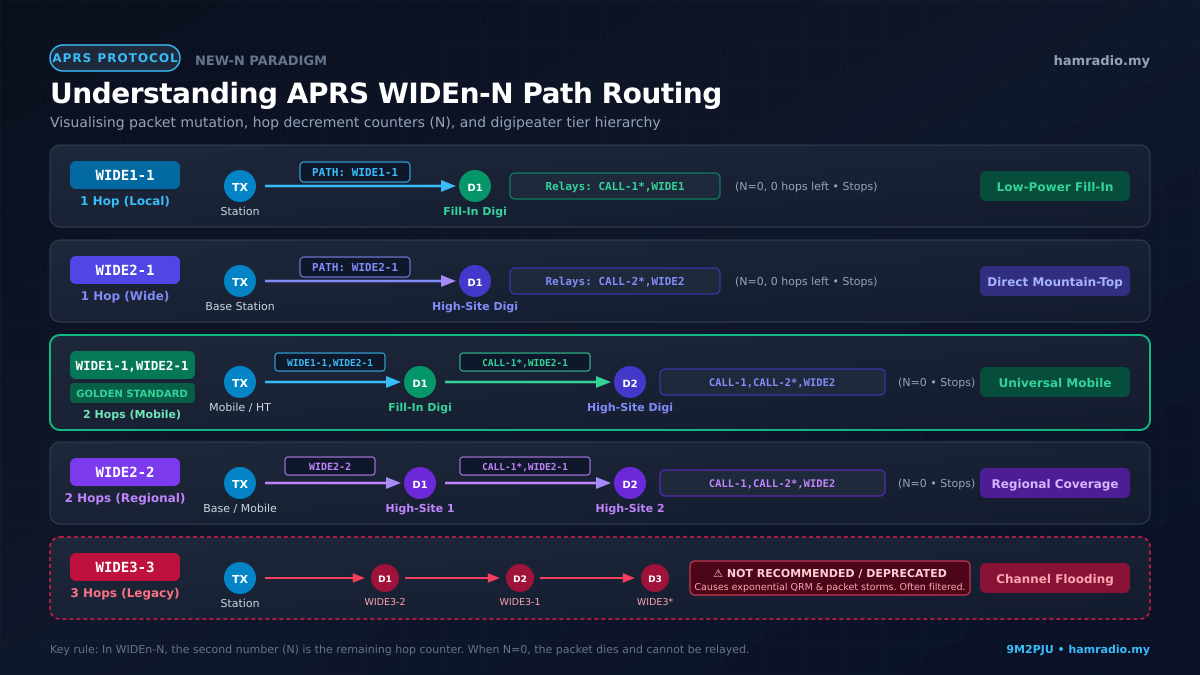
TL;DR: In the Automatic Packet Reporting System (APRS), WIDEn-N path routing controls how many times a packet is digipeated across the RF network. In
WIDEn-Nnotation,nrepresents the digipeater tier or geographic scope, whileNrepresents the remaining hop counter. Each digipeater decrementsNby 1; whenN=0, the packet stops propagating. For 90% of VHF mobile and portable stations, the universal golden standard path isWIDE1-1,WIDE2-1(2 hops: 1 fill-in digipeater + 1 high-site digipeater). Fixed base stations should useWIDE2-1or transmit direct with no path ("") to avoid jamming neighborhood fill-in repeaters. For LoRa APRS trackers (433.400 MHz in Malaysia, 433.775 MHz in Europe, 915 MHz in North America),WIDE1-1is the standard single-hop path due to LoRa Time-on-Air constraints.
Setting up an Automatic Packet Reporting System (APRS) station on 144.390 MHz VHF (144.800 MHz in Europe) or UHF LoRa (433.400 MHz in Malaysia, 433.775 MHz in Europe, 915 MHz in the Americas) involves configuring your unproto packet path. New operators often look at settings like WIDE1-1, WIDE2-1, WIDE2-2, and WIDE3-3 and assume higher numbers mean better coverage. In practice, improper path selection can degrade the entire local APRS RF network by causing packet collisions and channel saturation.
This guide provides a comprehensive technical breakdown of APRS wide path routing under the New-N Paradigm created by Bob Bruninga (WB4APR), explains step-by-step AX.25 packet header mutation, clarifies why base stations must avoid WIDE1-1, explores modern LoRa APRS path routing, and outlines exactly which path you should use for every operating scenario.
What Is an APRS Wide Path?
An APRS wide path is a standardized AX.25 destination routing alias that instructs network digipeaters to relay a digital packet across a designated number of radio hops without requiring the transmitting station to know specific repeater callsigns in advance.
When your radio transmits an APRS beacon or message, it sends an unnumbered information (UI) frame using the AX.25 amateur packet radio protocol. Embedded in the AX.25 frame header is a destination field followed by a digipeater path. Because mobile stations move continuously across cities and mountains, hardcoding fixed repeater callsigns (such as 9M2PJU-1, W6ABC-3) into your radio is impractical.
Generic “wide paths” solve this problem by allowing digipeaters with wide-area coverage to recognize common aliases, decrement a numeric counter, substitute their own callsign into the header, and retransmit the packet.
The History: From Legacy RELAY/WIDE to the New-N Paradigm
To understand modern WIDEn-N routing, it helps to understand the historical problem it solved.
+--------------------------------------------------------------------------------+
|                         EVOLUTION OF APRS ROUTING                              |
+--------------------------------------------------------------------------------+
|  1990s Legacy Paradigm:                                                        |
|  PATH: RELAY,WIDE,WIDE                                                         |
|  • No hop decrementing; no callsign tracing on sub-hops.                       |
|  • Every digi hearing "WIDE" repeated it indefinitely across the region.       |
|  • Result: Catastrophic packet flooding, QRM storms, and RF channel collapse.  |
|                                                                                |
|  2004-2005 New-N Paradigm (Bob Bruninga, WB4APR):                              |
|  PATH: WIDE1-1,WIDE2-1                                                         |
|  • Digis decrement N (e.g., WIDE2-2 -> WIDE2-1 -> WIDE2).                     |
|  • Digis insert their own callsign with the "has-been-digipeated" H-bit (*).   |
|  • N=0 terminates propagation. Packet dupes are suppressed within 30 seconds.  |
|  • Result: Strict hop limits, full path traceability, and clean RF spectrum.   |
+--------------------------------------------------------------------------------+
In the 1990s, early APRS implementations used generic unnumbered aliases such as RELAY, WIDE, and TRACE. A popular path was RELAY,WIDE,WIDE.
Under that legacy model, every high-site digipeater that heard a packet marked WIDE would blindly retransmit it with another WIDE request. In dense amateur radio regions, a single mobile position report would trigger dozens of secondary and tertiary retransmissions from overlapping repeaters. The channel suffered massive packet storms, hidden-transmitter collisions, and high packet loss.
In November 2004, Bob Bruninga (WB4APR) introduced the New-N Paradigm (finalized in 2005). The New-N standard introduced two major concepts:
- Hop-decrement counters (the
-NSSID): The transmitting station specifies the exact number of hops allowed using the sub-station identifier (SSID). Every digipeater reduces the SSID counter by 1 before retransmitting. - Mandatory callsign substitution with H-bit insertion: Every digipeater replaces the generic alias (or prepends its own callsign) and sets the AX.25 “has-been-digipeated” bit (displayed with an asterisk
*in packet monitors).
This eliminated infinite packet loops and established full accountability for every packet traversing the RF network.
Deconstructing WIDEn-N: The Math and Logic of Packet Decrementing
The syntax of a modern APRS path is WIDEn-N, where n and N represent two distinct parameters:
n(Digipeater Tier / Network Class): Defines the structural level and geographic scope of digipeaters that should respond to the packet.WIDE1: Targeted exclusively at low-power, local Fill-In Digipeaters (as well as wide digis).WIDE2: Targeted at high-power, mountain-top Wide-Area / Regional Digipeaters.WIDE3: Targeted at super-regional long-haul digipeaters (rarely supported or clamped).
N(Remaining Hop Counter): Defines the total number of hops remaining. When you originate a packet,Nrepresents the maximum number of relays you are requesting.
Step-by-Step AX.25 Packet Mutation on RF
To see how digipeaters mutate packet headers in real time, consider a station (9M2PJU) transmitting with a path of WIDE2-2:
1. TRANSMISSION (Station 9M2PJU on 5W Handheld):
   Raw Header: 9M2PJU > APDR16, WIDE2-2: !0308.12N/10141.56E>...
   [Remaining hops: 2]

2. FIRST RELAY (Heard by Mountain-Top Digi 9M2RBA-1):
   9M2RBA-1 decrements N from 2 to 1 (2-1=1).
   9M2RBA-1 prepends its callsign with H-bit set (*).
   Transmitted Header: 9M2PJU > APDR16, 9M2RBA-1*, WIDE2-1: !0308.12N/10141.56E>...
   [Remaining hops: 1]

3. SECOND RELAY (Heard by Distant Digi 9M2RBB-1):
   9M2RBB-1 decrements N from 1 to 0 (1-1=0).
   9M2RBB-1 inserts its callsign with H-bit set (*).
   The WIDE2 alias drops its SSID or is marked exhausted.
   Transmitted Header: 9M2PJU > APDR16, 9M2RBA-1, 9M2RBB-1*, WIDE2: !0308.12N/10141.56E>...
   [Remaining hops: 0]

4. FINAL STATE (Heard by Third Digi 9M2RBC-1 or iGate):
   9M2RBC-1 inspects the path: N is 0 (WIDE2 has no remaining hops).
   9M2RBC-1 drops the packet from RF retransmission.
   The local iGate receives the frame and passes it to APRS-IS (the Internet).
When N reaches 0, the packet has exhausted its authorized relays. It is dropped from the RF repeat queue.
Breakdown of Individual Wide Path Settings
Let us examine the specific behavior, hop count, and operational application for each individual wide path setting.
+---------------------------------------------------------------------------------------------------+
|                                 INDIVIDUAL WIDE PATH PROPERTIES                                   |
+----------+------------+-------------------------------------+-------------------------------------+
| Path     | Total Hops | Responding Digipeater Types         | Practical Use Case                  |
+----------+------------+-------------------------------------+-------------------------------------+
| WIDE1-1  | 1 Hop      | Low-power Fill-In Digis & Wide Digis| Urban handhelds, local events, LoRa |
| WIDE2-1  | 1 Hop      | High-site Wide Digis only           | Fixed base stations, direct to hill |
| WIDE2-2  | 2 Hops     | High-site Wide Digis only           | Regional mobile / base coverage     |
| WIDE3-1  | 1 Hop      | Wide Digis supporting WIDE3         | Legacy / rarely used                |
| WIDE3-2  | 2 Hops     | Wide Digis supporting WIDE3         | Legacy / rarely used                |
| WIDE3-3  | 3 Hops     | Wide Digis supporting WIDE3         | Obsolete, deprecated, high QRM      |
+----------+------------+-------------------------------------+-------------------------------------+
WIDE1-1 (1 Hop – Fill-In Digipeaters)
- Total Hops: Exactly 1 hop.
- How It Works:
WIDE1-1is specifically recognized by low-altitude, low-power “Fill-In” digipeaters. Fill-in digipeaters are installed in basements, valleys, or suburban rooftops to provide coverage where high-altitude mountain-top repeaters cannot penetrate. - Header Transition:
WIDE1-1->DIGI1*,WIDE1(exhausted). - Best For: Short-range local beaconing, community public service nets, handheld radios transmitting inside dense urban canyons, and LoRa APRS trackers.
WIDE2-1 (1 Hop – High-Site Wide Digipeaters)
- Total Hops: Exactly 1 hop.
- How It Works:
WIDE2-1requests a single hop from a high-altitude, wide-coverage regional digipeater. Crucially, fill-in digipeaters ignoreWIDE2-xrequests entirely. This ensures that packets from stations with good antennas do not unnecessarily key up neighborhood fill-in repeaters. - Header Transition:
WIDE2-1->DIGI1*,WIDE2(exhausted). - Best For: Fixed home base stations with elevated outdoor antennas, and mobile stations that already have a direct line-of-sight path to a primary mountain-top repeater.
WIDE2-2 (2 Hops – Regional Backbone)
- Total Hops: Exactly 2 hops.
- How It Works:
WIDE2-2allows a packet to traverse two consecutive high-altitude wide digipeaters. The first high-site decrementsWIDE2-2toWIDE2-1, and the second high-site decrements it toWIDE2(0 remaining hops). - Header Transition:
WIDE2-2->DIGI1*,WIDE2-1->DIGI1,DIGI2*,WIDE2(exhausted). - Best For: Mobile stations traveling across rural highways, or base stations seeking broad regional coverage (e.g., spanning 100-250 km).
WIDE3-1 and WIDE3-2 (1 to 2 Hops – Super-Regional Legacy)
- Total Hops:
WIDE3-1provides 1 hop;WIDE3-2provides 2 hops. - How It Works: These paths were designed for large-area multi-state or multi-province networks. However, because
WIDE2-2already provides up to 2 wide-area hops,WIDE3-1andWIDE3-2are redundant. - Best For: Generally unnecessary in modern networks;
WIDE2-1orWIDE2-2should be used instead.
WIDE3-3 (3 Hops – Obsolete, Deprecated, and High Congestion)
- Total Hops: Exactly 3 hops.
- How It Works:
WIDE3-3permits three full wide-area hops across high-site digipeaters. - Why It Is Discouraged: In modern amateur radio,
WIDE3-3creates an uncontrolled flood of duplicate packets that blankets thousands of square kilometers. On a single 5-watt transmission,WIDE3-3can cause dozens of repeaters to key up simultaneously, wiping out local packets and creating massive co-channel interference (QRM). - Digipeater Trapping: Most modern APRS digipeaters (such as Dire Wolf, Kantronics KPC-3+, and UI-View nodes) are configured with Path Trapping. When a digipeater receives a
WIDE3-3packet, it automatically clamps the path toWIDE2-1or drops the packet entirely to protect network health.
Why Fixed Base Stations Must NOT Use WIDE1-1
One of the most frequent operating mistakes in APRS is configuring a fixed home base station with WIDE1-1 or WIDE1-1,WIDE2-1.
                                  [High-Site Mountain Digi]
                                    ^                   ^
                              Direct Line          Direct Line
                              of Sight (OK)        of Sight (OK)
                                  |                   |
                  +---------------+                   +--------------+
                  |                                                  |
         [Fixed Base Station]                             [Fixed Base Station]
         (50W, Elevated Antenna)                          (50W, Elevated Antenna)
                  |                                                  |
           Sends WIDE1-1 (BAD)                             Sends WIDE2-1 (GOOD)
                  |                                                  |
                  v                                                  v
      [Neighborhood Fill-In Digi]                        [Neighborhood Fill-In Digi]
      Keys up unnecessarily,                             Ignores WIDE2-x completely.
      floods local RF, & blocks                          Stays silent & available
      weak handheld trackers.                            for weak mobile stations.
The Technical Reason
- Base Stations Already Have Good RF Height: Fixed home stations typically operate with elevated outdoor antennas (such as a Diamond X-50 or X-510 at 10 to 20 meters above ground) and transmit at 25 to 50 watts. They already enjoy solid direct line-of-sight to regional mountain-top digipeaters and local iGates.
- Fill-In Digis Are a Shared Resource for Weak Mobiles: Fill-in digipeaters (which listen for
WIDE1-1) are intentionally deployed to rescue weak 5W handhelds and vehicle trackers driving through low valleys or suburban streets. - The Consequences of Base Station Misconfiguration: When a 50W base station transmits with
WIDE1-1, it triggers every low-power fill-in digipeater within a 30 km radius. Those repeaters all key up and retransmit the base station’s packet simultaneously. This causes co-channel collisions and blinds the fill-in repeaters from hearing weak mobile stations that genuinely need help.
The Golden Rule for Base Stations: Fixed stations should use WIDE2-1 (which fill-in digis ignore) or "" (Direct / No Path) if directly reaching an iGate. Never use WIDE1-1 from a base station.
Chained Multi-Tier Paths: How Real-World APRS Works
In real-world mobile operations, single-token paths like WIDE2-2 have a significant drawback: if a low-power mobile or handheld is in a valley, it cannot reach a high mountain-top repeater directly, and a high-site repeater cannot hear it.
To solve this, the New-N Paradigm allows chained multi-tier paths.
+-----------------------------------------------------------------------------------------------------------------+
|                             THE UNIVERSAL MOBILE STANDARD: WIDE1-1,WIDE2-1                                      |
+-----------------------------------------------------------------------------------------------------------------+
|                                                                                                                 |
|   +-------------------+                +--------------------+                +--------------------+             |
|   |  Mobile Station   |                | Low-Power Fill-In  |                | Mountain-Top Wide  |             |
|   |     (9M2PJU)      |  Hop 1 (Local) |     (9M2RBA-1)     |  Hop 2 (Wide)  |     (9M2RBB-1)     |   iGate /   |
|   |  5W VHF / Tracker +--------------->+ Decrements WIDE1-1 +--------------->+ Decrements WIDE2-1 +--> APRS-IS   |
|   +-------------------+                +--------------------+                +--------------------+  (Internet) |
|         PATH TX:                             RELAY TX:                             RELAY TX:                    |
|     WIDE1-1,WIDE2-1                    9M2RBA-1*,WIDE2-1                    9M2RBA-1,9M2RBB-1*,WIDE2            |
|     [Total Hops: 2]                    [Remaining Hops: 1]                   [Remaining Hops: 0]                |
|                                                                                                                 |
+-----------------------------------------------------------------------------------------------------------------+
WIDE1-1,WIDE2-1 (The Universal Mobile Golden Standard)
This is the universally recommended path for 90% of all mobile and portable stations worldwide:
- Hop 1 (Local Fill-In): The mobile station transmits
WIDE1-1,WIDE2-1. A nearby low-power fill-in digipeater hears the weak signal, consumes theWIDE1-1token, and retransmits the packet at full power as:MYCALL-1*, WIDE2-1. - Hop 2 (Regional High-Site):** A distant mountain-top digipeater hears the fill-in repeater’s clean transmission, consumes the
WIDE2-1token, and retransmits the packet across the broader region as:MYCALL-1, DIGI2*, WIDE2. - Completion: With all SSIDs decremented to 0, propagation ceases cleanly.
- Total Hops: Exactly 2 hops (1 local + 1 wide).
- Network Impact: Extremely efficient. If the mobile station happens to be heard directly by the high-site digipeater first, the high-site consumes both tokens in one step, preventing duplicate relay loops.
WIDE1-1,WIDE2-2 (Rural / Fringe Mobile Standard)
- Total Hops: Exactly 3 hops (1 local fill-in + 2 regional wide hops).
- When to Use: Use this path only when driving through remote desert, mountain, or rural regions where digipeater spacing exceeds 100 km and an extra hop is required to reach an Internet Gateway (iGate).
- Urban Rule: Never use
WIDE1-1,WIDE2-2inside metropolitan areas.
LoRa APRS Path Configurations: Why WIDE1-1 Is the Standard
In recent years, LoRa APRS (operating on 433.400 MHz in Malaysia, 433.775 MHz in Europe, and 915.000 MHz / 433.775 MHz in the Americas) has emerged as an ultra-low-power alternative to traditional 2-meter VHF APRS.
+--------------------------------------------------------------------------------------------------+
|                                    LORA APRS ROUTING WORKFLOW                                    |
+--------------------------------------------------------------------------------------------------+
|                                                                                                  |
|   +-----------------------+              +---------------------+             +---------------+   |
|   |   LoRa APRS Tracker   |              | LoRa APRS Digipeater|             |  LoRa iGate   |   |
|   | (LilyGO T-Beam / 100mW)              |   (Hilltop / Tower) |             |  (Home / RX)  |   |
|   |    Path: WIDE1-1      +------------->+ Relays: CALL*,WIDE1 +------------>+ Passes to     |   |
|   +-----------------------+   (Hop 1)    +---------------------+   (Hop 2)   | APRS-IS (Net) |   |
|                                                                              +---------------+   |
|                                                                                                  |
+--------------------------------------------------------------------------------------------------+
How LoRa APRS Changes the Physical Layer
While VHF APRS uses 1200-baud audio tones over FM, LoRa APRS uses Chirp Spread Spectrum (CSS) digital modulation (typically Spreading Factor SF12, Bandwidth 125 kHz, Coding Rate 4/5). This provides extreme receiver sensitivity (down to -138 dBm), allowing a 100 mW (0.1W) pocket tracker like the LilyGO T-Beam to match or exceed the range of a 5W VHF handheld.
Time-on-Air (ToA) and Single-Hop Routing
While a 1200-baud VHF packet takes only ~30 ms on air, a LoRa APRS packet at SF12/125kHz requires 400 ms to 800 ms of Time-on-Air (ToA).
Because each packet holds the RF channel for nearly a full second:
- Multi-Hop Paths Are Banned: Chained paths like
WIDE2-2orWIDE1-1,WIDE2-1on LoRa would rapidly saturate the channel and cause continuous packet collisions. WIDE1-1Is the Enforced Standard: LoRa trackers (LilyGO T-Beam, Heltec V3) are configured withWIDE1-1(or direct to iGate). If a tracker cannot reach an iGate directly, a single hilltop LoRa digipeater relays the packet once (WIDE1-1->WIDE1), delivering it to the nearest iGate.- SmartBeaconing Integration: Tracker firmware (e.g., CA2RXU / richonguzman or OE5BPA) paired with APRSdroid 9M2PJU Mod adjusts transmission intervals based on speed and cornering, keeping channel utilization minimal.
APRS Wide Path Comparison Table
| Path Configuration | Total Hops | Responding Repeaters | Typical RF Range | Channel Load Impact | Recommended Operating Scenario |
|---|---|---|---|---|---|
Direct / No Path ("") |
0 | None (Direct to station/iGate) | 5 – 20 km | None | Fixed base station within line-of-sight of an iGate; local club nets. |
WIDE1-1 (LoRa APRS) |
1 | LoRa Digis & iGates | 20 – 80 km | Low | The universal standard for all LoRa APRS trackers (T-Beam, Heltec). |
WIDE1-1 (VHF APRS) |
1 | Fill-in digis & wide digis | 15 – 40 km | Very Low | VHF Handhelds (HT), walking events, bicycle rallies, dense urban nets. |
WIDE2-1 (VHF Base) |
1 | High-site wide digis only | 40 – 100 km | Low | Home base stations with outdoor antennas; mobiles with clear line-of-sight. |
WIDE1-1,WIDE2-1 |
2 | 1 Fill-in + 1 Wide digi | 60 – 150 km | Optimal | The universal golden standard for all 2m VHF mobile and vehicle trackers. |
WIDE2-2 |
2 | 2 High-site wide digis | 80 – 200 km | Moderate | Fixed base stations needing regional reach without triggering local fill-in digis. |
WIDE1-1,WIDE2-2 |
3 | 1 Fill-in + 2 Wide digis | 150 – 300 km | High | Remote rural travel, cross-country expeditions, search and rescue (SAR). |
WIDE3-3 |
3 | 3 High-site wide digis | 200 – 400 km | Severe | Obsolete / Deprecated. Do not use. Causes heavy packet flooding and is filtered. |
Packet Flooding, Dupe Checking, and Digipeater Trapping
Why does APRS require such strict hop controls? The answer lies in the physics of AX.25 packet radio on a single, shared half-duplex simplex frequency (1200 baud AFSK Bell 202 or 9600 baud GFSK).
The Math of Exponential Relay Flooding
When a station transmits an uncontrolled 3-hop packet in an area with 4 overlapping repeaters:
- Hop 1: 4 repeaters hear and retransmit the packet (4 transmissions).
- Hop 2: Each of the 4 repeaters is heard by 3 neighboring repeaters (4 * 3 = 12 transmissions).
- Hop 3: Each of those repeaters attempts further retransmissions (12 * 3 = 36 transmissions).
A single position report results in over 50 separate RF transmissions, locking the channel for several seconds and causing packet collisions with nearby stations.
+--------------------------------------------------------------------------------+
|                        HOW DIGIPEATER DUPE-CHECKING WORKS                      |
+--------------------------------------------------------------------------------+
|                                                                                |
|  Station TX --> Digi 1 Relays --> Digi 2 Hears Relay                           |
|                                       |                                        |
|                                       v                                        |
|                     +-----------------------------------+                      |
|                     |   Digi 2 Duplicate Check Cache    |                      |
|                     |   Stores: [Source Callsign + Body]|                      |
|                     |   Window: 28 to 30 Seconds        |                      |
|                     +-----------------+-----------------+                      |
|                                       |                                        |
|                  +--------------------+--------------------+                   |
|                  v                                         v                   |
|           [Already in Cache?]                       [New Packet?]              |
|                  |                                         |                   |
|                  v                                         v                   |
|          DROP SILENTLY                              DECREMENT N &              |
|        (Prevent RF Loop)                            RETRANSMIT                 |
|                                                                                |
+--------------------------------------------------------------------------------+
30-Second Duplicate Suppression Buffer
To combat this, all modern APRS digipeaters maintain a duplicate packet buffer (typically 28 to 30 seconds). When a digipeater hears a packet, it hashes the originating callsign and packet body. If the identical packet is heard again within 30 seconds from a different neighboring digipeater, the second packet is dropped silently.
Best Practices for Choosing Your APRS Path
Follow these operational guidelines to ensure your APRS station is heard reliably while preserving spectrum capacity for the entire amateur radio community:
1. Match Your Path to Station Type
- Vehicle Mobiles (2m VHF): Configure
WIDE1-1,WIDE2-1. This provides the best balance of local fill-in penetration and wide-area backbone relay. - LoRa APRS Trackers (433.400 MHz MY / 433.775 MHz EU / 915 MHz US): Configure
WIDE1-1. Single-hop routing preserves channel airtime and matches LoRa network topology. - Handhelds / Portable Trackers (5W or less): Use
WIDE1-1,WIDE2-1orWIDE1-1. If you are at a high vantage point (e.g., SOTA summit), drop your path toWIDE2-1orWIDE1-1to prevent over-deviating into adjacent repeater coverage zones. - Fixed Base Stations: Use
WIDE2-1or direct""(no path). Never useWIDE1-1from a base station with a high antenna; doing so wastes the receiver capacity of nearby low-power fill-in repeaters. - High-Altitude Balloons (HAB) / Airborne Stations: Set path to
""(Direct / No Path) or at mostWIDE2-1. Because an aircraft has direct line-of-sight to hundreds of square kilometers, using a multi-hop path will key up dozens of repeaters across multiple states simultaneously.
2. Pair Path Selection with SmartBeaconing
If your radio supports SmartBeaconing (such as Kenwood TM-D710, Yaesu FTM-300D/400D/500D, or APRSdroid 9M2PJU Mod), your beacon rate adjusts automatically based on vehicle speed and cornering.
- When stopped at a traffic light, your radio beacons once every 15-30 minutes.
- When driving at highway speeds, it beacons every 60-120 seconds.
- When turning corners, it transmits an immediate corner-peg beacon.
Combining SmartBeaconing with a clean WIDE1-1,WIDE2-1 path (or WIDE1-1 on LoRa) ensures optimal tracking accuracy with minimal RF channel overhead.
Frequently Asked Questions (FAQ)
What does the number after the dash mean in WIDE2-1?
The number after the dash is the SSID hop counter (N). In WIDE2-1, the -1 means the packet is permitted exactly 1 relay. When a digipeater retransmits it, N becomes 0 and the packet stops.
Why shouldn’t fixed base stations use WIDE1-1?
Fixed base stations usually have elevated outdoor antennas that reach high-site repeaters directly. Using WIDE1-1 needlessly triggers low-power neighborhood fill-in digipeaters designed specifically to assist weak portable and mobile stations.
Why is WIDE1-1 the standard for LoRa APRS trackers?
LoRa packets have longer Time-on-Air (400-800 ms) than VHF packets. Multi-hop paths would rapidly saturate the channel, so LoRa networks rely on a single hop (WIDE1-1) to reach an iGate.
Does WIDE3-3 give my station longer range?
In theory, yes; in practice, no. WIDE3-3 causes massive packet collisions and is actively blocked or clamped to WIDE2-1 by modern digipeater firmware to prevent network congestion.
What is the difference between WIDE1-1 and WIDE2-1?
WIDE1-1 is relayed by local low-power fill-in digipeaters and wide digipeaters. WIDE2-1 is relayed exclusively by high-altitude wide-coverage digipeaters; fill-in digipeaters ignore WIDE2-1 packets completely.
What happens when an APRS packet reaches an iGate?
An Internet Gateway (iGate) receives the packet over RF and injects it into the global APRS-IS internet backbone. Once on APRS-IS, your position appears on live tracking websites like aprs.fi and aprsdirect.com.
Conclusion
Understanding APRS wide path routing is essential for every amateur radio operator operating on digital VHF/UHF modes. By abandoning obsolete 3-hop configurations and standardizing on WIDE1-1,WIDE2-1 for 2m VHF mobiles, WIDE1-1 for LoRa APRS trackers, and WIDE2-1 (or direct) for base stations, you ensure that your position reports, weather telemetry, and messages reach their destination reliably while keeping the shared APRS frequency clean and responsive for all users.
73, and see you on the APRS map!
Sources and Further Reading
- Bob Bruninga (WB4APR) APRS Working Group – The New-N Paradigm Specification: http://www.aprs.org/fix14439.html
- APRS 1.01 Protocol Specification (APRS Working Group): http://www.aprs.org/doc/APRS101.PDF
- APRS.org Official Home Page by Bob Bruninga: http://www.aprs.org/
- APRS-IS Global Network Architecture: https://aprs-is.net/
- CA2RXU / richonguzman LoRa APRS Tracker & iGate Firmware: https://github.com/richonguzman/LoRa_APRS_Tracker
- Dire Wolf Software TNC & Digipeater Documentation (John Langner WB2OSZ): https://github.com/wb2osz/direwolf
- APRSdroid 9M2PJU Mod – Android APRS Client: https://aprsdroid.hamradio.my/
- HamRadio.my – Malaysian Amateur Radio Tools and Resources: https://hamradio.my/
- About 9M2PJU – Station Profile & Projects: https://hamradio.my/about/








5 comments