FreqBuddy: Free 40,400+ Radio Frequency Database and Browser SDR Toolbox
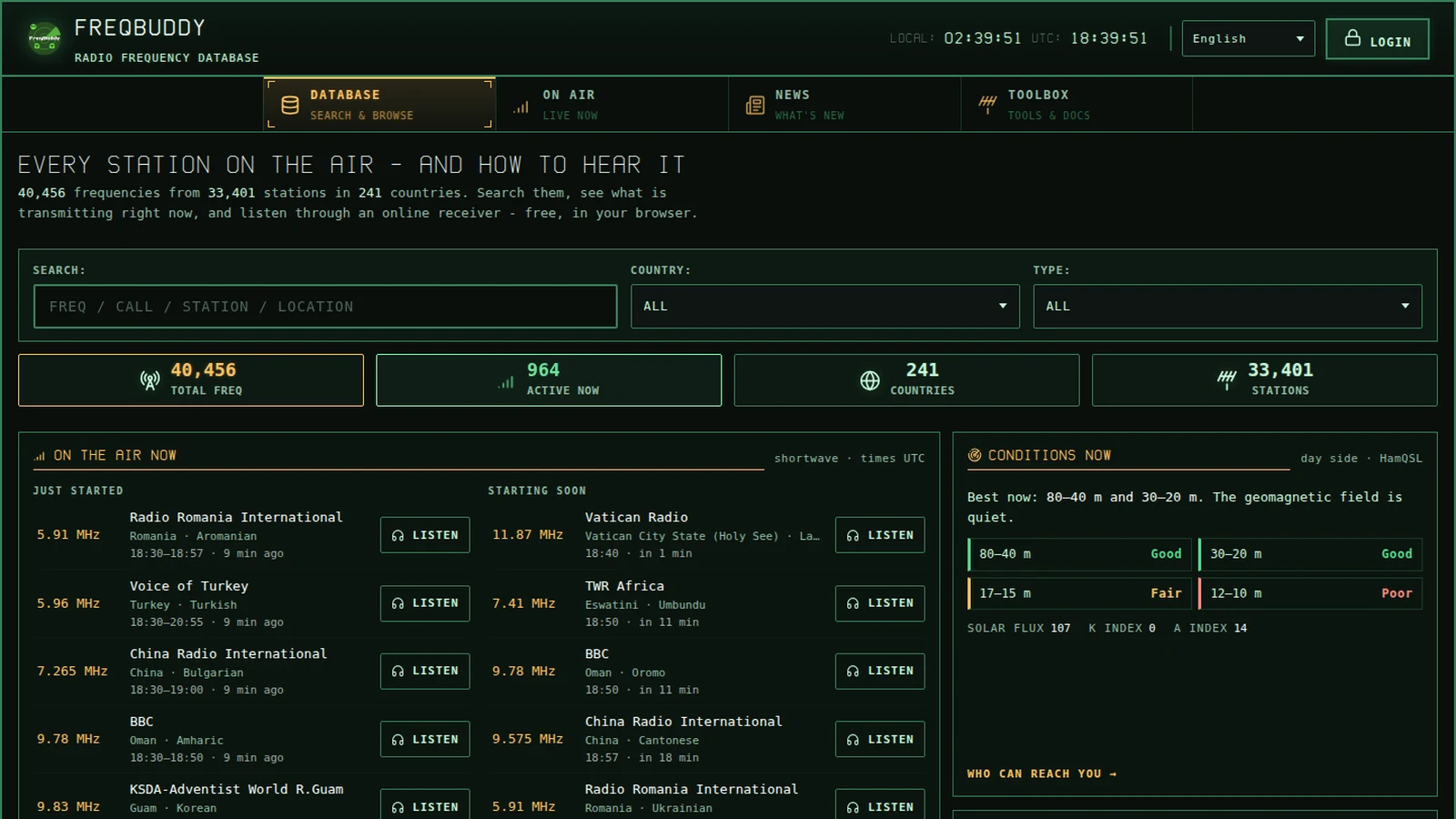
TL;DR: FreqBuddy (freqbuddy.com), built by Spanish amateur radio operator EA5IYR, is a free browser-based Progressive Web App combining a searchable database of 40,456 radio frequencies (40 kHz to 2.4 GHz across 241 countries) with live UTC on-air schedules, HamQSL HF propagation, one-click WebSDR listening, and eight built-in browser radio tools including SSTV, RTTY, and CW decoders.
Every shortwave listener and amateur radio operator eventually hits the same tab-explosion problem. You hear a mystery carrier on 6849 kHz or wonder what is active on 31 metres at 18:30 UTC, and suddenly your browser has seven different tabs open: Short-Wave.info or EiBi for broadcast schedules, Priyom for numbers stations, HamQSL for solar flux and K-index, KiwiSDR or WebSDR to hunt for a working receiver, Heavens-Above for the next ISS pass, an antenna length calculator, and a separate desktop app just to decode a quick SSTV image or CW beacon.
Spanish amateur radio operator EA5IYR decided to pull that scattered workflow into a single fast web application and shared it on r/HamRadio. The result is FreqBuddy, a free, ad-free Progressive Web App (PWA) that pairs a global radio frequency database of over 40,400 transmissions with live propagation, path scoring, one-click online receiver tuning, and a full suite of in-browser digital mode decoders.
This article explores what FreqBuddy offers, breaks down the database coverage from 40 kHz to 2.4 GHz, walks through all eight instruments inside the FreqBuddy Toolbox, compares it against classic references like Short-Wave.info, RepeaterBook, and RadioReference, and highlights where it shines (and where its gaps still sit) for everyday amateur radio and SWL operating.
Last updated: November 2026.
What Is FreqBuddy?
FreqBuddy is a free, browser-based radio frequency database and web toolbox created by EA5IYR that indexes 40,456 frequencies from 33,401 stations across 241 countries (40 kHz to 2.4 GHz) alongside live UTC schedules, propagation data, and built-in digital decoders. It runs on desktop and mobile browsers without requiring installation, can be saved to a home screen as a Progressive Web App, and supports nine interface languages.
Unlike legacy frequency directories that dump raw CSV tables onto a page and leave you to figure out the rest, FreqBuddy is designed around the practical question every operator asks at the dial: “Who is on the air right now, can they reach my location, and how do I listen or decode them?”
Key design choices that make it stand out:
- No paywall or mandatory sign-up: Searching, live schedules, propagation, WebSDR tuning, and every tool in the Toolbox work immediately without an account. A free account is only needed if you want to save favourites into custom categories.
- Built-in Local and UTC clocks: Both local time and UTC sit permanently in the top navigation bar, saving mental timezone conversions when checking shortwave broadcast windows.
- Zero-install PWA: Runs cleanly in modern desktop and mobile browsers, and even serves a static fallback summary for slow connections and search crawlers.
- Privacy-conscious defaults: Analytics are strictly opt-in anonymous page views with no IP addresses stored.
Inside the 40,456-Frequency Database
FreqBuddy spans the radio spectrum from 40 kHz up to 2.4 GHz, covering VLF, LF, Medium Wave (MW), every shortwave broadcast metre band (90 m through 11 m), HF, VHF, UHF, and SHF/microwave allocations. Each entry carries the frequency, station name, country, language, target area, UTC transmission schedule, and service category.
Category Breakdown
At the time of writing, the live database holds 40,456 frequency records across 33,401 stations in 241 countries and territories:
| Service Category | Indexed Entries | Typical Signals Covered |
|---|---|---|
| Aviation | 30,396 | Airband voice, ATC, VOLMET, ATIS, and aeronautical frequencies |
| Commercial Broadcast | 4,391 | International and national LW, MW, shortwave, and FM broadcasters |
| Satellite | 2,996 | Amateur, weather, and telemetry satellite uplinks/downlinks |
| Utility | 2,006 | Point-to-point, meteorological, and service transmissions |
| Numbers Station | 314 | Encrypted shortwave broadcasts (schedules via Priyom.org, CC BY-NC-SA) |
| Amateur Radio | 134 | Key ham allocations, calling frequencies, and reference channels |
| Maritime | 120 | Naval, coastal, and maritime mobile channels |
| Time Signal | 60 | Standard time and frequency stations (WWV, CHU, DCF77, BPM, JJY) |
| Military | 26 | Known military utility and broadcast channels |
| Emergency | 13 | Recognised emergency and distress frequencies |
Geographically, the largest country datasets currently belong to the United States (14,367 entries), Australia (4,044), China (2,033), Germany (1,620), and Canada (1,581), with coverage extending across 241 countries and territories worldwide.
Live On-Air Schedules, Propagation, and One-Click Listening
One of FreqBuddy’s smartest workflow touches is tying the database directly to real-time UTC schedules and online SDR receivers:
  [ Search / "On The Air Now" (UTC) ]
        |
        +--> Station details (country, language, schedule, grey-line map)
        |
        +--> Live HF Conditions (HamQSL: SFI, K-index, A-index, band ratings)
        |
        +--> "Who Reaches Me" Path Scoring (35,704 transmitters vs. your QTH)
        |
        +--> One-click "LISTEN" --> Nearest Online Receiver (1,593 SDRs)
                                     opens already tuned to exact kHz
On The Air Now (/active-now)
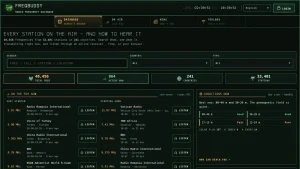
Open the homepage or /active-now and FreqBuddy immediately separates transmissions into Just Started and Starting Soon based on current UTC time. You can see stations like Radio Romania International, BBC, Voice of Turkey, China Radio International, Vatican Radio, or Priyom-tracked numbers stations with countdown minutes and broadcast windows. Next to every entry sits a LISTEN button that routes straight to an online receiver capable of hearing that exact frequency.
Live HF Propagation Conditions
Right alongside the active broadcasts, FreqBuddy pulls live solar and geomagnetic data from HamQSL, displaying:
- Band-by-band ratings for 80-40 m, 30-20 m, 17-15 m, and 12-10 m (Good / Fair / Poor)
- Current Solar Flux Index (SFI), K-index, and A-index
- A plain-English summary of which bands are best right now and whether the geomagnetic field is quiet or disturbed
Opening an individual station also displays the great-circle path and grey-line map, showing exact distance from your position so you can judge whether a dawn/dusk terminator enhancement is working in your favour.
The FreqBuddy Toolbox: Eight Browser Instruments Built on the Database
Beyond the directory itself, the /toolbox section is what turns FreqBuddy into a genuine daily driver for hams and SWLs. Every tool runs natively in the browser with no plugins or desktop installs:
- Listen Now (Nearest Receiver): Searches 1,593 online receivers (such as KiwiSDR and WebSDR nodes), filters for those whose hardware tuning range actually covers your chosen frequency, sorts them nearest first, and launches the receiver already tuned to channel.
- Who Reaches Me (Path Analysis): Takes your coordinates and scores 35,704 transmitters with known locations by distance, beam heading, band behaviour, and solar day/night conditions at both ends of the path.
- Satellite Passes: Tracks 1,653 satellites, including the ISS, weather satellites, and amateur FM repeaters. It reports pass elevation, azimuth, whether the pass is visible to the naked eye, and real-time Doppler downlink shift.
- Antenna Calculator: Computes cut lengths for six antenna designs on any target frequency with velocity factor already applied, plus matching sections for six feedline types.
- SSTV (Pictures by Radio): Decodes seven SSTV modes directly in the browser from your microphone or an uploaded audio recording, and encodes your own pictures into SSTV audio tones.
- RTTY (Text by Radio): Decodes radioteletype across four baud rates and three frequency shifts, and includes an audio TX generator with canned call-answering macros.
- CW / Morse (Dots and Dashes): A zero-configuration Morse decoder that automatically locks onto the audio pitch and learns the sender’s speed from 5 to 40 WPM, paired with a text-to-CW keyer supporting Farnsworth spacing.
- Field Guide: A built-in reference manual of 38 concise articles covering radio modes, HF propagation, band characteristics, antennas, and operating practice, plus an editorial News Desk covering topics like Baltic GPS jamming/spoofing and UVB-76 (“The Buzzer”).
Comparison: FreqBuddy vs. Classic Frequency Databases and Radio Tools
How does FreqBuddy stack up against the established websites most hams already have bookmarked?
| Feature | FreqBuddy | Short-Wave.info / EiBi | RadioReference | RepeaterBook | KiwiSDR Map / rx.linkfanel.net |
|---|---|---|---|---|---|
| Price / Access | Free (no login required) | Free | Freemium (paid API/exports) | Free | Free |
| Frequency Scope | 40 kHz – 2.4 GHz (40.4k entries) | Shortwave broadcast (HF) | Public safety, trunked, aviation, ham | Amateur repeaters (VHF/UHF) | Receiver directory only |
| Live “On Air Now” UTC | Yes (broadcast + numbers) | Yes (broadcast) | No | No | No |
| Built-in WebSDR Routing | Yes (1,593 receivers, auto-tuned) | No | No | No | Yes (manual search) |
| HF Path & Solar Scoring | Yes (HamQSL + 35.7k TX paths) | Basic map only | No | No | No |
| In-Browser Digital Decoders | Yes (SSTV, RTTY, CW) | No | No | No | KiwiSDR extensions only |
| Satellite & Antenna Tools | Yes (1,653 sats + 6 antennas) | No | No | No | No |
| Best Strength | All-in-one SWL, utility & ham companion | Exhaustive SW broadcast schedules | Deep local US/CA scanner & trunked data | Local VHF/UHF ham repeater lookup | Direct wideband HF listening |
FreqBuddy doesn’t try to replace RepeaterBook for local 2 m / 70 cm repeater tones, nor does it replace RadioReference for local P25 trunked public-safety talkgroups. Instead, it bridges shortwave schedules, aviation/utility/satellite directories, propagation, WebSDR listening, and browser digital decoders into one cohesive workspace.
Honest Limitations to Keep in Mind
Even for a remarkably polished community project, it helps to know where FreqBuddy’s current boundaries lie:
- Amateur radio category is still small (134 entries): While aviation (30,396), commercial broadcast (4,391), satellite (2,996), and utility (2,006) are heavily populated, the dedicated “Amateur Radio” tag currently focuses on key allocations and calling channels rather than local FM/DMR repeater directories. Keep RepeaterBook or your national club list handy for local VHF/UHF repeaters.
- Browser audio decoders need clean audio coupling: In-browser SSTV, RTTY, and CW decoding via microphone is fantastic for quick acoustic testing (holding a phone next to a radio speaker), though noisy rooms degrade copy. For serious weak-signal decoding, feeding line-level audio or virtual audio cable into the browser gives far better results.
- Online SDR availability fluctuates: The “Listen Now” finder indexes 1,593 receivers, but public WebSDR and KiwiSDR nodes occasionally fill up with listeners or go offline for maintenance, so you may occasionally click down to the second or third nearest receiver.
- Needs JavaScript and an internet connection for full features: Although FreqBuddy is installable as a PWA and renders a clean HTML fallback on slow connections, live search, maps, HamQSL updates, and WebSDR handoffs rely on active connectivity.
Practical Ways Hams and SWLs Can Use FreqBuddy Today
- Quick unknown-signal identification: Hear a strange carrier, utility beacon, or foreign-language broadcast while spinning the VFO? Punch the frequency in kHz into FreqBuddy and check the UTC window in seconds.
- Checking band openings before setting up portable: Use Who Reaches Me and Conditions Now alongside our own 9M2PJU HF Prediction Tool to see which HF paths are open to your QTH right now.
- Zero-hardware radio listening for newcomers: Share
freqbuddy.comwith friends or students curious about amateur radio. They can browse active shortwave or numbers stations, click LISTEN, and hear live RF through a nearby WebSDR in two clicks. - Quick portable satellite and antenna checks: Need a 20-metre dipole cut length with coax velocity factor or the next ISS FM repeater pass elevation and Doppler shift while out in the field? Both live inside the same mobile PWA bookmark.
- Instant ISS SSTV decoding: During an ISS SSTV event, open the browser SSTV decoder on a phone or laptop, pick up the 145.800 MHz downlink from a handheld radio, and watch the image draw line by line without installing desktop software.
Why It Matters
One of the best things about amateur radio in 2026 is watching individual operators build modern, fast, clutter-free web tools that solve real shack headaches and share them freely with the world. EA5IYR’s FreqBuddy replaces half a dozen ageing bookmarks with a single clean interface that respects both your time and your privacy.
Give freqbuddy.com a spin on your next listening session, test the Who Reaches Me path scorer from your own QTH, and drop feedback on EA5IYR’s r/HamRadio thread to help shape what gets added next.
73 de 9M2PJU.
Sources and Further Reading
- FreqBuddy Official Web App (freqbuddy.com)
- FreqBuddy Toolbox (Antenna Calculator, Path Analysis, SSTV, RTTY, CW, Satellites)
- FreqBuddy On The Air Now (Live UTC Shortwave & Numbers Schedule)
- EA5IYR Announcement Thread on r/HamRadio
- Priyom.org Numbers Station Schedule
- Meet the 9M2PJU HF Prediction Tool (hamradio.my)
- KiwiDX: Native Windows Client for KiwiSDR, OpenWebRX and WebSDR (hamradio.my)


Post Comment