The Swiss Army Multi-Tool: From Military Origin to 50 Practical Everyday Uses

The Victorinox Swiss Army Knife (SAK) is one of the most recognized design icons in human history. To understand its value, one must look beyond its modern identity as a pocket companion and examine its roots. It was not conceived as a commercial luxury or a casual gadget; it was forged out of political necessity, economic survival, and sheer engineering genius.
The Birth of an Icon: The History and Origin
The Economic Crisis and Karl Elsener’s Vision
The story begins in Ibach, Switzerland, in the year 1884. Switzerland, today known for its high standard of living, was a poor, mountainous country in the late 19th century. Poverty was widespread, and young men were forced to emigrate to America or neighboring European countries to find work.
Karl Elsener, a Swiss master cutler (knife maker) who had learned his trade in Germany and France, wanted to change this. He opened a small workshop powered by a waterwheel on the Tobelbach river in Ibach. His primary goal was noble: to create sustainable manufacturing jobs for his fellow citizens and stem the tide of forced emigration.
The Problem Facing the Swiss Military
In 1889, the Swiss Armed Forces introduced a new service rifle, the Schmidt-Rubin. This cutting-edge rifle required a specific screwdriver tool for soldiers to disassemble, clean, and maintain the firing mechanism in the field. At the same time, the military was modernizing its food rations, issuing canned food to soldiers on the front lines.
The military top brass realized they needed to equip every soldier with a compact, standardized pocket tool that combined a knife blade, a flathead screwdriver, an awl for leatherwork, and a robust can opener. This required official military specification document led to the birth of the “Modell 1891”.
Breaking the German Monopoly
When the Swiss government went to procure this knife in 1890, they discovered a major problem: no single blade manufacturer in Switzerland possessed the machinery, factory size, or industrial capacity to produce tens of thousands of knives simultaneously. As a result, the very first contract for the Swiss Army’s knife was awarded to a large industrial manufacturer in Solingen, Germany.
This deeply bothered Karl Elsener. He believed that the national army of Switzerland should be equipped with tools made by Swiss hands, keeping government funds within the local economy. In 1891, Elsener took a massive financial gamble. He united several small Swiss knife artisans into a single cooperative, expanded his workshop, and successfully delivered the first batch of Swiss-made military pocketknives to the army in October 1891.
However, the enterprise was a financial disaster at first. The German manufacturers could produce the knives much cheaper, and Elsener’s company almost went bankrupt. He survived only because family members stepped in to bail him out.
The Invention of the “Officer’s Knife” (1897)
The original Modell 1891 was a brutal, heavy tool. It featured thick wooden scales (handles) blackened with oil, a heavy blade, and bulky implements. While perfect for infantry grunts digging trenches, it was far too heavy and unrefined for military officers, who wore elegant uniforms and spent time in tactical offices.
Elsener went back to the drawing board to design a knife that was sleek, lightweight, and packed with more functions. The breakthrough came when he invented a revolutionary two-spring mechanism. Instead of using a separate spring for every single tool (which made knives incredibly thick), he placed tools on both sides of the handle using the same shared springs. This allowed him to offer six distinct tools using only two structural springs.
On June 12, 1897, Elsener officially registered his patent for the “Original Swiss Officer’s and Sports Knife.” This sleeker design featured a second, smaller cutting blade (the pen blade) and a corkscrew for opening wine bottles during officer gatherings. The military did not officially subsidize this knife for common soldiers, but officers bought them privately in droves, and the design became an instant commercial hit.
The Evolution of the Name: Victoria and Inox
- 1909 (Victoria): Following the death of his beloved mother, Victoria, Karl Elsener renamed the company in her honor. In the same year, the Swiss government authorized the company to display the Swiss coat of arms-the iconic Cross and Shield-on the handles to verify authenticity and protect against cheap counterfeits.
- 1921 (Victorinox): The invention of stainless steel (acier inoxydable, or simply Inox) revolutionized the cutlery industry. Stainless steel meant tools would not rust when exposed to rain, sweat, or food acids. Elsener immediately adopted the material and combined his mother’s name, “Victoria,” with “Inox” to create the worldwide trademark we know today: Victorinox.
During World War II, American soldiers stationed in Europe bought these knives in massive quantities. Because they struggled to pronounce the German name Schweizer Offiziersmesser, they simply called it the “Swiss Army Knife.” The name stuck, and a global legend was born.
50 Practical Things You Can Do with Your Swiss Army Knife
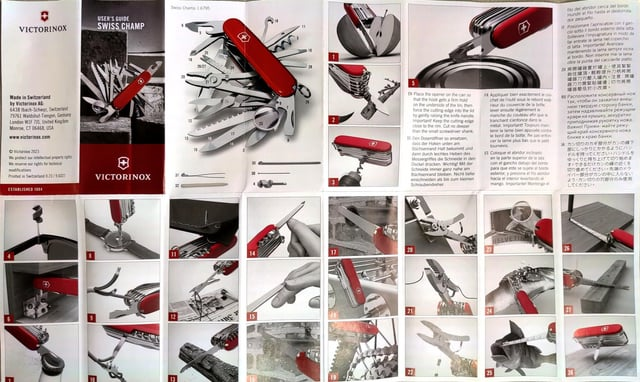
Having explored its rich heritage, let us dive into the sheer functionality of this tool. Here are 50 concrete, practical ways to use your Victorinox SAK across everyday life, electronics, survival, and emergencies.
Part I: Domestic Utility & Everyday Carry (EDC)
1. Opening Packages and Letters
The small pen blade is a surgical instrument perfect for opening mail, slashing heavy cardboard packing tape, and slicing through plastic shrink-wrap without damaging the goods inside.
2. Preparing and Slicing Food
The primary large blade is ground down to a razor edge, making it an excellent lunchroom companion for slicing apples, cutting cheese blocks, portioning dried meat, and spreading butter or jam.
3. Popping Bottle Caps
The heavy-duty cap lifter locks firmly into place at 90 and 180 degrees, allowing you to easily pop crown caps off soda, mineral water, or craft beer bottles.
4. Opening Canned Rations
The forward-pushing can opener is incredibly efficient. It rolls smoothly along the inner rim of cans, ensuring you can access food during a power outage or a camping trip.
5. Untying Tight Knots
When paracord, shoelaces, or nylon twine get wet and bound up tightly, you can carefully worm the spiral corkscrew into the center of the knot to pry it open without cutting the cord.
6. Snipping Clothing Tags
New clothes come with tough nylon price anchors. The spring-loaded SAK scissors snip these plastic tags flush against the fabric instantly, avoiding any fabric tears.
7. Repairing Eyeglasses
The micro-screwdriver threads tightly inside the corkscrew coils. It is specifically designed to tighten the tiny hinge screws on reading glasses and sunglasses.
8. Scraping Off Labels and Stickers
The flat spine of the knife blade or the edge of the multi-purpose hook can scrape off sticky price tags, product labels, and adhesive residue from glass bottles.
9. Assembling Flat-Pack Furniture
The tip of the can opener doubles as a highly capable small-to-medium Phillips and flathead driver, letting you tighten furniture joints without hunting for a heavy toolbox.
10. Trimming Loose Threads
A loose thread on a suit jacket can ruin your look. The precision alignment of the SAK scissors allows you to snip the stray fiber right down to the seam safely.
Part II: Mechanical Troubleshooting & Electronics
11. Stripping Electrical Wire
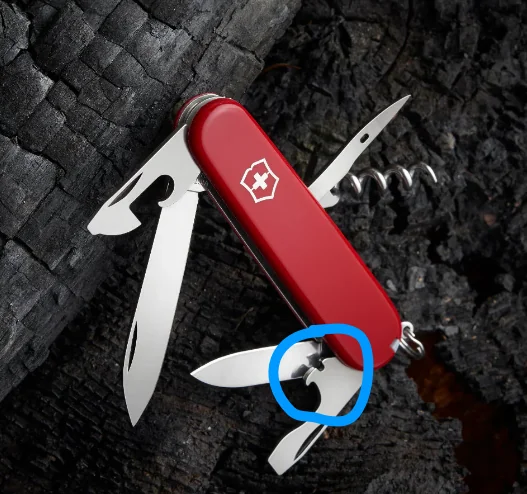
The small U-notched cutout at the base of the bottle opener tool functions as a wire stripper. Score the plastic casing with the blade, place it in the notch, and pull to expose bare copper.
12. Prying Open Electronics Casings
The thick, unsharpened flat edge of the large screwdriver blade allows you to gently pry apart plastic friction tabs on remote controls and key fobs without marring the exterior.
13. Changing Watch Back Covers
For watch collectors, the fine edge of the small pen blade can be carefully wedged into the case notch of snap-back watches to pop the rear cover open for battery changes.
14. Tuning Small Engine Carburetors
The narrow, extended profile of the inline Philips screwdriver tool reaches deep down recessed adjustment tubes to tune fuel-air mixture screws on trimmers or old motorbikes.
15. Cleaning Battery Corrosion
When alkaline batteries leak white crust inside a flashlight, the tip of the metal file or pen blade can scrape the metallic contacts clean to restore electrical conductivity.
16. Boring Starter Holes in Plastic
The back-mounted reamer/awl features a sharp, distinct cutting edge. Pressing it against a plastic project enclosure and twisting it creates a clean, perfectly circular hole.
17. Scraping Gasket Material
During light motorcycle or car maintenance, old silicone or paper gasket residue must be cleared. The flat, dull edge of the large screwdriver works beautifully as a miniature scraper.
18. Tightening Camera Tripod Plates
Tripod quick-release plates use a wide-slotted D-ring screw that frequently comes loose. The 6mm wide flathead screwdriver tool fits these wide slots perfectly to lock the camera down.
19. Opening Sealed Paint Cans
Never use a knife tip to pry open paint cans. The thick steel profile of the cap lifter is designed for heavy vertical prying, popping the airtight seal effortlessly.
20. Clearing Clogged Threaded Bolts
Dirt, rust, and old oil can pack into bolt holes on machinery or bike frames. The hardened, sharp point of the awl can track through the internal threads to clear out debris.
Part III: Wilderness Survival & Bushcraft
21. Shaving Tinder for Fire Starting
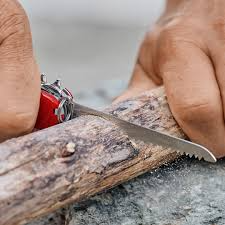
The razor-sharp factory edge of the primary blade lets you carve fine curls of wood from dry branches to create “feather sticks” that catch a spark immediately.
22. Notching Wood for Traps and Shelters
The double-toothed wood saw on models like the Huntsman cuts deep “V” and “L” notches into branches, allowing you to build stable camp structures or cooking tripods.
23. Field-Dressing and Gutting Fish
The primary blade acts as a great skinning and gutting tool for small game or fish, slicing through bellies cleanly and clearing out internal organs with ease.
24. Harvesting Building Materials
The aggressive tooth pattern of the wood saw allows you to cut down saplings up to wrist-thickness, providing structural poles for an emergency lean-to shelter.
25. Pulling Out Splinters and Thorns
Brushing against thorns or handling wood often embeds painful splinters in your hands. The fine-tipped stainless steel tweezers pull them out cleanly along their entry path.
26. Creating an Improvised Compass
If lost, you can rub the straight pin against a magnet (or your hair) to magnetize it, place it carefully on a still leaf floating in water, and watch it rotate to face North.
27. Sewing Heavy Canvas or Webbing
The SAK reamer/awl features a distinct sewing eye hole. Threading heavy line through it allows you to punch through thick canvas or leather to repair torn tents or backpack straps.
28. Scaling and Measuring Catch
The serrated fish scaler tool rakes scales off fish effortlessly. The reverse side of the tool is often stamped with a ruler, letting you immediately check if your fish is legal size.
29. Whittling Camp Utensils
If you arrive at your campsite only to realize you forgot spoons, you can spend an hour using the large blade to whittle dry, safe wood into functional wooden chopsticks or stirrers.
30. Clearing Overgrown Paths
The aggressive wood saw or large blade can quickly trim away hanging vines, briars, and low branches that block trail markers or entry paths.
Part IV: First Aid, Hygiene & Emergency Situations
31. Cutting Medical Gauze and Tape
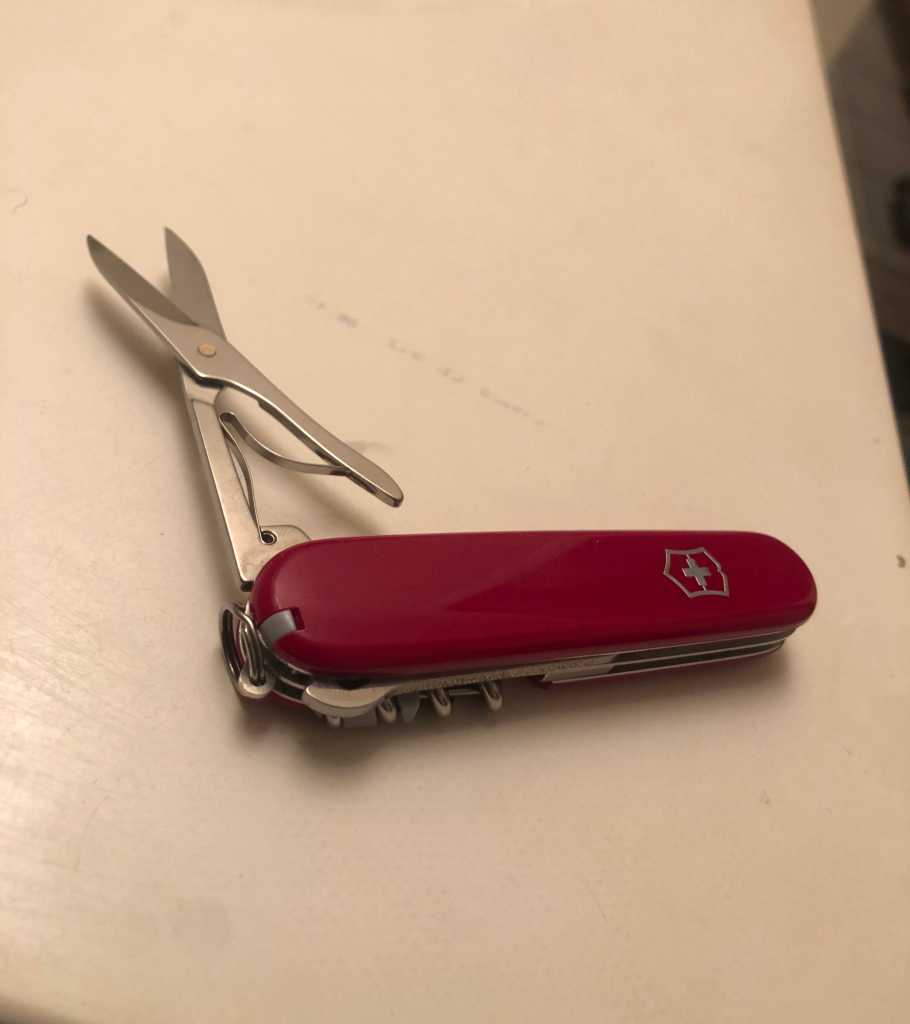
In first-aid moments, the SAK scissors cut smoothly through sterile gauze pads, medical tape, and thick bandages without tearing or chewing the fabric.
32. Disinfecting Tools for Wound Extraction
Because Victorinox uses premium high-grade steel, you can safely hold the tweezers or blades over an open flame or drop them in boiling water to sterilize them before touching skin.
33. Slicing Trapped Vehicle Seatbelts
If a car seatbelt jams after an accident, pulling the belt taut and slicing diagonally with the sharpest base of the large blade cuts through the heavy webbing instantly.
34. Breaking Shatterproof Side Windows
In an emergency vehicle escape, holding a closed, heavy SAK firmly and striking the window corner with the exposed steel edges of the screwdriver tool shatters tempered glass.
35. Lancing and Draining Blisters
The straight metal pin hidden in the scale near the corkscrew base can be sterilized and used to carefully prick the base of a painful hiking blister to drain fluid safely.
36. Striking Ferrocerium Rods
The hard, 90-degree spine of the SAK wood saw or the back of the reamer can be struck against a flint or ferro rod to produce a massive shower of sparks to light a survival fire.
37. Trimming Jagged Nails
A torn, jagged fingernail sustained during manual labor can snag and rip into the skin. The precision scissors allow you to trim and round off nails cleanly to prevent infection.
38. Safely Extracting Embedded Ticks
To remove a tick without leaving the mouthparts behind, clamp the fine tips of the SAK tweezers firmly around the tick’s head right at the skin line and pull straight up evenly.
39. Framing a Finger or Wrist Splint
If a joint is fractured in the wild, you can use the wood saw to cut straight twigs, then use the scissors to cut clothing strips to lash the twigs down, immobilizing the injury.
40. Signaling Helicopters or Rescuers
If lost without signal, the mirror-polished finish of the primary SAK blade can catch direct sunlight to flash Morse code or SOS signals toward distant search teams.
Part V: Specialized & Unconventional Tricks
41. Carrying Heavy Twine Parcels (The Hook)
The back-mounted parcel hook can hook onto heavy, rough twine packages or grocery bags. The body of the knife then becomes a comfortable handle, stopping the twine from cutting into your fingers.
42. Hitting Recessed Factory Reset Buttons
The straight steel pin is the perfect diameter to slide down the deep, narrow reset channels on modern internet routers and smart electronic devices to reset firmware.
43. Opening Stiff Split Key Rings
Instead of ruining your fingernails trying to pry open a heavy steel split ring, slide the flat tip of the small flathead or can opener between the metal coils and twist.
44. Digging Out Embedded Shoe Rocks
Hiking boots collect sharp pebbles in their deep rubber lugs. The sturdy, unsharpened curve of the parcel hook or reamer can hook beneath stones and pop them right out.
45. Cleaning Fouled Spark Plugs
If a generator fails to spark due to black carbon buildup, you can slide the fine metal file tool or pen blade between the electrode gaps to scrape the carbon clean.
46. Punching Custom Belt Holes
When adjusting your gear setup, place the sharp tip of the reamer/awl onto a leather belt and twist it back and forth; it will cut a perfect, round hole without tearing the leather.
47. Extracting Stubborn Tent Pegs
When breaking camp on frozen ground, hook the SAK parcel hook into the eyelet of the stuck tent peg, wrap your hand around the scale, and pull upward using your legs.
48. Tuning Fine Radio Control Knobs
The micro flathead tip on the end of the can opener matches small metric calibration screws on communication equipment and amateur radio dial knobs perfectly.
49. Creating an Emergency Cord Toggle
Pass your paracord through the lanyard ring or key ring of the knife, wrap it around a structural branch, and the weight/friction of the knife will act as a tight cord toggle lock.
50. Writing in Extreme Conditions
Premium SAK models contain a pressurized ballpoint pen inside the scale. This cartridge allows you to write upside down, through oil, on wet paper, or in freezing weather.
Bonus: Amateur Radio Operator Usages
For amateur radio operators, particularly those engaged in portable field operations like Summits on the Air (SOTA), Beaches on the Air (BOTA), or Parks on the Air (POTA), a Victorinox Swiss Army Knife is not just a pocketknife, it is an essential station maintenance tool. When setting up a temporary high-frequency (HF) or very-high-frequency (VHF) station miles away from a permanent workshop, the compact multi-tool handles everything from antenna deployment to emergency transceiver troubleshooting.
The primary blade and wire-stripper notch are invaluable for fabricating or repairing field antennas on the fly. Whether a ham needs to cut a length of lightweight copper wire to resonant length for a 20-meter dipole, trim an antenna wire for a specific frequency using a built-in ruler tool, or cleanly strip away heavy polyethylene insulation from a piece of RG-58 coaxial cable to expose the center conductor for a temporary splice, the SAK delivers clean cuts without tearing the delicate strands inside.
For operators running continuous-wave (CW) modes, the SAK’s precision tools keep Morse code equipment functional in rugged environments. The fine flathead screwdriver or the small pen blade can be used to clear oxidation from mechanical straight key or paddle contacts, back out small set screws to adjust the spacing and tension of a portable keyer, or secure a loose 3.5mm audio jack enclosure that links the keyer to the transceiver rig.
When operating portable stations in heavily forested or mountainous areas, deploying a wire antenna into the tree canopy requires resourcefulness. Hams can utilize the SAK’s lanyard ring or key ring to attach a guide line (such as paracord or monofilament fishing line) to the knife body, or use the multi-purpose hook to snag a tangled antenna line suspended in the branches, creating an improvised weighted toggle or retrieval tool to haul a wire dipole or end-fed inverted-V high into the air.
Modern amateur radio equipment relies on stable DC power, and loose power connections can cause voltage drops or complete station failure. The robust flathead and inline Phillips screwdrivers provide the exact torque needed to securely tighten the terminal screws on portable lifepo4 battery packs, lock down Anderson Powerpole connectors, or screw down heavy ground-wire clamps onto portable grounding rods to bleed off static electricity and stray radio frequency interference (RFI).
Portable transceivers used in field operations feature small modular components that can easily wiggle loose under vibrational stress during transport. The SAK can be used to gently tighten loose BNC, PL-259, or SMA antenna adapters on the radio chassis, or to pry open external battery compartments and speaker enclosures using the flat edge of the bottle opener without scratching or fracturing the radio’s delicate plastic or aluminum housing.
For amateur radio operators who integrate digital modes and automated tracking networks into their field stations, such as the Automatic Packet Reporting System (APRS) or digital packet radio, hardware connections must remain flawless. Hams can use the micro-screwdriver tucked inside the corkscrew to tighten the tiny, recessed screws on RS-232 serial interfaces, DB9 connectors, or custom audio interface cables linking a mobile transceiver to a field laptop or a dedicated automated bot controller.
The SAK’s back-mounted reamer/awl tool functions beautifully as an improvised drill bit for emergency field-shack modifications. If an operator needs to route a piece of coaxial cable, a grounding wire, or an audio patch cable through a plastic project box, a waterproof pelican case casing, or a temporary wooden structural panel, a few controlled twists of the sharp, hardened awl will bore a clean, round hole through the material without cracking the surrounding surface.
During extended field events or emergency communication drills, weather conditions can degrade outdoor antenna performance. Operators can deploy the SAK’s aggressive double-toothed wood saw to clear interfering tree limbs that are brushing against uninsulated antenna elements, or use the metal file tool to rake away rust, scale, and heavy carbon buildup from exposed copper terminals and mobile whip antenna mounts to ensure a low Voltage Standing Wave Ratio (VSWR).
Ultimately, for the licensed amateur radio operator, the Victorinox Swiss Army Knife functions as a lightweight, pocket-sized insurance policy against the unpredictable failures of field communications. From scraping a fouled ground connection clean to adjusting the micro-switches on a digital modem, it ensures that an operator can maintain optimal signal propagation, keep the station on the air, and successfully log contacts or pass emergency traffic no matter how remote the location.
Technical Maintenance of Your Victorinox
To ensure your tool remains functional across all 50 tasks, follow this basic care routine:
| Maintenance Task | Frequency | Procedure |
| Cleaning | Monthly | Open all tools and submerge in warm water with mild dish soap. Use an old toothbrush to clear out pocket lint and dirt from the spring channels. |
| Drying | After every wash | Shake out excess water and dry with a cloth. Use a hairdryer on a low, cool setting to ensure hidden internal moisture is evaporated. |
| Lubrication | After cleaning | Apply one drop of food-safe mineral oil or multi-tool oil to the friction joints. Cycle the tools open and closed to distribute the oil. |
| Sharpening | As needed | Use a fine ceramic hone or pocket stone at a 15 to 20-degree angle. Light, sweeping strokes will restore the factory edge easily. |
Summary
The Victorinox Swiss Army Knife is a masterclass in space optimization, historical resilience, and engineering. By understanding how Karl Elsener transformed a military necessity into a multi-tool legacy, you can appreciate why this red pocketknife remains the ultimate symbol of individual self-reliance. Keep it oiled, keep it sharp, and keep it in your pocket.














Post Comment