Wi-Fi HaLow: The Long-Range, Low-Power Wi-Fi That Quietly Grew Up
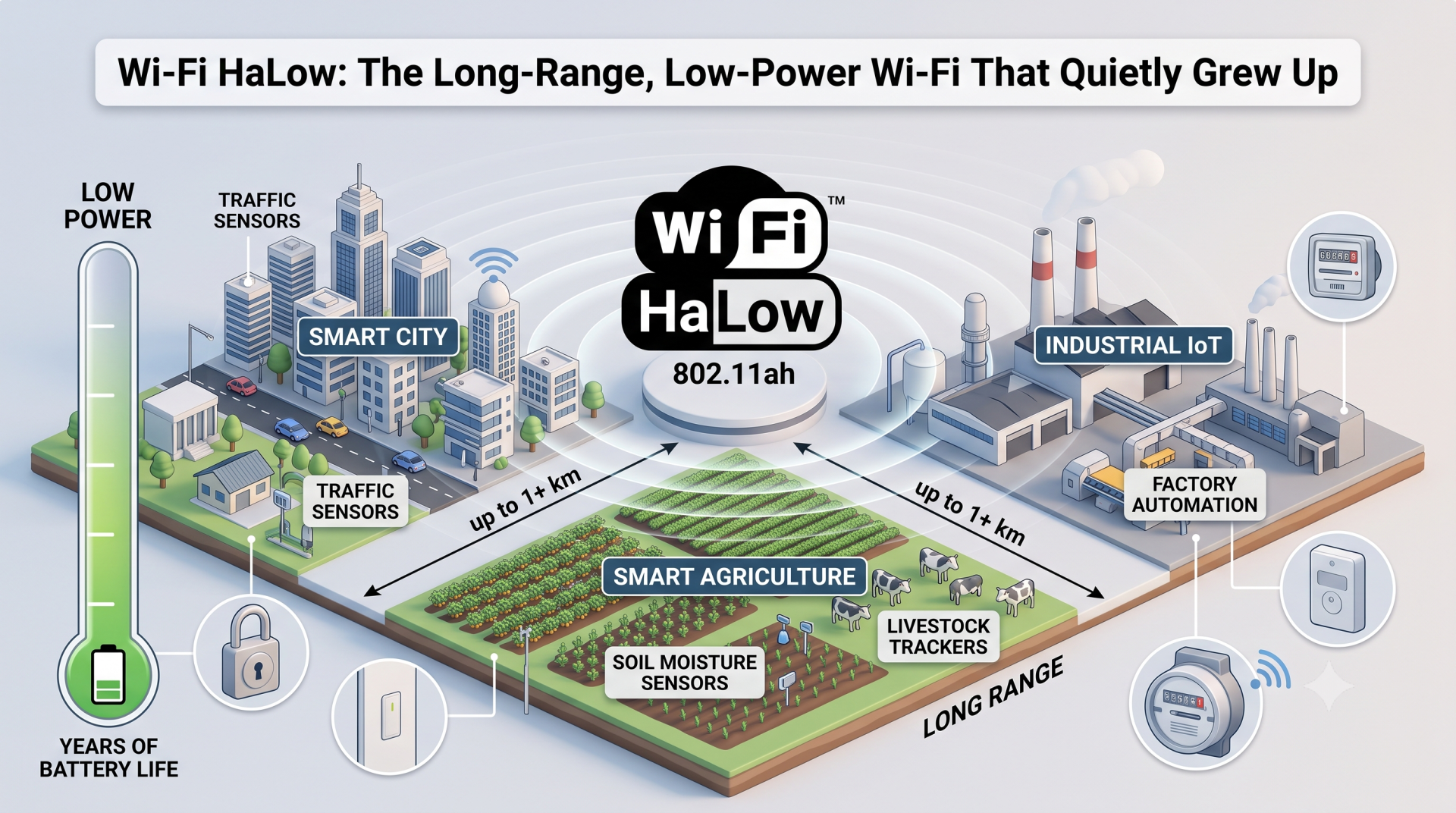
If you have ever tried to make a regular Wi-Fi camera reach the end of a long garden, the back of a barn, or a sensor at the far corner of a farm, you already know the problem. Standard 2.4 GHz and 5 GHz Wi-Fi is fast, but it gives up after a wall or two and a few dozen metres. Range extenders and mesh nodes help, but they cost money, need power, and turn one hop into three.
Wi-Fi HaLow is the answer the Wi-Fi Alliance came up with for exactly those situations. It is real Wi-Fi, with IP addresses and WPA3 security and the same easy setup you are used to, but it runs down in the sub-1 GHz band where signals travel much, much further and slip through walls in a way 2.4 GHz can only dream about.
This article is a relaxed walk through what Wi-Fi HaLow is, where the name came from, how it actually achieves that range, what real-world performance looks like (spoiler: the marketing numbers are optimistic), how it compares to LoRaWAN and friends, what hardware you can buy today, and why it should matter to anyone who plays with radios, sensors, or off-grid networks, hams very much included.
What Wi-Fi HaLow Is, In Plain Language
Wi-Fi HaLow is the marketing name for IEEE 802.11ah, a Wi-Fi standard that operates in the unlicensed sub-1 GHz band instead of the usual 2.4 GHz or 5/6 GHz. The technical standard was published in 2016 as IEEE 802.11ah-2016, and the Wi-Fi Alliance launched the Wi-Fi CERTIFIED HaLow program on 2 November 2021.
The core idea is simple. Lower frequency means longer wavelength, longer wavelength means better diffraction and penetration, and that means a single access point can cover a much larger area and reach devices tucked behind brick, concrete, foliage, or vehicle bodies. The tradeoff is bandwidth, you give up the multi-hundred-megabit speeds of modern Wi-Fi for something more modest, but for most IoT and sensor work that is a perfectly fine deal.
A few headline numbers from the standard:
- Frequency: sub-1 GHz ISM bands. 902 to 928 MHz in the US, 863 to 868 MHz in Europe, 950 to 958 MHz in Japan, with various sub-bands in China and Korea.
- Channel widths: 1, 2, 4, 8, and 16 MHz, with 1 and 2 MHz mandatory. Narrower channels trade speed for range and link budget.
- Data rates: from 150 kbps at the slowest MCS all the way up to about 78 Mbps with a single spatial stream on a 16 MHz channel.
- Stations per AP: up to 8,191 associated devices on a single SSID. Yes, eight thousand.
- Target range: up to 1 km in the standard, with marketing claims of “100x the range” of older IoT radios in favourable conditions.
It is still Wi-Fi under the hood. Native IP, WPA3 security, the same association and roaming machinery, the same easy onboarding. You do not need a proprietary gateway or a LoRaWAN network server. You plug a HaLow AP into your network and your HaLow sensors show up as IP devices, full stop.
Where the Name “HaLow” Came From
The “HaLow” name is pure Wi-Fi Alliance branding, the same way “Wi-Fi 6” is branding for 802.11ax. The Alliance has a habit of giving friendly names to standards with unmemorable numbers, and 802.11ah got “HaLow”. The “ah” in the standard number is echoed in the name, and the rest is marketing.
Before the certification launched, you will sometimes see the technology referred to simply as 802.11ah or “sub-1 GHz Wi-Fi” in academic papers and datasheets. After November 2021, “Wi-Fi HaLow” became the official consumer-facing term, and “Wi-Fi CERTIFIED HaLow” is the logo you look for on a product box if you care about interoperability.
How It Actually Achieves The Range
There is no magic here, just physics and some clever MAC-layer engineering. Three things do most of the work.
Lower frequency. Path loss scales with frequency. Drop from 2.4 GHz to around 900 MHz and, in a typical outdoor path-loss model with exponent n = 3, you roughly double the achievable distance for the same received power. The signal also diffracts around obstacles better and penetrates walls and foliage more effectively. This is the same reason 160 meters reaches farther than 70 centimeters, just applied to Wi-Fi.
Narrower channels. A 1 MHz or 2 MHz HaLow channel concentrates power into less bandwidth, which lifts the signal-to-noise ratio at the receiver. The standard’s lowest MCS uses a 1 MHz channel with a robust MCS10 mode (repetition coding) that can pull usable data out of signals buried deep in the noise. You trade throughput for link budget, exactly the same tradeoff a ham makes choosing CW over SSB.
Smarter power saving. HaLow introduced several MAC features that later showed up in Wi-Fi 6, most notably Target Wake Time (TWT), which lets the AP schedule exactly when each station wakes up to send or receive. A battery sensor can sleep for minutes or hours and only wake for a tiny scheduled window. Combined with Restricted Access Window (RAW) and TIM segmentation, this is how a single AP can keep 8,191 mostly-sleeping devices alive on coin cells for years.
The PHY itself is essentially a 10x down-clocked version of 802.11ac’s OFDM PHY, which is why the symbol times are long, the subcarrier spacing is narrow, and the whole thing is so forgiving on weak links.
Real-World Range: The Honest Numbers
The standard says “up to 1 km” and marketing sometimes says more. Real measurements are more sobering, and worth knowing before you design a deployment around them.
A 2017 outdoor characterisation study (Bellekens et al.) using realistic hardware parameters found:
- Near line-of-sight, macro deployment: around 450 m at 150 kbps.
- Non-line-of-sight, pico deployment: around 80 to 150 m depending on antenna height.
- Ideal hardware at maximum legal transmit power: up to about 1,700 m near-LoS, 490 m pico near-LoS, 300 to 550 m non-LoS.
A 2023 ZHAW (Winterthur) study using the Newracom NRC7394 evaluation kit under European/Swiss regulatory limits and a 1 MHz channel reported:
- Maximum throughput: about 2.3 Mbit/s.
- With the EU 2.8% duty-cycle limit: around 64 kbit/s sustained mean.
- Indoor range: across 3 floors.
- Urban outdoor range: about 230 m.
The takeaway is the same one hams already know. The number on the datasheet is the number you get on a mountaintop with line of sight and a clean band. In a real building, behind real walls, under real regulatory power and duty-cycle limits, expect a fraction of that. Even a fraction of a kilometre is still a lot more than 2.4 GHz Wi-Fi gives you, which is the whole point.
HaLow Versus LoRaWAN, Sigfox, NB-IoT, And Friends
This is the comparison everyone asks about, so let us be straight about it.
LoRaWAN is the elephant in the room. It also runs in sub-GHz ISM bands, also reaches kilometres, also runs on coin cells for years, and has a huge installed base and a mature ecosystem of network servers and gateways. LoRaWAN’s strengths are very long range (multiple km, sometimes 10+ km LoS), very low data rates (bit/s to a few kbit/s), and a star-of-stars architecture where one gateway serves many nodes through a network server. Its weaknesses are tiny payload sizes, downlink is awkward and limited, and you usually need either a public LoRaWAN network (which may not cover your site) or your own gateway plus network server software.
Sigfox is even more minimal, ultra-narrowband, very small messages, very long range, but it is a closed proprietary network that has been winding down in many markets. Worth knowing about historically, less so for new designs.
NB-IoT and LTE-M are cellular, licensed-spectrum technologies. Great coverage where there is cellular, carrier-grade reliability, but you pay a per-device subscription and you are tied to a mobile operator. No spectrum freedom, no rolling your own.
Zigbee, Thread, BLE Mesh are short-range, low-power, mesh-oriented. Brilliant for in-building sensor networks, not the tool for a 500-metre farm link.
Where Wi-Fi HaLow sits is interesting. It is unlicensed (no subscription, no operator), native IP (no gateway protocol translation, no LoRaWAN network server), WPA3 secure out of the box, and offers much higher data rates than LoRaWAN, tens of Mbit/s versus a few kbit/s. That makes it the right answer when you need real IP connectivity, possibly streaming (a compressed security camera feed, for example), over distances that regular Wi-Fi cannot reach, without paying a carrier. LoRaWAN still wins on raw range and on ecosystem maturity for tiny telemetry. They are genuinely complementary, not competitors.
What Hardware You Can Actually Buy Today
The chip side has matured a lot since 2021. The names to know:
- Newracom NRC7394 is the most widely available HaLow SoC. ARM Cortex-M3, integrated baseband and sub-GHz radio, 1/2/4 MHz channels, up to 15 Mbps, 17 dBm on-chip PA, -109 dBm receiver sensitivity. The WHM500A module wraps the NRC7394 with flash and RF filtering and is CE-certified, which matters a lot in Europe. Newracom was one of the first three vendors to earn Wi-Fi CERTIFIED HaLow.
- Morse Micro MM6108 is the other big name, an Australian fabless company that has been HaLow-only from the start and is generally credited with pushing HaLow into real products. Their eval kits and modules are common in HaLow demos.
- Espressif does not (as of mid-2026) make a native HaLow chip. The ESP32-H2 is IEEE 802.15.4 + BLE, not HaLow, and Espressif has repeatedly said HaLow is “not in our plan”. What people do instead is pair a regular ESP32 (or ESP32-S3) with an external HaLow module like the Newracom WHM500A or a Morse Micro module over SPI or UART, using AT commands. There are community shields and a long-running ESP-IDF feature request for a proper host-side SPI driver. So “ESP32 + HaLow” is real, it is just two chips, not one.
- Modules and boards are starting to appear from the usual Shenzhen ecosystem: ESP32-S3 + HaLow camera modules advertising 1 to 2 km and up to 32 Mbps, HaLow gateways that bridge Wi-Fi / HaLow / Ethernet, and bare HaLow radio modules in the $15 to $20 range. Quality and regulatory compliance vary, so check certifications before you deploy anything commercial.
For a hobbyist or ham wanting to experiment, a Newracom WHM500A-EVK paired with a Raspberry Pi is the safest starting point, and there are ESP32 shields built around the same module if you prefer that workflow.
Why Hams And Off-Grid Tinkerers Should Care
Here is the part that ties this back to the rest of this blog.
The US 902 to 928 MHz ISM band sits right on top of the 33 cm amateur band (902 to 928 MHz in the US, shared with ISM). Hams already know this slice, it is where you find 33 cm FM, ATV, repeater links, and increasingly AREDN-style data. Wi-Fi HaLow is a non-amateur, license-by-rule ISM service living in the same spectrum, which makes it a fascinating neighbour to understand even if you never deploy it.
More practically, HaLow is a genuinely good fit for several things hams and makers actually do:
- Remote site monitoring. Solar-powered sensor nodes at a repeater site, a field-day location, or a SOTA summit, reporting temperature, battery voltage, door state, or SWR back to a base over a single HaLow AP instead of a chain of mesh nodes.
- APRS over IP at the edge. An APRS-IS igate or digi at a remote shack with no cellular coverage, fed over a HaLow link from a house with internet a kilometre away.
- Off-grid camera and telemetry. A security or wildlife camera at the back of a property, streaming compressed video over HaLow where 2.4 GHz would never reach and LoRaWAN could not carry the bandwidth.
- Emcomm and served agencies. A portable HaLow AP covering a drill site, a marathon, or a parade, giving IP connectivity to tablets and sensors across a venue without depending on cellular or public Wi-Fi. This is the same niche TAK and AREDN operators work in, and HaLow is a neat tool for the longer, lower-bandwidth links.
- Learning. If you enjoy tinkering with radios, HaLow is a great playground. It is real Wi-Fi, so you can capture and analyse frames with standard tools, but the propagation behaviour is sub-GHz and the link budgets are forgiving enough to actually experiment with antennas, heights, and polarisation.
The one caveat for hams: HaLow gear is not amateur gear, it is Part 15 / CE / etc. certified ISM equipment, and you operate it under those rules, not under your amateur license. You cannot, for example, crank up the power or attach an external amplifier the way you might on the 33 cm ham band. The trade is that you also do not need a license, anyone can deploy it.
A Few Practical Notes If You Want To Try It
- Check your local regulations first. The sub-1 GHz ISM rules differ a lot between the US, EU, UK, Japan, and elsewhere. Europe in particular limits the 868 MHz band to low duty cycles and low transmit power, which is why the ZHAW numbers above are so much lower than the US ones. A HaLow kit built for the US 902 to 928 MHz band may not be legal to transmit with in the EU.
- Pick your channel width deliberately. 1 MHz for maximum range and link budget on a marginal link, 2 MHz as a sensible default, wider only when you have line of sight and want throughput.
- Mind the antenna. Sub-GHz antennas are physically larger than 2.4 GHz ones. A decent 900 MHz yagi or a mounted collinear will dramatically outperform the tiny chip antenna on a module. Height and line of sight matter just as much as on any other UHF link.
- Use TWT for battery devices. If you are running a sensor on solar or coin cells, configure Target Wake Time so the radio sleeps almost all the time. This is where HaLow’s battery life claims actually come from.
- Start with an eval kit, not a custom board. A Newracom or Morse Micro EVK with a Raspberry Pi will save you weeks of bring-up pain and let you actually measure range in your environment before you commit to a design.
Why Wi-Fi HaLow Still Matters
Wi-Fi HaLow spent its first few years as a solution looking for a problem, a standard published in 2016 that nobody quite knew what to do with while LoRaWAN ate the LPWAN market. That has shifted. The certification program is live, real silicon is shipping from more than one vendor, modules are cheap enough to tinker with, and the use cases that suit it, real IP connectivity over real distances without a carrier subscription, are exactly the ones that mesh networks, off-grid sites, and the broader IoT world keep running into.
It is not going to replace LoRaWAN for kilometre-scale telemetry, and it is not going to replace regular Wi-Fi for speed. What it does is fill a quiet but useful gap in the middle: Wi-Fi’s ease and security, sub-GHz’s reach, and no monthly fee. For hams, makers, and anyone who has ever fought a Wi-Fi camera at the end of a long garden, that is a tool worth knowing about.
So the next time you are cursing a 2.4 GHz link that dies at the garden fence, remember there is a flavour of Wi-Fi built for exactly that. It has been growing up quietly for a decade, and it is finally ready to do some work.
Sources and Further Reading
- Wi-Fi Alliance: Wi-Fi CERTIFIED HaLow launch (2 Nov 2021): https://www.wi-fi.org/news-events/newsroom/wi-fi-certified-halow-delivers-long-range-low-power-wi-fi
- Wi-Fi Alliance: Wi-Fi CERTIFIED HaLow for IoT applications (2021): https://www.wi-fi.org/file/wi-fi-certified-halow-wi-fi-for-iot-applications-2021
- IEEE 802.11ah-2016 standard page: https://standards.ieee.org/ieee/802.11ah/4960/
- IEEE 802.11ah Project Authorization Request (PAR): https://ieee802.org/11/PARs/P802.11ah.pdf
- Wi-Fi HaLow for the Internet of Things: An Up-to-date Survey (Tian et al., 2021): https://www.famaey.eu/papers/jnl-tian2021a.pdf
- Outdoor IEEE 802.11ah Range Characterization using Validated Propagation Models (Bellekens et al., 2017): https://www.famaey.eu/papers/cnf-bellekens2017a.pdf
- Practical evaluation of Wi-Fi HaLow performance (Maudet et al., Internet of Things, 2023): https://doi.org/10.1016/j.iot.2023.100957
- ZHAW: NRC7394 Wi-Fi HaLow SoC and Eval-Kit measurements (Jan 2025): https://www.zhaw.ch/storage/engineering/institute-zentren/isc/Dateienablage_News/ZHAW_WiFi_HaLow_ISC_InEs_22.01.2025_V2.pdf
- ZHAW: Wi-Fi HaLow shield for an ESP32 board: https://www.zhaw.ch/storage/engineering/institute-zentren/isc/Dateienablage_News/Wi-Fi_HaLow_Shield_ESP32_ZHAW_V1.0.pdf
- Newracom NRC7394 product page: https://newracom.com/products/nrc7394
- Newracom NRC7394 product brief (PDF): https://newracom.com/hubfs/Resources%20Documents/Product%20Brief%20(NRC7394)(NEWRACOM).pdf
- RCR Wireless: Wi-Fi Alliance certifies HaLow for IoT (2 Nov 2021): https://www.rcrwireless.com/20211102/featured/wi-fi-alliance-certifies-halow-for-iot-applications
- Stacey on IoT: Wi-Fi HaLow is now certified and ready for action: https://staceyoniot.com/wi-fi-halow-is-now-certified-and-ready-for-action/
- Espressif ESP-IDF issue #16037: Host-side SPI driver for Wi-Fi HaLow modules: https://github.com/espressif/esp-idf/issues/16037
- Espressif ESP-IDF issue #913: ESP32 Wi-Fi Support for 802.11ah HaLow: https://github.com/espressif/esp-idf/issues/913
- Wi-Fi HaLow on Wikipedia: https://en.wikipedia.org/wiki/Wi-Fi_HaLow


1 comment