CW Prosigns and Abbreviations That Leaked Into Everyday Life

“You don’t have to love Morse code. Morse code has already moved into your typing.”
If you have spent any time around ham radio, even just lurking in a forum, scrolling a Discord server, or reading a YouTube comment under a DXpedition video, you have seen them. 73. HIHI. DE. QSL. QSY. QRZ? Little clusters of letters and numbers that look like typos to the rest of the world, but to a ham they read as plainly as “goodbye”, “lol”, “from”, “got it”, “let’s move”, and “who’s calling?”
Here is the funny part: most of the people typing them today do not own a Morse key. Some of them actively dislike CW. A few would happily banish the whole mode to the dustbin of radio history if they could. And yet, every time they sign an email with 73, every time they type HIHI at a joke in a group chat, every time they tell a friend “QSL on that”, they are sending telegrams. They just don’t realise it.
This article is a relaxed wander through how that happened. No exams. No speed tests. Just the story of how a handful of dots and dashes from the 1850s quietly took over the way hams, and a lot of non-hams, still write to each other today.
Why CW and Ham Radio Are Basically the Same Grandfather
To understand why CW shorthand is everywhere in ham radio, you have to remember one simple thing: for the first few decades of the hobby, there was no other way to do it.
When amateur radio got going in the early 1900s, voice transmission was either impossible, terrible, or illegal for amateurs depending on where you lived and what year it was. The first transatlantic amateur contacts in 1921 and 1922 were CW. The first ARRL DX contests were CW. The original logbooks were all CW. The QSL cards arriving in the mail said “TNX FER QSO” and “73” because that is what had been sent over the air to confirm the contact in the first place.
So when voice finally became practical, AM in the 1920s and 1930s, SSB in the 1950s, FM and repeaters in the 1960s and 1970s, then all the digital modes from RTTY through FT8, the operators moving into those new modes were the same people who had grown up on CW. They brought their shorthand with them. It was the operating language they already shared.
That is why, even today, a brand-new ham who has never touched a straight key will still learn what QSO means within a week of getting licensed. It is in every manual, every logging program, every contest rules sheet, every piece of chat in every ham forum. CW isn’t a mode you can fully escape in amateur radio. It is the substrate the hobby was built on. The vocabulary came with the building.
The Ham Who Hates CW, And Still Types It Every Day
There is a particular kind of ham we all know. They will tell you, at length, that Morse code is obsolete, that the code test was a stupid barrier, that CW operators are elitist, that the bottom of every HF band is wasted spectrum, and that the day the ITU dropped the Morse requirement in 2003 was the best day in amateur radio history.
Then they sign off their email with 73.
Then they post on Facebook: “Worked JA this morning on 20m FT8, QSL received, TNX to all who called. 73 de 9M2PJU.”
Then they message a friend: “QRZ? Who’s calling on the repeater?”
Then they laugh at a joke in the club WhatsApp: HIHI.
They are not being hypocrites. They are being hams. The shorthand is so deep in the culture that you absorb it by osmosis. You do not need to know a single dit from a dah to use it. You just need to hang around hams long enough, and the words stick.
This is the part that surprises outsiders: CW is not just a mode, it is a vocabulary. And the vocabulary outlived the requirement. When the Morse code test was dropped worldwide, nobody stopped using the abbreviations. Why would they? They are short, they are clear, they work in any language, and every ham on Earth already knows them. Dropping the test made the skill optional. It did nothing to retire the language.
So the ham who hates CW still uses CW every day. They just type it instead of keying it. The brass is gone; the slang remains.
Where All This Stuff Came From
Before we get to the fun part, the actual list of things you have probably typed without knowing why, it helps to know that almost none of it was invented by hams. We inherited it, the way a language inherits words from a country it used to be.
There are three main family trees.
1. The Telegraph Numerical Codes (1850s onwards)
Back in the landline telegraph era, every minute on a wire cost money. Operators were paid by the message, lines were shared, and there was strong pressure to say as much as possible in as few key presses as possible. The solution was numerical brevity codes: a small set of numbers, each standing for a whole phrase.
The most famous is the Western Union 92 Code, adopted in 1859. Numbers 1 through 92 each mapped to a stock phrase. A few of them survived into ham radio and never left:
- 73, originally “accept my compliments” in the 1859 code, later softened to “best regards”. Still the standard ham sign-off, on CW, voice, email, text, forum posts, anywhere.
- 88, “love and kisses”. Still used between spouses, sweethearts, and (cheekily) close friends at the end of a contact or a card.
- 30, “the end” or “no more”, used for decades to mark the end of a press wire story. Old journalists still recognise it.
- 92, “deliver promptly”. Mostly forgotten, but it gave the whole code its name.
The 92 Code was later folded into the Philips Code of 1879, a wider set of telegraphic abbreviations compiled by Walter Phillips of the Associated Press for press traffic. A lot of newspaper abbreviations people assume are modern are actually Philips Code. Hams borrowed freely from both.
So when you write 73 at the bottom of an email, you are quoting a telegraph operator from before the American Civil War. That is genuinely how old it is.
2. The Q Code (1909-1913)
The Q-codes are the other great pillar of ham shorthand, and they have a cleaner origin story.
In the first decade of the 1900s, ships at sea were carrying wireless telegraphs, and their operators often did not share a language. A British ship might need to talk to a French coast station, an Italian ship, a German liner. Spelling out “what is your position and what is your heading?” in plain English was hopeless. So a list of three-letter groups, all starting with Q, was drawn up to stand for whole operational sentences. The Q prefix was chosen because it was rarely used at the start of ordinary words, so a Q-group could not be confused with normal text.
The first formal list was prepared around 1909 by the British Post Office for British ships and coast stations, on the lines of proposals made at the 1906 Berlin International Radiotelegraph Conference. The big international moment came at the London International Radiotelegraph Conference of 1912 (signed 5 July 1912, in force 1 July 1913), which adopted a list of around 45 Q-codes for station identity, distance, bearings, reception quality, interference, atmospheric noise, power, speed, readiness, traffic, and so on.
The grammar is the clever bit, and it has never changed: add a question mark to ask, omit it to answer. QRZ? means “who is calling me?” QRZ means “you are being called by _______”. QTH? means “what is your location?” QTH means “my location is _______”. One code, two uses, no ambiguity, any language.
Hams took to the Q-code instantly because it solved the same problem at sea that it solved on the HF bands: short, standard, language-independent. By 1915 the ARRL was naming its magazine QST, the Q-code for “general call to all stations”. Over a century later, that magazine is still called QST, and hams still say QSL, QSO, QSY, QRP, QRM, QRN, QRV, QRO, QRZ, QTH in everyday speech, typing, and voice operating. Many of them have never read the 1912 regulations. They don’t need to. The words are just part of being a ham.
3. CW Prosigns and Operating Abbreviations
The third family is the prosigns, “procedural signals”, and the short letter abbreviations that grew up around CW operating. These are the ones that look the most like typos to outsiders: AR, SK, BT, KN, AS, HH, DE, ES, HI, HW, OM, YL, FB, TNX, PSE, AGN, NW, UR, R, RR, CQ, DX, LID, and so on.
A prosign is, in essence, two characters sent as one, with no space between them, standing for a whole operating phrase. They were invented by telegraphers for the same reason as everything else: time on the wire was expensive, and a single compact signal was faster and clearer than spelling out “end of message” or “wait” or “error, I’m going to resend that”.
Some of them are written with an overline or a joining bar in formal notation (<AR>, <SK>, <BT>), but in plain text most hams just type the letters: AR, SK, BT, KN, AS.
A few of the most common prosigns and what they mean:
- AR, end of message. The CW full stop.
- SK, end of contact, last transmission, signing off. The CW goodbye.
- BT, break, used like a paragraph break or a pause. Hams on voice still say “break” the same way.
- KN, “go only”, directed at the station being worked, not a general invitation.
- AS, “wait”, stand by a moment.
- HH (eight dots), error, I made a mistake, ignore that last bit. The CW equivalent of backspacing.
- AA, new line / separator, used in radiograms and structured messages.
- CQ, general call to any station. Not strictly a prosign, but used the same way: “calling anyone, anyone, anyone”. Still typed in chat as
CQ CQ CQwhen someone wants attention.
The letter abbreviations are simpler still, just shortened English words, shaped to fit a CW rhythm:
- DE, “from” (French de, “from”). Used to identify the sender:
CQ CQ CQ DE 9M2PJU= “calling anyone, from 9M2PJU”. Still typed at the top of forum posts and emails:73 de 9M2PJU. - ES, “and” (Latin et).
RST 599 599 ES QSB= “RST 599 599 and QSB”. - HI, laughter. The Morse for HI sounds like a chuckle when sent at speed. So
HIHIis “haha”, and hams still type it in chat to this day, even when they have never heard the actual sound. - HW?, “how copy?” Did you get that all right?
- R / RR, “received” / “roger”.
Ris the single-letter acknowledgement.RRis “roger roger”, solid copy. - OM, “old man”, a friendly term for a male operator. Not an insult.
- YL, “young lady”, a female operator. XYL, “ex-young lady”, a wife. (Yes, really. It is from the 1920s. We are stuck with it.)
- FB, “fine business”, meaning “excellent” or “all good”.
FB OM= “fine business, old man” = “great, mate”. - TNX / TKS, “thanks”.
- PSE, “please”.
- AGN, “again”.
- NW, “now”. (Not “new”. This one trips up newcomers constantly.)
- UR, “your”.
- SIG, “signal”.
- RPRT, “report”, as in signal report.
- LID, a poor operator. Mild insult, affectionate when used about yourself.
- DX, distance, usually another country. A “DXer” chases rare countries.
- QRP, low power (5 watts or less on HF, by convention). Also a whole philosophy of operating.
- QRO, high power, the opposite of QRP.
- QSL, “I confirm receipt”, or a postcard confirming a contact.
- QSO, a conversation, a contact.
- QSY, change frequency.
- QRM, interference, man-made noise.
- QRN, static, atmospheric noise.
- QRZ?, who is calling me?
- QTH, my location.
- QRV, ready.
- QSB, fading.
Almost none of these were invented by amateurs. They came from commercial and maritime wireless operating, which came from landline telegraphy, which came from the simple economic fact that time on a wire cost money and short was cheap.
How They Leak Into the Internet and Social Media
Here is where it gets fun. Once you start looking, you see CW shorthand everywhere a ham has been typing.
Email and forum signatures. 73 de 9M2PJU is the classic ham email sign-off. It is so standard that omitting it can feel rude, and adding 88 to a spouse’s email is a small ham in-joke that nobody outside the hobby will ever decode.
Social media posts. Scroll any ham Facebook group, Mastodon feed, or Reddit /r/amateurradio thread and you will see QSL, QSO, QSY, QRM, QRN, QRP, DX, OM, YL, FB, TNX, HIHI, and 73 constantly. People who have not touched a key in decades still type them. People who never touched a key type them.
Chat apps. Discord, WhatsApp, Telegram, Slack, any group with hams in it will have HIHI at jokes, QSL as a quick “got it”, QSY as “let’s take this to another channel”, and QRZ? as “who said that?”. The shorthand is faster than the long form, and every ham understands it, so it sticks.
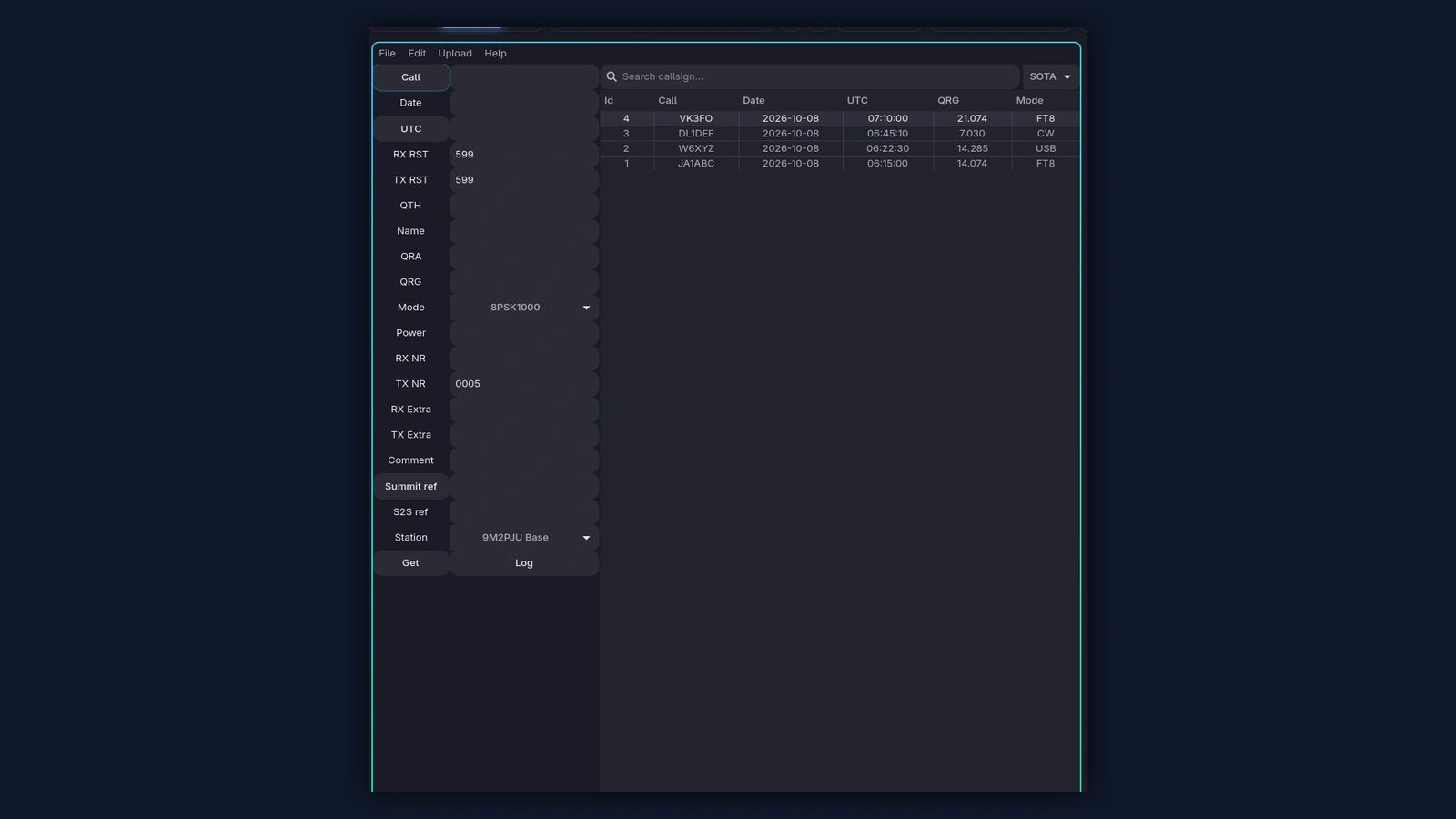
Logging and contest software. Every logging program in existence uses Q-codes and CW abbreviations in its fields, labels, and macros. QSO count, QSL received, QSL sent, QRP category, QRM report. The vocabulary is baked into the software.
YouTube and blog comments. Under any ham video: FB OM, 73, TNX fer the vid, HIHI, QSL on that, QSY to 20m. It is a kind of in-group signalling, a quiet way of saying “I’m a ham too”.
Even non-hams pick a few up. SOS is a CW prosign that literally every person on Earth recognises, even if they do not know it is Morse for nothing in particular, it is not the letters S-O-S, it is a single prosign sent as one continuous signal, but it was chosen because it reads as S-O-S in text and is unmistakable on a key.
HIHI is the best one. It is the ham equivalent of “lol”, and it exists for the purest reason: the Morse characters for H and I, sent quickly, sound like a little chuckle. dit-dit-dit-dit dit-dit. Try it in your head. It is funny. So hams started sending HI to mean “I’m laughing”, then HIHI for a real laugh, and a century later people are typing it in WhatsApp groups without ever having heard the sound that started it. That is a beautiful little piece of cultural drift.
A Quick Cheat Sheet, For When You See Them in the Wild
If you are new to the hobby, or just trying to decode a ham forum, here is a compact reference. None of this is exam material. It is just the words people actually use.
| You see | It means | Where it came from |
|---|---|---|
| 73 | Best regards, sign-off | Western Union 92 Code, 1859 |
| 88 | Love and kisses | Western Union 92 Code, 1859 |
| 33 | Best regards (YL to YL, sisterhood) | Newer ham usage |
| 72 | Best regards (QRP operator to QRP operator) | Newer ham usage |
| DE | From (identifies sender) | French de, CW operating |
| ES | And | Latin et, CW operating |
| HI / HIHI | Laughter / haha | Morse for H-I sounds like a chuckle |
| HW? | How copy? Did you get that? | CW operating |
| R / RR | Received / Roger roger | CW operating |
| FB | Fine business, excellent | CW operating slang |
| OM | Old man, friendly male operator | CW operating slang |
| YL | Young lady, female operator | CW operating slang |
| XYL | Wife (“ex-young lady”) | 1920s CW slang, still here |
| TNX / TKS | Thanks | CW abbreviation |
| PSE | Please | CW abbreviation |
| AGN | Again | CW abbreviation |
| NW | Now (not “new”) | CW abbreviation |
| UR | Your | CW abbreviation |
| LID | Poor operator | CW slang |
| DX | Distance, foreign country | CW abbreviation |
| CQ | Calling any station | General call, CW operating |
| QSL | I confirm / a confirmation card | Q-code, 1912 |
| QSO | A contact, a conversation | Q-code, 1912 |
| QSY | Change frequency | Q-code, 1912 |
| QRM | Interference, man-made noise | Q-code, 1912 |
| QRN | Static, atmospheric noise | Q-code, 1912 |
| QRP | Low power (≤5W HF) | Q-code, 1912 |
| QRO | High power | Q-code, 1912 |
| QRZ? | Who is calling me? | Q-code, 1912 |
| QTH | My location | Q-code, 1912 |
| QRV | Ready | Q-code, 1912 |
| QSB | Fading | Q-code, 1912 |
| AR | End of message (prosign) | Telegraph operating |
| SK | End of contact, signing off (prosign) | Telegraph operating |
| BT | Break, paragraph break (prosign) | Telegraph operating |
| KN | Go only, directed back to one station (prosign) | Telegraph operating |
| AS | Wait, stand by (prosign) | Telegraph operating |
| HH | Error, scratch that (prosign) | Telegraph operating |
| SOS | Distress (a single prosign, not the letters S-O-S) | International distress, 1906 |
So, Should You Use Them?
Honestly, yes, if you want to. There is no rule that says you have to know Morse to type 73 at the end of an email. There is no CW police. The whole point of the shorthand is that it is short, friendly, and shared. If you know what it means and the person you are writing to knows what it means, it works. That has been true since 1859.
And if you are a ham who hates CW, that is fine too. You are still going to type 73 and QSL and HIHI for the rest of your life. You inherited them. They were already old when your grandfather was born. They will still be here when the last straight key is in a museum. The mode may be optional now, but the vocabulary is not.
Morse code stopped being a requirement a long time ago. It never stopped being a language.
73 de 9M2PJU. HIHI.


Post Comment