The Copper-Wire Internet: How Ham Radio Conquered Real-Time Data and Global Spotting Before the Internet Wielded Its Might
Today, tracking a rare DX station or viewing the live movement of a portable radio operator feels almost trivial. An amateur radio operator steps into their shack, glides a finger across a smartphone screen, or opens a web browser to sites like aprs.fi or DXWatch.com. Within milliseconds, routing tables, fiber-optic undersea cables, and high-speed 5G networks deliver real-time spatial positioning, telemetry, and spotting data directly to their eyes. The digital global infrastructure handles the heavy lifting, acting as an invisible, omnipresent conduit for amateur radio metadata.
But transport yourself back to the mid-1980s and early 1990s. The commercial internet did not exist. The World Wide Web was either an unhatched egg in Tim Berners-Lee’s mind or a niche academic text interface. Google Maps was decades away from inception, and the concept of an interconnected, consumer-grade digital network spanning the globe was pure science fiction.
Yet, during this analogue-dominated era, amateur radio operators (hams) were already doing the impossible: they were sending real-time short text messages, automatically plotting precise GPS coordinates onto dynamic digital maps, and executing instantaneous, crowd-sourced global DX spotting alerts.
They did not use a single drop of internet data. Instead, they weaponized raw radio frequencies (RF) and homebrew computer networking logic, building their own parallel, decentralized, airwave-bound “internet.” This is the comprehensive, forgotten history of how the Automatic Packet Reporting System (APRS) and the DX Cluster network conquered real-time data over the airwaves.
Part I: The Pre-Internet Vacuum and the Genesis of Packet Radio
To comprehend why these systems were engineered without the internet, one must look at the technological landscape of the late 1970s and early 1980s. The only existing nationwide computer network of note was ARPANET, a highly restricted environment funded by the United States Department of Defense, accessible exclusively to military installations, government contractors, and elite research universities. For the average citizen (and the average ham) the computer was an isolated island: an Apple II, a Commodore 64, or an early IBM PC running MS-DOS, completely cut off from external communication unless paired with an expensive, low-speed telephone acoustic coupler modem.
Radio amateurs, driven by an innate philosophy of self-reliance and public service communication, recognized that computers could be used to automate traffic handling and tactical awareness. They asked a fundamental question: If a telephone wire can carry digital bits via audio tones, why can’t a radio channel do the same?
The Birth of the AX.25 Protocol
The breakthrough occurred when a group of pioneering hams in Vancouver, Canada, followed closely by the Tucson Amateur Packet Radio (TAPR) organization in Arizona, adapted a commercial CCITT international standard networking protocol known as X.25. Because X.25 was designed for reliable, wired telephone switching networks, it was ill-suited for the chaotic, noise-plagued environment of amateur radio frequencies.
The community re-engineered it into AX.25 (Amateur X.25). This protocol introduced crucial modifications:
- Amateur Radio Callsigns as Network Addresses: Instead of abstract IP addresses or numeric routing nodes, every data packet embedded the sender’s and receiver’s legal amateur radio callsigns directly into the frame header (e.g.,
9M2PJUorWB4APR). - Unacknowledged Frames (UI-Frames): The protocol allowed for “fire-and-forget” beaconing, meaning a radio could broadcast information to anyone listening without requiring a complex, resource-heavy two-way digital handshake.
The Terminal Node Controller (TNC)
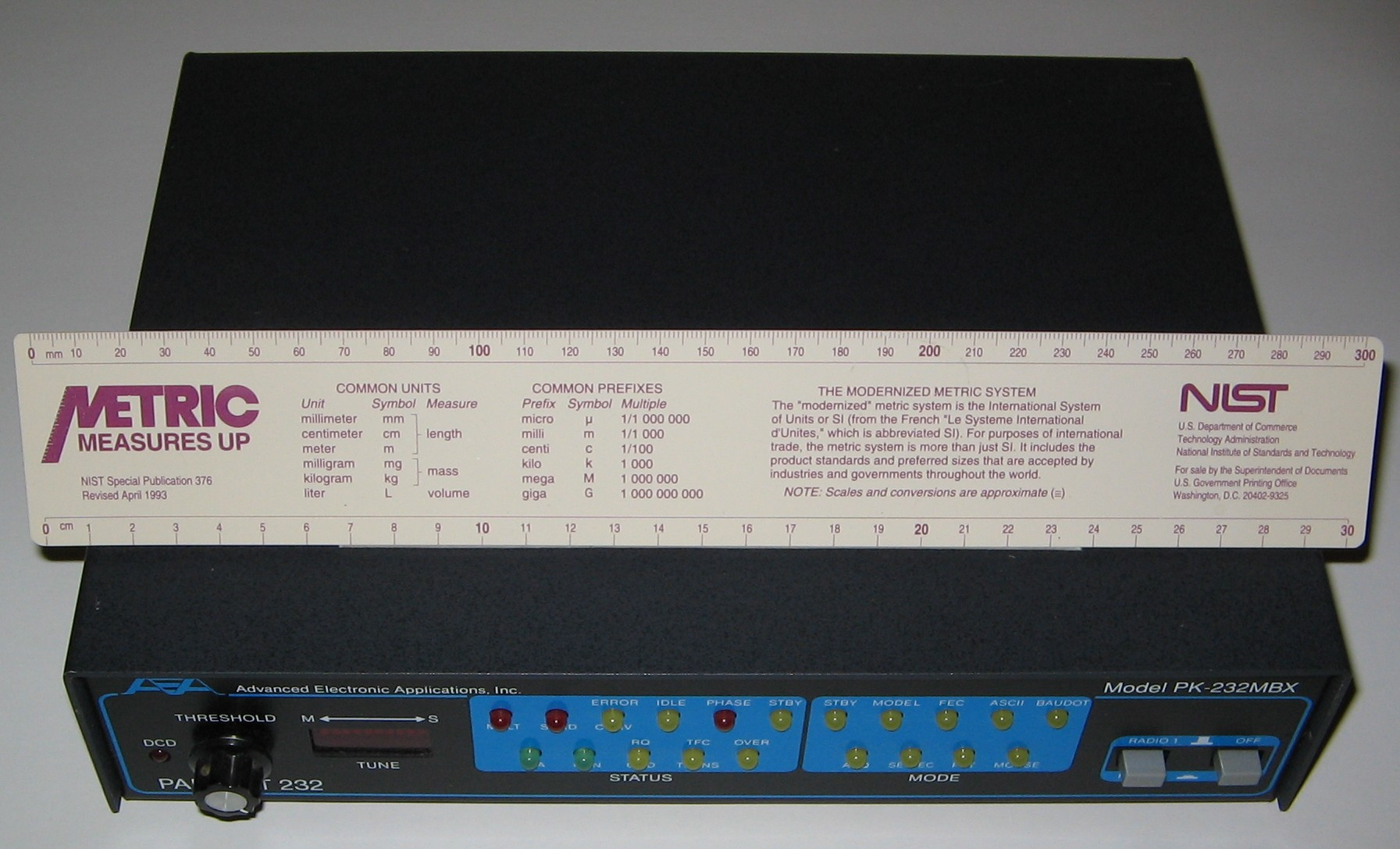
To bridge the gap between the digital computer and the analogue transceiver, hams created the Terminal Node Controller (TNC). The TNC was a dedicated microcomputer containing its own microprocessor, RAM, and a specialized modem chip (such as the AMD 7910).
Computer (DOS) <---> Terminal Node Controller (TNC) <---> VHF Transceiver
When a ham typed a message on an old green-screen DOS terminal, the computer sent the ASCII text via a serial RS-232 cable to the TNC. The TNC wrapped the text in an AX.25 packet frame, calculated a cyclical redundancy check (CRC) for error detection, and converted the digital ones and zeros into audible audio shifts using Audio Frequency Shift Keying (AFSK).
On VHF (typically the 2-meter band), this meant shifting between 1200 Hz and 2200 Hz tones at a modest speed of 1200 bits per second (bps). This distinctive, chaotic screech (resembling a high-pitched digital chirp) became the soundtrack of the data revolution on the ham bands.
Part II: The DX Cluster: The World’s First Over-The-Air Social Network
For decades, finding “DX” (amateur radio shorthand for distant, rare, or hard-to-reach international stations) was a matter of luck, endless dial-spinning, and listening through static. If a rare DXpedition went live from a remote island in the Pacific, an operator who stumbled upon them would have to make contacts, then manually call local friends on a local VHF voice repeater to spread the word. It was slow, localized, and inefficient.
In 1985, an inventive software engineer and ham named Dick Newell (AK1A) revolutionized the hunt by writing a software program for MS-DOS computers called PR7300, which later evolved into the commercially legendary PacketCluster. It became the blueprint for the DX Cluster.
The Architecture of an Isolated Cluster
A DX Cluster was built as a hierarchical, localized network that operated entirely over radio frequencies. It did not require a central server in a Silicon Valley data center. Instead, it relied on localized infrastructure maintained by volunteer SysOps (System Operators).
1. The Local Node Host
The core of the system was the Node. A SysOp would dedicate a high-performance desktop PC (often a 286 or 386 processor running DOS) located at a premier radio site with a high antenna. This PC ran the PacketCluster software 24 hours a day, 7 days a week. It was physically connected to a high-grade TNC and a VHF transceiver locked onto a dedicated local packet frequency.
2. The Point-to-Point User Connection
To access the cluster, a local ham operator at home did not boot up a web browser. They turned on their VHF radio, loaded a terminal emulation program (such as Procomm Plus, Telix, or HyperTerminal) on their computer, and commanded their home TNC to connect directly to the local node over the airwaves.
For example, a user would type:
cmd: C AK1A-1The home radio would key up, transmit the packet, and within moments, the local node would respond, greeting the user with a text-based interface displaying the latest DX station listings.
Local User (Home QTH) <---[VHF RF Link]---> Local Node (SysOp) <---[UHF/HF Backbone]---> Regional NodeThe Magic of Inter-Cluster Linking (The RF Backbone)
An isolated local node is only as good as the information its local users feed it. If a ham in your city doesn’t hear a station from Malaysia, your cluster remains blank. How did Dick Newell solve this without the internet?
He engineered Inter-Cluster Linking. Nodes were programmed to connect to other nodes in neighboring cities, states, or even countries. Because a standard 2-meter VHF frequency is limited by line-of-sight propagation, SysOps set up dedicated, high-speed UHF (70cm or 23cm bands) point-to-point directional links or utilized HF packet links (such as 20 meters or 40 meters) to bridge massive distances.
When a ham in Boston spotted a rare station, the Boston Node processed the text. It then automatically packed that spot into a specialized node-to-node data routing packet and blasted it across its UHF link to the Providence, Rhode Island Node. The Providence Node updated its database and instantly forwarded it to the Hartford, Connecticut Node, and so on, cascading down the coast like a digital bucket brigade.
Within seconds, an over-the-air data packet ripple effect spread throughout entire continents. Hundreds of hams connected to disparate local nodes saw their screens refresh simultaneously with the exact frequency and callsign of the target station.
The Anatomy of a Classic Packet DX Spot
The interface was sparse, beautiful, and utterly functional. It minimized bandwidth consumption to ensure that 1200 bps channels did not bottleneck. A typical raw terminal printout looked precisely like this:
DX de 9M2PJU: 14025.0 K2AU CW Loud in Malaysia up 2 1422Z- DX de 9M2PJU: Explains that the spotter reporting the station is
9M2PJU. - 14025.0: The exact operating frequency in Kilohertz (14.025 MHz, inside the 20-meter band).
- K2AU: The target DX station that was heard.
- CW Loud in Malaysia up 2: Crucial tactical comments detailing the modulation mode (CW/Morse Code), signal strength, and that the station is listening 2 kHz higher than its transmitting frequency (split operation).
- 1422Z: The precise time of the spot in Zulu Time (Coordinated Universal Time, UTC).
Part III: APRS: The Tactical Airwave Grid Map
While the DX Cluster was transforming the way hams hunted distant signals, a brilliant researcher named Bob Bruninga (WB4APR) at the United States Naval Academy was tackling a completely different problem: shared tactical situational awareness.
In 1982, Bruninga wrote a foundational tracking program on an Apple II computer called CERS (Connectionless Emergency Radio System). It was engineered to track the positions of Navy boats via high-frequency radio reports. In 1984, he migrated the concept to the low-cost Commodore VIC-20 and C64 platforms to map the real-time progress of runners across a marathon course. By 1992, Bruninga formalized this framework for the global amateur radio community, branding it the Automatic Position Reporting System, later refined to the Automatic Packet Reporting System (APRS).
The Core Problem: Mapping Without Google Maps
To comprehend the technical genius of early APRS, one must strip away the modern luxuries of digital mapping. In 1992, there was no online map imagery api, no tile server cache, and consumer GPS units were rare, heavy, prohibitively expensive tools that output raw NMEA-0183 sentences (long strings of text containing numbers like $GPRMC,142200,A,0253.200,N,10144.100,E...).
Bruninga’s APRS software, written natively for MS-DOS, overcame these computational limitations through a masterful blend of compression and offline asset deployment.
1. Pre-Loaded Vector Cartography via Floppy Disks
Because maps could not be fetched on-demand from a network cloud, the APRS DOS software included precompiled, highly efficient, small-footprint vector map files. These files contained coordinate outlines of coastlines, international borders, major interstate highways, and primary geographic features.
Users received these maps by copying them from 3.5-inch or 5.25-inch floppy disks distributed by hand at hamfests or downloaded slowly from local dial-up Bulletin Board Systems (BBS).
2. Raw GPS Transmutation over RF
For mobile stations, early adopters spliced a serial cable from their early consumer GPS receivers into the input port of a specialized mobile TNC (like the Kantronics KPC-3). The TNC was configured to parse the raw incoming NMEA string, extract the longitude and latitude, compress the data string to save precious over-the-air transmission time, and pack it into an AX.25 UI-frame.
The mobile radio would periodically key up its transmitter and broadcast a quick burst of AFSK data onto the universal regional APRS frequency.
The Digipeater: The Foundation of Airwave Scalability
Because mobile stations typically used low-power handheld or mobile transceivers pushing 5 to 50 watts of power into simple whip antennas, their raw RF packets could rarely travel past the horizon. Without an internet backbone to upload these coordinates to a central database, how did a mobile station moving through a valley register on a map on a computer screen 150 miles away?
The answer lay in the deployment of Digipeaters (Digital Repeaters).
Unlike traditional voice repeaters that receive a signal on one frequency and instantly retransmit it on another frequency simultaneously, a digipeater is an intelligent store-and-forward system operating on a single shared simplex frequency.
- Listen: The digipeater, placed atop a mountain peak, tall commercial tower, or high-altitude structural roof, constantly monitors the regional APRS data channel.
- Buffer: It catches an incoming packet frame from a mobile station (e.g.,
9M2PJU-9). It verifies that the frame arrived completely intact without data corruption by verifying its CRC checksum. - Inspect Routing Headers: It looks at the path instruction embedded in the packet. Early paths used commands like
WIDEorRELAY. - Retransmit: If the path indicated that the packet required further propagation, the digipeater queued the exact data packet, waited for a fraction of a second for the airwaves to clear, keyed its high-power transmitter, and blasted the packet back out over the entire region.
Through clever pathing configurations like WIDE2-2, a single mobile beacon could hop from one mountain-top digipeater to a second mountain-top digipeater, blanket-broadcasting its geographic telemetry across an entire territory or state within two seconds. Every home station running the APRS DOS software within listening range of any of those digipeaters would decode the packet, and a small, flickering icon of a car, van, or pedestrian would instantly materialize and move across their offline vector map grid.
Part IV: A Comparative Analysis of Early Architectures
To truly appreciate the genius of these two distinct pre-internet data networks, we can look at their design paradigms side-by-side. While both relied on AX.25 packet radio at 1200 bps, they were optimized for entirely different data behaviors:
| System Parameter | Early DX Cluster (PacketCluster) | Early APRS (Automatic Packet Reporting System) |
|---|---|---|
| Primary Creator | Dick Newell (AK1A) in 1985 | Bob Bruninga (WB4APR) in 1992 |
| Connection Topology | Connection-Oriented: Users executed a deliberate, continuous two-way login session to a specific server node. | Connectionless: Users utilized stateless beaconing (UI-frames) with no logins or persistent handshakes. |
| Primary Data Type | Raw alphanumeric text strings detailing frequency, time, callsign, and comments. | Geographic coordinates (Lat/Long), weather station telemetry, short status messages, and icon symbols. |
| Network Expansion Method | Dedicated point-to-point Inter-Cluster Links via specific UHF/HF backbone frequencies. | Flooding regional propagation via single-frequency Digipeaters utilizing intelligent path routing. |
| User Map Interface | Completely text-driven terminal; spatial visualization happened inside the operator’s mind. | Offline vector geographic maps precompiled and loaded locally via floppy disks. |
Part V: The Great Internet Convergence
As the late 1990s rolled around, the landscape of technology changed forever. Consumer dial-up internet accounts proliferated, giving rise to persistent, cheap network connectivity. The amateur radio community recognized that while RF links were an exquisite, resilient proof of concept, they had physical limits: solar flares degraded HF links, and severe terrain could isolate regional VHF digipeater networks.
Hams did not abandon their creations; they built bridges between their radio networks and the burgeoning global internet.
The Invention of the IGate and APRS-IS
In the late 90s, software developers introduced the APRS Internet Service (APRS-IS) alongside the concept of the IGate (Internet Gateway). An IGate is an amateur radio station running a standard receiver or transceiver tuned to the local APRS frequency, but its host computer is simultaneously connected to a live internet connection.
Mobile Station (RF) ---> Local IGate (RF + Internet) ---> APRS-IS Server (WAN) ---> Web Browsers (aprs.fi)When the IGate receives a packet over the air from a local mobile station, it extracts the AX.25 frame information, converts it into an internet-friendly data packet, and pipes it via a TCP/IP connection to a core cluster of global APRS servers. This allowed data from an HT in a small town in Malaysia to be uploaded instantly to a global stream, viewable by an operator in London via an early web browser.
The Migration of the Cluster to Telnet
Similarly, DX Clusters adopted the Telnet protocol. SysOps kept their specialized cluster logic intact but added internet connection modules. Hams at home no longer needed to fire up a 2-meter radio just to see what was active on the HF bands; they could open a command terminal on their internet-connected PC, type telnet 9m2pju.hamradio.my, and log directly into the node over the internet.
Part VI: The Modern Value of Pre-Internet Engineering
It is easy for a modern observer to view these early packet architectures as obsolete milestones of a bygone era. However, this perspective misses the foundational lesson embedded in the DNA of APRS and the DX Cluster: resilience through complete independence from public telecommunications infrastructure.
Because APRS and the early DX Cluster were born in a world without internet service providers, cellular towers, or web servers, their core designs do not assume that a network connection is guaranteed. They do not fail if a submarine data cable is severed, a primary domain name system server experiences a distributed denial-of-service attack, or a regional power grid failure brings down local commercial cellular towers.
In a catastrophic emergency scenario where civilian communication networks drop offline entirely, a modern ham radio operator can pull an old TNC out of a storage bin, connect it to a 12-volt battery, hook up a transceiver, and boot up an offline mapping application. Within seconds, they can re-establish a local, self-configuring, highly accurate digital tracking and text alerting mesh grid network that spans an entire city or county.
The story of early APRS and the DX Cluster is a reminder of what makes amateur radio unique. Long before the multi-billion-dollar tech giants built the global, cloud-dependent digital landscape we inhabit today, radio amateurs had already mapped the world, networked the continents, and shared data at the speed of light, all using nothing more than a personal computer, a few homebrew circuits, and the open, sovereign airwaves of the sky.








Post Comment