Chrome Sockets vs Black Sockets: Metallurgy, Safety, and the Complete Guide for Power and Hand Tools
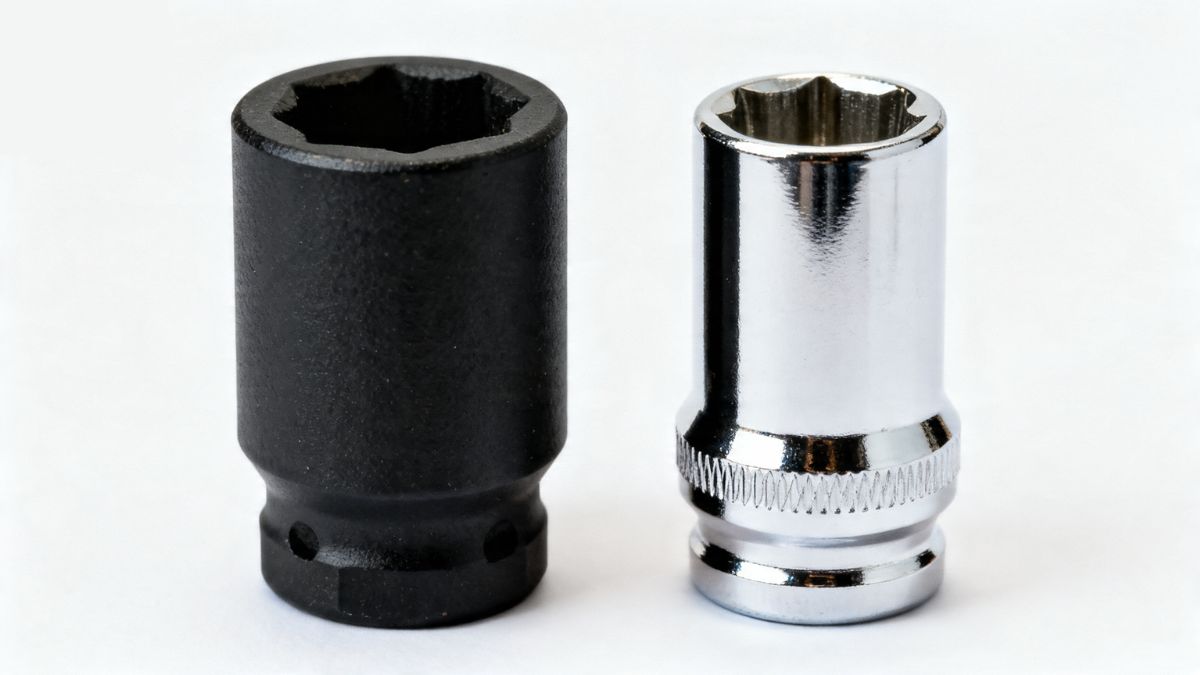
If you have ever stared at a tool chest and wondered whether you can snap that shiny chrome socket onto your cordless impact wrench for a quick lug nut removal, you aren’t alone. Both chrome and black sockets look similar at a glance, fit the same square drive anvils, and turn the same hex fasteners. Using the wrong socket on a power tool is one of the most common and hazardous mistakes in both professional auto shops and home workshops.
The distinction between chrome hand sockets and black impact sockets isn’t cosmetic. It is rooted in metallurgy, heat treatment, wall geometry, and failure mechanics. Using a chrome socket on an impact power tool can cause catastrophic shattering, sending hardened steel fragments flying across your workspace.
Here is the definitive guide to chrome versus black sockets, explaining the science behind why they exist, what happens under load, and how to choose the right tool for every hand and power driving task.
TL;DR: Quick Decision Guide
- Chrome Sockets (Chrome Vanadium / Cr-V): Engineered strictly for manual hand tools like ratchets, breaker bars, and torque wrenches. They feature thin walls for tight clearances and high surface hardness to prevent wear. Under the violent shock pulses of an impact tool, their brittle structure causes them to shatter violently.
- Black Sockets (Chrome Molybdenum / Cr-Mo): Engineered for powered impact wrenches and impact drivers. They feature thick walls, high ductility, and a black phosphate finish. They absorb rapid rotational hammer blows by flexing microscopically rather than cracking.
- The Golden Rule: You can safely use black impact sockets on hand ratchets, but you must never use chrome sockets on impact power tools.
What Is the Difference Between Chrome and Black Sockets?
A chrome socket is a hardened steel tool designed exclusively for static manual torque with hand ratchets, whereas a black impact socket is a ductile, shock-absorbing alloy steel tool engineered to withstand the violent hammering blows of powered impact wrenches.
While both socket types turn nuts and bolts, their internal crystalline structure and physical dimensions are optimized for completely different mechanical forces:
+-------------------------------------------------------------------------+
|                           SOCKET DESIGN MATRIX                          |
+------------------------------------+------------------------------------+
|         CHROME HAND SOCKET         |        BLACK IMPACT SOCKET         |
+------------------------------------+------------------------------------+
| Material: Chrome Vanadium (Cr-V)   | Material: Chrome Molybdenum (Cr-Mo)|
| Hardness: High (HRC 44 to 48+)     | Hardness: Medium (HRC 38 to 44)    |
| Behavior: Rigid, High Wear Resist. | Behavior: Tough, Ductile, Elastic  |
| Wall: Thin for tight access        | Wall: Thick to resist hoop stress  |
| Finish: Electroplated Nickel-Chrome| Finish: Black Manganese Phosphate  |
| Drive: 4-way ball detent recesses  | Drive: Pin cross-hole / hog ring   |
| Safe Tools: Ratchets, Torque Wrench| Safe Tools: Impact Wrenches, All   |
| Hazard: Shatters under impact load | Hazard: May not fit tight spaces   |
+------------------------------------+------------------------------------+
Metallurgy: Chrome Vanadium (Cr-V) vs Chrome Molybdenum (Cr-Mo)
The functional differences between chrome and black sockets begin in the steel mill and the heat treatment furnace.
                  +-----------------------------------+
                  |        STEEL ALLOY SELECTION      |
                  +-----------------+-----------------+
                                    |
            +-----------------------+-----------------------+
            |                                               |
            v                                               v
+-----------------------+                       +-----------------------+
|  Chrome Vanadium Cr-V |                       | Chrome Molybdenum CrMo|
|      (AISI 6150)      |                       |      (AISI 4140)      |
+-----------+-----------+                       +-----------+-----------+
            |                                               |
            v                                               v
+-----------------------+                       +-----------------------+
|  Heat Treatment:      |                       |  Heat Treatment:      |
|  High Hardness        |                       |  High Toughness       |
|  HRC 44 - 48+         |                       |  HRC 38 - 44          |
+-----------+-----------+                       +-----------+-----------+
            |                                               |
            v                                               v
+-----------------------+                       +-----------------------+
|  Mechanical Profile:  |                       |  Mechanical Profile:  |
|  - Ultra-rigid        |                       |  - High ductility     |
|  - Resists stripping  |                       |  - Absorbs shock      |
|  - Brittle fracture   |                       |  - Yields before burst|
+-----------------------+                       +-----------------------+
1. Chrome Sockets: Chrome Vanadium (Cr-V / AISI 6150)
Standard chrome hand sockets are forged from Chrome Vanadium alloy steel (commonly AISI 6150 or European 50CrV4). Cr-V contains iron alloyed with approximately 0.80% to 1.10% chromium and 0.15% to 0.25% vanadium, alongside roughly 0.50% carbon.
- Vanadium refines the grain structure of the steel, inhibits grain growth during heat treating, and dramatically increases tensile strength and fatigue resistance.
- Chromium improves hardenability and provides base corrosion resistance.
During manufacturing, chrome sockets undergo quenching and tempering to achieve a high Rockwell hardness rating, typically between HRC 44 and HRC 48 (and sometimes higher in budget lines).
This high hardness gives the socket exceptional yield strength. When you apply 150 Nm of manual torque through a hand ratchet, the socket walls don’t flex, the drive square doesn’t deform, and the broached 6-point or 12-point internal flats resist rounding out.
Metallurgical hardness comes at the expense of fracture toughness. High-hardness Cr-V steel is brittle. When subjected to sudden, violent dynamic shock loads, it can’t stretch or absorb energy. Instead of deforming, it fractures instantly along its crystalline boundaries.
2. Black Sockets: Chrome Molybdenum (Cr-Mo / AISI 4140 / AISI 4340)
Professional impact sockets are forged from Chrome Molybdenum alloy steel (typically AISI 4140, AISI 4340, or Japanese SCM435/SCM440). Cr-Mo contains iron alloyed with chromium (0.80% to 1.10%) and molybdenum (0.15% to 0.30%).
- Molybdenum provides remarkable impact toughness, elevates high-temperature strength, and prevents temper embrittlement.
- Chromium ensures uniform depth of hardness throughout the thick socket wall.
Impact sockets are heat treated to a noticeably lower hardness range, typically HRC 38 to HRC 44.
This tempering creates a ductile, highly elastic crystalline microstructure. When an impact wrench hammer strikes the anvil and delivers an explosive burst of rotational kinetic energy, a Cr-Mo socket flexes microscopically. It absorbs the shock pulse, dissipates the energy through its mass, and springs back to its original geometry without cracking.
If an impact socket ever experiences a load beyond its ultimate tensile strength, it fails by ductile yielding (stretching, swelling, or stripping out) rather than exploding into fragments.
Warning: Beware of “Black Cr-V” Sockets: Some budget tool manufacturers produce low-cost sockets made of standard Chrome Vanadium steel coated in black oxide to mimic genuine impact sockets. While slightly safer than chrome-plated Cr-V due to thicker walls and no flaking plating, they lack the impact toughness of genuine forged Cr-Mo and can still crack prematurely under heavy power tool use. Always check the alloy stamping on the socket body.
Surface Finishes: Why Chrome Flakes and Black Oxide Protects
The visible difference between silver and black sockets reflects two completely different surface treatments tailored to their working environments.
+-------------------------------------------------------------------------+
|                       SURFACE FINISH COMPARISON                         |
+------------------------------------+------------------------------------+
|      NICKEL-CHROME PLATING         |     BLACK MANGANESE PHOSPHATE      |
+------------------------------------+------------------------------------+
| Process: Multi-stage electroplating| Process: Chemical conversion bath  |
| Layer: Physical external shell     | Layer: Micro-crystalline substrate |
| Corrosion: Superior waterproof seal| Corrosion: Oil-retentive porous bed|
| Cleaning: Wipes clean instantly    | Cleaning: Requires periodic oiling |
| Impact Behavior: Flakes and chips  | Impact Behavior: Wears uniformly   |
+------------------------------------+------------------------------------+
Why Chrome Plating Fails on Power Tools
Chrome hand sockets receive an electroplated finish consisting of a base layer of nickel followed by a thin flash layer of chromium. This plating provides an attractive mirror or satin finish that is impervious to water, resistant to shop chemicals, and effortless to wipe clean with a shop towel.
Electroplated chrome is brittle and forms a separate mechanical layer over the base steel:
- Shear Delamination: When a power tool anvil hammers into the socket drive, the underlying steel flexes microscopically. Because the chrome plating can’t stretch, the bond between the steel and the chrome shears off.
- Razor-Sharp Shrapnel: The chrome plating peels, chips, and flakes away in razor-sharp metal slivers that can cut skin or lodge in your eyes.
- Hydrogen Embrittlement Risk: If electroplating isn’t carefully baked during post-treatment, trapped hydrogen atoms can cause micro-cracks in high-strength steel.
Why Impact Sockets Use Black Phosphate
Black impact sockets are treated with a manganese phosphate or black oxide chemical conversion coating. This isn’t paint or plating. It’s a controlled chemical reaction that converts the outer microns of the steel surface into an insoluble, crystalline phosphate layer.
- Zero Layer Separation: Because there is no separate metal shell, there is no coating to chip, peel, or turn into flying debris under hammer blows.
- Oil-Holding Porosity: Manganese phosphate is naturally porous. It absorbs and holds rust-inhibiting oils and lubricants deep in its crystalline matrix.
- Maintenance Requirement: Because black phosphate relies on retained oil for corrosion protection, impact sockets stored in humid environments or unheated garages will develop surface oxidation if not wiped down with a light coat of machine oil or WD-40 periodically.
Physical and Geometric Differences
Beyond metallurgy and surface finishes, chrome and black sockets are shaped differently to solve specific engineering challenges.
+-------------------------------------------------------------------------+
|                  SOCKET CROSS-SECTION AND GEOMETRY                      |
+-------------------------------------------------------------------------+
|                                                                         |
|     CHROME HAND SOCKET                     BLACK IMPACT SOCKET          |
|    +-------------------+                  +---------------------+       |
|    | |               | |                  | ||               || |       |
|    | |  Thin Wall    | |                  | ||  Thick Wall   || |       |
|    | |  (Tight Fit)  | |                  | || (Absorbs Burst)|| |      |
|    | |               | |                  | ||               || |       |
|    +-+---------------+--+                  +-++---------------++-+      |
|    |   4 Detent Nots   |                  |  Pin Hole & Ring Grv|       |
|    +-------------------+                  +---------------------+       |
+-------------------------------------------------------------------------+
1. Wall Thickness and Clearances
- Chrome Sockets: Feature thin outer walls. Hand torque is smooth and controlled, so the socket wall only needs to resist static hoop stress. This allows chrome sockets to slip into tight recessed spaces, such as spark plug wells, crowded automotive engine bays, motorcycle cylinder heads, and electronics enclosures.
- Black Impact Sockets: Feature substantially thicker walls, typically 20% to 40% more material than a comparable chrome socket. This extra mass is necessary to contain the explosive peak radial pressures generated when an impact hammer slams into a fastener. This extra bulk prevents impact sockets from fitting into narrow clearances.
2. Drive Anvil Retention Mechanisms
Look at the square drive end of both sockets:
- Chrome Sockets: Feature four internal detent recesses (grooves) stamped into the inside faces of the drive square. These recesses capture the spring-loaded ball bearing found on hand ratchets, sliding T-handles, and extensions. This allows fast, tool-free push-on and pull-off attachment.
- Black Impact Sockets: Feature a drilled cross-hole (pin detent hole) through one side of the drive wall and a recessed perimeter groove on the outside. This accommodates the safety retention mechanisms used on power tools:
- Friction Ring (Hog Ring): Standard on cordless impact wrenches. A split spring-steel ring on the anvil snaps into the inner recess of the socket.
- Pin and O-Ring (Ret-Ring): Standard on industrial, construction, and heavy pneumatic impact wrenches (3/4-inch and 1-inch drives). A hardened steel locking pin is inserted through the socket and anvil, then locked in place with a heavy rubber O-ring. This completely prevents the socket from flying off the anvil at high RPM.
       HOG RING ANVIL                      PIN & O-RING RETENTION
     (Cordless Impacts)                    (Heavy Industrial/Pneumatic)

        +---------+                            +---------+
        |  Anvil  |                            |  Anvil  |
        | [=Ring=]|                            | (Hole)  |
        +----+----+                            +----+----+
             |                                      |
     +-------v-------+                      +-------v-------+
     | Impact Socket |                      | Impact Socket |
     | Inner Groove  |                      | [Pin] + (Ring)|
     +---------------+                      +---------------+
Power Tools vs Hand Tools: The Mechanics of Torque
To understand why socket selection matters, you must understand how different tools deliver mechanical force.
+-------------------------------------------------------------------------+
|                     TORQUE DELIVERY PROFILE BY TOOL                     |
+------------------------------------+------------------------------------+
|       STATIC MANUAL TORQUE         |      DYNAMIC ROTARY IMPACT         |
|  (Hand Ratchet / Breaker Bar)      |  (Cordless / Pneumatic Impact)     |
+------------------------------------+------------------------------------+
| Continuous, smooth application     | 2,000 to 4,000 impacts per minute  |
| Low frequency (0 to 1 Hz)          | High frequency (30 to 60+ Hz)      |
| Peak torque = applied muscle force | Peak torque = kinetic hammer spike |
| Zero shockwaves                    | Violent microsecond shock pulses   |
| Demands high rigidity (Cr-V)       | Demands high ductility (Cr-Mo)     |
+------------------------------------+------------------------------------+
1. Hand Tools: Smooth, Controlled Torque
When you pull a 3/8-inch hand ratchet or a 1/2-inch breaker bar, you are applying static or quasi-static torsional load. The force builds smoothly over seconds.
For hand tools, rigidity is an asset. You want minimal torsional deflection so that every ounce of muscle effort translates directly into rotational movement on the fastener. On precision tools like clicker torque wrenches, socket flex can absorb energy and alter the calibration point, making rigid chrome sockets the ideal choice.
2. Powered Drill Drivers: Continuous Rotary Motion
A standard cordless drill driver uses a continuous planetary gearbox with a mechanical slip clutch. It delivers smooth, uninterrupted rotational torque with zero impacting action.
For light-duty driving with a 1/4-inch hex to square-drive adapter, chrome sockets can be used safely on drill drivers because there are no shock pulses. If the fastener suddenly binds, the sudden stop can strain thin-walled sockets.
3. 1/4-Inch Hex Impact Drivers: High-Frequency Micro-Impacts
A 1/4-inch cordless impact driver (such as a 18V or 20V Makita, Milwaukee, or DeWalt driver) doesn’t operate like a drill. When resistance is met, an internal spring-loaded hammer strikes an anvil up to 3,500 to 4,000 times per minute.
Many people use a cheap 1/4-inch hex to 3/8-inch square adapter and snap a chrome socket onto their impact driver. This is dangerous. While an impact driver produces less single-blow torque than a heavy 1/2-inch impact wrench, the rapid micro-impacts induce fatigue micro-cracks in brittle Cr-V chrome sockets, leading to sudden failure. Always use impact-rated sockets on impact drivers.
4. 1/2-Inch to 1-Inch Impact Wrenches: Massive Kinetic Blows
Cordless and pneumatic impact wrenches utilize heavy twin-hammer or rocking-dog mechanisms delivering between 300 Nm and over 2,000 Nm of torque in violent, millisecond-long shockwaves.
When a chrome socket is placed on an impact wrench:
- The hammer blows strike the drive square with intense point-loading.
- The brittle Cr-V steel can’t deform to distribute the shockwave.
- Radial hoop stress exceeds the tensile limit of the thin wall.
- The socket fractures instantly, exploding into high-velocity jagged fragments.
What Happens When You Mix Them Up?
+-------------------------------------------------------------------------+
|                        SOCKET COMPATIBILITY MATRIX                      |
+------------------------------------+------------------------------------+
|          TOOL APPLIED              | CHROME SOCKET   |  IMPACT SOCKET   |
+------------------------------------+-----------------+------------------+
| Hand Ratchet (1/4", 3/8", 1/2")    | IDEAL (Best fit)| SAFE (Bulky)     |
| Breaker Bar / Cheater Pipe         | IDEAL           | SAFE             |
| Clicker / Digital Torque Wrench    | IDEAL (No flex) | ACCEPTABLE       |
| Cordless Drill (Clutched Rotary)   | SAFE            | SAFE             |
| 1/4" Hex Cordless Impact Driver    | DANGEROUS       | IDEAL (Required) |
| Cordless / Air Impact Wrench       | FORBIDDEN       | IDEAL (Required) |
+------------------------------------+-----------------+------------------+
Scenario A: Chrome Socket on an Impact Wrench (Dangerous)
- Failure Risk: Catastrophic brittle bursting.
- Safety Hazard: Flying metal shards, severed skin, eye damage.
- Tool Damage: The hardened drive square of the chrome socket can chip or mushroom the anvil of the impact wrench, ruining the hog ring or detent pin.
- Fastener Damage: Brittle deformation at high RPM can strip bolt heads.
Scenario B: Black Impact Socket on a Hand Ratchet (Safe)
- Safety: 100% safe. An impact socket will never shatter under human hand strength.
- Trade-off 1: Clearance: The thick wall may prevent the socket from reaching recessed nuts or fitting next to obstructions.
- Trade-off 2: Retention: Impact sockets with through-holes don’t lock as tightly on hand ratchet ball detents, resulting in a looser, wobblier connection.
- Trade-off 3: Weight: A complete set of impact sockets weighs nearly double that of a chrome set, making tool bags heavy to transport.
- Trade-off 4: Legibility: Stamped or laser-etched black phosphate markings can be harder to read in low-light engine bays compared to high-contrast stamped chrome.
Comprehensive Comparison: Chrome vs Black Sockets
| Specification / Property | Chrome Hand Sockets | Black Impact Sockets |
|---|---|---|
| Primary Base Material | Chrome Vanadium Steel (Cr-V / 6150) | Chrome Molybdenum Steel (Cr-Mo / 4140) |
| Rockwell Hardness | High: HRC 44 to 48+ | Medium: HRC 38 to 44 |
| Mechanical Characteristic | Rigid, wear-resistant, brittle | Tough, elastic, ductile |
| Failure Mode | Sudden brittle shattering (shrapnel) | Ductile yielding / stretching / rounding |
| Surface Finish | Nickel-Chrome electroplating | Manganese Phosphate / Black Oxide |
| Corrosion Resistance | Excellent (impervious surface seal) | Moderate (requires periodic oil coating) |
| Wall Thickness | Thin (engineered for tight spaces) | Thick (engineered to resist radial burst) |
| Drive Retention | 4-sided internal ball-detent grooves | Through-hole for pin/O-ring and hog ring |
| Hand Ratchets & Bars | Optimized / Recommended | Safe, but bulkier and looser fit |
| Precision Torque Wrenches | Recommended (minimal flex) | Usable (may exhibit minor torsion loss) |
| Cordless Impact Drivers | Unsafe / Prohibited | Required / Impact Rated |
| Pneumatic Impact Wrenches | Prohibited / Serious Hazard | Required / Standard |
| Ease of Cleaning | Wipes clean instantly with rag | Traps grime; needs degreaser and re-oiling |
5 Practical Rules for Your Workshop
To maximize safety, tool life, and work efficiency, follow these five workshop guidelines:
- Establish a Hard Separation in Your Tool Storage: Keep your chrome hand sockets in your top chest drawer alongside your ratchets and torque wrenches. Store your black impact sockets in a dedicated lower drawer or portable rail next to your impact wrenches. Never mix them on the same rail.
- Never Use Adapters to Cheat the System: Using a 1/4-inch hex to 1/2-inch square drive adapter to run a 19 mm chrome socket on an impact driver is tempting when in a hurry, but it represents the most common cause of socket shattering.
- Inspect Sockets for Micro-Cracks: Periodically clean your impact sockets and inspect the drive square corners and hex flats. If you see hairline cracks or wall swelling, discard the socket immediately.
- Oil Your Black Sockets Once a Year: Black phosphate is porous. Wipe down your impact socket set with a rag dampened with light machine oil or corrosion inhibitor every six to twelve months, particularly if working in high-humidity or marine environments.
- Use 6-Point Sockets for High-Torque Work: While 12-point chrome sockets allow easier engagement in tight spots with hand ratchets, always use 6-point sockets (chrome or black) whenever applying maximum torque or using power tools to prevent fastener rounding.
Standalone FAQ: Answer Engine Optimization
Can I use chrome sockets on an impact wrench?
No. Chrome sockets are forged from hardened, brittle Chrome Vanadium steel that can’t absorb impact pulses. Under an impact wrench, they can shatter violently into high-velocity metal shrapnel, posing severe injury hazards.
Why are impact sockets black instead of chrome?
Impact sockets use a black manganese phosphate conversion coating instead of chrome plating. Electroplated chrome flakes off under violent hammer blows, whereas black phosphate can’t peel, doesn’t produce sharp debris, and holds rust-inhibiting oil.
Can you use black impact sockets on a hand ratchet?
Yes. Black impact sockets are completely safe on hand ratchets. Their thicker walls can restrict access in tight spaces, their drive square fits slightly looser on ball detents, and they are heavier than chrome sockets.
What steel is used for chrome versus impact sockets?
Chrome hand sockets are typically made from Chrome Vanadium (Cr-V / AISI 6150) heat-treated for high hardness and rigidity. True impact sockets are forged from Chrome Molybdenum (Cr-Mo / AISI 4140) tempered for ductility and shock absorption.
Why do chrome sockets shatter on impact drivers?
Impact drivers deliver thousands of rapid rotational blows per minute. Because chrome sockets have thin walls and a brittle, high-hardness crystalline structure, the repeated shockwaves cause rapid fatigue cracking and catastrophic shattering.
Sources and Further Reading
- American Society of Mechanical Engineers (ASME). ASME B107.110: Sockets, Handles, and Attachments for Hand and Power Drive Tools.
- International Organization for Standardization. ISO 2725-1: Assembly tools for screws and nuts – Hand sockets.
- International Organization for Standardization. ISO 2725-2: Assembly tools for screws and nuts – Machine sockets (impact).
- Occupational Safety and Health Administration (OSHA). General Industry Safety and Health Regulations: 29 CFR 1910.242 (Hand and portable powered tools).
- ASM International. Metals Handbook, Vol. 1: Properties and Selection: Irons, Steels, and High-Performance Alloys (AISI 4140 and 6150 Steel Data).


Post Comment