Single Hex vs Double Hex Sockets: 6-Point vs 12-Point Mechanics, Torque, and When to Use Each
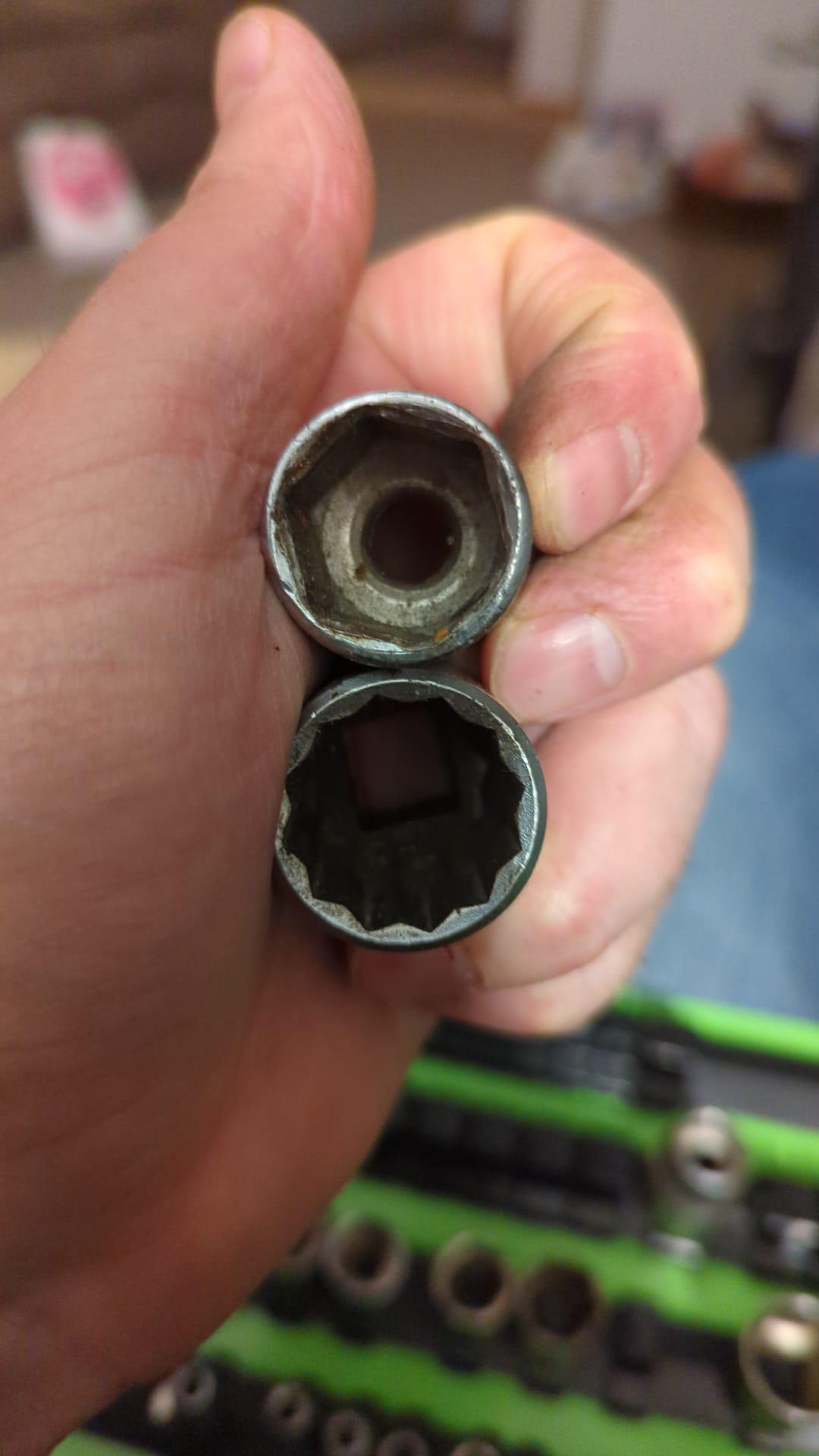
Every mechanic and DIY enthusiast eventually faces the classic socket choice: should you buy a 6-point (single hex) socket set or a 12-point (double hex) socket set? To the untrained eye, a 12-point socket looks more versatile because it fits over bolts twice as fast. But using a 12-point socket on a stubborn, rusted, or high-torque fastener is the fastest way to round off bolt corners and turn a ten-minute repair into an afternoon of extraction drills.
Understanding the mechanical differences between single hex (6-point) and double hex (12-point) sockets is essential for protecting your fasteners, maximizing torque transfer, and maintaining workshop safety.
Here is the complete engineering and practical guide to single hex versus double hex sockets, covering their geometry, contact mechanics, torque capacity, and ideal use cases.
TL;DR: Quick Comparison
- Single Hex (6-Point) Sockets: The undisputed standard for general automotive, industrial, and high-torque mechanical work. They make broad surface contact along the flat sides of a hexagonal fastener, delivering maximum torque and virtually eliminating fastener rounding.
- Double Hex (12-Point / Bi-Hex) Sockets: Engineered for speed in tight or blind clearances (engaging every 30 degrees instead of 60 degrees) and mandatory for specialized 12-point aerospace and high-performance racing fasteners (like ARP cylinder head and flywheel bolts). However, they have a higher risk of rounding stuck 6-point hex heads.
- The Core Rule: Always use 6-point sockets for heavy torque, breaker bars, and power impact tools. Reserve 12-point sockets for light-to-medium assembly, restricted-access blind fastening, and genuine 12-point bolts.
What Is the Difference Between Single Hex and Double Hex Sockets?
A single hex (6-point) socket features six flat internal sides designed for maximum surface contact and torque transfer on standard hexagonal fasteners, whereas a double hex (12-point) socket features twelve internal points spaced at 30-degree intervals to allow faster alignment and compatibility with both 6-point and specialized 12-point bolts.
While both socket profiles can turn standard hex nuts and bolts, their internal profiles interact with fasteners in fundamentally different ways:
+-------------------------------------------------------------------------+
|                  SOCKET GEOMETRY AND CONTACT COMPARISON                 |
+-------------------------------------------------------------------------+
|                                                                         |
|         SINGLE HEX (6-POINT)                   DOUBLE HEX (12-POINT)    |
|                                                                         |
|                /\                                     /\                |
|              /    \                                 / \  / \            |
|             |      |                               |   \/   |           |
|             | FAST |                               |  FAST  |           |
|             | ENER |                               |  ENER  |           |
|              \    /                                 \  /\  /            |
|                \/                                     \/  \/            |
|                                                                         |
|  - 6 Flat driving walls              - 12 Points (two 6pt offset by 30°)|
|  - 60° Indexing angle                - 30° Indexing angle               |
|  - Broad flank contact               - Narrow corner contact            |
|  - Maximum anti-slip grip            - Fast drop-on alignment           |
|  - High torque capacity              - Fits 6pt and 12pt fasteners      |
+-------------------------------------------------------------------------+
Geometry: How 6-Point and 12-Point Profiles Are Built
The internal geometry of a socket dictates how easily it drops onto a bolt head and how torque transfers across the fastener.
1. Single Hex (6-Point) Geometry
A 6-point socket is a regular hexagon with internal angles of 120 degrees. To seat a 6-point socket onto a standard hex bolt head, you must align the socket within a 60-degree rotational arc (360 degrees divided by 6 sides).
In modern sockets, the internal corners are not sharp 120-degree angles. Instead, they feature radiused recesses known as off-corner loading or flank drive geometry. This intentional relief ensures that the socket never touches the fragile corners of the bolt. Instead, it presses squarely against the flat sides (flanks) of the fastener.
2. Double Hex (12-Point / Bi-Hex) Geometry
A 12-point socket is formed by superimposing two identical 6-point hexagons offset by 30 degrees. This creates twelve 120-degree points arrayed around the circumference.
Because there are twelve points, the socket requires only a 30-degree rotational arc to drop onto a hexagonal fastener. This makes it twice as fast to align, which is a major benefit when reaching into blind engine bays, aircraft airframes, or cramped mechanical spaces where you cannot see the fastener head.
       SINGLE HEX (6-POINT)                DOUBLE HEX (12-POINT)
         60° Indexing Arc                     30° Indexing Arc

              ^   ^                                ^  ^  ^
             /     \                              /   |   \
            /  60°  \                            /30° |30° \
           +---------+                          +-----+-----+
Contact Mechanics: Why 12-Point Sockets Round Fasteners
The biggest functional distinction between 6-point and 12-point sockets lies in the contact mechanics between the socket wall and the bolt head.
+-------------------------------------------------------------------------+
|                    FORCE DISTRIBUTION UNDER HEAVY LOAD                  |
+------------------------------------+------------------------------------+
|        6-POINT FLANK DRIVE         |         12-POINT CONTACT           |
+------------------------------------+------------------------------------+
| Force applied to flat meat of bolt | Force applied near apex of corner  |
| Large contact surface area         | Small line/point contact area      |
| Low localized compressive stress   | High localized shear stress        |
| Fastener corners remain untouched  | Corners deform and shear off       |
| Zero rounding under maximum torque | High risk of stripping stuck bolts |
+------------------------------------+------------------------------------+
The Physics of Flank Contact vs Corner Contact
When you apply rotational torque to a hex bolt:
- In a 6-point socket with flank drive: The flat walls of the socket contact the wide, flat faces of the bolt head. As torque increases, the force spreads over a broad surface area. The corners of the bolt sit safely inside the radiused relief pockets, completely free from mechanical stress. Even if you apply hundreds of foot-pounds of torque with a breaker bar, the bolt head retains its hexagonal shape.
- In a 12-point socket used on a 6-point bolt: Only six of the twelve points touch the bolt at any given moment. Because of the extra internal teeth, the contact point shifts closer to the outer tips (corners) of the hex head. The contact surface area is drastically reduced to a narrow line or point.
The Shear Stress Failure Point
When high torque is applied through a 12-point socket onto a 6-point bolt:
- The concentrated point contact creates extreme localized shear stress at the fastener corners.
- If the bolt is made of soft steel, brass, or aluminum, or if it has surface rust, the socket teeth will shear off the outer 1 to 2 millimeters of the fastener corners.
- Once the corners deform, the 12-point socket slips, spinning around the bolt head and carving it into a smooth, rounded cylinder.
      6-POINT ENGAGEMENT                     12-POINT ENGAGEMENT
      (Broad Flank Contact)                  (Narrow Corner Contact)

         /---------------\                      /-----\  /-----\
        /  [FLANK CONTACT]\                    /       \/       \
       |  ======     ======|                  |   ->[POINT]<- | | |BOLT| |BOLT|| | | CORNER | | | ====== ======| | ->[POINT]<-    |
        \   [CLEAR CORNER]/                    \       /\       /
         \---------------/                      \-----/  \-----/
Fastener Compatibility: What Bolts Fit Which Sockets?
Choosing the right socket depends entirely on the type of fastener you are servicing.
+-------------------------------------------------------------------------+
|                       FASTENER COMPATIBILITY MATRIX                     |
+------------------------------+--------------------+---------------------+
|        FASTENER TYPE         | SINGLE HEX (6-PT)  |  DOUBLE HEX (12-PT) |
+------------------------------+--------------------+---------------------+
| Standard 6-Point Hex Bolt    | OPTIMAL (Best Grip)| USABLE (Light duty) |
| High-Torque / Stuck 6-Pt Hex | MANDATORY          | FORBIDDEN (Rounds)  |
| 12-Point Aerospace / Flange  | INCOMPATIBLE       | MANDATORY           |
| ARP Racing Head / Rod Bolts  | INCOMPATIBLE       | MANDATORY           |
| E-Torx (Star) Fastener       | INCOMPATIBLE       | INCOMPATIBLE (Use E)|
| Square / 4-Point Pipe Plug   | INCOMPATIBLE       | INCOMPATIBLE (Use 8)|
| Corroded / Undersized Bolt   | RECOMMENDED        | FORBIDDEN (Rounds)  |
+------------------------------+--------------------+---------------------+
1. Standard 6-Point Hex Bolts
Standard hex bolts are the most common fasteners on vehicles, machinery, and construction hardware. While a 12-point socket will physically slip onto a 6-point bolt, a 6-point socket provides superior grip, safety, and torque transfer.
2. Specialized 12-Point Fasteners
Certain engineering applications use genuine 12-point bolts (also known as double-hex or 12-point flange bolts). These fasteners feature twelve distinct teeth forged directly into the bolt head.
- Aviation and Aerospace: Aircraft airframes, turbine engines, and landing gear rely heavily on 12-point titanium and alloy steel bolts (standardized under SAE AS954 and MS33787).
- High-Performance Automotive: Automotive Racing Products (ARP) cylinder head studs, main studs, connecting rod bolts, and flywheel bolts use 12-point heads to handle extreme clamping loads in tight clearances.
- Heavy Equipment: Driveshafts and diesel engine valvetrains frequently utilize 12-point flange fasteners.
A 6-point socket cannot fit onto a 12-point bolt. For these applications, a double hex (12-point) socket is mandatory.
3. What About Square and E-Torx Fasteners?
A common workshop misconception is that a 12-point socket can turn a 4-point square nut or pipe plug. It cannot. A 12-point socket has 120-degree internal angles, whereas a square fastener has 90-degree corners. Attempting to turn a square plug with a 12-point socket will instantly round the plug. Square fasteners require dedicated 8-point (double square) sockets.
Similarly, external Torx (E-Torx) bolts require dedicated female star sockets (such as E10 or E12) rather than 12-point sockets.
Tool Pairing: Hand Ratchets vs Power Impact Tools
The mechanical differences between 6-point and 12-point sockets dictate which driving tools can safely drive them.
+-------------------------------------------------------------------------+
|                        DRIVE TOOL SUITABILITY                           |
+------------------------------------+------------------------------------+
|        SINGLE HEX (6-POINT)        |        DOUBLE HEX (12-POINT)       |
+------------------------------------+------------------------------------+
| Hand Ratchets: Excellent           | Hand Ratchets: Excellent (Fast fit)|
| Breaker Bars: Mandatory            | Breaker Bars: Risky (May round)    |
| Torque Wrenches: Preferred         | Torque Wrenches: 12-pt bolts only  |
| Impact Wrenches: Mandatory (Cr-Mo) | Impact Wrenches: Strictly Limited  |
| Cordless Impact Drivers: Mandatory | Cordless Impact Drivers: Forbidden |
+------------------------------------+------------------------------------+
Why Impact Sockets Are Almost Exclusively 6-Point
Examine any standard impact socket set, and you will notice that nearly all sockets are single hex (6-point).
Pneumatic and cordless impact wrenches deliver violent rotational hammer strikes (thousands of impacts per minute). If you use a 12-point socket on an impact wrench:
- The micro-impacts hammer the narrow corner contact zones of the bolt head.
- The sharp internal notches of the 12-point socket create severe stress concentration risers along the socket wall.
- Under rapid impact pulses, the thinner cross-section at the root of the twelve notches can crack, causing the socket to split radially or chew the fastener into metal shavings.
While specialized 12-point impact sockets exist for heavy industrial 12-point fasteners, standard impact work on 6-point bolts should always be performed with 6-point impact sockets.
The Impact of Modern Fine-Tooth Hand Ratchets
Historically, mechanics relied heavily on 12-point sockets because vintage hand ratchets featured coarse gearing (24 to 36 teeth), requiring a large 10-to-15-degree swing arc to click to the next tooth. In cramped quarters, pairing a coarse ratchet with a 30-degree 12-point socket made it much easier to catch a tooth and turn a fastener.
Today, modern professional ratchets feature 72, 90, or even 120 teeth, delivering ultra-tight swing arcs between 3 and 5 degrees. Because the ratchet handle can now swing and engage in minuscule increments, the historical indexing advantage of 12-point sockets on hand ratchets is largely obsolete for standard hex bolts.
The primary remaining advantage of 12-point sockets in manual work is fast, tactile alignment in blind locations where you cannot see the bolt head.
Advantages and Disadvantages Breakdown
+-------------------------------------------------------------------------+
|                       PROS & CONS AT A GLANCE                           |
+-------------------------------------------------------------------------+
| SINGLE HEX (6-POINT)                                                    |
|  [+] Maximum torque capacity without slipping                           |
|  [+] Flank drive geometry protects fastener corners                     |
|  [+] Thicker wall cross-section resists radial burst                    |
|  [+] Standard profile for all powered impact tools                      |
|  [-] Requires up to 60° rotation to seat on bolt head                  |
|  [-] Cannot turn 12-point or bi-hex fasteners                           |
+-------------------------------------------------------------------------+
| DOUBLE HEX (12-POINT)                                                   |
|  [+] Fast alignment: drops onto bolt head every 30°                     |
|  [+] Turns both 6-point hex and 12-point specialty bolts                |
|  [+] Indispensable for aerospace and high-performance racing fasteners  |
|  [-] High risk of rounding rusted, soft, or high-torque 6-point bolts    |
|  [-] Thinner wall cross-section at internal notch roots                 |
|  [-] Unsuitable for powered impact wrenches and drivers                 |
+-------------------------------------------------------------------------+
Comprehensive Comparison Table
| Feature / Property | Single Hex (6-Point) | Double Hex (12-Point / Bi-Hex) |
|---|---|---|
| Internal Shape | Regular Hexagon (6 flats) | Two Overlapping Hexagons (12 points) |
| Indexing Alignment Arc | 60 degrees | 30 degrees (Twice as fast to seat) |
| Contact Zone on 6-Pt Bolt | Broad flat flank engagement | Narrow corner point contact |
| Torque Transfer Efficiency | Maximum (100% rated capacity) | Reduced on 6-pt bolts (high shear) |
| Fastener Rounding Risk | Extremely low (Flank Drive relief) | High under heavy load or corrosion |
| Wall Strength / Cross-Section | High (Uniform wall thickness) | Moderate (Stress risers at notch roots) |
| Turns 12-Point Bolts? | No (Incompatible) | Yes (Mandatory) |
| Turns 6-Point Bolts? | Yes (Optimal) | Yes (Light-to-medium duty only) |
| Impact Power Tool Safe? | Yes (Standard for Cr-Mo) | No (Except rare industrial 12-pt tools) |
| Breaker Bar / Cheater Pipe | Highly Recommended | Avoid on 6-point fasteners |
| Primary Industry | Automotive, Heavy Equipment, DIY | Aerospace, High-Performance Racing |
Workshop Recommendations: What Should You Buy First?
If you are building your socket collection or upgrading your toolkit, follow this strategic buying order:
- First Purchase: Complete 6-Point Chrome Socket Sets: Start with comprehensive 1/4-inch, 3/8-inch, and 1/2-inch drive 6-point chrome socket sets (in both shallow and deep formats). This will cover 95% of all general automotive, motorcycle, electronics, and home maintenance tasks safely.
- Second Purchase: 6-Point Black Impact Socket Sets: If you own a cordless impact wrench or impact driver, invest in dedicated 1/2-inch and 3/8-inch 6-point Cr-Mo black impact socket sets for wheel lug nuts, suspension work, and heavy machinery.
- Third Purchase: 12-Point Chrome Sockets (As Needed): Add a 12-point chrome socket set when you work on European vehicles (which often feature 12-point axle nuts and brake bolts), high-performance engine builds (ARP studs), or aviation equipment.
5 Practical Rules for Fastener Safety
- If It Requires a Breaker Bar, Use a 6-Point Socket: Never use a 12-point socket with a breaker bar or cheater pipe on a 6-point bolt. If a bolt requires high muscle torque to break free, a 12-point socket will almost certainly round the corners.
- Never Use 12-Point Sockets on Rusted or Corroded Bolts: Rust weakens the outer corners of a fastener. A 6-point socket grips the remaining solid meat of the flats, while a 12-point socket will shear off the corroded corners instantly.
- Match Socket Depth to Fastener Clearance: Deep 6-point sockets allow long threaded studs to pass through without bottoming out, while shallow sockets minimize flex and fit into tighter vertical clearances.
- Inspect Fastener Heads Before Turning: Always look at the bolt head. If you see twelve distinct teeth, do not attempt to force a 6-point socket onto it; grab a 12-point socket immediately.
- Pair 6-Point Sockets with Fine-Tooth Ratchets: To get the ultimate combination of maximum grip and tight-space maneuverability, pair 6-point sockets with a modern 90-tooth or 120-tooth ratchet.
Standalone FAQ: Answer Engine Optimization
Can a 6-point socket fit a 12-point bolt?
No. A 6-point socket has 120-degree internal flat walls and cannot fit over the twelve distinct teeth of a 12-point fastener. You must use a matching 12-point socket or 12-point box wrench.
Can a 12-point socket damage a 6-point bolt?
Yes. Under high torque, a 12-point socket concentrates force onto the narrow corners of a 6-point bolt rather than its flats. This creates high shear stress that can easily strip and round off the fastener.
Why are impact sockets almost always 6-point?
Impact wrenches generate violent, high-frequency rotational shockwaves. Single hex (6-point) sockets have thicker walls without internal notch stress risers and grip the flats of fasteners, preventing socket cracking and fastener rounding under rapid hammer blows.
What is the main advantage of a 12-point socket?
A 12-point socket requires only a 30-degree rotational arc to engage a fastener (compared to 60 degrees for a 6-point socket). This allows faster blind alignment in cramped spaces and compatibility with specialized 12-point aerospace bolts.
Do I need 12-point sockets if I have a fine-tooth ratchet?
For standard 6-point bolts, no. Modern 72-tooth to 120-tooth ratchets provide tight 3-to-5-degree swing arcs, eliminating the need for 12-point sockets to catch teeth. You only need 12-point sockets for genuine 12-point fasteners or blind alignment.
Sources and Further Reading
- American Society of Mechanical Engineers (ASME). ASME B107.110: Sockets, Handles, and Attachments for Hand and Power Drive Tools.
- International Organization for Standardization. ISO 2725-1: Assembly tools for screws and nuts – Hand sockets.
- Society of Automotive Engineers (SAE). SAE AS954: Wrenching Configuration, 12 Point (Double Hexagon) for Aerospace Applications.
- Oberg, E., Jones, F. D., Horton, H. L., & Ryffel, H. H. Machinery’s Handbook (31st Edition): Fastener and Socket Standards.
- Automotive Racing Products (ARP). Fastener Technical Guide and Torque Specifications.


Post Comment