General Interest
Technology
ad preferences, ad targeting, Android permissions, car ads, confirmation bias, data brokers, digital footprint, Facebook, frequency illusion, iOS privacy, location tracking, lookalike audiences, Meta, microphone myth, Off-Facebook Activity, online privacy, privacy, social media, surveillance advertising, targeted ads
9M2PJU
0 Comments
Talked About Buying a Car Then Saw Car Ads? Why Facebook Feels Like It Is Listening
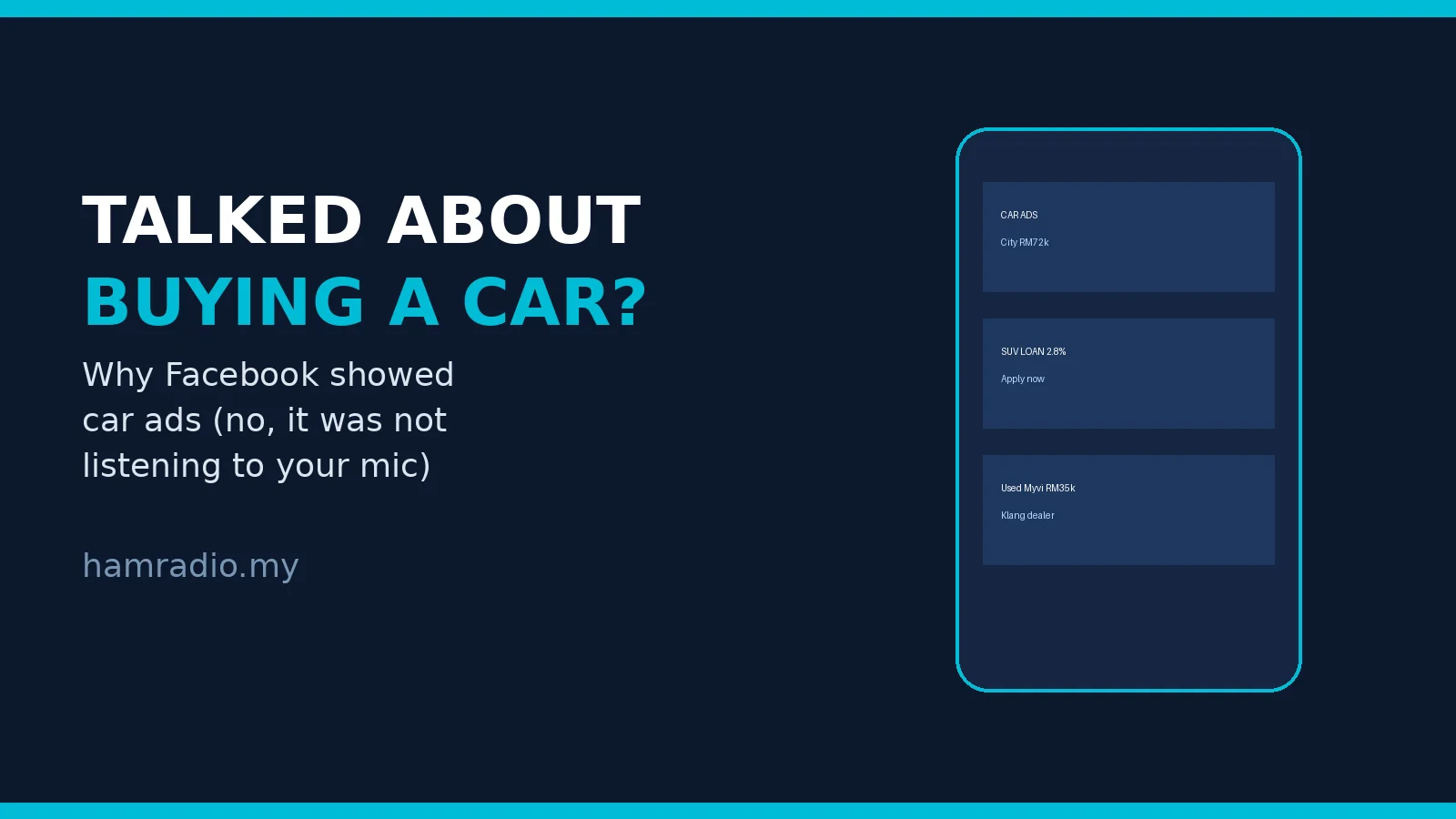
TL;DR: Talking about buying a car doesn’t trigger car ads because your microphone heard you. Facebook and other ad platforms target you with car ads because of searches, video watches, location visits, friend activity, demographics, and data broker lists, plus your brain suddenly notices car ads it ignored before. The mic myth persists because the timing feels perfect, but researchers have never caught ad platforms uploading raw mic audio for targeting. Check mic permissions, review Off-Facebook Activity and ad preferences, and limit location sharing if you want fewer creepy coincidences.
You are having teh tarik with friends. Someone says Myvi prices are crazy now, maybe get a City. Everyone laughs, compares loans, talks about second hand dealers in Klang. An hour later you open Facebook. First post: a Carsome ad for a used Honda City. Second post: a bank car loan ad. Third post: a Toyota dealer in Puchong.
It feels too exact to be chance. So you ask the obvious question: is Facebook listening to my mic?
Short answer: no, not for ads. Long answer: what it does instead is more boring, more legal, and in some ways more powerful than listening.
This post explains everything in plain language: what Meta says on record, what independent researchers tested, why always-on mic spying makes no engineering sense, the seven real reasons that car ad found you, how the Facebook ad auction actually picks that ad, and what to switch off if you want less of it.
What Is Facebook Ad Targeting?
Facebook ad targeting is a prediction system that guesses which ad you are most likely to tap, based on what you did, where you went, who you know, and what advertisers asked for, then auctions that guess to the highest bidder in milliseconds.
It doesn’t need your live voice. It has years of taps, searches, locations, purchases, and friend connections. Voice would add little and cost a lot. That’s the core point most mic myth stories miss.
Does Facebook Listen to Your Microphone for Ads?
No. There’s no credible evidence that Facebook turns your phone mic on in the background, transcribes your cafe talk about cars, and feeds that text into its ad system.
That sounds like a denial you shouldn’t trust at face value, so here is the evidence behind it.
What Meta has said on record
Meta has denied mic-based ad targeting since at least 2016 in its newsroom statement that Facebook does not use your phone microphone for ads. The post says the app only accesses the mic when you give permission and use a feature that needs it, like recording a Story or going Live, and that voice isn’t used for ad ranking.
Meta repeated the same position in later Hard Questions posts about how ads use your data and in US Senate testimony. You can disbelieve a company blog, but a false statement there plus false statements to Congress would create huge legal risk for zero gain, when they already have better signals.
What independent researchers found
In 2018 a Northeastern University study on 17,000 apps that found no mic eavesdropping tested more than 17,000 popular Android apps, including Facebook, for unexpected audio and screenshot exfiltration. They found apps taking screenshots and sending them out. But no evidence of apps secretly streaming mic audio for ads.
Security researchers, journalists, and hobbyists have repeated simpler versions since: install Facebook on a test phone, grant mic permission, talk about cars or dog food for hours next to it, proxy all network traffic, and watch what leaves. What leaves is routine analytics, photo preloads, and video chunks. Nobody has published a capture showing continuous mic uploads tied to ad keywords. If Facebook did this to 2 billion users, it would be trivial to catch.
Always-on listening makes no engineering sense
Think about what always-on mic spying would require:
- Continuous recording, even with screen off, on millions of phone models
- Either on-device keyword spotting for thousands of products in Malay, English, Chinese, and Tamil mix, or uploading hours of cafe noise to servers
- Hiding the battery drain, data usage, heat, and the permanent mic dot on iPhone privacy indicators and Android privacy indicators
Apple and Google now show a green or orange dot whenever any app uses the mic or camera. If Facebook listened all day, that dot would never turn off. It does turn off.
Upload math is worse. Compressed voice at 32 kbps is about 14 MB per hour. Times a billion users, that is exabytes per month, just to catch the rare moment someone says Proton Saga. Meanwhile search logs already say who wants a Saga, for free.
The one real voice case people remember
In 2019 Bloomberg reported that Meta contractors listened to and transcribed short voice clips from Portal wake word false triggers and from an opt-in Messenger voice-to-text feature. Meta confirmed it, said users had opted in, and paused human review.
That was real and rightly criticized. It was also transcription quality control for a voice assistant, not ad targeting. It’s the closest thing to a smoking gun, and it still wasn’t ads.
Why It Feels Like Listening: 7 Real Reasons You Saw That Car Ad
Here is what usually happened before that City ad appeared.
1. You or your friend already searched
You may not remember searching, but did you:
- Google “City vs Vios 2025” or “Myvi loan calculator”
- Watch a YouTube review, TikTok test drive, orPandu Laju comparison
- Open Carsome, Mudah, Carlist, or a bank hire purchase page
- Check insurance renewal or JPJ summon that hints at car ownership timing
One search can put you in an in-market auto audience for 30 to 90 days. Visiting a dealer site can trigger retargeting: the dealer pays Meta to show ads to recent site visitors. You don’t need to click. The Meta Pixel on that site reports the visit.
2. Your friends infected you
You talked with friends. Facebook knows those friends.
If one of them searched for cars, joined a car group, or listed a car on Marketplace, Meta can show car ads to people like him. That includes you, through:
- Contact lists uploaded by friends or dealers
- Same WiFi, same office, same mamak location at the same time
- Tagged photos, group chats, event RSVPs
- Lookalike audiences, where an advertiser says find more people like my buyers
Car dealers love lookalikes. Give Meta 5,000 past buyers, get 2 million similar Malaysians. You match the pattern: age, area, phone model, job, behavior. Your friend only had to start the topic.
3. Location gave you away
Phones leak location constantly:
- You parked at a Proton or Perodua showroom in Glenmarie for 40 minutes
- You passed the same used car row in Klang three weekends in a row
- Your Grab drop off was at Puspakom inspection center
- Your friend lives next to a Honda dealer you walk past daily
Meta, Google, and data brokers buy and trade these trails. A dealer can geofence its lot and retarget every phone seen there. No mic needed.
4. You are exactly who car advertisers want
Car ads aren’t narrow. In Malaysia, men aged 25 to 44 in Klang Valley, Penang, and Johor are in thousands of auto campaigns by default.
Advertisers bid on:
- Age, gender, language, city
- Phone model and price tier as income proxy
- Life events: new job, married, new baby, moved house
- Interest in banks, petrol loyalty, insurance, highway toll apps
If you fit, you will see car ads even if you never searched. Talking about cars just made you notice them today.
5. Data brokers filled the gaps
Beyond Facebook, there is a whole market for your data. Loyalty cards, bank pre approvals, insurance quotes, telco location aggregates, and warranty lists get matched by email or phone number to your profile. The EFF explains this targeted advertising ecosystem in detail.
Example path: you applied for a loan pre check on a bank site. The bank or its agency uploads hashed emails to Meta as a custom audience. You see the bank car loan ad that night. You never told Facebook. The advertiser did.
6. Your brain started noticing: frequency illusion
This is the big one. Psychologists call it the frequency illusion, also called Baader-Meinhof, plus confirmation bias.
Before the talk, Facebook showed you 100 ads. You ignored 98, including 3 car ads. After the talk, you notice the next car ad and think wow, listening. You still ignore the baby product ads, gambling ads, and property ads in between. Memory keeps the hit and drops the misses.
Pew Research found most Americans feel confused about what data companies hold. Confusion plus perfect timing feels like spying.
7. Coincidence is common at scale
Facebook shows billions of ads per day. Car brands are among the top spenders in Malaysia. The chance that any given user sees a car ad on any given day is high. Multiply by millions of car conversations daily, and thousands will see an ad within the hour by pure chance. Those thousands post about it. The millions who saw nothing post nothing.
Mic Myth vs Reality: Comparison Table
| Claim | Mic myth version | What actually happens |
|---|---|---|
| Trigger | Phone hears the word City | Friend searched, you visited a dealer site, or you fit the buyer profile |
| Proof people cite | Ad appeared minutes after talking | Frequency illusion plus retargeting delay of hours to days |
| Battery and data | Secret silent upload | Would show permanent mic dot on iPhone and Android, never observed |
| Research | Nobody checked | Northeastern study of 17,000 apps found no ad mic streaming |
| Company motive | Voice is gold | Search, location, and purchase data are cleaner and cheaper than noisy cafe audio |
| Real voice case | 2019 proved listening | Contractors transcribed opt-in Portal and Messenger clips for quality, paused after exposure, not ads |
| Who told Facebook | Your voice | An advertiser uploaded you, a Pixel reported you, or a friend looks like you |
| How to stop it | Cover the mic | Limit tracking, location, off app activity, and advertiser lists, details below |
How Facebook Actually Picked That Car Ad for You
Simplified flow when you opened the app:
- Facebook builds a profile from on app behavior: pages followed, videos watched past 3 seconds, Marketplace taps, groups, events.
- It adds off app signals: sites with Meta Pixel visited, apps using Meta SDK, purchases from advertisers, and for some users location history.
- Advertisers upload rules: show my used City listing to ages 25 to 45 within 30 km of Puchong who visited my site in 60 days, plus a 2 percent lookalike of past buyers, exclude recent purchasers.
- When you scroll, an auction runs. Each eligible ad bids based on money plus predicted action rate plus ad quality. Winner shows.
- You tap or hide it. That feedback tunes the next auction.
Notice voice appears nowhere in that chain. Text, taps, and trails do the work.
Meta documents parts of this in its explanation of how ads use your data. Ad blockers and privacy tools focus on the Pixel and SDK layer for exactly this reason.
Could Any App Listen? Permissions Explained
Could is different from does for ads.
On modern phones, apps can use the mic only with permission:
- IPhone: Settings, Privacy and Security, Microphone. Options are on or off per app. An orange dot means mic in use. See Apple control access to hardware.
- Android: Settings, Security and Privacy, Permission Manager, Microphone. Options include Allow only while using the app, Ask every time, and Don’t allow. A green icon appears when in use. See Android change app permissions.
Facebook legitimately asks for mic for Stories, Reels, Live, video calls, and voice search. If you grant it, it technically could record while you use those features. That is true for TikTok, Instagram, Shopee Live, banking apps with voice login, and any keyboard with voice typing.
The check is simple: if no dot is showing and the app is in background, it isn’t recording through the official API. Malware or a hacked phone is a different story, but that isn’t Facebook ads.
Test It Yourself and Lock It Down in 10 Minutes
Want less creepy ads without deleting Facebook?
- Turn off mic access if you don’t post videos. IPhone and Android both let you set Facebook mic to off. The feed still works. Re enable only when recording.
- Review Off-Facebook Activity. This page lists sites and shops that reported you via Pixel. Disconnect past activity and turn off future linking. Search Meta help for Off-Facebook Activity if the menu moved, settings shift often.
- Check Ad Preferences. Remove auto interests like Cars, Toyota, Loan. Hide the City ad and pick irrelevant or already purchased. That negative signal matters.
- Limit location. Set Facebook location to Never or Only while using, turn off precise location, turn off Location History, and avoid checking in at dealers if you don’t want retargeting.
- Use browser containers for research. Research cars in Firefox with tracking protection or Brave, not in Facebook in app browser. Less Pixel linkage.
- Don’t upload contacts. Turn off contact sync on Facebook, Instagram, and WhatsApp if you don’t need it. Every upload links your graph tighter.
- Talk freely, search carefully. Ironically, voice is the safest channel. Typing City price into Google or opening Carsome is what follows you for weeks.
If you run a small business and buy these ads yourself, you will see how little voice matters. Upload a customer list, pick a 30 km radius, pick auto intenders, set RM50 per day, and Meta will find buyers who never said a word near their phones.
Why This Matters Beyond Cars
Cars are harmless. The same system prices insurance, approves loans, targets job ads by age and gender, and aims political messages at persuadable voters. The US Federal Trade Commission has warned data brokers about sensitive location and health inferences, and Malaysia has its own Personal Data Protection Act covering commercial use of personal data.
Understanding the real mechanism beats fearing the mic. You can’t put tape over math. You can starve it of clean signals.
For ham radio readers, the lesson transfers directly. We already think in signals, noise, and propagation. Ad targeting is the same: weak signals in, strong prediction out. Nobody needs to hear your QSO to know you are a ham. Your YouTube history of FT8 demos, your visit to a DX shop site, your presence at a hamfest with 200 other hams carrying phones, and your friend uploading his Field Day log with your callsign do it better than any mic.
Next time the City ad appears right after teh tarik, smile at the timing. Then check who searched, who visited, and who uploaded. The answer is usually in the logs, not in the mic.
Sources and Further Reading
- Facebook does not use your phone microphone for ads
- BBC: why phones that secretly listen are a myth
- Northeastern University: is your smartphone spying on you
- EFF on targeted advertising
- Frequency illusion on Wikipedia
- Confirmation bias on Wikipedia
- Targeted advertising on Wikipedia
- Meta Pixel on Wikipedia
- Apple: control access to mic and camera on iPhone
- Google: change app permissions on Android
- Pew Research on Americans and privacy
- Carsome Malaysia
- Mudah Malaysia
- Carlist Malaysia
- MCMC and Personal Data Protection
73 de 9M2PJU



Post Comment