zBitx v2: Ashhar Farhan’s 5-Watt All-Band Pocket SDR with LDMOS PA and Built-in EFHW Matching
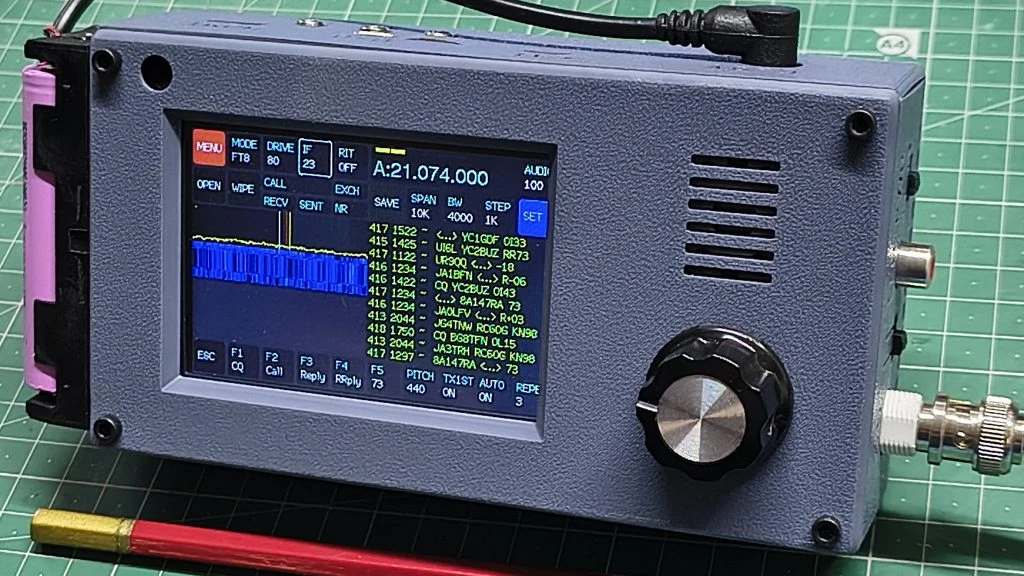
When Ashhar Farhan VU2ESE and the team at HF Signals released the original zBitx, the concept of a self-contained, pocket-sized 64-bit Linux software-defined transceiver with an integrated colour touch screen and standalone FT8 decoding felt genuinely revolutionary. Packaged into a form factor barely larger than a paperback novel, it promised full-featured digital and analogue operation without dragging an external laptop, audio interfaces, or tangled cabling into the woods. Yet, like many pioneering QRP designs, the original version had noticeable rough edges in the field: the I2C-based front-panel communication repeatedly stalled the CPU, causing an audible “chugging” artefact in the receiver audio and frustrating latency during CW keying, while the push-pull MOSFET power amplifier ran hot and punished portable batteries.
The new zBitx v2 directly confronts those field shortcomings. Rather than a cosmetic refresh, Farhan has re-engineered the architecture from the circuit board up. The front-panel display and rotary encoder are now driven by a dedicated Raspberry Pi Pico W microcontroller that communicates with the host single-board computer over a local Wi-Fi TCP socket stream, completely eliminating the bus stalls that plagued the first iteration. Coupled with a rugged NXP LDMOS final amplifier stage, an integrated toroidal End-Fed Half-Wave (EFHW) matching transformer, and lossless active MOSFET reverse polarity protection, the v2 matures the zBitx into a formidable pocket station for portable operating.
Priced at $269 including international shipping, the zBitx v2 covers 80 metres through 10 metres with 5 watts output across CW, SSB, AM, FreeDV, and native FT8. This technical review walks through the revised hardware architecture, analyses the schematic enhancements, explains why decoupling the front panel transformed its CW performance, and evaluates its practical capabilities for SOTA, POTA, and emergency communications.
TL;DR: The zBitx v2 by HF Signals is an open-source, 5-watt all-band (80m-10m) pocket SDR transceiver running the sBitx Linux software suite on an embedded 64-bit SBC. Version 2 solves earlier receiver stutter and CW latency by decoupling its 480×320 touch display to an RP2040 Pico W over an internal Wi-Fi socket, upgrades the final stage to dual AFT05MS004 LDMOS transistors for cooler 7.4V battery operation, adds an onboard EFHW matching transformer, and integrates lossless P-channel MOSFET reverse polarity protection.
What the zBitx v2 Is
The zBitx v2 is an ultra-compact, open-source 5-watt high-frequency SDR transceiver covering 80 to 10 metres, featuring an integrated 480×320 colour touchscreen display, native digital mode decoding, and an LDMOS power amplifier powered by two internal 18650 lithium cells.
Unlike traditional micro-transceivers that rely on closed firmware running on bare-metal 8-bit or 32-bit microcontrollers, the zBitx family runs a full 64-bit Linux operating system executing the open-source sBitx DSP processing engine. This means digital modes like FT8, FreeDV, PSK31, and SSTV are decoded natively inside the radio. You don’t need a computer, a tablet, soundcard interfaces, or third-party decoding software to work digital contacts from a mountain summit or a campsite picnic table.
Measuring 170 mm x 80 mm x 45 mm (6.7 x 3.1 x 1.8 inches) including the attached dual-cell 18650 battery holder, and weighing just 415 grams with cells installed, the zBitx v2 fits effortlessly into a backpack pocket or glove compartment. It features a built-in electret microphone and speaker, an optical tuning encoder, and an on-screen QWERTY touch keyboard that enables typing out CW or entering contest exchanges even if you forgot to pack your physical CW key or paddle.
+-----------------------------------------------------------------------------+
|                      zBitx v2 DECOUPLED SDR ARCHITECTURE                   |
+-----------------------------------------------------------------------------+

  [ FRONT-PANEL SUBSYSTEM ]                  [ HOST SDR LINUX SUBSYSTEM ]
  RP2040 Raspberry Pi Pico W                 Embedded 64-bit Linux SBC
  +--------------------------+               +--------------------------+
  | * 480x320 ILI9488 TFT    |               | * sBitx C/GTK DSP Engine |
  | * Resistive Touch Layer  |   Wi-Fi Link  | * Native FT8 & FreeDV    |
  | * Optical Tuning Encoder | <===========> | * Mongoose Web Server    |
  | * On-Screen CW Keyboard  | TCP:8081      | * SQLite ADIF Logbook    |
  | * TCP Client (192.168.4) | (SSID: zbitx) | * Access Point Mode      |
  +--------------------------+               +--------------------------+
                                                          |
                                                          | I2S / Audio
                                                          v
  [ RF SUPERHET & PA BOARD ]                [ QUAD SWITCHING FRONT-END ]
  +--------------------------+               +--------------------------+
  | Dual AFT05MS004 LDMOS    | <============ | FSA3157 QSD/QSE Mixers   |
  | Clean 5W (80m - 10m)     |   RF Drive    | Si5351A Clock Generator  |
  +--------------------------+               | BFR106 Low-Noise Preamps |
         |                  |                +--------------------------+
         v                  v
  [ 50-Ohm Port ]   [ Built-in EFHW ]
     (BNC/SMA)       (49:1 Toroid)
What Changed: The Four Critical Upgrades in Version 2
The jump from the original zBitx to the v2 addresses the exact pain points reported by early adopters and portable operators:
1. Decoupled Front Panel via RP2040 Wi-Fi Streaming
In the original zBitx v1, the front-panel display and encoder communicated directly with the Raspberry Pi host over hardware I2C digital bus lines. Servicing that I2C bus required frequent polling and CPU interrupts multiple times per second. Whenever the processor paused audio processing to service I2C traffic, the receiver audio suffered from an irritating “chugging” rhythm, and CW transmit keying developed noticeable timing jitter.
In the zBitx v2, the host SBC runs a dedicated Wi-Fi Access Point (broadcasting the SSID zbitx on the internal 192.168.4.1 subnet). The front panel is controlled by an independent Raspberry Pi Pico W running Earle Philhower’s Arduino-Pico core. The Pico W connects to the host over Wi-Fi as a TCP client on port 8081. Touch coordinates, encoder ticks, and display frames stream asynchronously across this socket. By decoupling the interface from the local hardware bus, the audio thread runs completely uninterrupted. The receiver chugging is eradicated, and CW keying latency drops to imperceptible levels.
2. Dual NXP LDMOS Final Power Amplifier
The push-pull bipolar/MOSFET final amplifier of the v1 has been replaced by a pair of NXP AFT05MS004 LDMOS transistors (AFT05MS004N). These RF power devices are engineered for mobile radio equipment up to 1 GHz and exhibit high ruggedness, stability, and high gain. Running at nominal 7.4V from two series 18650 cells:
* The PA produces a clean, consistent 5 watts output from 80 metres through 10 metres.
* Thermal dissipation is significantly improved, allowing the compact case to run substantially cooler during long digital transmissions such as FT8 cycles.
* Current consumption on transmit ranges between 1.5A and 3A depending on the drive setting and band, keeping battery discharge within safe limits.
3. Integrated Toroidal EFHW Matching Transformer
One of the biggest practical hurdles in portable QRP operating is packing the ancillary gear: patch cables, baluns, and antenna tuners. The zBitx v2 builds an End-Fed Half-Wave (EFHW) matching transformer (wound on a broadband ferrite toroid) directly into the transceiver chassis.
Operators can connect a resonant wire directly to the terminal, hoist the far end into a nearby tree branch, and begin transmitting without carrying a standalone 49:1 matching box or manual ATU. For standard resonant dipoles or coax-fed verticals, the standard 50-ohm output remains available.
4. Active P-Channel MOSFET Reverse Polarity Protection
Field battery connections are notorious for accidental polarity reversals in low light or cold weather. Standard silicon protection diodes drop roughly 0.6V to 0.7V, which is disastrous when your power budget is limited to two 3.7V lithium-ion cells (7.4V nominal, dropping toward 6.5V as they discharge).
The zBitx v2 integrates a heavy-duty IRF4905 P-channel power MOSFET directly into the on/off power switch circuit. When connected with correct polarity, the MOSFET is driven into hard saturation with an on-state resistance (Rds(on)) of only 0.02 ohms, resulting in virtually zero millivolt drop. If the supply leads are reversed, the gate-source voltage prevents the channel from conducting, completely isolating the sensitive internal electronics without blowing sacrificial fuses.
Detailed Specifications Comparison
To see how the zBitx v2 fits into the modern world of portable QRP transceivers, consider how it stacks up against its predecessor and common alternatives:
| Parameter / Feature | HF Signals zBitx v2 | HF Signals zBitx v1 | Xiegu X6100 | Elecraft KX2 |
|---|---|---|---|---|
| Retail Price | $269 (Includes shipping) | ~$199 (Discontinued) | ~$640 | ~$1,100+ (Base) |
| RF Output Power | 5 Watts (All bands) | 3 – 5 Watts | 5W (Internal) / 10W (Ext) | 10 Watts |
| Frequency Coverage | 80m to 10m (Amateur bands) | 80m to 10m | 160m to 6m + Gen Coverage | 80m to 10m |
| Final PA Device | Dual AFT05MS004 LDMOS | Push-Pull MOSFETs | Dual RD16HHF1 MOSFET | Dual RD15HVF1 MOSFET |
| Architecture | Hybrid SDR + Linux SBC | Hybrid SDR + Linux SBC | Direct Conversion / SDR | Superhet / DSP |
| Front-Panel Bus | Wi-Fi Socket (Pico W) | Hardware I2C (Delays) | Internal SPI / I2C | Microcontroller Bus |
| Receiver Artefacts | Clean, ringless CW to 50Hz | Audio chugging / stutter | High internal spur floor | Excellent dynamic range |
| Built-in Digital Modes | FT8, FreeDV, PSK31, SSTV | FT8, FreeDV (Unstable) | None (Requires PC) | None (Requires PC/Audio) |
| Antenna Matching | Built-in EFHW Transformer | 50 Ohm only | Built-in Automatic ATU | Optional Internal ATU |
| Reverse Polarity | Active IRF4905 MOSFET | Fuse / Diode | Diode Protected | Diode / Fuse Protected |
| Operating Voltage | 6.0V to 9.0V DC | 7.0V to 12.0V DC | 9.0V to 15.0V DC | 8.0V to 15.0V DC |
| Weight with Battery | 415 grams (14.6 oz) | ~380 grams | 880 grams (31 oz) | ~510 grams (18 oz) |
Circuit Highlights: Deep Dive Into the Schematic
An examination of the open-source zbitxv2_schematic.pdf reveals thoughtful analogue engineering paired with economical modern silicon:
+-----------------------------------------------------------------------------+
|                     zBitx v2 RF FRONT-END SIGNAL PATH                       |
+-----------------------------------------------------------------------------+

  ANTENNA IN ---> [ Relay Bandpass Filters ] ---> [ BFR106 RF Preamp ]
                         (80m - 10m)                       |
                                                           v
  Si5351A Synth Clock (VFO) --------------------> [ FSA3157 Tayloe QSD Mixer ]
                                                           |
                                                           v
                                                [ Baseband I/Q Signals ]
                                                           |
                                                           v
                                                [ SBC Audio Line-In / I2S ]
                                                           |
                                                           v
                                                [ sBitx DSP Demodulation ]
                                                (CW, SSB, AM, FT8, FreeDV)
- Frontend Preselectors: Switched bandpass filters cover the amateur bands using miniature signal relays and SMD inductors to keep out-of-band broadcast energy from saturating the front end.
- Low-Noise Amplification: A BFR106 high-frequency bipolar transistor serves as the first active RF gain stage, maintaining a modest noise figure while preserving strong-signal linearity.
- Quadrature Sampling Detector (QSD): The mixer stage utilizes high-speed Fairchild/ON Semi FSA3157 SPDT analogue switches configured as a Tayloe detector. Driven by quadrature clock outputs from a Silicon Labs Si5351A-B-GT PLL synthesizer, the mixer produces low-noise, balanced in-phase (I) and quadrature (Q) baseband signals directly for digitization.
- Audio Power Amplification: Headphone and onboard speaker levels are driven by a classic LM386 audio amplifier, keeping the circuit serviceable and straightforward to troubleshoot.
- Reverse Polarity Gate: The power input routes through an IRF4905 P-channel FET in high-side configuration. The gate is tied to ground via a pull-down resistor, ensuring that positive voltage automatically pulls the gate low relative to the source, opening the channel with minimum insertion resistance. If a reverse supply is applied, the gate remains high, keeping the channel firmly shut.
On-Air Operating Experience: CW, FT8, and Voice
1. High-Performance CW with Full Break-In (QSK)
CW operators who found the original zBitx frustrating will notice an immediate difference in the v2. With the I2C bus bottleneck removed, keying latency is virtually non-existent. The sBitx engine provides:
* Noiseless T/R Switching: Electronic T/R switching provides silent, full break-in operation without clattering mechanical relays.
* Narrow-Band Filtering: Ringless digital filtering drops down to a razor-sharp 50 Hz width without ringing or hollow echo artefacts.
* Integrated Decoder & Keyer: An automated CW decoder translates received audio on screen, while the on-screen keyboard allows instant transmission of macros and exchange information.
* ADIF Logging: The built-in N1MM-style logbook automatically stores contest serials and QSO data, ready for export in standard .adi format for LoTW, eQSL, or QRZ.
2. Standalone FT8 in the Palm of Your Hand
The killer application for many portable enthusiasts is the integrated FT8 workstation. Rather than hauling a laptop running WSJT-X alongside a soundcard interface and rig-control cables, the zBitx v2 does everything internally:
* Tune to the designated band frequency (e.g., 14.074 MHz or 7.074 MHz).
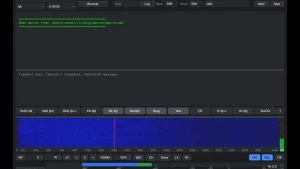
* The waterfall displays active decodes directly on the 480×320 touch screen.
* Tapping a decoded callsign initiates the standard FT8 QSO sequence: sending signal reports, receiving acknowledgements, and logging the finished contact to internal flash storage.
* If you operate from a hotel room or picnic bench, you can connect a resonant wire to the EFHW terminal, string it out the window, and work across continents on 5 watts.
3. Remote Web Control
Because the core software runs on top of a full Linux networking stack with an integrated Mongoose HTTP daemon, you can remote into the zBitx v2 from any web browser on your smartphone, iPad, or laptop. Simply connect your device to the radio’s Wi-Fi access point, open your browser, and you’re presented with the full sBitx virtual front panel, panadapter, and FT8 waterfall without installing proprietary apps.
Practical Field Realities and Tradeoffs
While the zBitx v2 is an extraordinary technical achievement for under $300, practical field engineers should keep several operational limitations in mind:
+-----------------------------------------------------------------------------+
|                       PRACTICAL FIELD TRADE-OFFS MATRIX                     |
+-----------------------------------------------------------------------------+

  STRENGTHS                                 CONSIDERATIONS
  ---------------------------------------   -----------------------------------
  * True standalone FT8 without a PC        * Resistive screen requires firm stylus
  * 415g pocket weight with 18650s          * Daylight readability is moderate
  * Clean 5W output via LDMOS finals        * 300mA RX drain empties cells in ~6h
  * No external tuner needed for EFHW       * Common-mode currents on EFHW wire
  * Fully hackable C and Python codebase    * No internal battery charging circuit
+-----------------------------------------------------------------------------+
- Battery Endurance: The receiver draws approximately 300 mA on receive due to the continuous Linux SBC processing load. A pair of quality 3,500 mAh 18650 cells will provide roughly 6 to 8 hours of mixed casual operating, but heavy FT8 transmitting will exhaust the pack in 2 to 3 hours.
- Charging Circuitry: There’s no internal charging management on board. You must remove the 18650 cells to charge them in a dedicated cradle, or power the radio externally from a regulated 9V battery bank or solar panel.
- Resistive Touchscreen: The 480×320 display uses a resistive touch digitizer. While this allows operation while wearing gloves in cold weather, it requires a deliberate press rather than the feather-light swipe of capacitive smartphone glass. In bright direct tropical sunlight, you’ll need to shield the screen with your hand or hat.
- RF Common Mode on EFHW: The built-in EFHW matching transformer makes rapid deployment effortless, but operating an un-counterpoised end-fed wire at 5 watts can induce RF currents on the radio enclosure or microphone cable. Adding a small 0.05-wavelength counterpoise wire or clipping a ferrite choke onto the battery leads is sound engineering practice.
Why the zBitx v2 Matters to Open Source Radio
In an era where major amateur radio manufacturers produce increasingly closed, proprietary black boxes with unserviceable custom ASICs, Ashhar Farhan’s HF Signals project represents the best traditions of amateur experimentation.
Every schematic, PCB layout, C source file, and front-panel UF2 binary is completely open on GitHub. If you wish to write your own DSP filter, tweak the FT8 decoding algorithms, customize the display UI, or interface external sensors, the code is right there. The zBitx v2 transforms what was once an ambitious experimental prototype into a genuinely robust, field-ready travel transceiver that proves high-performance SDR technology doesn’t require an exorbitant price tag.
Sources and Further Reading / Sumber dan Rujukan Lanjut
- HF Signals Official zBitx v2 Product Page: https://www.hfsignals.com/index.php/zbitx-v2/
- SBitx and zBitx Community Documentation Portal: https://www.sbitx.net/
- Ashhar Farhan zBitx v2 Host Software Repository: https://github.com/afarhan/zbitxv2
- Ashhar Farhan zBitx v2 Pico W Front Panel Source Code: https://github.com/afarhan/zbitxv2_front_panel
- NXP AFT05MS004N RF LDMOS Power Transistor Datasheet: https://www.nxp.com/docs/en/data-sheet/AFT05MS004N.pdf
- Earle Philhower Arduino-Pico Core for RP2040: https://github.com/earlephilhower/arduino-pico
73 de 9M2PJU.


Post Comment