Exploring APRS Live Services: A Health-Monitored Directory for APRS Bots
The Automatic Packet Reporting System (APRS) is a phenomenally powerful tool for amateur radio operators. Beyond simple position reporting, the APRS network hosts a vibrant ecosystem of interactive bots and services. These services can do everything from sending SMS messages and emails, to fetching weather forecasts, tracking radiosondes, and even finding nearby hospitals during an emergency.
However, a long-standing pain point in the APRS community has been discovery: How do you know what services are currently online, and what commands they support?
Recently on the r/APRS subreddit, user hemna (the developer behind aprslive.com) announced a brilliant solution to this exact problem: the APRS Service Registry.
What is the APRS Service Registry?
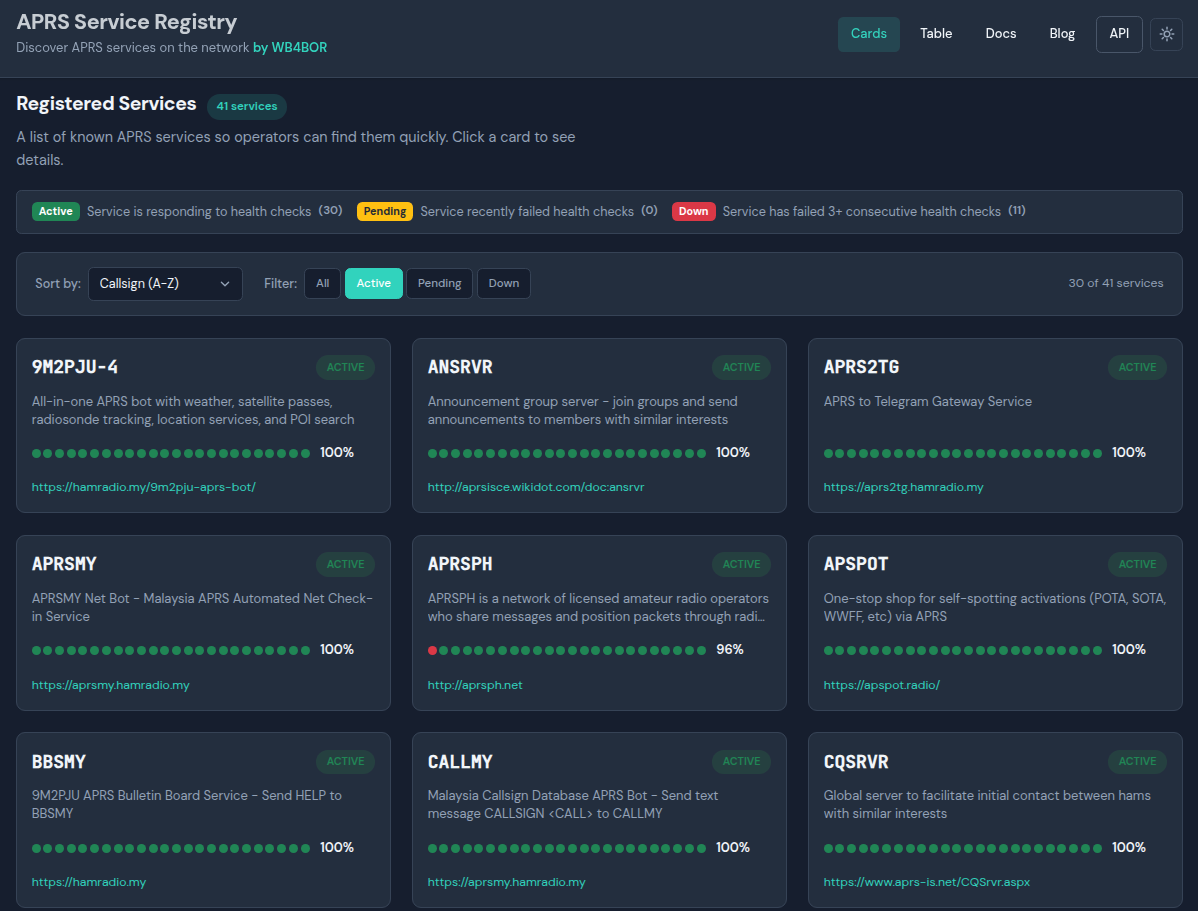
Located at services.aprslive.com, the APRS Service Registry is a live, health-monitored directory of known APRS interactive services. It acts as a central hub where operators can quickly find active bots, view their historical uptime, and—most importantly—discover exactly what commands those bots accept.
Currently tracking over 40 distinct services, the registry is a game changer for operators who rely on APRS for off-grid information retrieval.
Key Features of the Dashboard
The dashboard is built with a clean, responsive interface featuring dark-mode support and several highly practical tools for operators:
Real-Time Health Monitoring
The registry actively pings registered services (usually every 60 minutes) to verify they are alive and responding to messages on the APRS-IS network. Services are categorized into three easy-to-read states:
- Active: The service is responding to health checks normally.
- Pending: The service recently failed a health check and is being watched.
- Down: The service has failed 3 or more consecutive checks and is likely offline.
Uptime Heatmaps
When you click on a service card, you are presented with a beautiful GitHub-style heatmap. Each dot represents a health check (e.g., hourly), allowing you to visually confirm a service’s reliability over time. It even displays the response latency (e.g., 800.0ms) to give you an idea of the bot’s processing speed.
Command Discovery
Perhaps the most valuable feature of the registry is the command list. Instead of guessing how to interact with a bot or digging through obscure wiki pages, the registry lists the exact syntax required.
For example, looking at the 9M2PJU-4 all-in-one bot on the registry reveals a massive list of supported commands, including:
temp: Current temperaturesatpass: Next satellite pass timeshospital: Find nearby hospitalspredict: Active radiosondes in your areaposmsg: Email your location
Users can also click the “Suggest” button to submit new commands or correct existing ones, making the directory a community-driven effort.
Why This Matters for Amateur Radio
In grid-down scenarios or during remote Summits on the Air (SOTA) activations, internet access is often non-existent. An HT and a digipeater might be your only link to the outside world.
Having a reliable, curated list of APRS services means you know exactly who to send a message to when you need a weather update or emergency contact info. You don’t have to waste battery power sending messages to a bot that has been offline for months.
By actively monitoring the health of services like ANSRVR (the announcement group server), SMSGTE (SMS gateway), and 9M2PJU-4, the APRS Service Registry brings a modern, web-scale reliability mindset to amateur radio infrastructure.
Check It Out
If you develop an APRS service, or if you just want to see what the network has to offer, head over to the registry and explore the cards.
Visit the directory here: https://services.aprslive.com/
Read the original Reddit announcement: r/APRS Discussion


Post Comment